
Introduction
The Wolverine, Gulo gulo, occupies a position in the ecology of the circumpolar north that is disproportionate to its size in almost every measurable way.
At 11 to 20 kilograms, roughly comparable to a medium-sized dog, the wolverine maintains home ranges of up to 1,500 square kilometres, travels up to 50 kilometres daily through deep arctic snow, caches food at scattered locations across this vast territory and returns to each cache over the following months, displaces grizzly bears and pumas from carcasses through sheer aggressive persistence, and raises young in dens excavated within snowdrifts during temperatures that can fall below -40°C.
This is the world’s largest fully terrestrial mustelid, a member of the weasel family that includes otters, badgers, martens, and ferrets, and it represents the northern hemisphere’s ecological counterpart to the Honey Badger: a muscular, audaciously aggressive, nearly solitary predator-scavenger that defies the normal relationship between body size and ecological ambition.
Like the Honey Badger, the wolverine has acquired a reputation for fearlessness that is grounded in documented field observation rather than myth.
The wolverine is a species of cold places, boreal forest, subarctic tundra, and alpine terrain, and its biology is profoundly shaped by the conditions of these environments: the deep snow, the extreme cold, the low prey density, the wide dispersal of food resources.
Climate change, by threatening the deep spring snowpack that wolverines require for denning, poses the most significant long-term threat to a species that has otherwise maintained stable populations across its circumpolar range for millennia.
Etymology and Classification
The genus name Gulo is the Latin word for ‘glutton’, gluttire, to swallow, referencing the wolverine’s reportedly voracious and indiscriminate appetite, which impressed early European observers. The species epithet gulo repeats the genus name (a tautonym), confirming this as the type species of the genus.
The common name ‘wolverine’ is of uncertain etymology but appears to derive from a corruption of earlier English forms related to ‘wolf’, via the Norse and Swedish forms used in Scandinavia where the animal was historically common. Alternative common names include ‘glutton’ (in English), ‘Vielfraß’ (German, also meaning glutton), and ‘carcajou’ (French-Canadian, from an indigenous Algonquian term).
Gulo gulo is classified within the family Mustelidae, the weasel family, and within this family is placed in the subfamily Guloninae alongside the martens (Martes spp.) and the tayra (Eira barbara). Two subspecies are recognised: the North American Wolverine (G. g. luscus) and the Eurasian Wolverine (G. g. gulo), though the distinction between them is subtle.
Physical Description
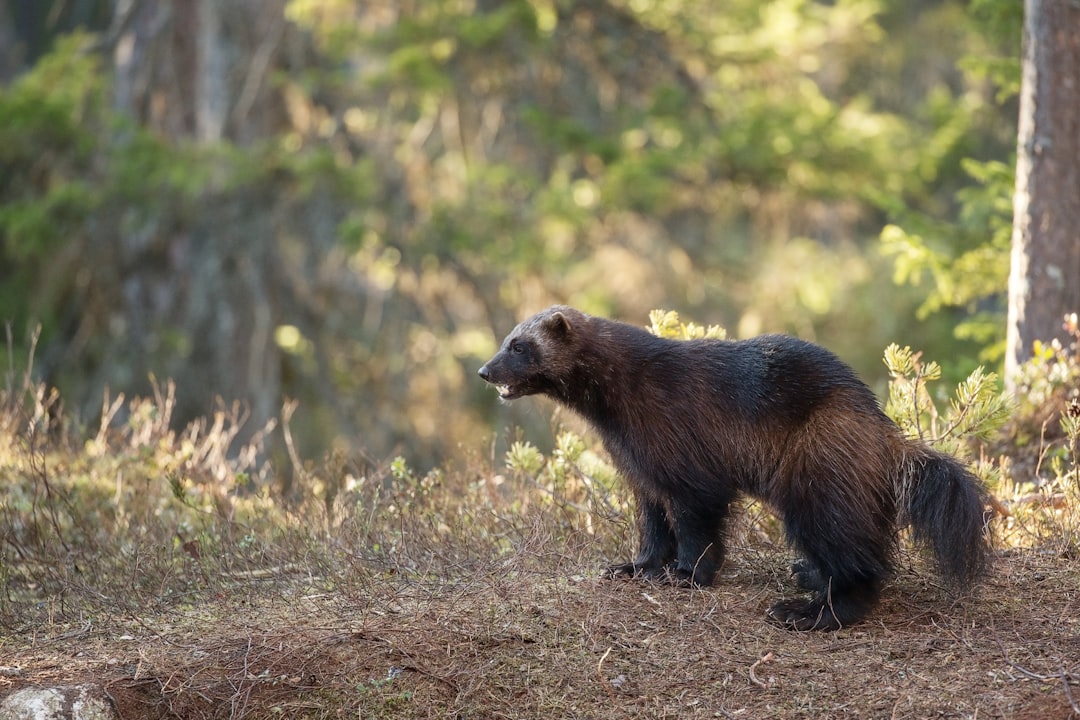
The Wolverine’s body is compact, muscular, and low-slung, with a broad, rounded head, small rounded ears, and a bushy tail. The fur is thick and coarse, dark brown to black on the body, with a pair of pale yellow to cream lateral stripes that extend from the shoulders to the base of the tail. These pale stripes are individually variable and can serve as identification markings in field studies. The face is often paler, with a dark muzzle and forehead.
The feet are among the most functionally important features of the wolverine’s anatomy. They are large relative to body size, almost bear-like in their proportions, and semi-plantigrade, meaning the wolverine walks with partial contact between the heel and the ground.
This foot morphology distributes body weight over a large area when walking on soft snow, reducing sinkage in the manner of a natural snowshoe. The claws are semi-retractile, curved, and sturdy, adapted for both digging and climbing.
The skull is massively constructed relative to body size, with broad zygomatic arches (cheekbones) that anchor powerful temporalis muscles, and large, robust dentition.
The carnassial complex, the shearing teeth used to cut through meat and bone, includes a specialised upper carnassial molar that can rotate 90 degrees in the socket, allowing the wolverine to apply shearing force at an angle that maximises the effectiveness of the bite on frozen flesh and dense bone.
This anatomical feature is unique to the wolverine among mustelids and is the basis for its ability to consume frozen carcasses that defeat other scavengers.
Habitat and Range
The Wolverine is a circumpolar species occupying the boreal forest biome, subarctic and arctic tundra, and the alpine zones of major mountain ranges across the northern hemisphere. In North America, it ranges across most of Canada and Alaska, with smaller populations in the Rocky Mountains of the contiguous United States (Montana, Idaho, Wyoming, Washington, and Oregon).
In Eurasia, it is found from Scandinavia eastward through Russia to Kamchatka, with populations in Mongolia, Kazakhstan, and northeastern China.
Within this vast range, wolverines are highly sensitive to snowpack. Deep, persistent spring snowpack, snow that remains on north-facing slopes into May or June, is required for successful denning, as females excavate dens within snowdrifts and rely on the insulating properties of the snow to maintain stable, warm den temperatures during the coldest winter months.
In areas where snow depth or snow persistence declines below the threshold needed for successful den construction, wolverine reproductive success drops and populations decline.
The species is incompatible with high levels of human landscape modification. It avoids roads and human infrastructure, requires large, intact wild areas for the establishment of viable home ranges, and is highly sensitive to trapping pressure.
Diet, Foraging, and Caching Behaviour
The Wolverine is primarily a scavenger in winter, exploiting the frozen carcasses of large ungulates killed by wolves, bears, other predators, cold stress, or avalanche, and a more active predator in summer when a broader range of prey is available. The ability to consume frozen meat and crush large bones is critical to winter survival, as fresh prey may be unavailable for extended periods.
Wolverines are documented active hunters of ungulates under specific conditions: when deep snow immobilises prey (particularly moose, caribou, or elk) so that the prey cannot run or kick effectively. Under these conditions, a wolverine can kill animals many times its own body weight through persistence, powerful bites to the neck or skull, and the ungulate’s inability to escape.
This hunting strategy is opportunistic, wolverines spend far more time scavenging than actively hunting large prey, but its occurrence has been documented through telemetry studies and direct observation.
Caching behaviour is a central element of wolverine ecology. When food is abundant, a large carcass, a successful hunt, the wolverine caches excess food at multiple scattered locations across its range, marking each cache with musk secretions and returning to them over subsequent days, weeks, or months.
The spatial memory required to maintain and locate dozens of cached food sites across a range of hundreds of square kilometres is substantial and presumably places significant demands on the animal’s navigational and memory capabilities.
Reproduction, Delayed Implantation, and Early Life
The wolverine’s reproductive strategy is notable for two adaptations particularly well-suited to the unpredictable conditions of the boreal north. The first is delayed implantation (embryonic diapause): after mating in spring or early summer, fertilised blastocysts enter a state of developmental arrest and do not implant in the uterine wall until November or December.
This delay allows the female to assess her body condition during autumn, the critical period for building fat reserves, and effectively ‘decide’ whether to proceed with the pregnancy. In years when food availability has been poor, implantation may fail and no young are born, preventing the female from depleting reserves she cannot spare on a doomed litter.
The second adaptation is the use of deep snowpack as a denning environment. Snow dens provide stable temperatures, typically around -5°C to 0°C regardless of external temperature, and protect the vulnerable kits from predators. Dens are typically excavated in deep, north-facing snowdrifts that persist late into spring, giving kits the protected early-life environment they need before the den melts.
Kits (typically 1 to 3 per litter) are born in February or March in the deep-snow den. They grow rapidly on high-fat milk, begin eating solid food at approximately 7 to 8 weeks, and are fully weaned by approximately 10 weeks. The kits remain with the mother for approximately 12 months, during which they learn the foraging techniques, including caching, range navigation, and snow-hunting, that they will require for adult life.
Social Structure and Home Range
Wolverines are almost entirely solitary outside of the brief mating season and the period of mother-kit association. Adult males maintain huge home ranges, 200 to 1,500 square kilometres in North American studies, potentially larger in some Eurasian populations, that overlap with the smaller ranges of two to five females. Males patrol their ranges continuously, moving at a pace that can cover 50 kilometres per day across rugged, snow-covered terrain.
The primary social interactions are territorial, wolverines mark range boundaries and core areas with musk secretions from well-developed anal glands and from skin glands on the abdomen, leaving scent deposits on prominent objects including trees, rocks, and food caches. These scent marks communicate range-holder identity and reproductive status to other wolverines.
Wolverines are capable of climbing trees, a useful capability for accessing food cached by other predators in tree crotches or for escaping large predators, and are competent swimmers. Their locomotion on snow is characterised by a bounding gait that uses the broad feet effectively.
Conservation Status
The Wolverine is classified as Least Concern globally by the IUCN, but this status obscures substantial regional variation. In the contiguous United States, the species occupies less than 10% of its historical range and is classified as Threatened under the Endangered Species Act, with an estimated total population of fewer than 300 individuals in the lower 48 states.
The primary threat in the US and increasingly elsewhere is climate change: snowpack modelling predicts substantial reductions in the area of habitat providing adequate spring snowpack for wolverine denning in the Rocky Mountains over the coming decades.
In Canada, wolverine populations are generally more secure but face pressure from legal trapping (primarily for the fur trade), habitat loss from forestry and mining, and the indirect effects of climate change on prey availability. In Scandinavia, wolverine populations are recovering from historical extirpation under legal protection but remain small and fragmented in comparison to Russian populations.
Related Reading
- Honey Badger (Mellivora capensis): the Honey Badger is the wolverine’s southern hemisphere ecological counterpart, similarly ferocious relative to its size
- Spotted-Tail Quoll (Dasyurus maculatus): another high-aggression, medium-sized carnivore with analogous ecology
- Sunda Pangolin (Manis javanica): a very different approach to predator defence, passive armour rather than active aggression
References
Copeland, J.P., McKelvey, K.S., Aubry, K.B., Landa, A., Persson, J., Inman, R.M., Krebs, J., Lofroth, E., Golden, H., Squires, J.R., Magoun, A., Schwartz, M.K., Wilmot, J., Copeland, C.L., Yates, R.E., Kojola, I. & May, R. (2010). The bioclimatic envelope of the wolverine (Gulo gulo): do climatic constraints limit its geographic distribution? Canadian Journal of Zoology, 88(3), 233-246. https://doi.org/10.1139/Z09-136
Lofroth, E.C. (1993). Scale dependent analyses of habitat selection by wolverines in north-central British Columbia. MSc thesis, University of British Columbia.
Magoun, A.J. & Copeland, J.P. (1998). Characteristics of wolverine reproductive den sites. Journal of Wildlife Management, 62(4), 1313-1320. https://doi.org/10.2307/3801995
Krebs, J., Lofroth, E., Copeland, J., Banci, V., Cooley, D., Golden, H., Magoun, A., Mulders, R. & Shults, B. (2004). Synthesis of survival rates and causes of mortality in North American wolverines. Journal of Wildlife Management, 68(3), 493-502. https://doi.org/10.2193/0022-541X(2004)068[0493:SOSRAC]2.0.CO;2
Persson, J., Landa, A., Andersen, R. & Segerström, P. (2006). Reproductive characteristics of female wolverines (Gulo gulo) in Scandinavia. Journal of Mammalogy, 87(1), 75-79. https://doi.org/10.1644/04-.1
Chadwick, D.H. (2010). The Wolverine Way. Patagonia Books, Ventura, CA.
Frequently Asked Questions
How big is the Wolverine?
The Wolverine is the largest purely terrestrial member of the mustelid family (otters, which can be heavier, are semi-aquatic). Adult males measure 65 to 107 centimetres in body length and weigh 11 to 20 kilograms, while females are substantially smaller at 6 to 12 kilograms. The body is powerfully built, heavily muscled relative to body size, with a broad, rounded head, strong jaws, and notably large feet.
The thick, oily, dark-brown fur appears glossy even in Arctic conditions.
What do Wolverines eat?
Wolverines are opportunistic omnivores, consuming whatever is available and profitable at any given time. In winter, the diet is dominated by carrion (particularly the carcasses of ungulates killed by wolves, avalanches, or cold stress) and active predation of ungulates that have become immobilised in deep snow. In summer, the diet expands to include small mammals (rodents, ground squirrels), bird eggs, berries, and plant material.
Throughout the year, wolverines exploit food caches, both their own and those of other animals.
Where do Wolverines live?
Wolverines are circumpolar, inhabiting boreal forest, subarctic tundra, and alpine terrain across the Northern Hemisphere. They are found throughout Canada, Alaska, parts of the northern contiguous United States (Montana, Idaho, Wyoming, Washington), across Russia from the Ural Mountains to Kamchatka, in Scandinavia (Norway, Sweden, Finland), and in northern Mongolia.
They require large, wild areas with deep, persistent snowpack for denning, which makes them incompatible with most human-dominated landscapes.
How long do Wolverines live?
Wild Wolverines typically live 5 to 13 years, with the primary causes of mortality being trapping (in areas where legal trapping occurs), vehicle collisions, competition with wolves and other large predators, and starvation during periods of low prey or carrion availability. Captive Wolverines have been documented living up to 17 to 18 years. Sexual maturity is reached at approximately 2 to 3 years in females and slightly later in males.
How do Wolverines reproduce?
Wolverines mate in spring or early summer, but fertilised embryos do not implant in the uterine wall immediately, instead, they enter a state of embryonic diapause that delays development until November or December. This delayed implantation allows females to adjust birth timing in response to body condition and environmental cues.
Litters of 1 to 3 kits are born in February or March within a snow den, typically excavated in a deep drift on a north-facing slope where snow persists late into spring. Kits grow rapidly on milk and begin consuming solid food at approximately 7 weeks.
Is the Wolverine really more ferocious than its size suggests?
Field evidence supports the claim that wolverines regularly displace much larger predators from food resources. GPS and camera trap data have documented wolverines approaching active wolf feeding sites, bear dens, and puma kill sites and successfully taking food. The behaviour is facilitated by the wolverine’s apparently very high aggression threshold, its powerful bite, and its musk-scent capability which it uses as a deterrent, but it is not invincible.
Wolves, in particular, can and do kill wolverines when they encounter them, and wolverines generally avoid direct confrontation with wolf packs.
Is the Wolverine endangered?
Globally, the Wolverine is classified as Least Concern by the IUCN, but this masks significant regional variation. In the contiguous United States, the wolverine is classified as a Threatened species under the Endangered Species Act, with a total population estimated at fewer than 300 individuals.
The primary threat in the US and elsewhere is climate change: wolverines depend on deep, persistent spring snowpack for denning, and snowpack in many parts of their range is declining due to warming temperatures. Legal trapping also removes individuals in Canada and Russia.
What is the wolverine's relationship to its home range?
Male wolverines maintain some of the largest home ranges of any land carnivore relative to body size, up to 1,500 square kilometres in boreal forest, and potentially larger in tundra environments. They patrol these ranges continuously throughout the year, caching food at distributed sites across the range and returning to each cache over subsequent weeks and months.
A single male’s range typically overlaps the smaller home ranges of several females, with which he mates opportunistically. The vast range size reflects the low prey density and dispersed food resources characteristic of boreal and Arctic environments.