
Introduction
The Honey Badger, Mellivora capensis, holds a position in popular culture that is quite rare for a medium-sized omnivore: it is widely celebrated as the most audaciously fearless animal on Earth.
This reputation, substantiated by documented encounters in which individual honey badgers have attacked and driven off lions, confronted leopards, eaten live puff adders, and chased away entire packs of wild dogs, is not hyperbole but a reasonably accurate characterisation of an animal that has evolved, over millions of years, to be essentially undeterrable by any threat it is likely to encounter in its African and Asian range.
The biological basis for this fearlessness is multi-factorial. The Honey Badger possesses an exceptionally thick, loose, and chemically resistant skin that is extremely difficult to penetrate with fangs or claws. It has documented partial immunity to snake venom. Its muscular build and powerful claws make it a capable fighter.
And it appears to lack the neural machinery for rapid risk assessment that causes most animals to retreat from dangerous situations, or at least, its risk threshold is calibrated very differently from that of most comparably sized mammals.
Mellivora capensis is a mustelid, a member of the weasel family, and the sole species in its genus. It is distributed across an enormous range spanning Sub-Saharan and North Africa, the Middle East, and the Indian subcontinent, occupying habitats from equatorial rainforest to high-altitude mountain scrub to the margins of the Sahara and Thar deserts.
Etymology and Classification
The genus name Mellivora is derived from the Latin mel (honey) and vorare (to devour), ‘honey-devourer’. The species epithet capensis refers to the Cape of Good Hope, South Africa, near which the specimens used for the original species description were collected. The alternative common name ‘Ratel’ is derived from Afrikaans and remains the standard term used in South Africa and parts of the rest of Africa.
Mellivora capensis is classified within the family Mustelidae, the weasels, otters, badgers, and wolverines, which is the most species-rich family within the order Carnivora, containing approximately 66 species.
The genus Mellivora is monotypic (containing only this single species), and the phylogenetic position of the Honey Badger within Mustelidae has been debated; molecular phylogenetics places it as a sister group to the mustelid subfamily Ictonychinae, though some analyses suggest closer relationships to the wolverine (Gulo gulo).
Twelve subspecies of M. capensis are currently recognised, varying in size, colouration (the extent of white on the upper body), and skull morphology across the species’ extensive range.
Honey Badger Physical Description
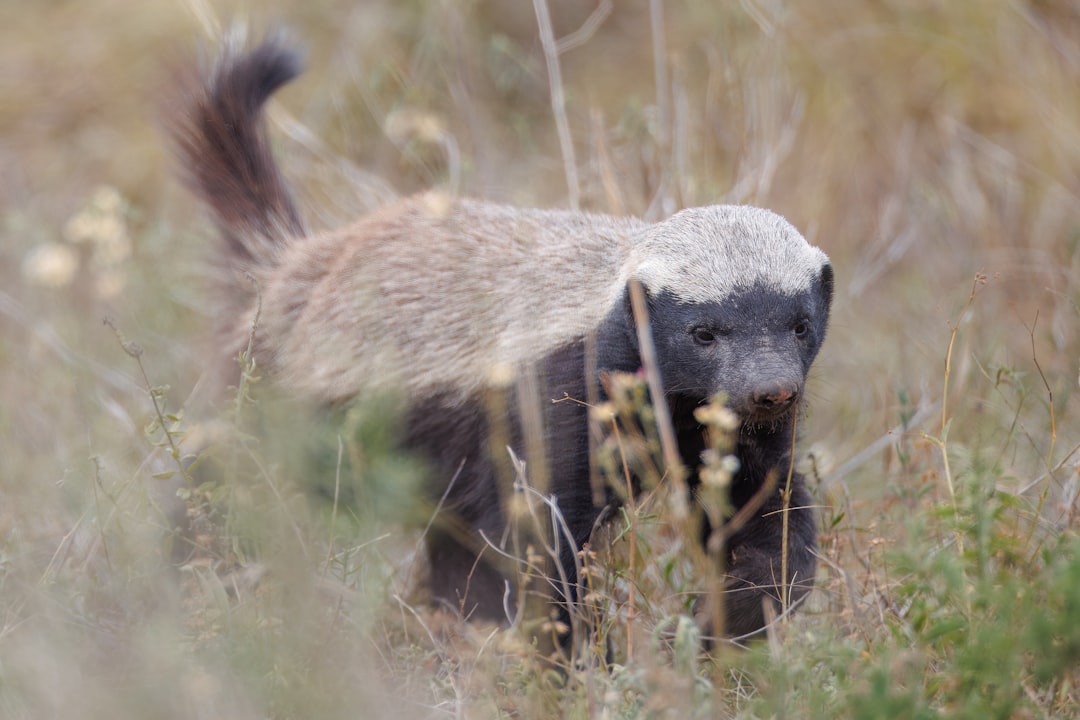
The Honey Badger’s body is broad, flat, and powerfully muscular, with short but extremely strong limbs terminating in large, curved claws that can reach 3 centimetres in length. The claws of the front feet are particularly massive and are the primary tools for digging, the Honey Badger can excavate through hard-packed earth with remarkable speed, disappearing completely underground in a matter of minutes when threatened or when pursuing a burrowing animal.
The dorsal colouration is white or silver-grey, a colour that extends from the top of the head down the back, while the face, flanks, and underside are black. This two-toned pattern, with pale upper surface and dark lower surface (the reverse of counter-shading), has been interpreted as aposematic (warning) colouration: the distinctive and conspicuous pattern may signal to experienced predators that this animal is not worth the trouble of attacking.
The skin is the Honey Badger’s most extraordinary feature. It is approximately 6 millimetres thick on the neck, several times thicker than the skin of most mammals of comparable size, and is remarkably loose, attached to the underlying muscle by only a thin layer of connective tissue.
This looseness means that a predator holding the honey badger from behind by the scruff of the neck finds that the animal can rotate almost 180 degrees within its own skin, bringing its teeth and claws to bear on the attacker. The skin’s thickness and toughness make it resistant to bee stings, porcupine quills, and the bites of snakes.
Habitat and Range
The Honey Badger occupies one of the broadest habitat ranges of any carnivore. In Africa, it is found from the coastal forests of West Africa and the Congo Basin through the savannas, grasslands, and bushveld of East and Southern Africa, the arid Sahel and Saharan margins, and the Mediterranean-climate regions of North Africa.
In Asia, it ranges from the Arabian Peninsula through Iran, Afghanistan, Pakistan, and across the Indian subcontinent, with records from lowland forest, grassland, dry scrub, and Himalayan foothills up to approximately 4,000 metres elevation.
Within this extensive range, the Honey Badger has no strong habitat preference: it is recorded from rainforest, deciduous forest, scrubland, grassland, agricultural land, and desert margins. Its only consistent habitat requirement is the presence of adequate food, principally insects, honey, and vertebrate prey, and suitable den sites, which may be self-excavated burrows, rock crevices, old termite mounds, or hollow logs.
Diet and Feeding Behaviour
The Honey Badger is an opportunistic omnivore with a diet that varies enormously across its geographic range and through the seasons. In Africa, honey and bee larvae represent a seasonally important food source, the Honey Badger locates bee nests using olfaction and the calls of the Greater Honeyguide bird, then excavates the nest using its powerful claws. The thick skin and apparent high pain tolerance allow it to sustain hundreds of bee stings while raiding a nest without retreating.
Reptiles, including highly venomous snakes, constitute a major prey category. Documented prey species include puff adders, Cape cobras, black mambas, and in Asia the king cobra. The honey badger kills snakes with a bite to the back of the skull and consumes the entire animal, venom glands and all. Small to medium-sized mammals, rodents, hares, small antelopes, birds and their eggs, insects and their larvae, carrion, and fruit and berries complete the diet.
Venom Resistance and Tolerance of Pain
The Honey Badger’s documented survival of snake envenomation events, falling unconscious after a puff adder bite and recovering hours later, has attracted significant scientific interest.
The mechanism of venom resistance is not fully characterised, but research on related species suggests that mutations in the nicotinic acetylcholine receptor, the primary target of neurotoxic snake venoms, reduce the binding affinity of the toxin, providing partial protection against neurotoxic effects.
The Honey Badger’s resistance appears to be specifically to neurotoxic venoms; haemotoxic venoms (such as those of puff adders) may cause greater effects that the animal recovers from through robust physiological mechanisms rather than biochemical resistance.
The Honey Badger also demonstrates high tolerance of bee stings, porcupine quills, and the stab wounds of prey animals. This is likely attributable partly to the physical thickness of its skin, which reduces penetration depth, and partly to a high threshold for pain-induced behavioural modification, the animal continues attacking even while sustaining apparent injury.
Honey Badger Behaviour and Intelligence
The Honey Badger is broadly recognised as one of the more intelligent small carnivores. Captive individuals have repeatedly been documented using tools, stacking rocks, branches, or food containers as steps to reach and manipulate enclosure latches, exploiting their keeper’s routine by waiting at specific locations where gates are opened, and systematically testing enclosure boundaries for weaknesses. Multiple zoos have reported chronic escape problems with honey badger enclosures.
In the wild, Honey Badgers have been observed working cooperatively in male-female pairs during foraging, with one animal flushing prey from cover and the other intercepting it, a coordination that requires some anticipation of the partner’s actions.
They are largely solitary outside of the mating season and breeding period, maintaining large home ranges (20 to 500 square kilometres in males, depending on habitat productivity) that are marked with scent gland secretions from both anal glands and a pouch-like gland on the underside of the tail.
Relationship with the Greater Honeyguide
The mutualistic relationship between the Honey Badger and the Greater Honeyguide (Indicator indicator) is one of the most widely cited examples of interspecific cooperation in the animal kingdom, though its frequency and reliability in the wild are subjects of ongoing research.
The Honeyguide is a bird specialised for finding bee nests and consuming bee larvae and beeswax; it lacks the physical capability to open large nests itself. When a Honeyguide locates a nest, it produces a distinctive, rattling ‘guiding call’ and flies in short movements towards the nest, leading any following individual, badger, human, or other potential ally, to the location.
Once the Honey Badger excavates and opens the nest, both animals benefit: the badger consumes honey, larvae, and adult bees, while the Honeyguide takes the beeswax and remaining larvae once the badger has left.
The relationship with human honey-hunters in East Africa is extensively documented; the relationship with honey badgers, while historically assumed, has been less frequently directly observed in systematic field studies. Both parties gain from the interaction, making it a classic mutualism.
Conservation Status
The Honey Badger is classified as Least Concern by the IUCN, reflecting its wide distribution and generalist ecology. However, local declines have been documented in parts of its range due to persecution, farmers and beekeepers view the animal as a pest because of its predation on poultry and its destruction of beehives. In India, the species is protected under Schedule I of the Wildlife Protection Act 1972, making killing or capture illegal.
The main anthropogenic threats are direct killing in retaliation for livestock or beehive depredation, roadkill in increasingly traffic-dense regions, and habitat loss through agricultural conversion. The Honey Badger’s boldness and willingness to enter human-occupied areas to raid beehives or poultry enclosures, combined with its reputation for extreme aggression, makes it a polarising species that generates significant human-wildlife conflict.
Related Reading
- Wolverine (Gulo gulo): the Honey Badger’s northern hemisphere ecological analogue, another mustelid with outsized aggression and remarkable physical capabilities
- Spotted-Tail Quoll (Dasyurus maculatus): an Australian marsupial carnivore with analogous fearless predatory habits
- Boomslang (Dispholidus typus): one of the African snakes the Honey Badger can survive a bite from
References
Begg, C.M., Begg, K.S., Du Toit, J.T. & Mills, M.G.L. (2003). Scent-marking behaviour of the honey badger, Mellivora capensis (Mustelidae), in the southern Kalahari. Animal Behaviour, 66(5), 917-929. https://doi.org/10.1006/anbe.2003.2223
Begg, C.M., Begg, K.S., Du Toit, J.T. & Mills, M.G.L. (2005). Life-history variables of an atypical mustelid, the honey badger Mellivora capensis in the southern Kalahari. Journal of Zoology, 265(1), 17-22. https://doi.org/10.1017/S0952836904006077
Hewitt, S.M., Hewitt, G.A. & Denny, M. (1989). Bite force in carnivores. Journal of Zoology, 218, 495-508.
Isbell, L.A. (2006). Snakes as agents of evolutionary change in primate brains. Journal of Human Evolution, 51(1), 1-35. https://doi.org/10.1016/j.jhevol.2005.12.012
Madsen, T., Shine, R., Olsson, M. & Wittzell, H. (1999). Restoration of an inbred adder population. Nature, 402, 34-35. https://doi.org/10.1038/46941
Skinner, J.D. & Chimimba, C.T. (2005). The Mammals of the Southern African Subregion (3rd ed.). Cambridge University Press, Cambridge.
Frequently Asked Questions
How big is the Honey Badger?
The Honey Badger is a medium-sized mustelid with a stocky, powerful build. Adult males measure 55 to 77 centimetres in body length, with an additional tail length of 12 to 20 centimetres, and weigh between 9 and 16 kilograms. Females are noticeably smaller, weighing 5 to 10 kilograms.
Despite its relatively modest dimensions, the Honey Badger’s muscular build, thick skin, and aggressive temperament give it a practical capability that far exceeds what its size suggests.
What do Honey Badgers eat?
Honey Badgers are opportunistic omnivores. Their diet includes honey and bee larvae (a major motivation for raiding bee nests), small to medium-sized mammals including rodents and hares, birds and their eggs, reptiles including highly venomous snakes, insects and their larvae, carrion, fruit, and berries. The diet varies significantly with geography and season.
Honey, consumed together with the bee larvae, which provide protein, is particularly important in the diet and gives the animal its common name.
Where do Honey Badgers live?
The Honey Badger has one of the widest distributions of any mustelid, spanning Sub-Saharan Africa, North Africa, the Middle East (including the Arabian Peninsula), and the Indian subcontinent as far east as Nepal and the foothills of the Himalayas. Within this extensive range, it occupies savanna, grassland, forest, desert scrubland, and mountain habitats at elevations up to 4,000 metres. Its habitat tolerance is exceptionally broad.
How long do Honey Badgers live?
Captive Honey Badgers have been documented living up to 26 years, an extraordinary lifespan for a mustelid of its size. Wild lifespans are difficult to estimate but are thought to be substantially shorter, approximately 7 to 12 years, due to competition, injury from prey and predators, and other environmental hazards. Sexual maturity is reached at approximately 14 to 18 months of age.
How do Honey Badgers reproduce?
Honey Badgers are largely solitary except during mating. After a gestation of 50 to 70 days, females give birth to litters of 1 to 2 cubs, usually in a burrow that the mother excavates or adopts from another animal. Cubs are born helpless and develop slowly, remaining dependent on the mother for 12 to 16 months, during which she feeds them, protects them, and progressively introduces them to prey and the techniques required to capture it.
The extended dependence allows cubs to learn complex hunting skills including how to handle venomous snakes.
Are Honey Badgers really immune to snake venom?
The Honey Badger’s venom resistance is real but not absolute. Wild and captive honey badgers have been observed surviving bites from puff adders (Bitis arietans), Cape cobras (Naja nivea), and other highly venomous snakes, sometimes losing consciousness for a period before recovering. The mechanism appears to involve mutations in the nicotinic acetylcholine receptor, the protein that most neurotoxins target, that reduce sensitivity to these toxins.
However, the resistance is partial, not total: very large venom doses or bites to highly vascular areas can still be fatal.
Is the Honey Badger endangered?
The Honey Badger is classified as Least Concern by the IUCN globally, though populations have declined in some areas due to persecution by beekeepers and livestock farmers, illegal hunting for traditional medicine, and habitat loss. The species remains widespread and relatively common across much of its range. In South Africa and India, it receives legal protection.
The main anthropogenic threat is killing by humans who consider it a pest due to its raiding of beehives and livestock pens.
Does the Honey Badger really work with the Honeyguide bird?
The mutualistic relationship between the Honey Badger and the Greater Honeyguide (Indicator indicator) is widely cited but more complex and contested than popular accounts suggest. Honeyguide birds do use a distinctive ‘guiding’ call to lead humans and potentially other large mammals to bee nests, and honey badgers are known to follow honeyguide calls to locate nests.
However, systematic field documentation of honeyguide-led honey badger raids in the wild is limited, and some researchers have questioned whether the relationship is as regular and reliable as traditionally described. The human-honeyguide mutualism is better-documented and has been confirmed in East Africa.