
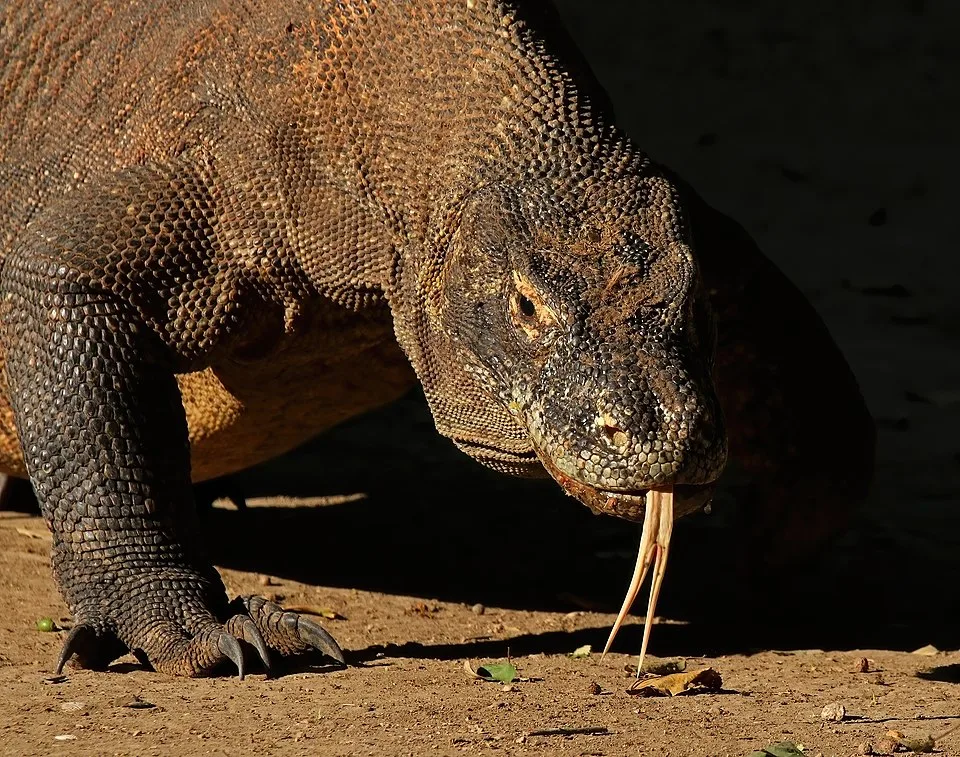
How big is a Komodo dragon?
Adult male Komodo dragons reach 2-3 meters (6-10 feet) in length and weigh 70-90 kg (150-200 lb), making them the largest lizards alive today. The largest verified specimen measured 3. 13 meters (10 feet 3 inches) and weighed 166 kg (366 lb). Females are smaller, typically 1. 8-2. 3 meters and 40-70 kg.
The Living Dragon of Indonesia
On five small islands in eastern Indonesia lives an animal that looks like a relic of a lost world. Three meters long, 90 kilograms, forked tongue, armored scales, a mouth full of serrated teeth and venom. The Komodo dragon is the closest thing to an actual dragon the real world has ever produced - and it is still hunting, still killing, still dominating its island ecosystem, as it has done for millions of years.
The Komodo dragon is the largest living lizard, an apex predator that hunts animals larger than itself, and the only reptile confirmed to reproduce through both sexual and asexual pathways. Everything about it seems designed by a fantasy novelist rather than evolution, but every detail is real.
Size: The Largest Lizard Alive
Adult Komodo dragons reach:
- Length: 2-3 meters (6-10 feet)
- Weight: 70-90 kg (150-200 lb) typical, 166 kg (366 lb) maximum verified
- Tail: approximately half the total body length
- Lifespan: 30-50 years in the wild
The largest confirmed Komodo dragon measured 3.13 meters (10 feet 3 inches) long. The species continues growing throughout life, so the largest individuals are also typically the oldest.
For comparison:
| Species | Maximum Length | Maximum Weight |
|---|---|---|
| Komodo dragon | 3.13 m | 166 kg |
| Crocodile monitor (Papua) | 2.5 m | 75 kg |
| Asian water monitor | 2.5 m | 70 kg |
| Perentie (Australian monitor) | 2.5 m | 40 kg |
The Komodo is significantly larger than any other lizard species alive today. The next largest (crocodile monitor) is about 80 percent of the length but less than half the weight of a large Komodo.
Females are smaller than males, typically 1.8-2.3 meters and 40-70 kg. This size dimorphism is relevant to the species' reproduction - males compete physically for mating access, and larger males have a significant advantage.
The Venom Discovery
For most of the 20th century, biologists believed Komodo dragons killed prey through bacterial infection. The story went like this: the dragon's mouth contained extraordinarily toxic bacteria from rotting meat stuck between its teeth. When the dragon bit prey, these bacteria entered the wound and caused septic infection. The prey wandered off, died days later, and the dragon followed the scent to consume the carcass.
This theory was elegant and widely taught. It was also wrong.
In 2009, a team led by Dr. Bryan Fry at the University of Queensland published research showing that Komodo dragons possess active venom glands in their lower jaws. The venom contains:
- Anticoagulants that prevent blood clotting
- Hypotensive compounds that drop blood pressure rapidly
- Shock-inducing proteins similar to those in snake venoms
- Paralyzing neurotoxins at lower concentrations
When a Komodo bites prey, it injects venom through grooved teeth that guide the toxic saliva into the wound. The prey animal rapidly loses blood pressure and may collapse from shock within minutes. Bleeding continues because the anticoagulants prevent clotting. A bitten deer or wild boar dies within hours - not days - from the venom, not from bacterial infection.
The bacteria theory was not just wrong. It was backward. Komodo dragon mouths do contain bacteria, but these bacteria are not particularly dangerous and are similar to those found in many carnivores' mouths. Bacterial infection plays at most a minor role in Komodo predation.
Fry's team also demonstrated that venom glands exist in many other lizard species - including some previously considered non-venomous. The Komodo discovery was part of a larger revelation: lizard venom is more widespread and sophisticated than biologists had realized.
Hunting Strategy
A Komodo dragon hunt follows a consistent pattern:
1. Ambush
Komodos spend most of their day resting or slowly moving through scrubland. They position themselves along game trails used by deer and wild boar, particularly near water sources. A hunting Komodo may wait motionless for hours.
2. Initial Strike
When prey passes within range, the Komodo attacks with surprising speed. Despite their bulky appearance, dragons can sprint at 20 km/h over short distances - fast enough to catch a surprised deer. The initial strike targets the legs or abdomen, delivering a single decisive bite.
3. Release
Unlike most predators that hold prey until death, the Komodo often releases after biting. The venom does the work. Releasing the prey prevents the dragon from taking retaliatory injuries from hooves, antlers, or tusks during the death struggle.
4. Patience
The dragon follows the wounded prey - sometimes for minutes, sometimes for hours - using its extraordinary sense of smell. The forked tongue collects scent molecules from the air, and the Jacobson's organ in the roof of the mouth analyzes them to track the weakening animal.
5. Consumption
Once the prey collapses, the dragon begins feeding immediately. Komodos are mostly alone hunters but often share large carcasses with other dragons that arrive at the scene. A hierarchy is established through intimidation - the largest dragon eats first, with smaller individuals waiting their turn.
A Komodo can consume up to 80 percent of its body weight in a single meal. A 90 kg dragon can eat 72 kg of meat at one feeding - nearly an entire adult Timor deer. After a large meal, the dragon does not need to eat again for 1-2 months.
What Komodo Dragons Hunt
Adult Komodos are the apex predators of their islands and eat essentially anything they can kill:
Timor deer (Cervus timorensis). The most common prey, making up approximately 50 percent of adult dragon diet. A mature buck weighs 90-120 kg, comparable in size to the dragon itself.
Wild boar (Sus scrofa). Fast-moving, aggressive, and well-armed with tusks. Dragons typically take younger or injured boars rather than prime adults.
Water buffalo (Bubalus bubalis). Large domesticated livestock that escaped onto the islands. A dragon may follow a buffalo for days after biting, waiting for the venom to weaken the much larger animal.
Timor monkeys, feral goats, and smaller livestock.
Juvenile Komodo dragons. Adults cannibalize younger dragons whenever possible. This is why juveniles spend their first 4-5 years almost exclusively in trees - adult dragons cannot climb effectively, so elevated positions provide safety.
Carrion. Dragons detect dead animals from up to 9 km away using their olfactory sensitivity. A whale carcass washed onto a Komodo island can attract dozens of dragons from across the territory.
Historical prey included pygmy elephants (Stegodon florensis), a species of small elephant that lived on Flores until approximately 12,000 years ago. Komodo dragons evolved to hunt these elephants, which explains the dragon's large body size and venom sophistication. The dragons effectively outlived their primary prey and had to adapt to smaller targets when the pygmy elephants went extinct.
Parthenogenesis: Reproduction Without Males
In 2006, two female Komodo dragons in European zoos - one at London Zoo and one at Chester Zoo - both produced viable offspring without any contact with males. This was one of the most remarkable reproductive biology discoveries in recent decades.
How it works. Komodo sex chromosomes are designated Z and W. Females have ZW (one Z, one W). Males have ZZ (two Z chromosomes). When an unfertilized egg undergoes parthenogenesis, it duplicates its own genetic material rather than combining with sperm. Eggs carrying Z chromosomes double up to ZZ - producing male offspring. Eggs carrying W chromosomes double up to WW - an unviable combination that results in no embryo development.
The result: all parthenogenetic offspring are male.
Why it matters. A single female Komodo dragon washed up on a new island (by natural rafting or human transport) could establish a breeding population alone. She produces male offspring through parthenogenesis, then breeds with her own sons to produce mixed-sex offspring through normal sexual reproduction. Within two generations, a viable population exists.
This reproductive flexibility may explain how Komodo dragons colonized the multiple islands where they now live - a puzzle that confused biologists before parthenogenesis was documented.
Parthenogenesis is rare in large animals. It occurs regularly in invertebrates and occasionally in small vertebrates (some fish, amphibians, and certain snakes). The Komodo dragon is among the largest animals ever documented using this reproductive strategy.
The Island Effect
Komodo dragons exist only on five Indonesian islands: Komodo, Rinca, Gili Motang, Gili Dasami, and the larger island of Flores. Why?
The answer is evolutionary isolation combined with a specific phenomenon called island gigantism.
In continental ecosystems, large predator niches are occupied by mammals - big cats, bears, wolves. On small remote islands, these mammals may be absent. The predator niche is open to whatever species can fill it, and reptiles sometimes evolve to exploit the opportunity.
The Komodo dragon's ancestors were smaller monitor lizards that reached Indonesia during periods of lower sea level approximately 4 million years ago. Without competition from large mammalian predators, the lizards evolved larger and larger body sizes to exploit the prey of pygmy elephants, deer, and wild pigs that lived on the islands.
Island gigantism produced Komodo dragons that occupied the apex predator role that, on continents, would have been held by tigers or leopards. The lizards became functional dragons because the niche was empty and the selection pressure favored large body size.
When pygmy elephants went extinct approximately 12,000 years ago, the dragons were left as enormous predators with no prey large enough to justify their size. They have persisted by eating Timor deer and wild boar, but their body size is still calibrated for larger prey that no longer exists.
Komodo Attacks on Humans
Komodo dragons have killed humans, though attacks are rare. Approximately 24 attacks have been documented since the 1970s, with 4 confirmed fatalities.
High-profile cases:
2007 - 8-year-old boy killed on Komodo Island. A dragon emerged from under bushes near the boy's home and killed him before villagers could intervene.
2009 - Swiss tourist bitten on Rinca Island. The tourist survived after extensive medical treatment for venom effects.
2017 - Singaporean tourist Loh Lee Aik bitten. He survived after being attacked while photographing a dragon. The incident led to stricter tour guide regulations.
2013 - Local fishermen killed on Rinca Island. Details remained unclear, but tooth marks on the bodies confirmed dragon involvement.
Most attacks involve humans who surprised a hidden dragon or approached too closely while photographing or feeding. Rangers on Komodo and Rinca islands carry forked sticks - long poles with a Y-shaped end that can be used to press a dragon's neck to the ground and redirect attacks. Experienced guides have never lost a tourist to an attack while following proper procedures.
Rural villagers face ongoing risk. Children have occasionally been taken from villages. Adults working in scrubland have been attacked. The Indonesian government manages the dragons through a combination of protected areas, village relocation incentives, and strict regulations on dragon-human interactions.
Conservation Status
Komodo dragons are classified as Endangered by the IUCN with an estimated wild population of 3,000 adults. Multiple threats affect the species:
Climate change. Rising sea levels are reducing the available habitat on the islands. Projected sea-level rise by 2050 could eliminate up to 30 percent of current dragon territory, particularly on the smaller islands.
Habitat fragmentation. Human settlement on Flores has divided the dragon populations there into disconnected groups, reducing genetic exchange.
Prey reduction. Timor deer populations have declined due to poaching. Dragons face food stress in some territories.
Disease. The small population is vulnerable to disease outbreaks. A 2013 respiratory disease outbreak killed dozens of dragons.
Illegal wildlife trade. Occasional poaching of young dragons for the international reptile trade.
Indonesia has designated Komodo National Park (Komodo and Rinca islands) as a UNESCO World Heritage Site, and the species is protected under Indonesian law. Tourism revenue supports conservation efforts, and ranger programs monitor the population continuously.
Captive populations exist at approximately 30 zoos worldwide, with successful breeding programs that include the first documented parthenogenetic reproduction. The Indianapolis Zoo, Smithsonian National Zoo, and Prague Zoo maintain significant captive populations that serve as genetic reserves.
The Living Dragon
Everything about the Komodo dragon sounds like mythology. A giant armored lizard with venomous bite that can kill water buffalo, reproduces without males, hunts animals larger than itself, and lives on remote tropical islands. Medieval bestiaries described dragons with approximately these characteristics, centuries before anyone in Europe knew this species existed.
The Komodo dragon was formally described by Western science only in 1910, when Dutch lieutenant Jacques Karel Henri van Steyn van Hensbroek brought specimens back from Flores. Before that, rumors of "giant land crocodiles" circulated among Indonesian traders but were dismissed as sailors' tales.
They were not tales. The dragons were real. They are still real. They still hunt deer and wild boar across the same five islands they have inhabited for millions of years. They are still venomous, still cannibalistic, still capable of parthenogenesis, and still larger than any other lizard on Earth.
And unlike the dragons of European mythology, which were killed off by knights and kings, Komodo dragons survive primarily because their remoteness has protected them. The question for the 21st century is whether they can survive climate change, habitat fragmentation, and the pressures of a rapidly shrinking natural world. If they can, the living dragon will continue to walk its islands for many generations to come.
If they cannot, one of the most remarkable animals on Earth will join the long list of apex predators humanity has eliminated in our brief tenure as the dominant species.
Distribution Across the Lesser Sunda Islands
Komodo dragons (Varanus komodoensis) occupy only five Indonesian islands in the Lesser Sunda chain. Our research team compiled the 2021 population census data published by the Komodo National Park Authority.
| Island | Area | Dragon Population | Key Habitat |
|---|---|---|---|
| Komodo | 390 km2 | 1,375 | Savanna woodland, scrubland |
| Rinca | 198 km2 | 1,410 | Open grassland, scrubland |
| Flores | 14,300 km2 | 1,200 (fragmented) | Forest, savanna, coastal |
| Gili Motang | 10 km2 | 68 | Dry scrubland |
| Nusa Kode | 8 km2 | 57 | Coastal forest |
The island populations show measurable genetic differentiation despite separations of less than 10 kilometers in some cases. Komodo dragons are poor swimmers and rarely cross ocean channels, producing strong population-level genetic structure across closely spaced islands.
Parthenogenesis in Captive Populations
In 2006, Flora, a female Komodo dragon at Chester Zoo in the United Kingdom, produced viable fertile eggs without ever having mated with a male. Genetic analysis published in Nature confirmed that the offspring were haploid-derived diploid clones of the mother, produced through facultative parthenogenesis - asexual reproduction from unfertilized eggs [1].
"The documentation of parthenogenesis in Komodo dragons dramatically complicated conservation planning. A single female dragon shipwrecked on a new island could theoretically produce an entire viable founding population without a male ever being present. This reproductive flexibility helps explain how the species originally colonized the Lesser Sunda islands and provides a safety mechanism against local extinctions." - Dr. Phillip Watts, lead author, University of Liverpool [1]
Subsequent parthenogenetic clutches have been documented at Sedgwick County Zoo in Kansas and the Memphis Zoo. All parthenogenetic offspring documented to date have been male, because the ZW sex-determination system in Komodo dragons produces male offspring from ZZ genotypes formed through duplication of the mother's Z chromosome.
References
- Watts, P. C., Buley, K. R., Sanderson, S., et al. (2006). Parthenogenesis in Komodo dragons. Nature, 444, 1021-1022. DOI: 10.1038/4441021a
- Fry, B. G., Wroe, S., Teeuwisse, W., et al. (2009). A central role for venom in predation by Varanus komodoensis. Proceedings of the National Academy of Sciences, 106(22), 8969-8974. DOI: 10.1073/pnas.0810883106
- Jessop, T. S., Smissen, P., Scheffers, B., & Dempster, T. (2020). Demographic sinks, dispersal dynamics, and the Komodo dragon's capacity to persist in small habitat fragments. Biological Conservation, 247, 108584. DOI: 10.1016/j.biocon.2020.108584
Related Articles
- Monitor Lizards: The Intelligent Giants of the Reptile World
- Lizards: Masters of Adaptation and Survival
- Crocodilians: Ancient Predators That Outlived the Dinosaurs
Frequently Asked Questions
How big is a Komodo dragon?
Adult male Komodo dragons reach 2-3 meters (6-10 feet) in length and weigh 70-90 kg (150-200 lb), making them the largest lizards alive today. The largest verified specimen measured 3.13 meters (10 feet 3 inches) and weighed 166 kg (366 lb). Females are smaller, typically 1.8-2.3 meters and 40-70 kg. For comparison, the next largest lizard species (the crocodile monitor of New Guinea) reaches about 2.5 meters but weighs only half as much as a Komodo.
Komodo dragons continue growing throughout their lives, with the largest individuals typically being the oldest - 30-50 years old. They exist only on five Indonesian islands: Komodo, Rinca, Gili Motang, Gili Dasami, and Flores. The total wild population is approximately 3,000 individuals.
Do Komodo dragons have venom or bacteria?
Komodo dragons use venom, not bacteria, to kill prey. The ‘septic bacteria’ theory was popular for decades but was disproven in 2009 by research from Dr. Bryan Fry at the University of Queensland. Komodo dragons possess venom glands in their lower jaws that inject a complex mixture of toxins when they bite.
The venom contains anticoagulants that prevent blood clotting, hypotensive compounds that drop blood pressure rapidly, and proteins that cause shock and paralysis. A bitten prey animal dies within hours from severe blood loss and circulatory collapse. The Komodo’s mouth does contain bacteria, but recent studies show these bacteria are not particularly dangerous and similar to bacteria found in many carnivores’ mouths.
The venom is the real weapon, and it represents one of the most sophisticated reptile venom systems ever documented.
Can Komodo dragons kill humans?
Yes, Komodo dragons have killed humans, though attacks are rare. Four confirmed fatalities have been documented on the Indonesian islands where they live, with approximately 24 attacks recorded since the 1970s. The most famous modern incident involved an 8-year-old boy killed by a Komodo dragon in 2007 on Komodo Island. Attacks typically occur when humans startle a hidden Komodo dragon or approach too closely to one that is feeding.
Rangers on Komodo and Rinca islands carry forked sticks to deflect attacks. The dragons are active predators that have historically hunted pygmy elephants, wild boar, and Timor deer - prey larger than an average human. The wild dragon population is small enough that encounters are rare for tourists who stay with guides, but rural villagers who share the islands face real ongoing risk.
What do Komodo dragons eat?
Komodo dragons are apex predators that hunt almost any animal they can kill. Adult dragons primarily hunt Timor deer (which make up approximately 50 percent of their diet), wild boar, water buffalo, and smaller dragons. They also eat birds, eggs, small mammals, and carrion. A Komodo dragon can eat up to 80 percent of its body weight in a single meal - a 90 kg dragon can consume 72 kg of meat in one feeding.
Their flexible jaws and expandable stomachs accommodate enormous prey. After a large meal, a Komodo dragon can go 1-2 months without eating again. They are also cannibalistic - adults regularly hunt and eat juvenile dragons, which is why young Komodos spend their first 4-5 years almost exclusively in trees, out of reach of adults.
Can Komodo dragons reproduce without males?
Yes, female Komodo dragons can reproduce without males through parthenogenesis - a form of asexual reproduction where an egg develops into an embryo without fertilization. This was first confirmed in 2006 when two female Komodo dragons in separate European zoos produced viable offspring without any contact with males. Genetic testing confirmed the offspring were produced through parthenogenesis rather than sperm storage or other explanations.
All offspring from parthenogenesis are male (due to Komodo sex chromosome genetics - females are WZ, males are ZZ, so unfertilized eggs produce ZZ males). This capability allows a single female to establish a population on a new island and then breed with her own male offspring to produce a mixed population.
Parthenogenesis has been documented in several reptile and shark species but is extraordinarily rare in large animals - Komodo dragons are among the largest parthenogenetic reptiles known.