
Introduction
On Isla Escudo de Veraguas, a tiny island of 4.3 square kilometres in the Bocas del Toro Archipelago of Panama, lives a mammal that represents one of the most extreme cases of geographic restriction and population fragility in the world. The Pygmy Three-Toed Sloth, Bradypus pygmaeus, is found nowhere else on Earth. Fewer than 100 individuals are believed to exist.
The species was only formally described by science in 2001. And the island it inhabits is accessible by boat from the tourist hub of Bocas del Toro, putting its entire global population within reach of the disturbances associated with ecotourism and casual visitation.
The Pygmy Three-Toed Sloth is approximately 40% smaller than its mainland relative, the Brown-Throated Three-Toed Sloth (Bradypus variegatus), having undergone island dwarfism after rising sea levels separated Isla Escudo from the Panamanian mainland approximately 9,000 years ago at the end of the last ice age.
In that brief evolutionary time, the isolated sloth population has differentiated sufficiently in body size, skull morphology, and presumably behaviour that it warrants recognition as a distinct species, a biological change achieved in what is, by evolutionary standards, an instant.
The species’ entire existence revolves around the mangrove forest: it lives in the canopy of red mangroves (Rhizophora mangle), feeds almost exclusively on their tough leaves, and hangs motionless in their branches for the majority of each 24-hour period, conserving the energy that its nutrient-poor diet barely provides.
Etymology and Classification
The genus name Bradypus derives from the Greek bradys (slow) and pous (foot), ‘slow-footed’, a fitting description of the world’s slowest-moving mammals. The species epithet pygmaeus is the Greek for ‘pygmy’ or ‘dwarf’, directly referencing the species’ reduced size relative to other three-toed sloths. The common name ‘Monk Sloth’ is occasionally applied, based on the pale facial colouration and hair pattern that gives large individuals a somewhat hooded appearance.
Bradypus pygmaeus is classified within the family Bradypodidae, the three-toed sloths, which contains four species, all in the single genus Bradypus.
Three-toed sloths are distinguished from the two-toed sloths (family Choloepodidae, genera Choloepus) not by a physical count of toes, all sloths have three toes on the hind feet, but by the number of toes on the forelimbs: Bradypodidae have three, while Choloepodidae have two.
The two sloth families are not closely related; they represent an extraordinary example of convergent evolution, both lineages having independently evolved the same sloth-like body plan, metabolic strategy, and lifestyle from different ancestral groups.
Physical Description
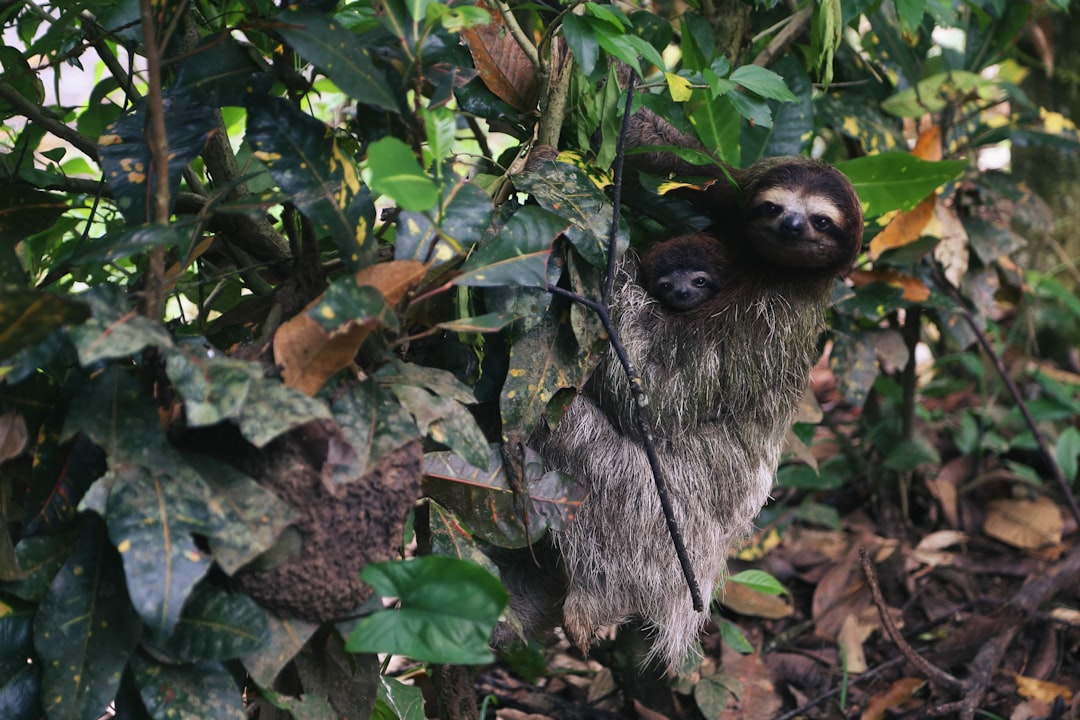
The Pygmy Three-Toed Sloth has the compact, rounded body form typical of Bradypus species, with a short neck (though three-toed sloths can turn their head 270 degrees), small eyes, a round face with a permanent, fixed expression that appears to many human observers as a smile, and three long curved claws on each forelimb and hindlimb.
The claws are the primary adaptation for arboreal hanging: they are passive hooks rather than active gripping structures, and the sloth hangs from branches through the mechanical force of the curved claw engaging with the branch rather than through muscular grip. This means that a sloth exerts minimal muscular effort while hanging; it is, literally, a low-energy posture.
The coat is long, coarse, and consists of two layers: a short dense underfur and longer guard hairs. The guard hairs are grooved, and within these grooves, cyanobacteria (Trichophilus welckeri) and green algae grow, turning the coat a faint greenish colour during the wet season.
This algal colonisation is mutualistic, the algae may provide additional nutrients to the sloth (possibly absorbed through the skin, though this is debated), and the greenish tint provides additional camouflage in the canopy.
Males of the Pygmy Three-Toed Sloth, like males of other three-toed sloths, possess a speculum, a patch of shortened fur on the mid-back coloured in orange and black; that becomes visible when the male’s back is viewed from above. The function of the speculum is not definitively established; it may aid in species or sex recognition, or play a role in thermoregulation.
Habitat and Range
Isla Escudo de Veraguas is a coral island in the Bocas del Toro Province of northwestern Panama. It lies approximately 17 kilometres from the nearest mainland. The island is almost entirely mantled with red mangrove forest (Rhizophora mangle) and is uninhabited by permanent human residents, though it lies within reach of boats from the Bocas del Toro town of Bocas del Toro on Isla Colón and is occasionally visited by tourists and fishers.
The Pygmy Three-Toed Sloth is restricted entirely to the mangrove canopy. It does not descend to the ground voluntarily (though it must cross occasional water channels between mangrove stands), does not use other forest types, and does not range across the open beach areas of the island. This extreme habitat specialisation means that any disturbance to the mangrove ecosystem, whether from storm damage, sea level rise, human clearing, or invasive species, directly threatens the species’ survival.
The island itself faces long-term threats from sea level rise associated with climate change: as a low-lying coral island entirely dependent on mangrove root systems for structural integrity, Isla Escudo is vulnerable to inundation and erosion if sea level rise exceeds the rate at which mangrove root systems can build sediment.
Diet and Feeding Behaviour
Leaves of the red mangrove are the near-exclusive dietary item of the Pygmy Three-Toed Sloth, making it one of the most dietary-restricted mammals known. This specialisation has a metabolic explanation: three-toed sloths have the lowest mass-specific metabolic rate of any non-hibernating mammal, approximately 74% below the expected metabolic rate for a mammal of their body mass.
This extraordinarily low metabolism allows the animals to subsist on food that would be nutritionally inadequate for virtually any other comparable mammal.
The digestive process is correspondingly slow. Food passes through the multi-chambered stomach over several days. Fermentation by symbiotic gut bacteria breaks down the tough cellulose of the mangrove leaves and neutralises the secondary plant metabolites (chemical defences) that would be toxic in higher concentrations.
The large fermentation stomach constitutes a substantial proportion of the total body mass, up to 30% of body weight when full, and represents the bulk of the sloth’s metabolic investment in digestion.
Defecation occurs only once per week, and the sloth descends from its canopy position to the base of a preferred tree for this event. The weekly defecation can remove up to one-third of the animal’s total body mass, a remarkable physiological feature reflecting the slow transit time and high dry-matter content of the digestive residue.
Reproduction and Life Cycle
The reproductive biology of the Pygmy Three-Toed Sloth has not been characterised through direct field study due to the difficulty of monitoring such a small population of cryptic, canopy-dwelling animals. Extrapolation from mainland three-toed sloth studies suggests the following: gestation lasts approximately 5 to 6 months. A single young is born, already well-developed and clinging immediately to the mother’s fur.
The young is carried by the mother through the canopy for up to 12 months, during which it learns the location of preferred feeding trees by direct association with the mother’s movements.
The slow reproductive rate, effectively one young per year, or possibly less, means that population recovery from any significant decline is very slow.
A population of approximately 80 individuals producing an effective population increment of perhaps 20 young per year (assuming 20+ reproductive females and 80% survival of young to independence) would require decades to recover from any significant mortality event. This low fecundity places the Pygmy Three-Toed Sloth among the most reproductively vulnerable mammals known.
Conservation Status and Threats
The Pygmy Three-Toed Sloth is classified as Critically Endangered (CR) by the IUCN, the highest category before ‘Extinct in the Wild’, with an estimated population of fewer than 100 mature individuals. The combination of factors that defines its vulnerability is formidable:
Range restriction: The entire global population lives on a single island of 4.3 square kilometres. Any catastrophic event affecting the island, a severe hurricane, a disease outbreak, an oil spill, a human-introduced predator, could potentially eliminate the species entirely.
Small population size: With fewer than 100 individuals and a closed, isolated gene pool, the species faces the genetic risks of small populations, including inbreeding depression and genetic drift. Whether current population size is sufficient to maintain long-term genetic health is unknown.
Slow reproductive rate: The approximately one-young-per-year maximum reproductive rate means that the population cannot recover rapidly from any decline.
Tourism pressure: Isla Escudo de Veraguas is accessible from Bocas del Toro and receives visitors, some of whom interact with sloths, handling, photographing, or disturbing animals that may subsequently descend from the canopy and face ground-level predation risks. A 2012 conservation assessment raised serious concerns about the sustainability of tourist contact with this population.
Climate change: Sea level rise threatens the island’s mangrove ecosystem directly, and changes in hurricane frequency and intensity could cause catastrophic storm damage.
The island was designated as a wildlife refuge under Panamanian law, but enforcement of access restrictions has been inconsistent. International conservation organisations have called for stronger protection, population monitoring, and genetic assessment of the remaining individuals.
Evolutionary Significance of Island Dwarfism
The Pygmy Three-Toed Sloth’s 40% size reduction from its mainland relatives, achieved in approximately 9,000 years since island isolation, is a rapid but not unprecedented example of island dwarfism, the well-documented evolutionary tendency for large mammals on islands to become smaller over generations.
The mechanism involves natural selection: on islands, food resources are typically more limited than on the mainland, and competition for those resources occurs among the isolated population without the input of mainland immigrants.
Smaller individuals, requiring less food per day, survive and reproduce more successfully in this resource-limited environment, and the average body size of the population gradually decreases over generations.
Other dramatic examples include the dwarf elephants that evolved on Mediterranean islands during the Pleistocene (Dwarf Mammoth, Mammuthus creticus), the Flores Island Homo floresiensis, and the Santa Cruz Island dwarf mammoths of California.
The Pygmy Three-Toed Sloth provides a particularly well-dated example, as the sea level history of the Bocas del Toro region during the Holocene is relatively well-constrained, allowing a reliable date of approximately 9,000 years ago for the start of the island isolation event.
Related Reading
- Honey Badger (Mellivora capensis): another mammal with extreme physiological adaptations, in this case for offensive rather than conservative survival
- Naked Mole-Rat (Heterocephalus glaber): another mammal with an extraordinarily low metabolic rate
- Vampire Bat (Desmodus rotundus): another Central/South American mammal with unusual biological adaptations
References
Anderson, R.P. & Handley, C.O. Jr. (2001). A new species of three-toed sloth (Mammalia: Xenarthra) from Panamá, with a review of the genus Bradypus. Proceedings of the Biological Society of Washington, 114(1), 1-33.
Cliffe, R.N., Hauber, M.E., Avery-Gomm, S. & Jones, T.T. (2015). Sloths in disguise: movement-induced camouflage in the three-toed sloth Bradypus variegatus. Tropical Zoology, 28(3-4), 89-97. https://doi.org/10.1080/03946975.2015.1083695
Pauli, J.N., Mendoza, J.E., Steffan, S.A., Carey, C.C., Weimer, P.J. & Peery, M.Z. (2014). A syndrome of mutualism reinforces the lifestyle of a sloth. Proceedings of the Royal Society B, 281(1778), 20133006. https://doi.org/10.1098/rspb.2013.3006
Voirin, B., Kays, R., Lowman, M. & Wikelski, M. (2009). Evidence for three-toed sloth (Bradypus variegatus) predation by spectacled owl (Pulsatrix perspicillata). Edentata, 10, 15-20.
Superina, M. & Solari, S. (2020). Bradypus pygmaeus. The IUCN Red List of Threatened Species 2020: e.T10072A47778933. https://dx.doi.org/10.2305/IUCN.UK.2020-2.RLTS.T10072A47778933.en
McNab, B.K. (1978). Energetics of arboreal folivores: physiological problems and ecological consequences of feeding on an ubiquitous food supply. In G.G. Montgomery (Ed.), The Ecology of Arboreal Folivores. Smithsonian Institution Press, Washington, DC.
Frequently Asked Questions
How big is the Pygmy Three-Toed Sloth?
The Pygmy Three-Toed Sloth is the smallest of the four three-toed sloth species, measuring 48 to 53 centimetres in head-body length and weighing approximately 2.5 to 3.5 kilograms. This makes it approximately 40% smaller by mass than its closest mainland relative, the Brown-Throated Three-Toed Sloth, which typically weighs 3.5 to 5 kilograms.
The size reduction reflects classic island dwarfism, a well-documented evolutionary response to the resource limitations and reduced predation pressure of island environments.
What do Pygmy Three-Toed Sloths eat?
Pygmy Three-Toed Sloths feed almost exclusively on the leaves of the red mangrove (Rhizophora mangle) and to a lesser extent other vegetation growing in or near the mangrove forest of Isla Escudo de Veraguas.
The leaves are tough, low in nutrients, and high in secondary metabolites (plant defence chemicals), but the sloth’s highly specialised digestive system, featuring a multi-chambered stomach with symbiotic bacteria, allows the slow, energy-efficient extraction of nutrients from this challenging diet.
Where do Pygmy Three-Toed Sloths live?
The Pygmy Three-Toed Sloth is endemic to Isla Escudo de Veraguas, a small island (4.3 square kilometres) in the Bocas del Toro Archipelago of Panama. It exists nowhere else on Earth. The island is almost entirely covered by red mangrove forest, which constitutes the sloth’s entire habitat. The island is uninhabited by permanent human residents but is accessible by boat from the nearby Bocas del Toro islands.
How long do Pygmy Three-Toed Sloths live?
The precise lifespan of the Pygmy Three-Toed Sloth has not been determined from long-term field studies. Based on data from the larger three-toed sloth species (Bradypus tridactylus and B. variegatus), which can live 20 to 30 years in captivity and likely somewhat less in the wild, the Pygmy Three-Toed Sloth is estimated to have a potential lifespan of 10 to 20 years.
The slow metabolism and low predation pressure in its island environment may support lifespans at the higher end of this range.
How do Pygmy Three-Toed Sloths reproduce?
Like other three-toed sloths, the Pygmy Three-Toed Sloth has a slow reproductive rate that reflects its minimal metabolic investment. Gestation lasts approximately 5 to 6 months, after which a single young is born. The infant clings to the mother’s fur and is carried by her through the canopy for up to 12 months. The species’ slow reproductive rate, approximately one young per year or less, means that recovery from population declines is extremely slow.
Is the Pygmy Three-Toed Sloth endangered?
The Pygmy Three-Toed Sloth is classified as Critically Endangered by the IUCN, the highest threat category before extinction. Population estimates range from approximately 79 to fewer than 100 individuals.
The combination of a tiny geographic range (a single 4.3 square kilometre island), a small population, slow reproductive rate, and the threats of habitat disturbance, tourism pressure, and potential disease makes it one of the world’s most vulnerable mammals. Any significant disturbance to the Isla Escudo mangrove ecosystem could drive the species to extinction.
How slow is the Pygmy Three-Toed Sloth?
Three-toed sloths are the slowest-moving mammals on Earth. Their average ground speed is approximately 0.24 kilometres per hour when moving urgently; their normal canopy movement is slower still.
The metabolic rate of three-toed sloths is the lowest of any non-hibernating mammal, approximately 74% lower than expected for a mammal of their body size, which allows them to subsist on a diet of nutrient-poor leaves but requires them to conserve energy by minimising all movement. At these metabolic rates, a sloth’s daily caloric requirement is so low that a single leaf can supply a meaningful fraction of its daily energy needs.
When was the Pygmy Three-Toed Sloth discovered?
The Pygmy Three-Toed Sloth was only formally described as a separate species in 2001 by the American mammalogists Robert P. Anderson and Charles O. Handley Jr., making it one of the most recently recognised mammal species in the Americas. Prior to its formal description, specimens from Isla Escudo de Veraguas had been noted as unusual in museum collections, but were attributed to the mainland Brown-Throated Three-Toed Sloth.
Its small body size, distinct cranial morphology, and completely isolated island distribution ultimately justified its recognition as a separate species.