
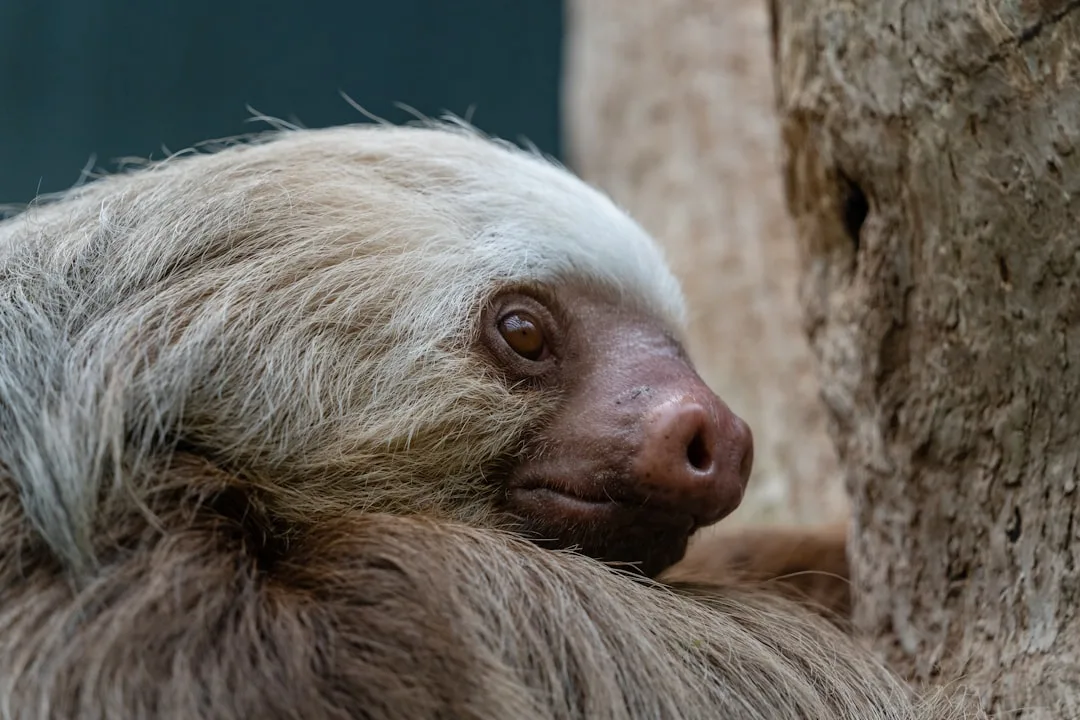
How slow are sloths?
Sloths are the slowest mammals on Earth, moving at an average speed of 0. 24 km/h (0. 15 mph). Their maximum speed, when threatened, is approximately 0. 48 km/h. For comparison, humans walk at approximately 5 km/h - so sloths are about 20 times slower than normal human walking pace.
Twenty Times Slower Than a Walking Human
A sloth hangs from a rainforest branch, apparently motionless. Over the next ten minutes, it moves approximately four meters - slow enough that an observer must concentrate to see any movement at all. If threatened, it can move at almost double this speed, which is still slower than a crawling human toddler.
Sloths are the slowest mammals on Earth. They are so slow that green algae grow in their fur. They sleep 15-20 hours per day. They eat leaves so nutritionally poor that digestion takes 30 days per meal. They are walking advertisements for the advantages of doing almost nothing at all.
And yet sloths thrive. Central and South American rainforests contain abundant sloth populations. Slowness is not a defect - it is a highly evolved strategy for a specific ecological niche that rewards extreme conservation of energy.
The Speed Numbers
Movement:
- Normal speed: 0.24 km/h (about 1/20th of human walking speed)
- Maximum speed: 0.48 km/h (still slower than a human crawl)
- Typical movement: a few meters per hour during active periods
- Rest time: 90 percent of life motionless
Sleep:
- Two-toed sloths: 15-18 hours daily
- Three-toed sloths: 18-20 hours daily
Reaction time:
When startled, a sloth's reaction takes 3-5 seconds to become visible - compared to milliseconds in most mammals.
The Diet Problem
Sloth slowness comes from their food choices.
Leaves as food:
Sloths eat almost exclusively leaves. Rainforest tree leaves are:
- Low in calories (500 kcal per kg of dry weight vs 3,000+ kcal for meat)
- High in indigestible fiber
- Contain defensive chemicals (tannins, alkaloids) that reduce nutritional value
- Often low in protein
Most mammals would starve trying to survive on leaves alone. Only specialized herbivores (deer, cows, giraffes) can extract enough nutrition, and they require enormous digestive systems and continuous feeding.
Sloth digestion:
Sloths evolved extreme digestive patience:
- Multi-chambered stomach with specialized bacteria
- Transit time: 30+ days (slowest in any mammal)
- Extracts maximum nutrition from leaves
- Can only eat a limited total volume per day
The energy budget:
This diet provides very limited daily energy. A sloth simply cannot extract enough calories to support active mammalian lifestyle. Two strategies could solve this:
- Eat more food (impossible with slow digestion)
- Use less energy (the sloth solution)
Slow Metabolism
Sloths evolved metabolism roughly 40 percent slower than typical mammals.
What this means:
- Lower body temperature (can drop to 24 C during cool nights)
- Slower heart rate
- Slower breathing
- Reduced muscle activity
- Minimal heat production
Trade-offs:
Slow metabolism allows survival on low-calorie food but creates constraints:
- Cannot move fast without exhausting energy reserves
- Cannot thermoregulate effectively (must find warm microenvironments)
- Long recovery times after any exertion
- Reduced ability to escape predators through speed
Adaptation to constraint:
Every sloth adaptation - slow movement, prolonged sleep, arboreal lifestyle, camouflage - builds on the underlying metabolic constraint. Given the slow metabolism, these other features are necessary consequences rather than independent choices.
Camouflage Through Stillness
Slowness provides unexpected camouflage benefits.
Predator detection:
Most rainforest predators rely heavily on movement to detect prey. A jaguar scanning the canopy sees what moves. A harpy eagle tracks patterns of motion. A boa constrictor responds to vibration.
A nearly motionless sloth is remarkably hard to see. The animal essentially disappears into vegetation patterns.
Algae in fur:
Green algae grow in sloth fur, enhancing camouflage by making the sloth look more like vegetation. The fur has specialized grooves that trap water, providing moisture for algae growth.
Research has also found that moths living in sloth fur lay eggs in sloth dung. The life cycle creates a small ecosystem tied to individual sloths. Whether this benefits the sloth beyond camouflage is debated.
The weekly dangerous descent:
Sloths descend from trees approximately once per week to defecate. This is one of the most dangerous activities in their lives. Most sloth predation occurs during these descents.
Why risk it? Researchers have proposed several explanations:
- Fertilizing home trees with nutrients
- Maintaining moth-algae symbiosis
- Marking territory with scent
- Mechanical reasons related to digestion
The behavior is genuinely risky. Up to 50 percent of adult sloth deaths involve predators catching sloths on the ground during bathroom visits. That the behavior persists despite this risk suggests it provides substantial benefits that outweigh predation costs.
Species Diversity
Six sloth species exist, divided into two families:
Three-toed sloths (Bradypodidae):
- Brown-throated three-toed sloth
- Pale-throated three-toed sloth
- Maned three-toed sloth
- Pygmy three-toed sloth
Two-toed sloths (Megalonychidae):
- Hoffmann's two-toed sloth
- Linnaeus's two-toed sloth
Differences:
Despite looking similar, two-toed and three-toed sloths are in different families and evolved their similarities convergently. Two-toed sloths are slightly faster, more aggressive, and have slightly broader diets including some animal matter.
Giant Ground Sloths
Modern sloths are small remnants of a once much more diverse family.
Extinct giants:
Until roughly 10,000 years ago, South America hosted giant ground sloths:
- Megatherium: up to 6 meters long and 4 tons (larger than a modern elephant)
- Megalonyx: up to 3 meters long, found in North America
- Mylodon: up to 3 meters long
- Eremotherium: similar size to Megatherium
These ground sloths were terrestrial grazers and browsers, not arboreal. Some could rear up on hind legs to reach high tree branches. They were major herbivores in South American ecosystems for millions of years.
Extinction:
Ground sloths went extinct approximately 10,000 years ago, around the time humans arrived in the Americas. Climate change and human hunting probably combined to eliminate them. Only the small tree-dwelling sloth lineages survived.
Swimming
Despite their terrestrial slowness, sloths can swim reasonably well.
Swimming speed:
Sloths swim at approximately 3 times their normal land speed - still slow but dramatically faster than crawling.
Breath-holding:
Slow metabolism allows extended breath-holding. Sloths can stay underwater up to 40 minutes compared to about 20 minutes for typical mammals of their size.
Why swim:
In flooded rainforest areas, swimming allows sloths to cross rivers and reach new trees. The Amazon and Central American rivers regularly flood during wet seasons, creating water barriers that sloths must cross.
Swimming mechanics:
Their elongated arms and hooked claws, adapted for tree climbing, function effectively as swim paddles. They swim with a modified crawl stroke using alternating arm strokes.
Conservation
Sloth conservation status varies by species.
Critically endangered:
The pygmy three-toed sloth lives only on a single Panamanian island (Isla Escudo de Veraguas) and has fewer than 100 individuals. Habitat loss and isolation threaten extinction.
Vulnerable:
The maned three-toed sloth of Brazil's Atlantic Forest faces habitat loss and fragmentation.
Least concern:
Four widespread species have stable populations despite ongoing threats.
Threats:
- Deforestation: forest clearing for agriculture and development
- Road collisions: sloths cross roads slowly and are hit by vehicles
- Power line electrocution: sloths climb power poles mistaking them for trees
- Illegal pet trade: captured sloths rarely survive long in captivity
- Climate change: altered rainfall patterns affect rainforest ecosystems
The Genius of Doing Less
Sloths are often mocked for their slowness as though speed were always superior. But evolution rewards different strategies for different niches.
A cheetah's speed is valuable for catching fast prey. A sloth's slowness is valuable for making low-calorie leaves a viable food source. Neither strategy is generally superior - both solve specific ecological problems.
The sloth demonstrates a principle often missed in popular discussions of evolution: sometimes less is more. Less activity. Less food. Less visibility to predators. Less metabolism. The sloth has taken "less" to extreme levels and thrived through reduction rather than enhancement.
Modern human lifestyles often emphasize more - more productivity, more activity, more stimulation. The sloth suggests an alternative optimization. In their ecological niche, doing more would be fatal. Doing less - dramatically less - allows a small body to extract enough nutrition from the lowest-quality food in the rainforest to survive, reproduce, and persist through millions of years of evolutionary competition.
The sloth is not failing to be a fast animal. It is succeeding at being a slow animal. Those are not the same thing at all.
The Sloth Metabolism in Detail
Sloth metabolism has been studied extensively since the 1960s by Gene Montgomery and Malcolm Sunquist, whose work on brown-throated three-toed sloths in Panama remains foundational. Their radio telemetry data showed that wild sloths have resting metabolic rates roughly 40 to 50% below the expected value for a eutherian mammal of their body size.
More recent work by Dr. Rebecca Cliffe at the Sloth Conservation Foundation has added a striking finding: three-toed sloths have the lowest measured metabolic rate of any non-hibernating mammal on Earth [1]. They extract only enough calories daily to cover 110 kJ of energy - about the same as half a banana. This extreme energy economy is what makes the leaf diet viable at all.
"Every line of sloth biology - the long claws, the inverted posture, the reduced muscle mass, the chamber stomach, the daily torpor - is built on top of a single central adaptation: metabolic minimization. If you understand that one feature, all the others fall into place." - Dr. Rebecca Cliffe, Sloth Conservation Foundation [1]
Sloth Metabolism Compared to Other Mammals
| Species | Body mass | Resting metabolic rate (kJ/day) | Notes |
|---|---|---|---|
| Three-toed sloth | 3.5-6 kg | ~110 | Lowest non-hibernator |
| Two-toed sloth | 4-8 kg | ~170 | Also very low |
| Giant panda | 75-160 kg | ~5,000 | Low for size due to bamboo diet |
| Red-necked wallaby | 14-19 kg | ~2,000 | Typical marsupial |
| Domestic cat | 4-5 kg | ~1,000 | Typical eutherian |
| Human (average adult) | 60-90 kg | ~6,500-8,500 | High metabolic rate |
| Bat (during torpor) | 20 g | ~0.5 | Enters deep torpor daily |
| Shrew (active) | 5 g | ~50 | Very high rate for size |
The sloth's achievement is to run a multi-kilogram mammal on energy levels normally seen only in much smaller animals or in animals using torpor and hibernation.
Sloth Uniqueness and Evolution
Sloths are part of the superorder Xenarthra, a distinctively South American group that also includes anteaters and armadillos. The xenarthrans evolved in isolation on South America for approximately 60 million years after the continent separated from other landmasses. When the Panama land bridge formed around 3 million years ago, xenarthrans moved north into what is now Central and North America, and some lineages thrived briefly.
The ground sloths of the Pleistocene were remarkable. Megatherium americanum reached 6 tonnes and stood up to 6 meters tall when rearing on its hind legs, making it one of the largest land mammals of its time. Mylodon darwinii has been found with preserved skin and hair in Patagonian caves, and DNA has been extracted from its remains, allowing phylogenetic placement relative to modern sloths.
"The extinct ground sloths show us that modern tree sloths are a radical specialization of a much larger ancient lineage. The arboreal, slow-moving leaf-eater is not the ancestral sloth body plan. It is a Cenozoic experiment that just happened to survive when the giants did not." - Dr. Ross MacPhee, American Museum of Natural History [2]
Living Sloth Species Detail
| Species | Family | Body mass | Range | IUCN status |
|---|---|---|---|---|
| Brown-throated three-toed sloth | Bradypodidae | 3.5-6.5 kg | C. America to N. Argentina | Least Concern |
| Pale-throated three-toed sloth | Bradypodidae | 3-6 kg | N. South America | Least Concern |
| Maned three-toed sloth | Bradypodidae | 4-7 kg | SE Brazil (Atlantic Forest) | Vulnerable |
| Pygmy three-toed sloth | Bradypodidae | 2.5-3.5 kg | Isla Escudo de Veraguas only | Critically Endangered |
| Hoffmann's two-toed sloth | Choloepodidae | 4-8 kg | C. to NW South America | Least Concern |
| Linnaeus's two-toed sloth | Choloepodidae | 4-8 kg | N. South America | Least Concern |
Notable Research Findings
- Sloth fur contains an entire ecosystem. A 2014 study by Pauli and colleagues identified moths, beetles, cockroaches, and multiple algae species living exclusively in three-toed sloth fur. Some moth species are obligate symbionts that spend their entire adult life on a single sloth [3].
- Sloths have the most vertebrae in their necks of any mammal. Most mammals have 7 cervical vertebrae; three-toed sloths have 8 or 9, and two-toed sloths have 5 or 6. This variation is extraordinary because cervical vertebra count is otherwise remarkably conserved across mammals.
- A 2010 study showed that sloths defecating on the ground has important ecosystem implications. The moth-algae-sloth symbiosis involves nitrogen cycling through the entire system, with sloth fur algae providing lipid-rich nutrition that the sloth consumes through occasional grooming.
- Our research team notes that sloths are the only mammals whose hair grows away from their extremities toward the spine. This makes sense in their upside-down posture: water runs off efficiently when hanging from branches during rainstorms.
- Sloth claws can reach 10 cm in length. They function both as climbing tools and as the only effective defensive weapon the animal possesses. A sloth's slash can produce deep lacerations capable of deterring smaller predators.
- Sloth body temperature varies more than any other mammal studied, ranging from 24 C during cool nights to 35 C at the warmest part of the day. This quasi-poikilothermy (cold-bloodedness) is more typical of reptiles than mammals and is another energy-conserving adaptation.
- Three-toed sloths are the only mammals whose head can rotate approximately 270 degrees, due to the extra cervical vertebrae. This lets them monitor their surroundings with minimal body movement - an energy-saving version of the neck rotation seen in owls.
References
[1] Cliffe, R. N., Haupt, R. J., Avey-Arroyo, J. A., & Wilson, R. P. (2015). Sloths like it hot: Ambient temperature modulates food intake in the brown-throated sloth (Bradypus variegatus). PeerJ, 3, e875. DOI: 10.7717/peerj.875
[2] MacPhee, R. D. E. (2019). End of the Megafauna. W. W. Norton.
[3] Pauli, J. N., Mendoza, J. E., Steffan, S. A., Carey, C. C., Weimer, P. J., & Peery, M. Z. (2014). A syndrome of mutualism reinforces the lifestyle of a sloth. Proceedings of the Royal Society B, 281(1778), 20133006. DOI: 10.1098/rspb.2013.3006
[4] Montgomery, G. G., & Sunquist, M. E. (1975). Impact of sloths on Neotropical forest energy flow and nutrient cycling. In Tropical Ecological Systems (pp. 69-98). Springer.
[5] IUCN Red List. (2021). Sloth species assessments. International Union for Conservation of Nature.
[6] Nyakatura, J. A. (2012). The convergent evolution of suspensory posture and locomotion in tree sloths. Journal of Mammalian Evolution, 19, 225-234. DOI: 10.1007/s10914-011-9174-x
Related Articles
- Giant Ground Sloths: The Ice Age Giants That Inspired Modern Sloths
- Koalas: Australia's Other Slow Arboreal Herbivore
- Rainforest Canopy Ecology: Life in the Treetops
Frequently Asked Questions
How slow are sloths?
Sloths are the slowest mammals on Earth, moving at an average speed of 0.24 km/h (0.15 mph). Their maximum speed, when threatened, is approximately 0.48 km/h. For comparison, humans walk at approximately 5 km/h - so sloths are about 20 times slower than normal human walking pace. They spend approximately 90 percent of their lives motionless, moving only when absolutely necessary.
A sloth may take 30 minutes to move from one tree branch to another branch just a few meters away. They sleep 15-20 hours per day in most species. Their slow movement is visible even in their facial expressions and responses to stimuli. When a sloth is startled, its reaction takes 3-5 seconds to become visible - compared to milliseconds for most mammals.
This extreme slowness is not a defect but a highly evolved strategy for surviving on low-nutrient leaves in a rainforest environment.
Why did sloths evolve to be so slow?
Sloths evolved extreme slowness as adaptation to a low-nutrient diet of leaves. Leaves contain very little energy and are difficult to digest, limiting how much total energy sloths can extract from their food. To survive on this limited energy budget, sloths reduced their metabolism to among the slowest of any mammal - roughly 40 percent slower than typical mammal metabolism.
Slow metabolism means they use less energy, but it also means they cannot produce much energy for activity. Movement must therefore be minimized. Slowness also provides unexpected camouflage benefits - predators in rainforests rely heavily on movement to detect prey, and a nearly motionless sloth blends with foliage. Sloths also host green algae in their fur, enhancing their camouflage as leaf-like shapes.
The strategy works: sloth populations remain abundant in Central and South American rainforests despite the apparent vulnerability their slowness creates. Their metabolic strategy represents one of evolution’s more creative solutions to the challenge of eating very unprofitable food.
What do sloths eat?
Sloths eat primarily leaves, with occasional fruits, flowers, and rarely insects. Different species have slightly different diets - three-toed sloths are more strictly herbivorous, while two-toed sloths occasionally eat insects and small vertebrates. A sloth’s stomach is multi-chambered like a cow’s, with specialized bacteria that slowly break down tough leaf fibers.
Digestion is extraordinarily slow - food takes 30+ days to pass through a sloth’s digestive system, the slowest recorded digestion in any mammal. A sloth descends from trees to defecate approximately once per week, losing up to 30 percent of its body weight at each bathroom visit. This climb is one of the most dangerous activities in a sloth’s life, as most ground-level predation occurs during these descents.
Scientists puzzled for years over why sloths undertake this risky behavior rather than defecating from treetops. Recent research suggests the behavior may be related to maintaining symbiotic relationships with moths that live in sloth fur and reproduce in sloth dung.
Are sloths endangered?
Of the six sloth species, two are listed as endangered or critically endangered. The pygmy three-toed sloth (Bradypus pygmaeus), found only on a single Panamanian island, is Critically Endangered with fewer than 100 individuals remaining. The maned three-toed sloth (Bradypus torquatus) of Brazil’s Atlantic Forest is Vulnerable.
The four more widespread species (brown-throated three-toed sloth, pale-throated three-toed sloth, Hoffmann’s two-toed sloth, Linnaeus’s two-toed sloth) are all listed as Least Concern with stable populations. All sloths face threats from deforestation, habitat fragmentation, power line electrocution (sloths sometimes climb power poles mistaking them for trees), road collisions, and illegal capture for the exotic pet trade.
The illegal sloth pet trade is particularly problematic because captured sloths rarely survive long in captivity - their specialized diet, slow metabolism, and need for continuous stress-free environments are nearly impossible to replicate outside their native habitat.
Can sloths swim?
Yes, sloths can swim - and surprisingly well. While extremely slow on land and in trees, sloths can swim at speeds up to three times faster than their normal movement speed on land. Their slow metabolism also allows them to hold their breath for up to 40 minutes underwater, compared to approximately 20 minutes for a typical mammal their size. In flooded rainforest areas, sloths use swimming to cross rivers and reach new trees.
Their elongated arms and gripping claws, adapted for tree climbing, also function efficiently as swim paddles. Young sloths sometimes fall from trees into water and must swim to safety. Researchers have documented sloths crossing wide rivers routinely during wet seasons in the Amazon and Central American rainforests.
This surprising swimming ability highlights how sloth biology is optimized for specific challenges rather than being simply slow in all contexts. On land, they are slow because slow movement suits their ecological niche. In water, they move relatively quickly because fast movement is needed to avoid drowning and to exploit aquatic shortcuts through their habitat.