
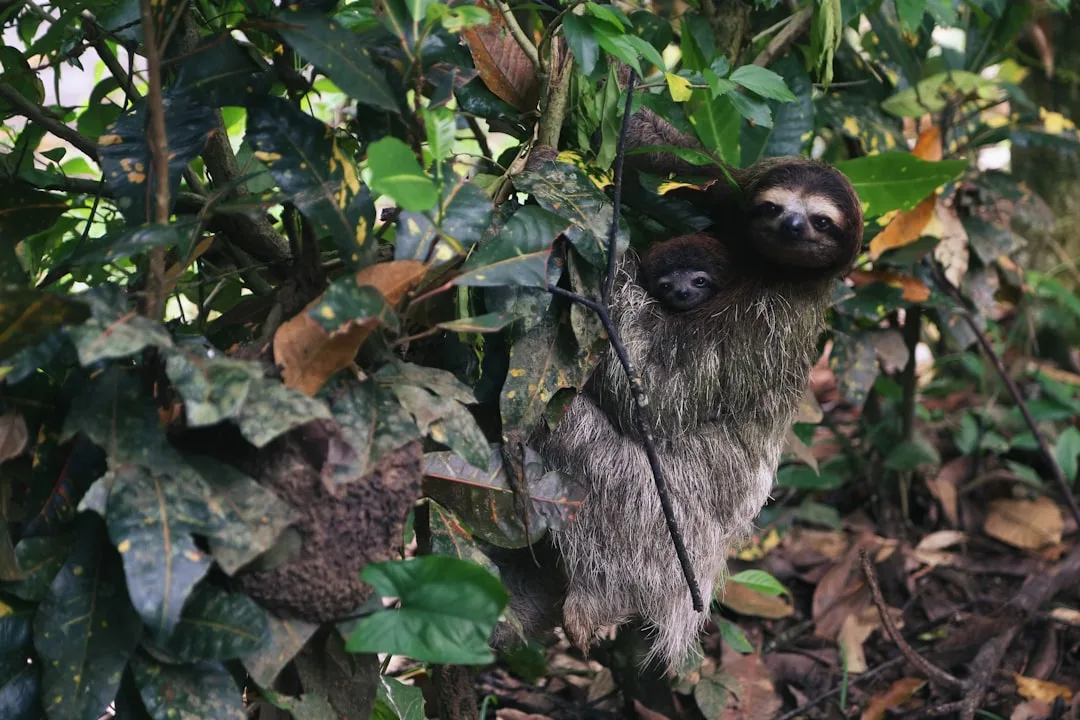
The brown-throated three-toed sloth is the slowest mammal alive, the most iconic member of a genus that has turned low-energy living into an evolutionary art form, and the public face of an entire order of mammals - the Pilosa - that most people have never heard of.
Hanging upside down in the rainforest canopy of Central and South America, Bradypus variegatus spends its life eating tough leaves, growing algae in its fur, and moving with such deliberate calm that its entire body can pass for dead foliage. It is not a primate, not a bear, and not remotely related to monkeys.
It is a xenarthran, sharing an order with anteaters and armadillos, and almost everything about its biology is strange on close inspection.
This guide is a reference entry for the brown-throated three-toed sloth: its anatomy, diet, reproduction, the algae-and-moth ecosystem living on its body, the weekly descent to defecate that kills more sloths than any other single cause, and the conservation status of the four living species in the genus. Expect specifics: centimetres, grams, digestion times, vertebra counts, and verified records.
Etymology and Classification
The scientific name Bradypus variegatus combines the Greek bradys (slow) and pous (foot) with the Latin variegatus (variegated), referring to the mottled pattern of grey, brown, and algae-tinted fur. Carl Linnaeus coined the genus name Bradypus in 1758. Early European naturalists, struggling to describe an animal unlike anything in Eurasia, produced some notable translation oddities.
Icelandic settled on letipardur - literally 'lazy leopard' - a naming accident from translators who had never seen a slow-moving rainforest mammal that was not some kind of cat. Spanish speakers in the neotropics settled on the more accurate perezoso (lazy one) or perico ligero.
The species sits in the order Pilosa, which together with the armadillos of order Cingulata makes up the superorder Xenarthra. Xenarthrans are an ancient radiation of South American mammals defined by extra articulations on their spinal vertebrae - the xenos arthros or 'strange joints' that give the group its name.
They are only distantly related to the rest of placental mammals and have no close Old World analogues. Three-toed sloths split from two-toed sloths roughly 30 to 40 million years ago; despite superficial resemblance, the two groups converged on the hanging lifestyle independently and are not sister taxa.
Four species currently populate the genus Bradypus:
- Brown-throated three-toed sloth (B. variegatus) - widest range, Least Concern
- Pale-throated three-toed sloth (B. tridactylus) - Guiana Shield, Least Concern
- Maned three-toed sloth (B. torquatus) - Brazilian Atlantic Forest, Vulnerable
- Pygmy three-toed sloth (B. pygmaeus) - Isla Escudo de Veraguas, Critically Endangered
A proposed fifth species, B. crinitus (Maranhao sloth), was suggested in 2017 but remains debated pending further genetic work.
Size and Physical Description
Adult brown-throated three-toed sloths are modest in size but unusual in proportion.
Adults:
- Length: 42-80 cm from nose to stub tail
- Weight: 2.5-6.5 kg, typically around 4 kg
- Tail: reduced to a 6-7 cm stub used as a spade for digging the defecation hole
- Limbs: front legs roughly 50% longer than back legs, all four ending in three hooked claws 7-8 cm long
Newborns:
- Weight: 200-300 grams
- Length: roughly 25 cm
- Ride clinging to the mother's abdominal fur for the first 5-6 months
Sexes are almost identical in size. Males are distinguished mainly by a patch of specialised short, bright orange or yellow fur between the shoulder blades - the speculum - which is often bisected by a dark stripe. Females lack the patch entirely.
The animal's shape is dictated by a life spent hanging upside down. The long, curved claws function as passive hooks; a sloth can sleep suspended with effectively zero muscular effort, because the claw grip closes under the bear's own weight rather than opening with it. The fur grows in the opposite direction from other mammals - parted along the belly and running down toward the spine - so that rainwater sheds off the back while the animal is inverted rather than soaking it.
The face carries a permanent expression that has made the species a social-media staple: a round head, small black eyes, a short muzzle, and a dark stripe through each eye that combines with the upturned corners of the mouth to produce what humans read as a contented smile. The smile is a coincidence of facial anatomy, not mood.
The Slowest Mammal on Earth
The three-toed sloth's speed is its defining feature and is not an exaggeration.
Speed data:
| Metric | Value |
|---|---|
| Typical canopy crawl | 0.24 km/h (~4 m per minute) |
| Maximum recorded climb | 0.27 km/h |
| Maximum swim speed | ~0.30 km/h |
| Ground crawl (rare, dangerous) | 0.03 km/h (~30 cm per minute) |
| Daily distance moved | 38 m median, 125 m maximum |
A large common garden snail can outrun a three-toed sloth on the ground. The slowness is not laziness - it is energy economics. Three-toed sloths have a metabolic rate of 40-45% of what standard mammalian scaling laws predict for a 4 kg animal. That is the lowest basal metabolic rate documented in any non-hibernating mammal.
Their muscle mass is roughly 30% below what body size predicts, and the fibre composition is tuned almost entirely for sustained isometric pulling rather than rapid movement.
The whole animal is engineered to get by on a diet that would starve most mammals of comparable size. Rainforest canopy leaves are low in calories, high in indigestible cellulose, and loaded with plant secondary metabolites - tannins, alkaloids, and terpenes - that are costly to detoxify. A sloth cannot afford to sprint. A sloth that sprints runs a net calorie deficit that no amount of leaf-chewing can repay.
The Upside-Down Specialist
Living inverted for roughly 90% of a 20-to-30-year lifespan places unique demands on anatomy. Three-toed sloths have responded with a suite of modifications found in no other mammal group.
Skeletal oddities:
- 9 cervical vertebrae in most individuals (occasionally 8 or 10). Nearly every other mammal, from blue whale to giraffe to house mouse, has exactly 7. The extra vertebrae allow a sloth to rotate its head through roughly 270 degrees, a field of view that helps an otherwise slow animal spot predators.
- Reduced rib mobility and fused lower thoracic vertebrae that create a rigid chassis to hang from.
- Enormous curved claws on hands and feet, functioning as passive hooks.
Organ suspension:
The most under-appreciated adaptation is internal. In a standing mammal, organs hang from mesenteries that evolved to handle gravity pulling them toward the ground. In an upside-down sloth those same organs would press against the diaphragm and crush breathing capacity from below. Three-toed sloths have evolved specialised adhesions and tendon-like suspensions pinning the liver, stomach, and kidneys to the ribcage.
The result is that the weight of the viscera is borne by the ribs rather than the lungs, regardless of orientation. Studies suggest this adaptation saves roughly 13% of the energy that breathing would otherwise cost.
Thermoregulation:
Three-toed sloths do not regulate core temperature as tightly as most mammals. Daytime body temperature sits around 30-34 degrees Celsius - several degrees below a typical placental mammal. On cool rainforest nights the core can drop another 5-10 degrees into a cryptobiosis-like torpor, with breathing and heart rate slowing dramatically. This flexibility is another energy-saving device: a sloth that lets its body cool at night does not have to burn leaves to stay warm.
Diet and Digestion
Brown-throated three-toed sloths are strict folivores. An individual sloth typically specialises on roughly 30 tree species out of the hundreds available in its home range, with cecropia (Cecropia spp.), fig (Ficus spp.), and leguminous canopy trees most heavily represented.
Remarkably, the specific menu is cultural: infants learn which leaves to eat by watching the mother during their first year of life, and the menu is passed down through generations. Neighbouring sloths in the same forest can have almost non-overlapping food lists.
Digestion is spectacularly slow. The stomach is multi-chambered, more like a ruminant's than a typical placental's, and occupies roughly a third of the body volume. A single meal can take up to 30 days to pass from mouth to rectum. Fermentation by gut bacteria breaks down cellulose and neutralises plant toxins. The energy yield is so low that a 4 kg sloth extracts only about 110 kcal per day - roughly what an active house cat burns in an hour.
Dietary data:
| Metric | Value |
|---|---|
| Preferred tree species | ~30 out of hundreds available |
| Daily food intake | ~50 g dry leaf mass |
| Digestion time | up to 30 days |
| Daily energy acquired | ~110 kcal |
| Stomach volume share of body | ~30% |
Water is obtained almost entirely from leaves and from licking wet foliage; three-toed sloths rarely drink freestanding water.
The Mobile Ecosystem
A brown-throated three-toed sloth is not a single organism in any strict sense. It is a mobile substrate hosting a stable multi-kingdom community.
The outer guard hairs have deep longitudinal grooves that trap rainwater, creating a permanent moist capillary layer. Inside those grooves grows the green alga Trichophilus welckeri, found nowhere else on Earth. The algae gives the fur a greenish tint that serves as camouflage in a canopy full of green leaves. Feeding on the algae and the fur itself are documented populations of:
- Sloth moths (Cryptoses choloepi and relatives) - fully dependent on sloths; females lay eggs only in fresh sloth dung, larvae develop there, adults fly back up to live in the fur
- Pyralid moth species unique to sloth fur
- Coleoptera (beetles) in at least 9 families
- Mites and ticks in several orders
- Ciliated protozoans grazing the algae
- Cyanobacteria and fungi filling microhabitats
Recent surveys count more than 950 distinct species documented from three-toed sloth fur samples, of which several dozen appear to be obligate symbionts found nowhere else. The relationship is at least partly mutualistic. Sloths appear to groom and lick their own fur, and laboratory analyses have identified lipid-rich nutrients in the algae that could supplement the calorie-starved leaf diet.
Camouflage benefit is also measurable: predator detection of sloths drops significantly when the fur is heavily colonised by algae.
The Weekly Descent
Perhaps the single strangest behaviour in the species is the weekly descent to defecate. Most arboreal mammals simply let waste fall from the canopy. Three-toed sloths instead undertake an extraordinary and statistically fatal journey:
- Every 5-8 days the sloth climbs down its home tree, a trip of roughly 30 metres that takes 30 minutes or more.
- At the base the animal digs a shallow hole with its stubby tail.
- It defecates and urinates in a single release that can equal 30% of body weight.
- It covers the hole with leaf litter.
- It slowly climbs back up, usually to the same tree.
The descent is by a wide margin the most dangerous thing a sloth ever does. Long-term field studies report that roughly half of all recorded adult wild mortality occurs on the ground during or right after defecation, with jaguars, ocelots, and large hawks waiting at known sloth trees. Given the obvious cost, biologists have proposed several explanations:
- Fertilisation hypothesis: concentrated dung at the base of the home tree boosts growth of the specific trees the sloth eats.
- Sloth-moth hypothesis: descending sloths provide the only oviposition substrate for their moth symbionts, and the moths in turn enrich the fur algae, which supplements sloth diet.
- Communication hypothesis: dung piles advertise territory and reproductive status to neighbouring sloths.
- Ancestral holdover: giant ground sloth ancestors (Megatherium and relatives) defecated on the ground as a matter of course, and Bradypus has simply failed to shed the behaviour.
None of these hypotheses has been conclusively confirmed. The behaviour remains one of the clearest open puzzles in mammalian ecology.
Movement, Climbing, and Swimming
Daily movement is modest. Home ranges for B. variegatus average 4-6 hectares for males and 2-3 hectares for females, and an individual sloth may spend weeks in the same tree or small cluster of neighbouring trees. Median daily distance moved is roughly 38 metres; the maximum recorded single-day movement is about 125 metres.
Swimming is the one exception to sloths' general slowness. When rainforest rivers flood or when individuals need to cross open water between forest fragments, three-toed sloths paddle through the water with the long front limbs in a slow doggy-paddle. They reach approximately 0.30 km/h - roughly three times their maximum climbing speed - and can keep going for hours if needed.
The same low-metabolism physiology that powers canopy life also allows them to slow the heart rate to one-third of resting and extend breath-holding up to about 40 minutes in emergencies.
On the ground, three-toed sloths are almost helpless. The long curved claws prevent walking; the animal drags itself by hooking the front claws into soil or leaf litter and pulling. Ground crawl speeds of around 30 centimetres per minute are typical, which is why the weekly defecation trip is so deadly.
Reproduction and Life Cycle
Three-toed sloth reproduction is slow and solitary. Females reach sexual maturity around age 3; males around age 4. Mating is aseasonal across most of the species' range, though peaks correlate with local rainfall patterns. Males locate oestrous females by scent and by the females' sharp, high-pitched calls that carry through the canopy.
Reproductive data:
| Metric | Value |
|---|---|
| Female maturity | ~3 years |
| Male maturity | ~4 years |
| Gestation | ~6 months |
| Litter size | 1 (twins extremely rare) |
| Birth weight | 200-300 g |
| Nursing period | 5 weeks |
| Mother-infant period | up to 12 months |
| Inter-birth interval | 1-2 years |
Infants are born in the canopy, clinging to the mother's abdominal fur almost immediately. The mother continues her normal routine with the infant attached. Solid food is introduced within days by the infant licking leaves from around the mother's mouth, a practice that seems to transmit the mother's species-specific menu.
Weaning occurs at roughly 5 weeks, but the young sloth continues to follow the mother through her canopy range for up to a year. When the mother eventually abandons the juvenile, she typically does so by moving to a new patch of home range and leaving the young animal in possession of the old one.
Distribution and Habitat
Bradypus variegatus has the widest range of any sloth species, stretching from Honduras through Central America and across most of the Amazon basin to the humid lowlands of northern Argentina. Preferred habitat is closed-canopy tropical rainforest, both lowland and lower montane, up to around 2,400 metres elevation. The species also uses secondary forest and some shaded agroforestry systems, particularly cacao plantations where a continuous canopy is maintained.
Connectivity of the canopy is the single most important habitat variable. A three-toed sloth effectively cannot cross a cleared strip of ground wider than about 20 metres; roads, pastures, and clear-cut corridors are functional barriers. Populations in fragmented landscapes become genetically isolated within a few generations.
Conservation Status
Current IUCN assessments split across the four species:
| Species | IUCN status | Approximate population |
|---|---|---|
| Brown-throated (B. variegatus) | Least Concern | Millions, declining locally |
| Pale-throated (B. tridactylus) | Least Concern | Unknown, stable |
| Maned (B. torquatus) | Vulnerable | ~2,500-3,000 |
| Pygmy (B. pygmaeus) | Critically Endangered | ~79 wild individuals |
Primary threats:
- Deforestation - direct habitat loss and canopy fragmentation; the Brazilian Atlantic Forest has lost over 85% of its original cover, which is why the maned three-toed sloth is in serious trouble.
- Roads - sloths attempting to cross cleared corridors on the ground are killed by vehicles and by opportunistic predators.
- Illegal wildlife trade - the round-faced, seemingly-smiling three-toed sloth is a heavily targeted species for the pet trade and for roadside photo tourism, particularly in Colombia and Peru. Confiscation rates are high and post-seizure survival in rehabilitation is poor.
- Electrocution - uninsulated power lines running through forest-edge habitat kill significant numbers of sloths each year; some Costa Rican and Panamanian rescue centres report electrocution as the top admission cause.
- Climate change - rising temperatures in lowland rainforest push sloths toward upper physiological limits, since the animals cannot efficiently shed heat and cannot simply move uphill through fragmented landscapes.
- Island vulnerability - the pygmy three-toed sloth on Isla Escudo de Veraguas faces acute risk from a single hurricane, mangrove die-off, or disease outbreak in its tiny population.
Conservation responses include designated canopy-bridge programmes that install rope crossings over roads, line-insulation projects on forest-edge power grids, anti-trafficking enforcement, captive rehabilitation centres (most notably the Sloth Sanctuary of Costa Rica and the Toucan Rescue Ranch), and habitat protection inside national parks such as Parque Nacional Amacayacu and the Osa Peninsula reserves.
Three-Toed Sloths and Humans
Three-toed sloths have coexisted with Indigenous peoples across neotropical Central and South America for millennia. Traditional knowledge generally identifies the sloth as harmless, sacred, or medicinally useful. Some Amazonian groups consider the animal an ancestor figure or dream-messenger.
Modern human interaction is more fraught. The three-toed sloth is the mascot of neotropical ecotourism - a slow, approachable, apparently-smiling animal that photographs well and poses no danger. That popularity has downsides.
Social-media photo tourism, particularly along beaches and tourist trails in Colombia and Ecuador, pulls sloths out of the canopy, exposes them to overheating and stress, and normalises the illegal pet trade. Field studies of confiscated sloths show elevated cortisol, muscle atrophy, and high post-release mortality.
The species does much better as an observed animal than a handled one. Well-run canopy-walk ecotourism in places like Manuel Antonio, Tortuguero, and Puerto Maldonado provides economic incentives for intact-forest conservation without contact, and generates some of the longest-running demographic data sets for wild sloths anywhere.
Related Reading
- Sloths: Masters of Slow Motion
- Two-Toed Sloth: The Other Hanging Mammal
- Xenarthrans: South America's Strange Mammal Order
- Anteaters, Armadillos, and Sloths
References
Relevant peer-reviewed and governmental sources consulted for this entry include IUCN Red List assessments for all four Bradypus species (2022-2024), The Sloth Conservation Foundation annual reports, and published research in Journal of Mammalogy, PLOS ONE, Proceedings of the Royal Society B, Biotropica, and Journal of Experimental Biology.
Physiological figures on metabolic rate, digestion time, and organ suspension are drawn from long-term field studies in Panama (Smithsonian Tropical Research Institute), Costa Rica (La Selva Biological Station), and Brazil (Atlantic Forest research networks). Species-level range and population data reflect the most recent consolidated assessments as of 2024.
Frequently Asked Questions
How big are brown-throated three-toed sloths?
Adult Bradypus variegatus measure 42-80 cm from nose to stub tail and weigh between 2.5 and 6.5 kg, with most wild adults clustering around 4 kg. That puts them roughly in the size class of a large domestic cat, though the proportions are nothing alike - the limbs are disproportionately long, the head is small and round, and the tail is reduced to a 6-7 cm stub.
Males and females are almost identical in size, with males distinguished mainly by a bright orange or yellow patch of specialised hair between the shoulders called the speculum. Newborns weigh roughly 200-300 grams and ride on the mother’s belly for the first six months.
Why are three-toed sloths so slow?
Three-toed sloths run the lowest metabolic rate of any non-hibernating mammal - roughly 40-45% of what their body size predicts. Their diet of tough, toxin-loaded rainforest leaves provides very little energy per gram, and the multi-chambered stomach needs up to 30 days to extract what is there. Slow living is the whole survival strategy: a sloth that sprints burns more calories than cecropia leaves can repay.
The muscles themselves are built differently too, with roughly 30% less mass than a similar-sized mammal and a fibre composition tuned for sustained pulling rather than fast contraction. The result is a typical branch-crawl speed of 0.24 km/h - slower than most garden snails when measured over distance.
What lives in a sloth's fur?
A three-toed sloth is a walking ecosystem. Its outer guard hairs have deep longitudinal grooves that trap rainwater, creating a permanent moist substrate. Inside those grooves the green alga Trichophilus welckeri grows so densely that the sloth often looks green rather than grey.
Feeding on the algae and the fur itself are at least 950 documented species of moths, beetles, mites, ciliates, fungi, and bacteria, including the sloth moth Cryptoses choloepi, which completes its entire life cycle on the animal. The relationship appears mutualistic - the sloth gains camouflage and possibly a lipid-rich snack when it grooms, while the community gets a stable, predator-free home several tonnes lighter than the rainforest floor.
Why do sloths climb down to poop?
This is one of the most debated behaviours in mammalogy. Roughly once a week, Bradypus variegatus descends the entire canopy, digs a shallow hole at the base of its home tree with its stubby tail, defecates and urinates in a single 30%-bodyweight dump, then slowly climbs back up.
The behaviour is bizarre because the descent is dangerous - most recorded wild mortality in adult three-toed sloths occurs on the ground, usually to jaguars, ocelots, or hawks waiting at known tree bases. Current leading hypotheses: the dung fertilises the home tree, the descent synchronises with sloth-moth reproduction (moths lay eggs in the fresh dung), or the behaviour is a vestigial holdover from ground-living giant sloth ancestors.
Can three-toed sloths swim?
Yes, and surprisingly well. Three-toed sloths are competent, confident swimmers and will cross flooded forest channels, slow rivers, and even small ocean inlets between mangrove islands. In water they doggy-paddle using the long front limbs, with the body mostly submerged and the head held clear. Swim speed reaches roughly 0.30 km/h - about three times their best climbing speed and the only time a three-toed sloth could be described as moving quickly.
They can slow their heart rate to one-third of resting to stretch breath-holds to 40 minutes underwater if needed, a feat linked to the same low-metabolism physiology that powers their canopy life.
How many species of three-toed sloth are there?
There are four recognised living species in the genus Bradypus. The brown-throated three-toed sloth (B. variegatus) has by far the widest range, stretching from Honduras through Central America across the Amazon basin to northern Argentina. The pale-throated three-toed sloth (B. tridactylus) is restricted to the Guiana Shield north of the Amazon River. The maned three-toed sloth (B. torquatus) is a Brazilian Atlantic Forest endemic, listed Vulnerable.
The pygmy three-toed sloth (B. pygmaeus), described only in 2001, lives solely in the red mangroves of Isla Escudo de Veraguas off Panama and is Critically Endangered with roughly 79 individuals in the wild. A fifth species, the Maranhao sloth (B. crinitus), was proposed in 2017 but remains debated.
How long do three-toed sloths live?
Wild brown-throated three-toed sloths typically live 20 to 30 years, with 25 being a reasonable average for individuals that survive past their first year. Captive animals can exceed 40 years when fed stable diets and protected from the descent-to-defecate predation that claims so many wild adults.
Sloths mature slowly - females reach breeding age around 3 years, males closer to 4 - and reproduction is equally deliberate, with gestation lasting roughly 6 months and a single 200-300 gram infant born each year at most. The baby clings to the mother’s abdomen fur for the first 5-6 months, continues to follow her through the canopy for up to a year, and inherits her specific menu of preferred leaf species by watching what she eats.
Are three-toed sloths endangered?
The most common species, Bradypus variegatus, is currently listed Least Concern by the IUCN thanks to its enormous geographic range. However, that label hides significant regional loss driven by rainforest clearance, roads that fragment the canopy, illegal pet-trade capture, and electrocution on uninsulated power lines that cross forest edges. The Brazilian maned three-toed sloth (B. torquatus) is Vulnerable and declining.
The pygmy three-toed sloth (B. pygmaeus) is Critically Endangered with a single tiny island population of roughly 79 animals - any hurricane, disease outbreak, or mangrove die-off could end the species. Conservation effort focuses on canopy corridors, anti-trafficking enforcement, and insulating electrical infrastructure around protected reserves.