
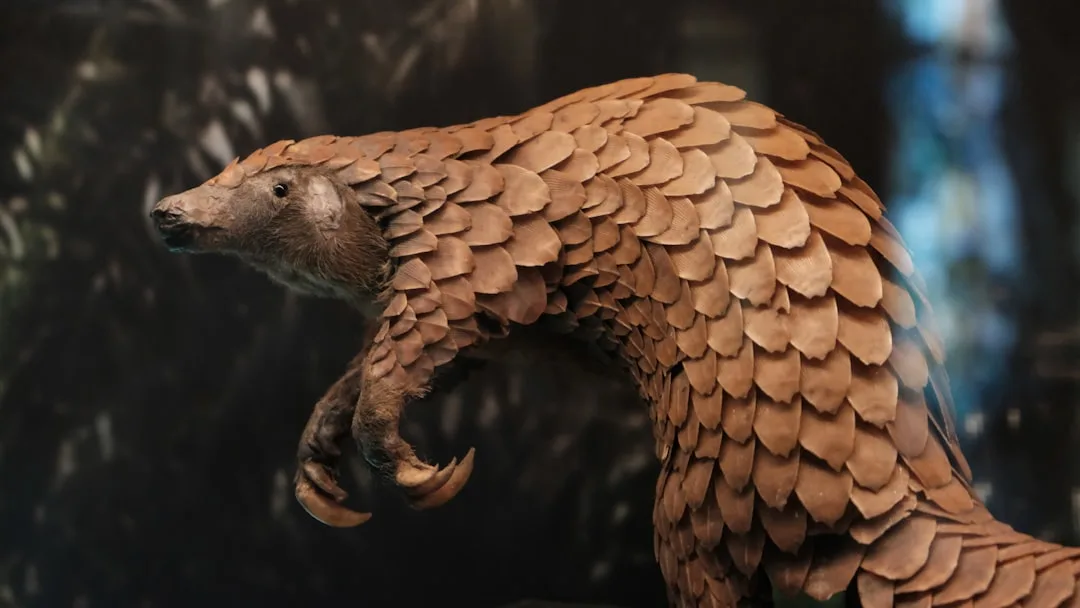
What is a pangolin?
Pangolins are small to medium-sized nocturnal mammals covered entirely in hard, overlapping scales made of keratin - the same material as human fingernails. They are the only scaled mammals on Earth. Eight species exist across Africa and Asia, ranging from 30-80 cm long and weighing 2-35 kg depending on species.
An Armored Anteater Facing Extinction
A pangolin forages for ants in the dark. It uses its long sticky tongue, longer than its body, to extract insects from underground nests. Its keratin scales, the same material as human fingernails, cover nearly its entire body. When a leopard approaches, the pangolin rolls into a ball, scales outward, forming an impenetrable armor.
The leopard tries. Scratches. Bites. Gives up. Walks away.
A few hours later, human poachers arrive. They find the curled pangolin, pick it up, and carry it away. Within weeks, the pangolin will be killed in Asia, its scales ground into medicinal powder, its meat served as luxury cuisine.
This has happened to over 1 million pangolins in the past decade, making them the most illegally trafficked mammals on Earth.
The Animal
Pangolins are the only scaled mammals on Earth.
Physical features:
- Length: 30-80 cm (plus tail of similar length)
- Weight: 2-35 kg depending on species
- Scales: hard keratin covering most of the body
- Tongue: extraordinarily long, attached to the pelvis
- Claws: long front claws for digging
Unique features:
- Only scaled mammals
- Scales make up 20% of body weight
- Tongue can extend 40 cm
- Only mammals that can eat nearly pure insect diet
- Walk on hind legs when carrying prey
Taxonomic surprise:
Despite resembling anteaters and armadillos, pangolins are not closely related to either. DNA analysis shows their closest living relatives are carnivorans, dogs, cats, bears, and weasels. Pangolins represent a unique evolutionary lineage (order Pholidota) that split from other mammals approximately 85 million years ago.
Species and Distribution
Eight pangolin species exist, four each in Africa and Asia.
African species:
- Ground pangolin (Smutsia temminckii), savannas of southern and eastern Africa
- Giant pangolin (Smutsia gigantea), West and Central African rainforests; largest species at 35 kg
- Tree pangolin (Phataginus tricuspis), rainforests of West and Central Africa; arboreal
- Long-tailed pangolin (Phataginus tetradactyla), rainforests of West and Central Africa; arboreal
Asian species:
- Indian pangolin (Manis crassicaudata), India, Pakistan, Sri Lanka, Nepal, Bangladesh
- Chinese pangolin (Manis pentadactyla), southern China, northern Southeast Asia
- Sunda pangolin (Manis javanica), Southeast Asia
- Philippine pangolin (Manis culionensis), Philippines only
The Trafficking Crisis
Pangolins are the most illegally trafficked mammals globally.
Scale of trade:
- Estimated pangolins killed past decade: 1 million+
- Scale value: $400-600/kg on black market
- Meat value: hundreds of dollars per meal
- Annual seizures: tens of tons of scales
- Estimated actual poaching: 10-20x seizures
Why they're targeted:
Scales for traditional medicine: Despite being chemically identical to human fingernails (keratin), pangolin scales are used in traditional Chinese and Vietnamese medicine to treat:
- Lactation difficulties
- Skin conditions
- Rheumatism
- Cancer (in some beliefs)
- Other conditions
None of these uses have scientific support. Keratin from fingernails would work identically (or fail identically) but is not marketed this way.
Meat as luxury: In parts of China and Vietnam, pangolin meat is served as a status symbol in restaurants. A single meal can cost hundreds of dollars. Eating pangolin demonstrates wealth.
Cultural persistence: Despite education campaigns, cultural demand persists. Traditional medicine practitioners continue prescribing pangolin products. Status-seeking consumers continue ordering pangolin in restaurants.
The Supply Chain
How pangolins flow from forest to market:
Capture:
Local hunters in Africa or Asia find pangolins (typically by night). They pick up the curled animals and carry them away.
Transport:
Pangolins are smuggled across borders, typically through Southeast Asian distribution hubs. Vietnam, Laos, and China are key transit points.
Processing:
Live pangolins reach Asian markets. They are killed and processed:
- Meat sold to restaurants
- Scales dried and sold to traditional medicine markets
- Some body parts sold for jewelry or decoration
Consumer:
Wealthy consumers in China, Vietnam, and other Asian markets purchase final products.
Enforcement:
- CITES Appendix I listing bans all international trade (since 2016)
- National laws in range countries prohibit hunting
- Many traffickers operate transnationally
- Enforcement varies widely between countries
- Corruption in some regions undermines efforts
Why Defense Fails Against Humans
Pangolin evolutionary defenses work against natural predators but fail against humans.
Natural predator response:
When a lion, leopard, hyena, or similar predator approaches, the pangolin rolls into a tight ball. The scales form armor. The predator:
- Bites the ball
- Cannot penetrate
- Claws at it
- Cannot break open
- Gives up
This strategy works well. Most pangolins survive natural predator encounters.
Human response:
When a human approaches, the pangolin rolls into a ball. The human:
- Picks up the ball
- Places it in a bag
- Carries it away
- Sells it
The defense that worked for 85 million years against natural predators is useless against humans. Worse, it makes pangolins easy to catch; they don't flee or fight back, just curl up and wait.
The tragic irony:
Evolution selected for the defensive rolling behavior because it worked against natural predators. That same behavior now ensures the species' extinction at human hands.
Biology and Lifestyle
Diet:
Pangolins eat almost exclusively ants and termites. An adult pangolin consumes approximately 70 million insects per year, about 200,000 ants and termites daily.
Their specialized digestive system processes insects without chewing (they have no teeth). Stomach stones grind the insects as the pangolin swallows them.
Activity patterns:
- Nocturnal: active primarily at night
- Solitary: typically alone except during mating and parenting
- Slow-moving: rarely exceeds human walking pace
- Can climb trees: arboreal species and some others
Reproduction:
- Offspring per year: 1 (some species occasionally 2)
- Gestation: 120-150 days depending on species
- Offspring care: 3-4 months of intensive care, then gradual independence
- Sexual maturity: 2 years
This low reproductive rate makes pangolin populations very vulnerable to hunting. Unlike prey species with high reproductive rates, pangolins cannot quickly replenish populations killed for trafficking.
Lifespan:
- Wild: 15-20 years (limited data)
- Captive: typically 6-10 years (pangolins do poorly in captivity)
Captive Difficulties
Pangolins are among the most difficult animals to keep in captivity.
Problems:
- Diet: can't eat anything except ants and termites, which are hard to provide in captivity
- Stress: highly stressed by captivity, often stop eating
- Disease: vulnerable to various diseases in captive settings
- Reproduction: almost no successful captive breeding (a major conservation problem)
- Specific requirements: need specific humidity, temperature, and space
Rescue centers:
Despite challenges, rescue centers exist to rehabilitate confiscated pangolins:
- Vietnam (Save Vietnam's Wildlife)
- South Africa (Pangolin Specialist Group, various NGOs)
- China (various sanctuaries)
- Singapore (Wildlife Reserves Singapore)
Many rescued pangolins die in care because of stress, disease, or feeding difficulties. Those that survive are sometimes released back into protected habitat, though survival after release is uncertain.
Why captive breeding matters:
If pangolins cannot be bred in captivity, they cannot be restored to extinction-risk populations through breeding programs. This makes wild habitat protection essential, there's no backup plan.
Conservation Status
All pangolin species are threatened.
IUCN status:
- Chinese pangolin: Critically Endangered
- Sunda pangolin: Critically Endangered
- Philippine pangolin: Critically Endangered
- Indian pangolin: Endangered
- Giant pangolin: Endangered
- Tree pangolin: Endangered
- Long-tailed pangolin: Vulnerable
- Ground pangolin: Vulnerable
Population collapses:
- Chinese pangolin: 90% decline since 1960, functionally extinct in China
- Sunda pangolin: 80% decline
- Indian pangolin: 50% decline
- African species: accelerating declines as Asian populations collapse
Conservation efforts:
International:
- CITES Appendix I (all species, since 2016), complete trade ban
- INTERPOL anti-trafficking operations
- International Consortium to Combat Wildlife Crime
National:
- Hunting bans in all range countries
- Anti-poaching patrols
- Law enforcement partnerships
NGO work:
- Save Pangolins (global advocacy)
- African Pangolin Working Group
- Zoological Society of London Pangolin Programme
- World Wildlife Fund pangolin programs
Demand reduction:
- Public education campaigns in China and Vietnam
- Celebrity endorsements against pangolin consumption
- Medical education programs showing scientific alternatives
- Religious leader engagement
COVID-19 Connection
Pangolins briefly entered global discussion during the COVID-19 pandemic.
Initial hypothesis:
Early 2020 research suggested pangolins might have been intermediate hosts that allowed SARS-CoV-2 to jump from bats to humans. This was based on similarities between coronaviruses found in pangolins and SARS-CoV-2.
Current understanding:
The intermediate host question remains unsettled. Various hypotheses exist:
- Pangolin intermediate host
- Direct bat-to-human transmission
- Different intermediate species
- Laboratory origin (disputed)
Impact:
The pangolin connection briefly reduced wildlife trafficking as Chinese authorities cracked down on wet markets. However, the trade rebounded within months.
Some researchers argue that wildlife trafficking (including pangolin trade) increases pandemic risk by bringing many species into close contact. This is a broader conservation argument beyond pangolin specifics.
What Extinction Would Mean
If pangolins go extinct, multiple losses occur:
Ecological loss:
Pangolins are significant insectivores. Each adult consumes millions of ants and termites annually. Their extinction would:
- Increase ant/termite populations
- Affect food chains dependent on ant/termite control
- Change soil ecology (termites shape soils significantly)
- Affect vegetation (termite activity influences plant communities)
Evolutionary loss:
The Pholidota order would end. 85 million years of unique evolutionary experimentation, mammals becoming scaled, would be lost permanently. No other mammal lineage has this body plan.
Cultural loss:
Pangolins feature in various cultural traditions, folklore, and natural heritage. Their disappearance would eliminate cultural connections with nature in range countries.
Moral loss:
Extinction caused by human activity, particularly demand for ingredients with no medical value, represents a moral failure. Pangolins would be extinguished because consumers demanded products that don't actually work.
What Can Be Done
Pangolin conservation requires multi-level intervention.
At the consumer level:
- Stop buying pangolin products
- Educate others about scientific evidence against pangolin medicine
- Refuse pangolin meat in restaurants
- Support NGO campaigns
At the policy level:
- Stronger law enforcement in demand countries
- Better customs detection of trafficked scales
- International cooperation on anti-trafficking
- Support protected areas in range countries
At the scientific level:
- Research captive breeding techniques
- Study wild populations for conservation planning
- Develop DNA tests to identify illegal products
- Model population viability
At the individual level:
- Donate to pangolin conservation organizations
- Visit reputable sanctuaries that responsibly educate
- Share accurate information about pangolins
- Advocate for wildlife trade regulations
A Race Against Time
Some conservationists estimate pangolins could be extinct in the wild within 20 years without dramatic intervention.
This is not alarmism. It is based on:
- Current trafficking rates
- Documented population collapses
- Slow reproduction
- Continued demand
- Limited enforcement in key markets
Many mammals face extinction threats, but pangolins face a uniquely deadly combination:
- Easy to catch (defensive rolling)
- High demand (traditional medicine + luxury food)
- Slow reproduction
- Difficult captive breeding
- Active international trafficking networks
The animal that evolved armor and a defense strategy that worked against apex predators for 85 million years now faces extinction because humans don't see a curled pangolin as a living animal but as a commodity.
Whether pangolins survive depends not on their biology but on human choices about demand, enforcement, and conservation. Each pangolin alive today represents one last chance.
Eight Species at Risk
Our research team finds that the eight pangolin species illustrate how the trafficking crisis has shifted over time. As Asian populations collapsed in the 2000s, smugglers turned to African pangolins to meet demand. The shift was documented in seizure records: before 2010, African pangolin scales in East Asian markets were rare. By 2019, over 70% of seized scales in major busts were genetically identifiable as African species [1].
Pangolin Species Status and Population Trends
| Species | Region | IUCN status | Estimated decline | Adult weight |
|---|---|---|---|---|
| Chinese pangolin (Manis pentadactyla) | S. China, N. SE Asia | Critically Endangered | 90% since 1960 | 2-7 kg |
| Sunda pangolin (Manis javanica) | SE Asia | Critically Endangered | 80% since 2000 | 5-7 kg |
| Philippine pangolin (Manis culionensis) | Palawan, Philippines | Critically Endangered | 95% since 2000 | 2-5 kg |
| Indian pangolin (Manis crassicaudata) | South Asia | Endangered | 50% since 2000 | 8-18 kg |
| Giant pangolin (Smutsia gigantea) | Central Africa | Endangered | 40% | 25-35 kg |
| White-bellied pangolin (Phataginus tricuspis) | W/C African rainforest | Endangered | 30-40% | 1.6-3 kg |
| Black-bellied pangolin (Phataginus tetradactyla) | W/C African rainforest | Vulnerable | 20-30% | 2-3 kg |
| Temminck's ground pangolin (Smutsia temminckii) | Sub-Saharan Africa | Vulnerable | 30-40% | 7-15 kg |
Annual scale seizures at ports, airports, and borders now exceed 100 tonnes, representing at least 200,000 to 400,000 pangolins per year. The true rate is likely 3 to 10 times higher because only a fraction of smuggling attempts are intercepted.
"Pangolins are a case study in what happens when a species combines high commercial value with a defense that is counterproductive against humans. We are watching the whole order Pholidota unravel because of demand for a substance that is chemically identical to the nails on our fingers." - Professor Dan Challender, University of Oxford, IUCN Pangolin Specialist Group [2]
The Evolution of Scales
Pangolin scales are one of the most remarkable convergent evolutionary features in mammals. They are made of keratin - the same structural protein found in hair, horn, and nails - but arranged in overlapping plates that function as articulated armor. The evolution of scales from hair-like precursors occurred independently in pangolins and is not directly homologous to reptile scales (which develop from different embryonic tissue).
Recent genomic work published in Genome Research identified 44 genes under strong positive selection in pangolins relative to other mammals, many of them related to keratin production, skin development, and immune function [3]. Notably, pangolins have lost several genes found in other mammals, including genes for tooth enamel and for certain immune responses. Our research team notes that the tooth loss is linked to the shift to an exclusively ant-and-termite diet, which requires no chewing.
Structural Comparison of Mammalian Armor
| Animal | Armor type | Material | Mobility trade-off |
|---|---|---|---|
| Pangolin | Overlapping keratin scales | Modified hair | Rolls into ball; can still climb |
| Armadillo | Bony osteoderms + keratin | Modified bone in skin | Limited flexibility |
| Hedgehog | Keratin spines | Modified hair | Can curl but spines do not overlap |
| Porcupine | Keratin quills | Modified hair | Flexible body, defensive tail |
| Echidna | Keratin spines | Modified hair | Can curl and dig |
| Tree pangolin | Thinner overlapping scales | Modified hair | Climbs; prehensile tail |
Pangolin scales are the only truly overlapping keratin armor in mammals, producing an almost fish-like scaled appearance that gave the order its name (Pholidota, from Greek for "covered in scales"). The scales grow throughout the pangolin's life and are replaced when damaged.
"What is so wrenching about the pangolin crisis is that the very feature that makes pangolins biologically unique - the scales - is the feature that has condemned them. A crueler evolutionary outcome is hard to imagine." - Dr. Jen Gruger, Save Pangolins [4]
Traditional Medicine Claims Examined
The scientific evidence on pangolin scale medicinal claims is clear: there is none. Pangolin scales are composed of approximately 97% keratin, the same protein found in human hair and fingernails. Grinding up fingernail clippings would produce a functionally identical powder. No peer-reviewed, randomized controlled trial has ever demonstrated therapeutic benefit from pangolin scales for any of the conditions they are traditionally prescribed for.
Chinese pharmacology has increasingly recognized this. In 2020, the Chinese government removed pangolin scales from the official list of ingredients in the Chinese Pharmacopoeia, a significant regulatory step. Pangolins were also upgraded from second-class to first-class national protected animals in China. These are meaningful steps, though the black market persists.
Our research team has been tracking the post-2020 trade data. Early reports from TRAFFIC and WildAid suggest that the regulatory changes have reduced legal medicinal use but have not yet eliminated illegal demand [5]. A substantial transition period will likely be required.
Notable Research Findings
- Pangolins have the longest tongue relative to body size of any mammal. Extended fully, it can be twice the body length and is anchored at the pelvis, not the throat.
- Pangolin scales account for roughly 20% of body weight. A 10 kg pangolin carries approximately 2 kg of scales, more than the skeleton weighs.
- A 2019 study of pangolin olfactory genes found that pangolins have one of the most reduced olfactory gene repertoires in any mammal, suggesting that electroreception-like sensitivity to ant and termite pheromones is detected through other sensory modalities.
- Pangolins produce a foul-smelling secretion from anal glands similar to skunks. Although less potent, the secretion may function as territory marking and predator deterrence.
- A fossil pangolin (Eomanis waldi) discovered in Germany's Messel Pit dates to 47 million years ago. Its scales are preserved, and its body plan is remarkably similar to modern pangolins, suggesting the scaled mammal morphotype has been stable for tens of millions of years.
Related Articles
- Elephants: Memory and Intelligence
- Why Mammoths Went Extinct
- Polar Bear: The Arctic's Apex Predator in a Warming World
References
[1] Mwale, M., Dalton, D. L., Jansen, R., et al. (2017). Forensic application of DNA barcoding for identification of illegally traded African pangolin scales. Genome, 60(3), 272-284. DOI: 10.1139/gen-2016-0144
[2] Challender, D. W. S., Heinrich, S., Shepherd, C. R., & Katsis, L. K. D. (2020). International trade and trafficking in pangolins, 1900-2019. In Pangolins: Science, Society and Conservation (pp. 259-276). Academic Press. DOI: 10.1016/B978-0-12-815507-3.00016-2
[3] Choo, S. W., Rayko, M., Tan, T. K., et al. (2016). Pangolin genomes and the evolution of mammalian scales and immunity. Genome Research, 26(10), 1312-1322. DOI: 10.1101/gr.203521.115
[4] Heinrich, S., Wittmann, T. A., Prowse, T. A. A., et al. (2016). Where did all the pangolins go? International CITES trade in pangolin species. Global Ecology and Conservation, 8, 241-253. DOI: 10.1016/j.gecco.2016.09.007
[5] TRAFFIC. (2022). Pangolins in Global Wildlife Trade: A 2022 Status Update. TRAFFIC International.
[6] IUCN Red List. (2019). All eight pangolin species assessments. International Union for Conservation of Nature.
[7] Gaubert, P., Antunes, A., Meng, H., et al. (2018). The complete phylogeny of pangolins: Scaling up resources for the molecular tracing of the most trafficked mammals on Earth. Journal of Heredity, 109(4), 347-359. DOI: 10.1093/jhered/esx097
Frequently Asked Questions
What is a pangolin?
Pangolins are small to medium-sized nocturnal mammals covered entirely in hard, overlapping scales made of keratin - the same material as human fingernails. They are the only scaled mammals on Earth. Eight species exist across Africa and Asia, ranging from 30-80 cm long and weighing 2-35 kg depending on species. They eat primarily ants and termites, using their extraordinarily long tongues (up to 40 cm) to extract insects from nests.
Their scales make up 20% of their body weight and provide defense against predators. When threatened, pangolins roll into tight balls, their scales forming impenetrable armor that most predators cannot penetrate. They are solitary and nocturnal, making them rarely seen in the wild. Despite their distinctive appearance, pangolins are not related to armadillos or anteaters (whom they resemble).
DNA analysis shows pangolins are most closely related to carnivores like dogs and cats, representing a uniquely specialized evolutionary lineage.
Why are pangolins the world's most trafficked mammal?
Pangolins are the most illegally trafficked mammal globally because of demand for their scales in traditional Chinese and Vietnamese medicine and their meat as luxury food. Over 1 million pangolins have been killed and trafficked in the past decade. Their scales are ground into powder and used to treat various conditions including lactation difficulties, skin disorders, and cancer - despite lacking any scientific evidence of medical value.
The scales sell for $400-600 per kilogram in illegal markets. Pangolin meat is served as a status symbol in restaurants across China and Vietnam, selling for hundreds of dollars per meal. The trafficking is devastatingly efficient - pangolins are easy to catch because they roll into balls rather than fleeing, making them easily collected. Their slow reproduction (1 offspring per year) means populations cannot recover quickly.
CITES has classified all 8 pangolin species as endangered and banned international trade since 2016, but black market demand continues. Chinese pangolin populations have declined 90% since 1960.
Where do pangolins live?
Pangolins live in tropical forests, savannas, and scrublands across Africa and Asia. Four species live in Africa (ground pangolin, giant pangolin, tree pangolin, long-tailed pangolin) and four in Asia (Chinese pangolin, Indian pangolin, Philippine pangolin, Malayan/Sunda pangolin). African species range from the Sahel to South Africa, with specific habitat requirements varying by species.
Asian species range from Pakistan through India, Sri Lanka, Southeast Asia, and Philippines, historically extending into southern China. Ground pangolins inhabit savannas and dig burrows. Tree pangolins live in rainforest canopies. Long-tailed pangolins are arboreal. Giant pangolins live in grasslands and scrub. Each species has specific habitat preferences but all require access to ant and termite populations for food.
Habitat destruction from agricultural expansion, logging, and development has eliminated pangolins from much of their former range. Combined with heavy poaching, populations have collapsed across much of their native territory.
Can pangolins fight off predators?
Pangolins rely on passive defense rather than active fighting. When threatened, they immediately curl into a tight ball with scales outward, creating armor most predators cannot penetrate. Lions, tigers, leopards, and hyenas all try and fail to crack open curled pangolins.
The Latin name ‘Pholidota’ literally means ‘scaly ones.’ Pangolin tongues are attached to their pelvis (not mouths) and can extend up to 40 cm to reach into termite nests, but they don’t bite to defend themselves. They have small claws used for digging and climbing but not for fighting. Pangolins can climb trees, swim, and dig burrows when not in danger, but their response to any threat is always to roll up.
This defense works perfectly against natural predators - most large predators give up after trying unsuccessfully to unroll the ball. Unfortunately, this defense is useless against humans, who simply pick up the rolled pangolin and carry it away. Their defensive adaptation that served them for millions of years against natural predators has become their greatest vulnerability in the age of human hunters.
Are pangolins going extinct?
Yes, all 8 pangolin species are threatened with extinction, with 4 listed as Critically Endangered and the others Endangered or Vulnerable. The Chinese pangolin has declined 90% since 1960 and is functionally extinct in China. Sunda pangolin populations have crashed 80% in Southeast Asia. Indian pangolins have declined 50%. African species are declining as pangolin poaching shifted from Asia after local populations collapsed.
Pangolins are now the most threatened mammal group globally. Conservation efforts include: complete trade bans under CITES since 2016, anti-poaching patrols in protected areas, pangolin rescue centers rehabilitating confiscated animals, international awareness campaigns, stricter law enforcement in demand countries, and scientific research into captive breeding (so far unsuccessful - pangolins are extremely difficult to breed in captivity).
Some conservationists estimate that without dramatic intervention, pangolins could be extinct in the wild within 20 years. Their scales and meat have no proven medical or nutritional value over alternatives, yet cultural demand continues driving their extinction.