
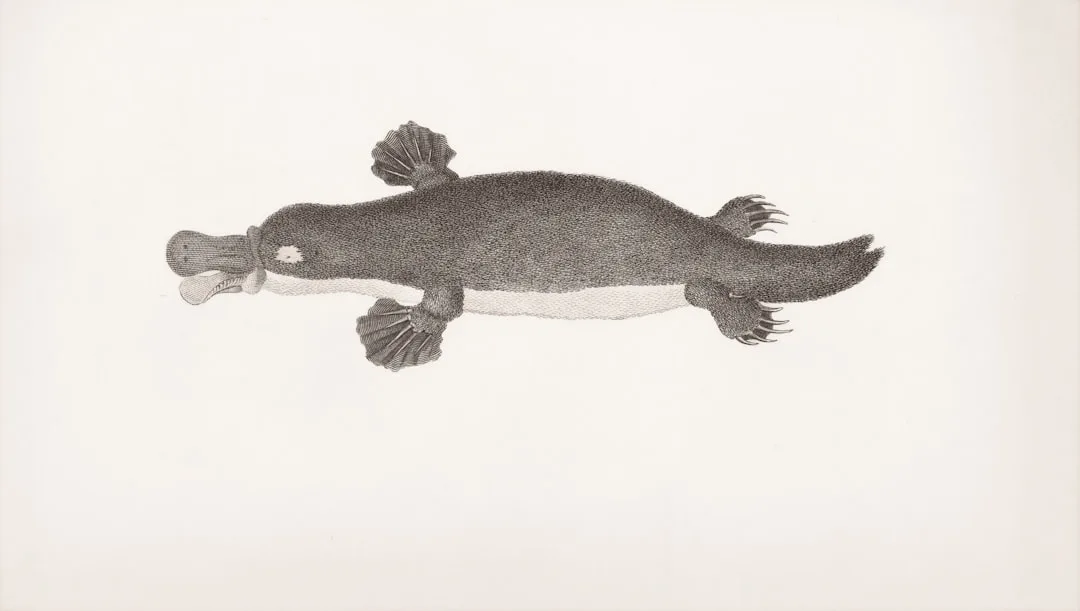
Why is the platypus so strange?
The platypus (Ornithorhynchus anatinus) breaks nearly every rule of mammalian biology. It is a mammal that lays eggs - one of only five monotreme species on Earth. It has a duck-like bill that houses electroreceptors for detecting prey. Males produce venom from spurs on their hind legs, a trait found in no other mammal.
The Animal That Broke Biology
When the first preserved platypus specimens reached Europe in the late 1700s, scientists concluded they were hoaxes. Someone had sewn a duck's bill onto a beaver-like body. The platypus could not possibly be real - it violated too many rules of what mammals were supposed to be.
But the platypus was real. It remains real. And nearly 250 years after its discovery shocked European science, it still represents one of the most bizarre and confusing animals on Earth - a mammal that lays eggs, produces venom, detects prey with electricity, and diverged from the rest of the mammal family 170 million years ago.
The List of Impossibilities
It lays eggs. Most mammals give live birth. Platypuses (and their monotreme cousins, the echidnas) lay leathery, reptile-like eggs.
Males produce venom. Male platypuses have spurs on their hind legs containing venom. No other mammal produces venom from hind-leg spurs.
It uses electroreception. Platypus bills contain 40,000 electroreceptor cells detecting the electrical fields of prey animals. No other mammal has this sense in any developed form.
It has no nipples. Platypuses produce milk but release it through skin patches rather than nipples. Young lick milk from the mother's fur.
Low body temperature. Normal platypus body temperature is 32 C, several degrees below other mammals.
Ten sex chromosomes. Mammals typically have two sex chromosomes (XY or XX). Platypuses have ten.
Webbed feet and duck bill. Physical appearance mixes mammal, reptile, and bird features.
Waterproof fur. Dense fur traps air, providing insulation underwater. Platypuses stay warm in cold streams where mammals normally shouldn't be able to thrive.
Electroreception
The most extraordinary platypus ability is electroreception.
How it works:
All living animals produce weak electrical fields. Muscle contractions, nerve signals, and even basic cellular activity generate tiny electrical currents. Water is a reasonably good conductor, spreading these fields through the surrounding environment.
Platypus bills contain approximately 40,000 electroreceptor cells arranged in longitudinal stripes. Each cell responds to electrical signals in a specific frequency range.
Hunting strategy:
Platypuses dive for 30-40 seconds at a time, closing their eyes, ears, and nostrils. They swim along stream bottoms with bills sweeping side to side through mud and debris.
As their bills sweep, electroreceptors detect prey. A shrimp flexing its body, an insect larva moving, a worm contracting its muscles - all produce detectable electrical signals.
Mechanoreceptors in the bill (about 60,000 of them) detect pressure changes as prey moves, adding spatial information. Combining electroreception and mechanoreception, the platypus pinpoints prey location with remarkable precision despite zero visual input.
Sensitivity:
Research has shown platypuses detect electrical fields as weak as 200 microvolts per meter. This is the field produced by a shrimp flexing its body 1 meter away in water.
Other animals with electroreception:
- Sharks and rays (well-developed)
- Some bony fish
- A few dolphin species
- Platypuses and echidnas (only mammals)
Venom
Male platypuses produce venom in glands connected to spurs on their hind legs.
The spurs:
Each hind leg has a hollow, pointed spur about 15 mm long. The spurs connect to venom glands that activate during the mating season.
Venom components:
Platypus venom contains approximately 83 different toxins. Key effects include:
- Severe pain (far exceeding most other venoms)
- Muscle damage at the sting site
- Swelling and inflammation
- Prolonged sensitivity that can last weeks
- Blood clotting effects
Purpose:
Venom is used primarily against rival male platypuses during breeding competition. Males fight for access to females by jabbing each other with spurs. Females lack functional spurs - the structures are present in juveniles but regress in females.
Human effects:
Human sting victims describe platypus venom pain as worse than any other experience - worse than gunshot wounds, kidney stones, or childbirth.
Morphine and conventional painkillers often fail to reduce platypus sting pain. Regional nerve blocks are sometimes required for pain management.
No human deaths have been documented, but dogs have been killed by platypus venom, and small children might be at risk.
Medical research:
Platypus venom contains unique peptides being studied for potential pain treatment applications. Some of these compounds might lead to new non-opioid painkillers.
Reproduction
Platypus reproduction retains egg-laying - an ancestral mammalian trait lost in other mammal lineages.
Mating:
Mating occurs between August and October in most of the platypus range. Males and females briefly come together, after which females dig extended breeding burrows up to 30 meters long.
Egg laying:
Females lay 1-3 small, leathery eggs in the breeding burrow. Eggs are about 11 mm in diameter - tiny compared to bird or reptile eggs.
Incubation:
The mother incubates eggs for approximately 10 days by curling her body around them, tail pulled over her belly to provide warmth. Despite laying eggs, incubation is warm-blooded - she maintains egg temperature through body heat.
Hatching:
Young platypuses (called puggles) hatch nearly hairless and about 1.5 cm long. They are helpless and completely dependent on their mother.
Milk without nipples:
Female platypuses produce milk from mammary glands similar to other mammals, but lack nipples. Milk oozes from skin patches on the mother's belly, and young platypuses lap it from her fur.
The milk is rich in proteins and fats, and recent research has found it contains antimicrobial compounds possibly important for protecting offspring in burrow environments contaminated with various bacteria.
Development:
Young platypuses remain in the burrow for 3-4 months, growing fur, developing swimming abilities, and learning to hunt. They emerge at approximately juvenile size and disperse to establish their own territories.
Habitat and Distribution
Platypuses live only in eastern Australia and Tasmania.
Range:
- Queensland: northern populations, some isolated
- New South Wales: widespread in suitable habitat
- Victoria: widespread throughout
- Tasmania: throughout suitable freshwater
Habitat requirements:
- Permanent freshwater (streams, rivers, lakes)
- Banks suitable for burrow construction
- Abundant invertebrate prey
- Water temperature: typically 10-25 degrees C
- Adequate water clarity for underwater activity
Conservation status:
Platypuses are listed as Near Threatened. Several threats affect populations:
- Drought: prolonged drought dries streams, eliminating habitat
- Pollution: agricultural runoff and urban pollution degrade water quality
- Climate change: extreme weather (drought, bushfire) stresses populations
- Habitat destruction: urban development, land clearing
- Illegal trapping: occasional incidents of platypuses caught in fishing nets or illegally captured
Population decline:
Platypus populations have declined approximately 50 percent since European colonization of Australia. Recent severe droughts and the 2019-2020 "Black Summer" bushfires caused local extinctions in some stream systems.
Evolution and Ancestry
Platypuses represent an ancient mammalian lineage.
Monotremes:
Platypuses and echidnas (four species found in Australia and New Guinea) together form the monotreme order. These are the only egg-laying mammals remaining on Earth.
Divergence:
Monotremes split from the lineage leading to other mammals approximately 170 million years ago, during the Jurassic period. This was before mammals evolved placental live birth (later than 100 million years ago) and before the rise of modern marsupial mammals.
Ancient features:
Many "strange" platypus features are actually ancient mammalian traits that other mammals later lost:
- Egg laying (original mammalian reproduction)
- No nipples (nipples evolved later)
- Lower body temperature (early mammalian thermoregulation)
- Certain skeletal features
Fossil record:
Fossil monotremes are rare but known from Australia, South America (ancient), and Antarctica (from warmer geological periods). The lineage was once more widespread before being reduced to its current Australian range.
Discovery and Reception
When platypuses were first described by European science, disbelief followed.
The first specimens:
The first preserved platypus arrived in Europe in 1798. Naturalist George Shaw examined it and initially suspected a hoax - someone had sewn parts of different animals together to create an impossible chimera.
Shaw even checked the specimen for stitches with scissors, looking for seams where the "fake" parts had been attached.
Scientific acceptance:
Live specimens and additional preserved animals eventually convinced European scientists that platypuses were real. But the strangeness continued - each new discovery (venom, egg-laying, electroreception) expanded the list of platypus peculiarities.
Egg-laying confirmation:
Platypus egg-laying was not definitively confirmed until 1884, when William Caldwell observed it in Australia. Until then, whether platypuses actually laid eggs was scientifically controversial.
Cultural significance:
The platypus appears on the Australian 20-cent coin and has become one of Australia's national symbols. The animal's bizarre features have made it an icon of unique Australian wildlife.
Why the Platypus Matters
The platypus is not merely a biological curiosity. It represents a window into deep mammalian history.
Before the platypus and its monotreme relatives were fully understood, the mammalian family seemed relatively unified - all mammals gave live birth, had nipples, and shared basic reproductive machinery. The platypus revealed that this apparent unity came from mammals sharing a relatively recent common ancestor that had already evolved live birth.
Going back further, mammalian biology was much more varied. Platypuses show us what those ancient mammals might have looked like - egg-laying, venomous, electro-sensing, warm-blooded but cooler than modern mammals, with reptilian and mammalian features in combination.
Every piece of platypus biology is a message from 170 million years ago. The platypus is not a failed or confused animal - it is a successful lineage that has maintained its ancient way of being mammal while the rest of its kin moved on to different strategies.
When European scientists first cut preserved platypus specimens looking for hoax stitches, they were responding to an animal that genuinely did not fit their categories. They were right that the platypus did not match expectations. What they were wrong about was the conclusion - it was not a hoax. It was just a mammal that had been doing things the other way for 170 million years, on a continent that preserved what continental drift had isolated.
The Platypus Genome
The 2008 publication of the platypus genome in Nature was one of the most revealing moments in mammalian evolutionary biology. The genome, sequenced by a consortium led by Wesley Warren at Washington University, contains a mosaic of mammalian, reptilian, and bird-like features preserved from different periods in the evolution of the lineage [1].
The platypus has 52 chromosomes in total. Its 10 sex chromosomes form a multivalent chain during meiosis, a configuration unlike anything seen in other mammals and reminiscent of some bird sex chromosome systems. The egg-laying genes (specifically the vitellogenin gene, which codes for the yolk protein) are degenerating but still partly functional - an evolutionary fingerprint of a lineage that has been losing the ancestral mammalian trait of egg production slowly over tens of millions of years.
"The platypus genome is an unparalleled window into the early evolution of mammals. It contains features we have lost, features we share, and features it has evolved uniquely. Nearly every chapter of mammalian history can be read in it if you know where to look." - Wesley Warren, Washington University in St. Louis [1]
Mixed Features in the Platypus Genome
| Feature | Reptilian origin | Mammalian origin | Bird-like origin | Platypus-specific |
|---|---|---|---|---|
| Vitellogenin (yolk) | Present (degrading) | Absent in other mammals | Present | - |
| Casein (milk proteins) | Absent | Present | Absent | Platypus variants |
| Immunoglobulin classes | - | 5 in most mammals | - | 4 plus unique class |
| Venom gene duplications | - | Only in platypus | Some reptile convergence | Independent origin |
| Electroreceptor genes | Evolved independently | Absent in other mammals | - | Lineage-specific expansion |
| Sex chromosomes | Not XY | Not XY | ZW-like | 10-chromosome chain |
| Olfactory genes | - | ~1,000 in mammals | ~500 | ~350 (reduced) |
The Kalenux Team notes that the platypus essentially preserves an evolutionary transitional stage. It is not a "primitive" mammal - that language misleads - but rather a highly specialized lineage that has kept some ancestral mammal features while losing others and evolving several of its own.
Platypus Biofluorescence
One of the most surprising recent discoveries about platypuses came in 2020. Researchers at Northland College in Wisconsin examined museum specimens under ultraviolet light and discovered that platypus fur glows a greenish-blue color under UV illumination [2]. This was the first documentation of biofluorescence in a monotreme.
Biofluorescence occurs when an animal absorbs light of one wavelength and re-emits it at a longer wavelength. It is known in some marine animals and a few mammals - including flying squirrels and opossums - but had never been reported in platypuses. Whether it serves a function remains unclear.
Platypuses are primarily nocturnal, and it is possible that the glow helps them communicate with each other under low-light conditions, or makes them less visible to predators that see into the UV range (such as some nocturnal raptors).
"We keep finding that the visual world of mammals is more complex than we realized. Biofluorescence in a monotreme tells us this trait is ancient and has been independently retained across diverse mammalian lineages. The platypus yet again shows us features that may once have been widespread." - Dr. Paula Spaeth Anich, Northland College [2]
Conservation Threats and Recent Research
The 2019-2020 "Black Summer" bushfires in Australia burned through platypus habitat across multiple river systems in New South Wales and Victoria. Ash and sediment flushed into streams killed invertebrate prey, raised water temperatures, and degraded burrow banks. Post-fire surveys by UNSW's Platypus Conservation Initiative estimated local population declines of 30 to 80% in affected catchments [3].
Platypus Distribution and Status
| Region | Estimated population | Trend | Primary threats |
|---|---|---|---|
| Far north Queensland | ~2,000 | Declining | Habitat loss, drought |
| New South Wales | 15,000-25,000 | Declining | Drought, water extraction |
| Victoria | 20,000-30,000 | Declining | Urban development, drought |
| Tasmania | 20,000+ | Relatively stable | Fungal disease (mucormycosis) |
| South Australia | Functionally extinct | Extinct on mainland | Historical trapping, habitat loss |
| Kangaroo Island | ~150 (introduced) | Stable | Fires (severe 2020 impact) |
A 2020 petition by Australian scientists proposed reclassifying the platypus from Near Threatened to Vulnerable on the IUCN Red List, citing a 22% decline in suitable habitat since European colonization and evidence of sharp local declines during recent drought periods. As of 2024, platypuses are listed as Near Threatened globally but Endangered in South Australia and Vulnerable in Victoria.
"The platypus is a species we are at risk of losing by inches rather than all at once. Each drought takes a catchment. Each urban expansion removes another stretch of suitable habitat. The cumulative effect over decades is a species that has quietly contracted into a fraction of its former range." - Dr. Gilad Bino, University of New South Wales [4]
Notable Research Findings
- Platypus venom contains at least 83 toxins, some unique to the species. One peptide called OvCNP (ornithorhynchus venom natriuretic peptide) is being studied as a potential non-opioid painkiller, and another, called glucagon-like peptides, has led to type 2 diabetes drug development.
- A platypus can process an estimated 5,000 prey detection events per second through its electroreceptor and mechanoreceptor array. This is among the highest sensory bandwidth documented in any mammal.
- Platypuses are one of few mammal species where males and females have significantly different skeletons - male platypuses have reinforced spur bones linked to venom production, females do not.
- Platypus milk contains Shotgun, a newly discovered antimicrobial protein effective against E. coli and other bacteria. It was identified by researchers at CSIRO and Deakin University in 2014 and has potential applications for antibiotic development.
- Our research team notes that the platypus "duck bill" is not actually beak-like in structure. It is soft, rubbery skin densely packed with sensory receptors - more similar to a shark's electrosensory snout than to a duck's keratinous bill.
What Venomous Animals Live in Australia?
Australia hosts some of the world's most venomous fauna, including a rare venomous mammal: the male platypus (Ornithorhynchus anatinus), one of only five monotreme species on Earth, delivers venom through spurs on its hind legs. Platypus venom causes severe pain that cannot be relieved by morphine and can persist for weeks.
Other Australian venomous residents include the inland taipan (Oxyuranus microlepidotus), Sydney funnel-web spider (Atrax robustus), redback spider (Latrodectus hasselti), blue-ringed octopus (Hapalochlaena), box jellyfish (Chironex fleckeri), Irukandji jellyfish, cone snails, and stonefish. Of roughly 170 Australian land snake species, about 100 are venomous.
The platypus is the only venomous mammal producing toxin from hind-leg spurs - no other mammal on Earth has this feature. Its 40,000 bill electroreceptors and 32°C body temperature make it one of the strangest vertebrates alive.
Related Articles
- Echidnas: The Other Egg-Laying Mammal
- Marsupials: Australia's Pouch-Bearing Mammals
- Kangaroos: How Pouched Mammals Dominate Australia
References
[1] Warren, W. C., Hillier, L. W., Marshall Graves, J. A., et al. (2008). Genome analysis of the platypus reveals unique signatures of evolution. Nature, 453, 175-183. DOI: 10.1038/nature06936
[2] Anich, P. S., Anthony, S., Carlson, M., et al. (2020). Biofluorescence in the platypus (Ornithorhynchus anatinus). Mammalia, 85(2), 179-181. DOI: 10.1515/mammalia-2020-0027
[3] Bino, G., Kingsford, R. T., & Wintle, B. A. (2020). A stitch in time - Synergistic impacts to platypus metapopulation extinction risk. Biological Conservation, 242, 108399. DOI: 10.1016/j.biocon.2020.108399
[4] Bino, G., Kingsford, R. T., Archer, M., et al. (2019). The platypus: Evolutionary history, biology, and an uncertain future. Journal of Mammalogy, 100(2), 308-327. DOI: 10.1093/jmammal/gyz058
[5] Grant, T. (2007). Platypus (4th ed.). CSIRO Publishing.
[6] Whittington, C. M., Papenfuss, A. T., Kuchel, P. W., & Belov, K. (2008). Expression patterns of platypus defensin and related venom genes across a range of tissue types. Toxicon, 52(4), 559-565.
[7] IUCN Red List. (2016). Ornithorhynchus anatinus assessment. International Union for Conservation of Nature.
Frequently Asked Questions
Why is the platypus so strange?
The platypus (Ornithorhynchus anatinus) breaks nearly every rule of mammalian biology. It is a mammal that lays eggs - one of only five monotreme species on Earth. It has a duck-like bill that houses electroreceptors for detecting prey. Males produce venom from spurs on their hind legs, a trait found in no other mammal. It has webbed feet and swims like an otter.
It has fur and nurses young with milk like normal mammals, but releases the milk through skin patches rather than nipples. Its body temperature averages 32 degrees C, several degrees below other mammals. It has 10 sex chromosomes (mammals normally have 2). Scientists studying platypuses in the 1700s initially thought preserved specimens were elaborate hoaxes.
The platypus is so unusual that it represents an entirely separate branch of mammal evolution that diverged from other mammals approximately 170 million years ago.
How does a platypus find prey without sight?
Platypuses close their eyes, ears, and nostrils when diving, relying entirely on electroreception and mechanoreception to find prey. Their bills contain approximately 40,000 electroreceptor cells and 60,000 mechanoreceptor cells. Electroreceptors detect the weak electrical fields produced by muscle contractions in prey animals (shrimp, insects, worms). Mechanoreceptors detect water pressure changes as prey moves.
By combining these two senses, platypuses pinpoint prey location with precision despite zero visual input. They sweep their bills side to side through muddy stream bottoms, detecting prey that would be invisible to other predators. This electrical hunting sense is shared with only a few other animals including sharks and some dolphins. In mammals, it is unique to platypuses and echidnas.
Research has shown platypuses can detect electrical fields as weak as 200 microvolts per meter - the field produced by a shrimp flexing its body 1 meter away.
Is platypus venom dangerous?
Platypus venom is extremely painful but not typically fatal to humans. Male platypuses have venomous spurs on their hind legs, used primarily against rival males during mating season. The venom contains approximately 83 different toxins causing severe muscle damage, extreme pain, and prolonged sensitivity. Victims describe the pain as worse than any other experience including childbirth.
Conventional painkillers including morphine often fail to reduce platypus sting pain, and effects can persist for weeks or months. However, no human deaths from platypus envenomation have ever been documented. The venom evolved to incapacitate other male platypuses during breeding competition, not to kill mammalian prey.
A dog or small child might be killed by platypus venom in rare circumstances, but adult humans survive with severe pain but no lasting damage. Platypus venom is of interest to pharmaceutical researchers because several of its unique toxins might lead to new pain treatments.
Where do platypuses live?
Platypuses live only in freshwater streams and rivers of eastern Australia and Tasmania. Their range stretches from Queensland through New South Wales, Victoria, and into Tasmania, always in wet forest habitats with permanent water. They dig burrows into streambanks, with entrances below the waterline for protection from predators.
A single platypus territory typically extends 1-5 km along a stream, and platypuses are largely solitary except during breeding season. They were never successfully introduced anywhere outside Australia - captive breeding programs have struggled, with only Taronga Zoo and a few facilities maintaining successful breeding populations. Platypus populations have declined significantly due to habitat loss, pollution, and climate change-induced drought.
The species is listed as Near Threatened, with some local populations vulnerable or endangered. Their water-dependent lifestyle makes them particularly vulnerable to Australia’s increasing droughts and bushfires. Researchers have documented populations disappearing from streams that dried up during recent severe droughts.
How do platypuses lay eggs?
Female platypuses lay 1-3 small leathery eggs, similar to reptile eggs, inside their burrows. The eggs are incubated for approximately 10 days by the mother, who curls her body around them with her tail pulled over her belly to maintain warmth. Unlike most mammal embryos, platypus eggs develop externally after a short internal gestation. After hatching, the tiny hairless young (called puggles) are approximately 1.5 cm long and completely helpless.
The mother produces milk which oozes from skin patches on her belly - platypuses lack nipples entirely. Young platypuses lap this milk from the mother’s fur for 3-4 months before venturing out of the burrow. They reach adulthood at around 2 years.
This egg-laying reproductive system was once considered an evolutionary curiosity, but recent research has clarified that monotremes (platypus and echidnas) diverged from other mammals before the evolution of live birth. Their egg-laying is an ancestral trait maintained since the Jurassic period, not a recently derived feature.