
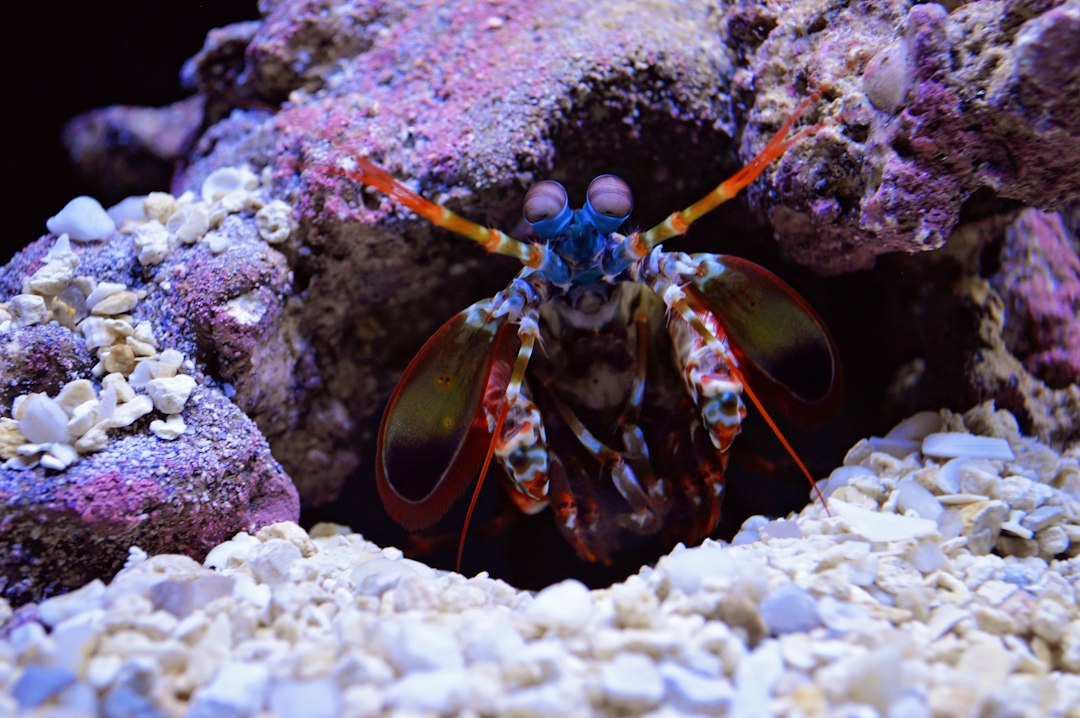
The ocean is full of small creatures that punch far above their weight, but few do so as literally as the mantis shrimp and the pistol shrimp. Both are small crustaceans, both possess weaponry that seems almost impossible for their size, and both have captured the imagination of scientists and ocean enthusiasts alike. Yet despite the similar reputations, these two animals are very different, and comparing them reveals just how varied and extreme life can get on the reef.
Meet the Mantis Shrimp
The mantis shrimp is not a true shrimp at all but a member of a group of crustaceans called stomatopods. It gets its name from the way its front limbs fold beneath its body, resembling the posture of a praying mantis. Mantis shrimp come in a dazzling array of colors and live in burrows and crevices in tropical and subtropical waters.
What makes the mantis shrimp famous is its raptorial appendages, the specialized limbs it uses to attack prey. There are two broad types. Some species are known as spearers, using sharp, barbed limbs to impale soft-bodied prey like fish and worms. Others are smashers, wielding club-like appendages that they use to deliver devastating blows to hard-shelled prey such as snails, crabs, and clams.
The smashing strike of a mantis shrimp is one of the fastest movements in the animal kingdom. The club accelerates so rapidly that it can shatter shells and even crack aquarium glass. The strike is so fast that it briefly creates cavitation bubbles in the water, which collapse with a burst of energy and heat, adding a second shockwave to the initial blow.
Meet the Pistol Shrimp
The pistol shrimp, also called the snapping shrimp, is a true shrimp and a different kind of marvel. It is small, often no more than a couple of inches long, and typically lives hidden in burrows or among coral rubble. Its defining feature is a single oversized claw that functions less like a pincer and more like a spring-loaded weapon.
When the pistol shrimp snaps this claw shut, it does so with astonishing speed. The rapid closure shoots out a jet of water so fast that it produces a cavitation bubble. When that bubble collapses, it generates an intense burst of sound and a shockwave powerful enough to stun or kill small prey. The snap is also famously loud. Colonies of pistol shrimp create so much noise that they can interfere with sonar and are among the loudest sources of sound in the ocean.
Remarkably, the collapse of the cavitation bubble produces a brief flash of light and an instant of extreme heat, a phenomenon that has fascinated researchers studying the physics of sound and bubbles.
Two Different Ways to Wield Cavitation
Both animals exploit the same underlying physics: cavitation, the formation and violent collapse of bubbles in fast-moving water. But they use it in different ways. The mantis shrimp relies on a physical club that strikes prey directly, with cavitation adding a secondary blow. The pistol shrimp does not touch its prey at all, instead firing a bubble-driven shockwave across a short distance.
The table below summarizes the key differences.
| Trait | Mantis Shrimp | Pistol Shrimp |
|---|---|---|
| Group | Stomatopod, not a true shrimp | True shrimp |
| Main weapon | Club or spear limbs | Single snapping claw |
| Method | Direct strike | Snapping bubble shockwave |
| Prey | Crabs, snails, clams, fish | Small fish and invertebrates |
| Notable trait | Powerful strike, advanced vision | Extremely loud snap |
| Size | Small to medium | Small |
The Mantis Shrimp’s Incredible Eyes
Beyond its strike, the mantis shrimp is renowned for having some of the most complex eyes in the animal kingdom. Its eyes are mounted on stalks and can move independently, giving it a remarkable field of view. More striking still is the number of photoreceptor types it possesses, far more than the human eye. This allows the mantis shrimp to perceive a broad range of colors and to detect polarized light, which most animals cannot see at all.
Scientists are still exploring exactly how the mantis shrimp uses this visual power. Rather than blending colors the way human brains do, it may process color information in a more direct, rapid way suited to quick reactions. Whatever the mechanism, its visual system is unlike anything else in the sea.
The Pistol Shrimp’s Surprising Partnerships
While the mantis shrimp is largely a solitary hunter, the pistol shrimp is known for forming cooperative relationships. Many species share their burrows with certain goby fish in a classic example of mutualism. The nearly blind pistol shrimp digs and maintains the burrow, providing shelter for both animals. The goby, with its sharp eyesight, acts as a lookout, warning the shrimp of approaching danger by flicking its tail. In return, the goby gains a safe home. This partnership is a striking example of how two very different animals can rely on each other to survive.
Which One Wins?
People often ask which of these two ocean powerhouses would come out on top. In reality, the question is a bit misleading, since they occupy different niches and rarely compete directly. The mantis shrimp is larger and more aggressive, armed with a strike capable of crushing hard shells, and it would likely dominate a direct confrontation. The pistol shrimp, however, is a specialist in its own right, using its snapping claw to hunt and defend its burrow rather than to fight larger opponents.
The more meaningful takeaway is not who would win, but how two small crustaceans independently evolved to harness the same extreme physics in completely different ways. Both animals show that in the ocean, size is no measure of power.
Why Cavitation Matters So Much
Cavitation is the shared secret behind both animals’ astonishing weapons, and it is worth understanding a little more deeply. When water is forced to move extremely fast, the pressure in certain regions can drop so low that the water briefly vaporizes, forming tiny bubbles. When those bubbles collapse an instant later, they release a concentrated burst of energy. This collapse can generate intense localized heat, a flash of light, and a shockwave powerful enough to damage nearby surfaces and stun living tissue.
For the mantis shrimp and the pistol shrimp, harnessing this phenomenon means they can deliver blows and shocks far more powerful than their small muscles alone could produce. The energy is stored and released through specialized anatomy, whether the spring-loaded claw of the pistol shrimp or the rapid club strike of the mantis shrimp. In both cases, the animals have effectively turned the physics of collapsing bubbles into a hunting tool. It is a striking example of how evolution can exploit the properties of water itself to create weapons of remarkable force.
Small Bodies, Enormous Impact
The mantis shrimp and the pistol shrimp remind us that some of the most astonishing biology comes in the smallest packages. One shatters shells with a club and sees the world in ways we cannot imagine. The other fires shockwaves from a spring-loaded claw and forms alliances with fish. Together, they showcase the boundless creativity of evolution and the hidden drama unfolding constantly on reefs and seabeds around the world.
Frequently Asked Questions
What is the main difference between a mantis shrimp and a pistol shrimp?
The mantis shrimp is a stomatopod, not a true shrimp, and attacks prey with club or spear-like limbs in a direct, powerful strike. The pistol shrimp is a true shrimp that uses a single oversized snapping claw to fire a bubble-driven shockwave at prey from a short distance. In short, the mantis shrimp strikes directly while the pistol shrimp attacks with sound and pressure. They also differ in size, with the mantis shrimp generally being larger.
How does the pistol shrimp make such a loud sound?
When the pistol shrimp snaps its specialized claw shut, it shoots out a jet of water so fast that it forms a cavitation bubble. When that bubble collapses, it releases an intense burst of sound and a shockwave. Colonies of pistol shrimp are so loud together that they can interfere with sonar. The collapse even produces a brief flash of light and extreme heat.
Why are mantis shrimp eyes so special?
Mantis shrimp have some of the most complex eyes in the animal kingdom. Their eyes are mounted on stalks and move independently, and they contain far more types of photoreceptors than human eyes. This lets them perceive a wide range of colors and detect polarized light, which most animals cannot see. Scientists believe they process color information in a rapid, direct way suited to quick reactions.
Can a mantis shrimp break aquarium glass?
Yes, the smashing species of mantis shrimp can crack aquarium glass with their strikes. Their club-like appendages accelerate extremely fast, delivering enough force to shatter hard shells and damage tanks. The strike is so rapid that it creates cavitation bubbles which add a second shockwave. This is why keepers of smasher mantis shrimp use especially strong tanks.