
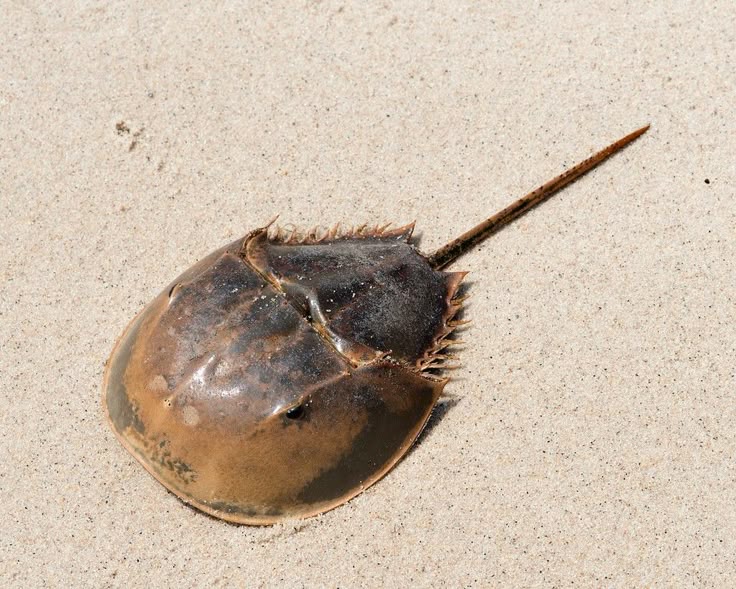
The Atlantic horseshoe crab is one of the strangest and most important animals in the sea, and almost nothing about it matches what its name suggests. It is not a crab. It is not a crustacean. It is not closely related to shrimp, lobsters, or blue crabs. Its closest living relatives are spiders, scorpions, ticks, and mites.
The body plan you see on the beach today has existed, largely unchanged, for roughly 450 million years - a stretch of time that predates dinosaurs, flowering plants, and the colonisation of dry land by most vertebrates. Limulus polyphemus is the only horseshoe crab species in the Americas and one of only four living species worldwide.
This guide covers the full biology, ecology, and biomedical significance of the Atlantic horseshoe crab: its taxonomy and evolutionary history, its anatomy of ten eyes and copper-based blue blood, its extraordinary spawning rituals on moonlit beaches, its central role in modern vaccine and medical device safety testing, and the conservation pressures that have turned a 450-million-year survivor into a Vulnerable species in a single human generation.
It is a reference entry, not a summary - so expect specifics: millimetres, millions of years, dollars per litre, population figures.
Etymology and Classification
The scientific name Limulus polyphemus was assigned by Carolus Linnaeus in 1758. Limulus is a Latin diminutive meaning "a little askance" or "slightly oblique", a reference to the animal's curious lateral eyes. Polyphemus is the one-eyed cyclops of Greek myth - a slightly misleading name, as researchers would later discover the animal actually has ten eyes, not one. Linnaeus likely chose the name based on the prominent pair of compound eyes visible on the upper shell.
The common English name is purely descriptive: the fused head-and-thorax of the animal, called the prosoma, forms a smooth curved dome that resembles a horse's shoe. In Japanese, the animal is known as kabutogani ("helmet crab"), and Chinese speakers call related species ma ti xie ("horseshoe crab"). No traditional name in any language captures how little the animal has in common with true crabs.
The taxonomy matters because it is so unusual:
- Kingdom: Animalia
- Phylum: Arthropoda
- Subphylum: Chelicerata - a group defined by the presence of chelicerae (pincer-like mouthparts) instead of antennae and mandibles. This is the same subphylum that contains spiders, scorpions, ticks, mites, and sea spiders.
- Class: Merostomata
- Order: Xiphosura ("sword-tail")
- Family: Limulidae
- Genus: Limulus
- Species: L. polyphemus
Only four horseshoe crab species are alive today. Limulus polyphemus ranges along the Atlantic coast of North America and the Gulf of Mexico. The three Asian species - Tachypleus tridentatus, Tachypleus gigas, and Carcinoscorpius rotundicauda - live in Southeast Asia, Japan, India, and neighbouring coastal waters. All four share the same basic body plan, fossil record, and reproductive biology.
A 450-Million-Year Fossil Record
Horseshoe crabs are the textbook example of a "living fossil". Their lineage appears in the fossil record during the Ordovician period, roughly 450 million years ago. A key specimen, Lunataspis aurora, was described in 2008 from 445-million-year-old rocks in Manitoba, Canada. Despite its age, Lunataspis shows the same three-part body plan - prosoma, opisthosoma, telson - that defines living horseshoe crabs today.
The fossil record of Xiphosura is remarkable for its stability. Horseshoe crabs survived:
- The Ordovician-Silurian extinction (~443 million years ago), which eliminated roughly 85 per cent of marine species.
- The Late Devonian extinction (~372 million years ago).
- The Permian-Triassic extinction (~252 million years ago), the most severe event in Earth's history, which killed an estimated 96 per cent of all marine species.
- The Triassic-Jurassic extinction (~201 million years ago).
- The Cretaceous-Paleogene extinction (~66 million years ago), which ended the non-avian dinosaurs.
No land vertebrate lineage alive today is remotely that old. The label "living fossil" is often criticised because organisms never truly stop evolving - horseshoe crabs have diversified and their internal biology has continued to change - but at the level of gross morphology, Limulus polyphemus would look almost at home in a Paleozoic sea.
The fossil stability of the lineage is thought to reflect both the structural success of the body plan and the relative stability of shallow coastal habitats across geological time. Horseshoe crabs occupy a niche - a slow, armoured, bottom-feeding arthropod in warm shallow seas - that has been continuously available for half a billion years.
Size and Anatomy
Adult Atlantic horseshoe crabs reach about 50 to 60 centimetres in total length, measured from the front of the prosoma to the tip of the telson. Females are consistently larger than males, often 25 to 30 per cent heavier, and range from 2 to 5 kilograms. Males typically weigh 1 to 2.5 kilograms.
The body is divided into three clearly visible sections:
- Prosoma - the large dome-shaped front section, roughly the shape of a horse's shoe, containing the brain, heart, most of the digestive tract, and the six pairs of walking legs.
- Opisthosoma - the abdomen, a flattened rear section bearing the book gills used for breathing. Spines along the outer margin protect the soft joint between the two sections.
- Telson - the long sword-like tail. Despite its appearance the telson is not used as a weapon. Its purpose is mechanical: it acts as a lever the animal uses to right itself when flipped upside down by waves.
| Body region | Function | Approximate length |
|---|---|---|
| Prosoma | Brain, heart, walking legs, eyes | 20-25 cm wide |
| Opisthosoma | Book gills, reproductive organs | 10-15 cm long |
| Telson (tail) | Righting lever, no sting | 15-20 cm long |
Horseshoe crabs breathe using book gills - stacks of flat leaf-like plates along the underside of the opisthosoma that resemble the pages of a book. These are one of the few invertebrate examples of gills that can function briefly in air. A horseshoe crab trapped on the beach can survive several hours out of water if the gills remain moist.
The mouth sits on the underside of the prosoma between the bases of the walking legs. There are no jaws in the vertebrate sense. Instead, the animal crushes food between hairy leg bases as it walks. This means a horseshoe crab must, in effect, walk in order to chew.
The Ten Eyes of Limulus
Horseshoe crabs have one of the most complex visual systems of any arthropod. A single animal has ten eyes and light-sensing organs distributed across the shell and tail:
- Two lateral compound eyes on the top of the prosoma, made up of roughly a thousand ommatidia each. These are the largest eyes and provide the animal's primary image-forming vision. They are particularly sensitive to circular polarised light.
- Two median eyes near the centre of the prosoma. These are sensitive to ultraviolet light, including the UV component of moonlight, and are thought to help synchronise spawning on lunar cycles.
- One endoparietal eye, set further forward on the midline.
- Two rudimentary lateral eyes near the median eyes, which may contribute to circadian rhythm regulation.
- Two ventral eyes near the mouth, facing downward to detect light from below.
- Photoreceptors along the telson - not proper eyes but light-sensing cells distributed along the tail that detect ambient light and contribute to day-night cycling of the animal's biology.
The compound eye of Limulus polyphemus became one of the most important model systems in the history of visual neuroscience. Starting in the 1930s, H. Keffer Hartline recorded the electrical activity of single photoreceptor cells, establishing how neurones respond to light and how lateral inhibition sharpens contrast. Hartline won the 1967 Nobel Prize in Physiology or Medicine for this work, which has been central to our understanding of vertebrate vision as well as invertebrate.
Copper-Based Blue Blood
The blood of a horseshoe crab is a striking pale blue. Unlike vertebrate blood, which uses iron-based haemoglobin to carry oxygen, horseshoe crab blood uses hemocyanin, a copper-based molecule. Hemocyanin is dissolved freely in the plasma rather than packaged inside cells. When exposed to oxygen, the copper-containing molecules turn blue, giving the blood its unmistakable colour.
But the commercially valuable feature of horseshoe crab blood is not hemocyanin. It is a population of immune cells called amebocytes, which circulate in the blood and respond to bacterial contamination by clotting almost instantly, even in the presence of vanishingly small amounts of bacterial endotoxin.
This clotting reaction is the basis of the Limulus Amebocyte Lysate (LAL) test, developed in the 1960s by Frederik Bang and Jack Levin. LAL is produced by lysing (breaking open) amebocytes and isolating the clotting proteins. A drop of LAL added to a fluid or surface will clot if even trace amounts of endotoxin are present. The test is the global standard for checking:
- Injectable pharmaceuticals
- Vaccines, including every modern COVID-19 vaccine produced
- Intravenous fluids
- Dialysis equipment
- Surgical implants
- Insulin, chemotherapy drugs, and virtually every parenteral medication
Processed LAL sells for roughly fifteen thousand US dollars per litre, making horseshoe crab blood among the most valuable biological fluids produced on Earth.
Biomedical Harvest and Welfare
Each year, between 400,000 and 600,000 Atlantic horseshoe crabs are captured during the spawning season along the US East Coast, transported to biomedical facilities, bled of approximately 30 per cent of their blood volume, and released back into the sea. Standard industry practice limits bleeding to once per animal per season and returns the crabs to the water within 72 hours.
| Harvest metric | Value |
|---|---|
| Crabs harvested per year (US) | 400,000-600,000 |
| Blood drawn per crab | Up to 30% of total blood volume |
| Market price of processed LAL | ~ 15,000 USD per litre |
| Estimated post-release mortality | 10-30% depending on study |
| Time from capture to release | 24-72 hours |
Industry figures historically cited 3 to 15 per cent mortality, but more recent peer-reviewed research - including work published in Biological Conservation - suggests the true figure may be higher, with lingering sub-lethal effects on behaviour and reproduction in surviving animals. Female crabs that have been bled have been shown to lay fewer eggs, move more slowly, and show altered activity patterns for extended periods.
Recombinant Factor C and the Synthetic Alternative
A synthetic alternative to LAL has existed for more than two decades. Recombinant Factor C (rFC) is the isolated endotoxin-detecting protein produced in the laboratory using recombinant DNA technology, without any animal sacrifice. It works on the same biochemical principle as the natural test but requires no horseshoe crabs at all.
The European Pharmacopoeia formally accepted rFC as equivalent to LAL in 2020. The US Pharmacopeia updated its standards in 2024 to allow rFC alongside LAL for routine testing. Several large pharmaceutical companies - Eli Lilly most notably - have converted large portions of their production lines to rFC.
Despite this, industry-wide adoption has been uneven. Reasons include the cost of revalidating existing production lines, regulatory familiarity with LAL, and the entrenched nature of the biomedical bleeding industry. Conservation groups have argued for faster transition, pointing to documented declines in both horseshoe crab populations and the dependent red knot shorebird.
Habitat and Range
The Atlantic horseshoe crab inhabits shallow coastal waters along the Atlantic coast of North America, from Maine and the Bay of Fundy south to the Yucatan Peninsula in Mexico. The species prefers:
- Sandy or muddy bottoms
- Depths from the intertidal zone down to about 30 metres
- Protected bays, estuaries, and sounds
- Water temperatures above approximately 10 degrees Celsius
Outside the spawning season the animals spend most of their time offshore, where they are difficult to study. Tagging data show individuals can move tens of kilometres along the coast between seasons, though many return to the same spawning beach year after year.
Delaware Bay, between New Jersey and Delaware, hosts the single largest known concentration of Atlantic horseshoe crabs on Earth. Other important aggregations occur along the Cape Cod area, the Chesapeake Bay, the Florida Keys, and the Yucatan coast.
Diet and Feeding
Horseshoe crabs are opportunistic omnivores. They feed by dragging their walking legs through bottom sediment, crushing prey between the hairy bases of the legs, and pushing the food forward into the mouth. Their diet includes:
- Marine worms (polychaetes)
- Clams and small bivalves
- Mussels
- Small crustaceans
- Algae and detritus
- Dead organic matter scavenged from the bottom
Horseshoe crabs swallow a great deal of sand and grit along with their food, which helps grind prey in the foregut. Young animals are especially active feeders; adults reduce feeding sharply during the spawning season and can fast for weeks while concentrated near spawning beaches.
Spawning and Reproduction
The spawning of Atlantic horseshoe crabs is one of the most dramatic synchronised reproductive events in the marine world. Each spring, particularly in May and June, hundreds of thousands of horseshoe crabs emerge from deeper water during the highest tides of the full and new moons and crawl up on to sandy beaches to lay their eggs.
Spawning is tightly keyed to:
- Water temperatures above roughly 15 degrees Celsius
- New moon and full moon high tides
- Calm weather and gentle surf
- Beaches with clean, well-oxygenated sand
Males arrive at the beach first, often in large numbers. When a female arrives, one or more males attach to her using specialised modified pincers at the front of the prosoma - a grip called the "amplexus clasp". The female drags her attached males up the wet sand to roughly the high-tide line, where she digs shallow nest pits with her rear legs. She lays roughly 4,000 pale greenish-blue eggs per nest.
The attached male - and often additional unattached "satellite" males crowded around the nest - release sperm over the eggs.
A single female can lay up to four million eggs over the course of a spawning season, distributed across dozens of nests over several successive tides. Only a vanishingly small fraction will survive to adulthood.
| Reproductive metric | Value |
|---|---|
| Age at sexual maturity | ~10 years (males), ~11 years (females) |
| Molts before maturity | ~16-17 |
| Eggs per nest | ~4,000 |
| Eggs per female per season | Up to ~4 million |
| Spawning peak | May-June, full and new moon tides |
| Incubation | 2-4 weeks |
The eggs incubate in the damp sand for two to four weeks. Larvae hatch as miniature tail-less versions of the adult and migrate to shallow tidal flats, where they spend their first year feeding and molting.
Red Knots and the Food Web
The spawning of horseshoe crabs on Delaware Bay coincides almost perfectly with the spring migration of long-distance shorebirds, most notably the red knot (Calidris canutus rufa). Red knots fly about 15,000 kilometres from wintering grounds in Tierra del Fuego at the southern tip of South America to breeding grounds in the Canadian Arctic. Delaware Bay is the critical refuelling stop on this journey, and the entire migration hinges on horseshoe crab eggs.
A red knot will roughly double its body weight in the ten to fourteen days it spends on the bay, eating almost exclusively horseshoe crab eggs dug from the sand by the waves and churned up by other spawning crabs. Without this food, the birds cannot reach the Arctic with the body reserves they need to breed.
When horseshoe crab populations on Delaware Bay fell sharply in the 1990s - driven by bait harvest for commercial eel and whelk fisheries - red knot numbers crashed in parallel. The rufa subspecies was listed as Threatened under the US Endangered Species Act in 2014. Quotas on horseshoe crab bait harvest are now explicitly tied to red knot survival, with Adaptive Resource Management models linking the two populations directly.
Other migratory shorebirds that depend on the Delaware Bay egg glut include ruddy turnstones, sanderlings, semipalmated sandpipers, and laughing gulls.
Growth, Molting, and Lifespan
Atlantic horseshoe crabs grow by molting - periodically shedding their rigid exoskeleton and emerging with a new, larger one. They are believed to molt around 16 or 17 times before reaching sexual maturity. After maturity they stop molting. Because there are no growth rings in a mature animal, exact ages in the wild are difficult to determine.
- Juveniles molt several times per year, outgrowing their shells rapidly.
- Young adults molt once per year.
- Mature adults do not molt at all.
Atlantic horseshoe crabs reach sexual maturity at roughly 10 years of age. Once mature, individuals are thought to live for approximately another decade, putting total wild lifespan at around 20 years. Some captive animals have been reported to live considerably longer.
Conservation Status and Threats
The IUCN Red List assesses Limulus polyphemus as Vulnerable with a decreasing population trend. In the United States, assessments by the Atlantic States Marine Fisheries Commission track regional subpopulations individually, with some showing stability and others in clear decline. The three Asian horseshoe crab species are generally in worse shape - Tachypleus tridentatus is classed as Endangered.
Primary threats to Atlantic horseshoe crabs include:
- Biomedical bleeding. Up to 600,000 animals per year are captured and bled, with measurable post-release mortality and sub-lethal effects on reproduction.
- Bait harvest. Horseshoe crabs have historically been used as bait for eel and whelk fisheries. Harvest levels peaked in the 1990s and caused population crashes; current levels are quota-regulated but still significant.
- Habitat loss. Coastal development, sea walls, beach armouring, and dredging reduce the suitable spawning beaches the species depends on.
- Sea level rise and storms. Climate-driven changes to Atlantic beach morphology are expected to reduce horseshoe crab spawning habitat.
- Pollution. Chemical contamination, plastic debris, and nutrient runoff all affect nearshore habitats where horseshoe crabs live and breed.
- Incidental capture. Trawl fisheries capture horseshoe crabs as bycatch, with significant mortality.
Management measures have been substantial but incomplete. The Atlantic States Marine Fisheries Commission sets coordinated quotas. Delaware and New Jersey have moratoria on commercial horseshoe crab harvest. Refuges and beach protections exist for spawning populations. The approval and gradual adoption of recombinant Factor C (rFC) offers the possibility of reducing biomedical demand without sacrificing human patient safety.
Horseshoe Crabs and Humans
Horseshoe crabs have been harvested by humans for thousands of years. Indigenous peoples of the Atlantic coast used them for fertiliser, bait, and food. Nineteenth and early twentieth century farmers on Delaware Bay ploughed tens of millions of horseshoe crabs into the soil as agricultural fertiliser, a practice that largely ended by the 1960s as populations declined and synthetic fertilisers became available.
The modern human relationship with horseshoe crabs is defined by biomedicine. The LAL test, invented in the 1960s and standardised in the 1970s, has saved an incalculable number of human lives by detecting bacterial endotoxin contamination in injectable drugs and medical devices. Virtually every vaccine ever administered to a human being - including every dose of every COVID-19 vaccine - has been tested at some point in its supply chain using LAL.
This creates one of the most complicated ethical situations in biomedical animal use. A 450-million-year-old lineage of harmless, slow, armoured arthropods has become indispensable to the safety of human medicine, and in the process has been pushed toward Vulnerable status. The availability of the synthetic alternative, rFC, makes the continuation of large-scale biomedical bleeding increasingly difficult to justify on either conservation or scientific grounds.
Related Reading
- Crustaceans: The Armored Wonders of the Ocean
- Coconut Crab: Largest Land Arthropod
- Mantis Shrimp: The Fastest Punch in Nature
- Pistol Shrimp: Loudest Animal in the Ocean
References
Relevant peer-reviewed and governmental sources consulted for this entry include the IUCN Red List assessment for Limulus polyphemus, the Atlantic States Marine Fisheries Commission stock assessments, US Fish and Wildlife Service red knot recovery documentation, and published research in Biological Conservation, Marine Ecology Progress Series, and Journal of Experimental Biology.
Data on horseshoe crab fossils including Lunataspis aurora reflect publications in Palaeontology and related journals. Figures on biomedical harvest and LAL pricing reflect reporting in the pharmaceutical and conservation press through 2024 and regulatory updates from the European Pharmacopoeia and US Pharmacopeia.
Frequently Asked Questions
Are horseshoe crabs actually crabs?
No. Despite the name, horseshoe crabs are not true crabs and are not even crustaceans. They belong to the subphylum Chelicerata, which makes their closest living relatives spiders, scorpions, ticks, and mites - not shrimp, lobsters, or blue crabs. True crabs are decapod crustaceans with antennae and mandibles; horseshoe crabs have neither.
They share the chelicerate body plan of a fused head-thorax (prosoma), a segmented abdomen (opisthosoma), and pincer-like feeding appendages called chelicerae. The order Xiphosura, to which Limulus polyphemus belongs, diverged from other chelicerates roughly 480 million years ago and has changed remarkably little since.
Why is horseshoe crab blood blue and so valuable?
Horseshoe crab blood is bright blue because it carries oxygen using hemocyanin, a copper-based molecule, instead of the iron-based hemoglobin found in vertebrates. More importantly, their blood contains amebocyte cells that clot instantly in the presence of bacterial endotoxins, even in vanishingly small amounts.
Biomedical companies harvest the blood and extract Limulus Amebocyte Lysate (LAL), which is used worldwide to test injectable drugs, vaccines, and medical implants for contamination. A single liter of processed LAL can sell for around fifteen thousand US dollars. Harvested crabs are bled of roughly thirty per cent of their blood volume and returned to the ocean, though mortality estimates after release range from ten to thirty per cent.
How many eyes does a horseshoe crab have?
A horseshoe crab has ten eyes, making it one of the most visually equipped arthropods alive. Two large lateral compound eyes on the upper shell detect images and movement and are especially sensitive to circular polarized light. Two median eyes near the centre of the shell detect ultraviolet light reflected from the moon, which researchers believe helps synchronize spawning. One endoparietal eye and a pair of rudimentary eyes sit further forward.
Two ventral eyes near the mouth detect light from below. Finally, clusters of photoreceptors along the telson (tail) allow the animal to gauge day-night cycles. The compound eyes of Limulus polyphemus are so large and accessible that they became the classical model for vertebrate and invertebrate vision research, leading to the 1967 Nobel Prize for H. Keffer Hartline.
How old is the horseshoe crab as a species?
The horseshoe crab lineage is approximately 450 million years old, dating to the Ordovician period. Fossil species from that era, such as Lunataspis aurora found in 445-million-year-old rocks in Manitoba, look strikingly similar to the modern Limulus polyphemus.
Horseshoe crabs predate dinosaurs by about 200 million years, predate flowering plants, and have survived four of the five major mass extinction events in Earth’s history, including the end-Permian extinction that wiped out more than ninety per cent of marine species.
Because their overall body plan has changed so little across that span, biologists often refer to them as living fossils - though the lineage has continued to evolve in subtle ways rather than remaining truly static.
Where and when do horseshoe crabs spawn?
Atlantic horseshoe crabs spawn along the Atlantic coast from Maine to the Yucatan Peninsula, with the largest known aggregation occurring on the beaches of Delaware Bay in the United States. Spawning peaks each spring during the highest tides of the full and new moons in May and June, when water temperatures climb above roughly 15 degrees Celsius. Males arrive first and clasp on to larger females with specialised modified pincers.
The female drags one or more males up the beach in the waves, digs shallow nests in wet sand, and lays up to four thousand pale green eggs per nest. A single female may lay several million eggs across multiple tides in a season. The synchronized lunar-tidal pattern is one of the most dramatic mass reproductive events in the marine world.
Why are horseshoe crab eggs important to birds?
The spring spawning of horseshoe crabs on Delaware Bay coincides almost exactly with the northbound migration of shorebirds, most famously the red knot (Calidris canutus rufa). Red knots fly roughly 15,000 kilometres from wintering grounds in Tierra del Fuego to breeding sites in the Canadian Arctic.
The Delaware Bay stopover is the critical refuelling point, and the birds double their body weight in about ten to fourteen days by eating nearly nothing but horseshoe crab eggs. When horseshoe crab populations fell in the 1990s due to bait harvest for commercial eel and whelk fisheries, red knot numbers crashed in parallel - the rufa subspecies was listed as Threatened under the US Endangered Species Act in 2014.
Ruddy turnstones, sanderlings, and semipalmated sandpipers also depend heavily on the egg glut.
Is there a synthetic alternative to horseshoe crab blood?
Yes. Recombinant Factor C, or rFC, is a laboratory-produced version of the specific protein in horseshoe crab blood that detects bacterial endotoxins. It was first developed in the 1990s and has been commercially available for more than a decade. In 2020 the European Pharmacopoeia formally accepted rFC as equivalent to the traditional LAL test. The US Pharmacopeia updated its standards in 2024 to more clearly permit its use.
Some large pharmaceutical companies including Eli Lilly have transitioned entire product lines to rFC. However, industry-wide adoption has been slow due to regulatory inertia, existing supply contracts, and validation costs, so millions of horseshoe crabs continue to be captured and bled each year.
Are horseshoe crabs endangered?
The Atlantic horseshoe crab (Limulus polyphemus) is listed as Vulnerable on the IUCN Red List with a decreasing trend, though in the United States its status is often cited as Near Threatened at the national level. The three Asian horseshoe crab species - Tachypleus tridentatus, Tachypleus gigas, and Carcinoscorpius rotundicauda - are in more critical condition, with T. tridentatus listed as Endangered.
Principal threats to all four species include biomedical bleeding, harvest as bait for eel and whelk fisheries, habitat loss from coastal development, loss of spawning beaches due to erosion and sea-wall construction, pollution, and increasing storm intensity from climate change. Population management is coordinated in the United States by the Atlantic States Marine Fisheries Commission, with harvest quotas explicitly linked to red knot survival.