
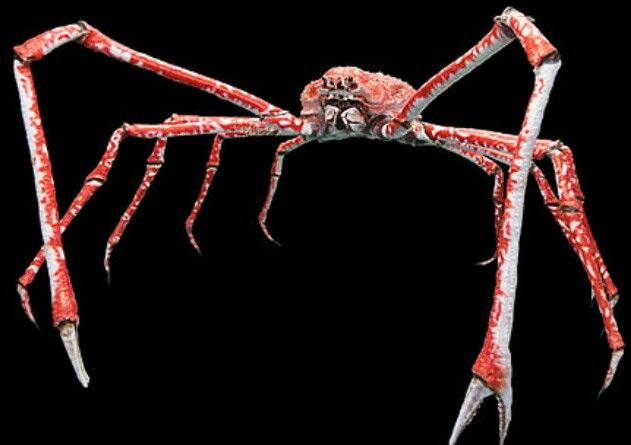
The Japanese spider crab is the largest arthropod alive today. No living insect, spider, lobster, or other crab matches its leg span, which routinely reaches four metres from claw tip to claw tip and which in the record specimen stretched to about five and a half metres. Yet the animal is not a monster.
Its body is modest - forty centimetres across the carapace, up to nineteen kilograms in mass - and most of the spectacular measurement is thin, jointed leg. Macrocheira kaempferi lives deep on the continental shelf and slope of the Pacific Ocean around Japan, walks slowly across rocky seafloors, eats carrion and shellfish, and may live more than a hundred years.
This guide covers every major aspect of Japanese spider crab biology and ecology: size and anatomy, the deep coastal Pacific habitat it prefers, feeding behaviour, the decorating camouflage that is one of the most sophisticated behaviours in any crustacean, reproduction and planktonic larvae, extreme longevity, and the fishery that threatens local populations. It is a reference entry, not a summary - so expect specifics: metres, kilograms, depths, temperatures, and verified records.
Etymology and Classification
The scientific name Macrocheira kaempferi combines Greek and Latin to describe the animal's most obvious feature and to honour its first European describer. Macrocheira means 'large-handed' or 'long-armed', referring to the enormous chelipeds.
The species epithet kaempferi honours Engelbert Kaempfer, the seventeenth-century German physician and naturalist whose observations in Japan introduced the animal to European science. The genus is monotypic, meaning M. kaempferi is the only living species in Macrocheira.
In Japanese the crab is called taka-ashi-gani, written with characters that literally mean 'tall-legged crab'. The name captures the proportions of the animal far better than the English common name, which borrows 'spider' because of the long, spindly appearance of the legs when the crab is seen from above.
Classification within the arthropods places M. kaempferi firmly in a familiar group:
- Kingdom: Animalia
- Phylum: Arthropoda
- Class: Malacostraca
- Order: Decapoda (ten-legged crustaceans)
- Family: Inachidae (majoid spider crabs)
- Genus: Macrocheira
- Species: M. kaempferi
The family Inachidae contains many spider crabs, most of them small, cryptic, and decorator-active species living in shallow water worldwide. Macrocheira is the outlier: far larger than any other member of the family, far deeper on average, and far more widely known to the public.
Size and Physical Description
The Japanese spider crab is best understood as a small body mounted on gigantic legs. Its sheer leg span is why the species dominates lists of record-sized arthropods.
Adult dimensions:
- Leg span (claw tip to claw tip): typically 3.7-4.0 metres; record 5.5 metres
- Carapace width (body only): up to 40 centimetres
- Total body weight: up to 19 kilograms
- Cheliped (front claw) length in males: often longer than the body and the walking legs combined
Males are consistently larger than females and have disproportionately long, heavy chelipeds used in combat and mating displays. Females have smaller claws and a broad, rounded abdomen that folds forward under the body to carry eggs.
The exoskeleton is hard, orange to brown in colour, and studded with blunt spines on the carapace and legs. The carapace is roughly pear-shaped, narrowing toward the front where a pair of rostral horns project between the eyes. Two compound eyes sit on short stalks and are flanked by small retractile horn-like protuberances. Ten legs extend from the thorax: the front pair ending in chelipeds and the remaining four pairs terminating in pointed walking tips.
The claws themselves are heavy, serrated, and powerful enough to shear through clam and snail shells. Despite this, the animal is not considered aggressive. It uses its claws to probe, pry, and manipulate food items rather than to strike or slash.
Where It Lives - The Deep Coastal Pacific
The Japanese spider crab is endemic to the Pacific Ocean around Japan, with most records concentrated along the southern and eastern coasts of Honshu.
Depth distribution:
- Total recorded range: approximately 50 to 600 metres
- Most typical depth: 150 to 300 metres
- Spring spawning depth: shallower, sometimes near 50 metres
Key regions:
- Suruga Bay
- Sagami Bay
- Waters off Kagoshima
- The waters south-east of Honshu more broadly
- Scattered records extending to Taiwan
The habitat is the continental shelf and upper continental slope: rocky and sandy seafloors with frequent crevices, boulders, hydrothermal chimneys, and submarine vents. Water temperatures at typical depths are cool - around 10 degrees Celsius - and the environment is stable, with little seasonal change compared with shallow coastal water. This stability is probably a major factor in the animal's extreme longevity.
The species does not migrate in the sense that whales or salmon do, but it does move vertically on a seasonal basis. Adults move toward shallower water in late winter and early spring for mating and egg-carrying, then return to deeper water during summer and autumn. This short seasonal shift is also the period during which Japanese spider crabs are most accessible to fishermen.
Diet and Feeding
Japanese spider crabs are opportunistic omnivores. They are not predators in the dramatic sense - their long, thin legs and slow gait are unsuited to pursuit - but they are effective foragers of a seafloor buffet.
Primary food sources:
- Shellfish: clams, mussels, and other bivalves, prised open with the chelipeds
- Carrion: dead fish, dead marine mammals, and organic debris that falls from the upper ocean
- Small invertebrates: sea stars, polychaete worms, small crustaceans
- Algae and kelp material when available at shallower depths
- Occasional living prey when it can be cornered in a crevice
Feeding behaviour:
The crab walks slowly across the seafloor, probing the substrate and crevices with its front legs and claws. When a potential food item is found, it manipulates it with the chelipeds, sometimes breaking shells against rocks or against the other claw.
Carrion is detected by scent over considerable distances - chemoreceptors on the antennae and walking legs allow the animal to track decaying matter even in slow currents. Feeding is unhurried. The animal's metabolism at ambient seafloor temperature is low, and it can go long periods without a meal.
The importance of carrion in the diet is probably underestimated. Observations from submersibles and baited deep-sea cameras show that Japanese spider crabs are rapid responders to large fallen carcasses, alongside deep-sea fish and amphipods. At shelf depth they occupy a scavenger niche similar to the one giant isopods fill in deeper water.
Decoration - Camouflage by Hand
One of the most fascinating behaviours in M. kaempferi is decoration. The crab actively attaches kelp, sponges, anemones, and other small seafloor organisms to the top of its carapace for camouflage. This is not passive fouling. The crab selects, plucks, shapes, and presses its decorations into place.
How decoration works:
- The crab inspects the surrounding seafloor and identifies a suitable organism - a sponge, a piece of kelp, a small anemone.
- It detaches the item with its chelipeds, sometimes chewing it briefly to trim the shape.
- It positions the item on the carapace, frequently on the spiny dorsal region.
- Hook-shaped hairs (setae) on the shell grip the decoration, holding it in place through movement and light currents.
- Living decorations such as anemones and sponges continue to grow while attached, becoming more effective over time.
The benefits are not purely visual. Sponges produce noxious chemicals that deter predators. Anemones add a stinging defence. Algae and kelp break up the crab's outline against a rocky background and make it harder for benthic fish and octopuses to identify as prey. Even where water is dim and vision limited, a sponge-covered crab smells less like a crab - chemical signals matter as much as visual ones in the deep.
Decoration persists through intermolt life. When a Japanese spider crab molts, it sheds its decorations with its old exoskeleton, then typically re-decorates the new one within days. The behaviour is not learned in any complex sense - it appears to be innate and is expressed even by lab-reared juveniles that have never seen an adult do it.
Life Cycle and Reproduction
Japanese spider crab reproduction follows a schedule tuned to spring productivity in coastal Japanese waters.
Mating:
Adults move into shallower water in late winter and early spring. Males compete for females using their long chelipeds in ritualised pushing and fencing displays. Serious injury is rare - the thin legs and claws risk breakage - but dominance is established clearly, and only larger males mate successfully. Mating itself is relatively brief, with the male transferring sperm packets to the female.
Egg carrying:
After fertilisation, the female carries the eggs externally, attached in a dense mass to swimmerets on the underside of her abdomen. Up to 1.5 million eggs can be held at once. She fans them regularly with the swimmerets to keep water flowing and to prevent suffocation or fungal infection. The egg mass is carried for roughly ten weeks, during which the female eats less and moves less than usual.
Larvae:
When the eggs hatch, they release minute, transparent larvae that bear no resemblance to the adult. The larvae drift in the plankton for approximately seventy days, passing through several zoeal stages and one megalopal stage. During this time they feed on even smaller plankton and are themselves food for fish, jellyfish, and filter-feeding invertebrates. Mortality is extreme.
Of the 1.5 million eggs released per female, only a tiny fraction - perhaps a few dozen, in good years - survive to settle on the seafloor. This is why the species produces such enormous egg clutches: it is a classic high-fecundity, high-mortality strategy.
Settlement and juvenile growth:
Surviving larvae settle onto the seafloor and molt into miniature crabs roughly a centimetre across. Early juveniles occupy shallower water than adults, gradually moving deeper as they grow. Growth is slow. Each molt involves a short burst in size followed by many months in the new shell. Full adult size is probably not reached for at least ten years, and some estimates suggest much longer.
Growth, Molting, and Extreme Longevity
Crabs, like all arthropods, grow by molting: they shed the old exoskeleton and emerge in a larger, soft new one that hardens over hours to days. The Japanese spider crab molts many times over its life, and each molt is a dangerous, energetically expensive event.
Molt mechanics:
- The old shell splits along a seam at the back of the carapace.
- The crab backs out of the old shell over roughly an hour, often in a protected crevice.
- The new shell is pale, soft, and stretchy; the crab pumps itself up with water to expand its volume before hardening.
- Hardening takes several days. During this period the animal is vulnerable and feeds little.
- The new shell is then re-decorated over subsequent days.
| Metric | Value |
|---|---|
| Leg span at birth (larva) | submillimetre |
| Leg span at settlement | approximately 1 cm |
| Leg span at maturity | approximately 1-2 m |
| Typical adult leg span | 3.7-4.0 m |
| Record leg span | approximately 5.5 m |
| Adult carapace width | up to 40 cm |
| Adult weight | up to 19 kg |
| Estimated lifespan | 100+ years |
Longevity estimates for Macrocheira kaempferi rely on growth models, molt frequency, and comparisons with other slow-growing cold-water decapods. A lifespan of a century or more is consistent with its deep, cool habitat, slow metabolism, and late maturity. If confirmed, it is among the longest-lived of all crustaceans and one of the longer-lived animals in general.
Precise ageing is difficult because the exoskeleton is shed at every molt and does not preserve the annular growth records available in bivalves or in fish otoliths.
Research History
Scientific attention to Japanese spider crabs began with European contact in Japan in the seventeenth and eighteenth centuries. Engelbert Kaempfer, the German physician whose name the species carries, brought back detailed accounts of Japanese natural history in the 1690s. Formal description under the current genus came in the nineteenth century.
Modern biological understanding of the species owes a large debt to Japanese marine researchers working through the twentieth century. The pioneering researcher Taku Akiyama conducted much of the foundational work on reproduction, larval development, and growth - including careful documentation of egg counts, larval duration, and molt patterns. His observations established the framework that later workers built on using submersibles, tagging studies, and genetic tools.
Public aquariums, particularly in Japan, have contributed enormously to what is known about the species by maintaining live adults long enough to observe feeding, decorating, and long-term behaviour under near-natural conditions. High-resolution camera work at depth over the past three decades has added ecological context, showing the animals in situ on the Japanese shelf and slope.
Fisheries and Human Use
The Japanese spider crab is harvested commercially in Japan as a delicacy. The meat is sweet and considered comparable to that of king crab, and the animal's sheer size makes individual specimens valuable at market.
Fishery methods:
- Trawling on shelf and slope grounds
- Tangle nets set across the seafloor
- Crab pots baited with fish
- Opportunistic catch in mixed-species fisheries
Fishery pressure:
Harvest intensity increased through the twentieth century as Japanese deep-water fisheries expanded. Catches are concentrated during the spring spawning period, when adults move into shallower, more accessible water. This is also when egg-carrying females are most exposed, which raises obvious sustainability concerns. Modern Japanese regulations now impose seasonal closures to protect spawning aggregations, and landings have declined from mid-century peaks.
The species is also a significant aquarium animal. Public aquariums in Japan, Europe, North America, and elsewhere display Japanese spider crabs as flagship deep-sea exhibits. Aquarium life for the species appears to be sustainable over years when temperature, water quality, and feeding are managed, although long-term captive breeding at scale remains difficult.
Conservation Status
The IUCN Red List has not formally assessed Macrocheira kaempferi, which means the species currently has no official global conservation category. The absence of assessment does not mean the species is secure. Local Japanese fisheries data indicate multi-decade declines in commercial catch, consistent with population-level decline, and the crab's slow growth, late maturity, and concentration during spawning leave it vulnerable to overexploitation.
Principal threats:
- Fishing pressure, particularly during spring spawning when adults concentrate in shallower water.
- Habitat disturbance from bottom trawling on the continental shelf and upper slope.
- Bycatch in mixed-species fisheries.
- Warming coastal waters that may alter timing of spawning or shift suitable depth ranges.
- Pollution of Japanese coastal waters, including chemical contaminants and plastics that can enter the benthic food chain.
Management measures are currently local rather than international. Seasonal closures during spawning, gear restrictions in certain bays, and fishery quotas form the main tools. A formal IUCN assessment would help clarify status and focus conservation planning.
Japanese Spider Crabs and Humans
Cultural attention to the Japanese spider crab is strongest along the coast of Honshu, where the animal has been known, fished, and eaten for centuries. Local culinary traditions treat it as a seasonal delicacy, particularly in regions adjacent to Suruga Bay and Sagami Bay. Fresh specimens are occasionally displayed whole in markets - an impressive visual feature in their own right.
International cultural presence is largely driven by aquarium exhibits and natural history documentaries. The combination of enormous leg span, spindly proportions, slow movement, and deep-sea habitat gives the species an almost alien appearance that translates well to film. Despite this slightly menacing image, divers and aquarists who work with the animals describe them as gentle, deliberate, and curious rather than aggressive.
Safety considerations are real but limited. The chelipeds can close with enough force to bruise a finger and to break small bones in handling accidents, so professional care is taken with nets and holding tanks. The long, thin walking legs are fragile and can break if the animal is handled roughly, which is another reason aquarium staff use deliberate, slow techniques.
Related Reading
References
Relevant peer-reviewed and governmental sources consulted for this entry include Japanese Fisheries Agency landings data, published research on decapod longevity in Journal of Crustacean Biology and Marine Biology, submersible observation logs from JAMSTEC, and the foundational reproductive work established by Taku Akiyama and subsequent Japanese researchers.
Size records rely on verified specimens documented by public aquariums and fisheries monitoring. Depth and distribution data reflect contemporary survey work along the Japanese continental shelf and slope.
Frequently Asked Questions
How big is the Japanese spider crab?
Adult Japanese spider crabs (Macrocheira kaempferi) routinely reach a leg span of 3.7-4 m from claw tip to claw tip, with the largest verified specimen measuring around 5.5 m across. The body itself, however, is much smaller - the carapace is only about 40 cm wide and the whole animal weighs up to 19 kg. Most of that length is leg.
By leg span, no other arthropod alive or in the fossil record clearly exceeds it, which is why the species is routinely called the largest arthropod on Earth. Males are generally larger than females and have longer, more robust chelipeds (front claws).
Where do Japanese spider crabs live?
The species is endemic to the Pacific Ocean around Japan. Most records come from the continental shelf and upper slope off the southern coast of Honshu, particularly Suruga Bay, Sagami Bay, and the waters off Kagoshima, with additional populations reaching as far as the waters of Taiwan. Typical depth is 150-300 m, but the crabs have been recorded from about 50 m down to 600 m.
They prefer rocky and sandy seafloors with crevices, holes, and vents to shelter in, and they tend to move into slightly shallower water during the spring spawning season.
What do Japanese spider crabs eat?
Japanese spider crabs are opportunistic omnivores rather than active hunters. Their diet includes shellfish such as clams and mussels, which they pry open with their chelipeds, along with small invertebrates, algae, and - critically - carrion. Dead fish, dead marine mammals, and organic debris that sinks from the upper ocean are important food sources.
Their long legs and slow gait are better suited to methodically walking the seafloor and probing crevices than to pursuit, so the animal works more like a benthic scavenger than a predator. In captivity they readily take squid, shrimp, and fish.
Why do Japanese spider crabs decorate their shells?
The crab actively attaches kelp, sponges, anemones, and other small organisms to the top of its carapace as camouflage. This decorating behaviour is not unique to the species - many spider crabs do it - but the Japanese spider crab is the largest animal that engages in it. Sponges and algae blend the crab into the rocky, encrusted seafloor, breaking up its outline from predators such as large octopuses and benthic fish.
Anemones add a chemical defence: their stinging cells deter attackers. The crab selects material, trims it with its claws, and presses it onto tiny hook-shaped hairs (setae) on the carapace that hold the decoration in place even through movement.
How long do Japanese spider crabs live?
Estimates put the lifespan of Macrocheira kaempferi at 100 years or more, which would make it among the longest-lived crustaceans known. Precise ageing is difficult in crabs because their exoskeleton is shed during each molt and does not preserve growth records the way fish otoliths or bivalve shells do. Longevity estimates come from growth rates, molt frequency, and comparisons with other large, cold-water decapods.
A century-scale lifespan is consistent with their slow growth, late maturity, and deep, cold habitat, which all tend to extend life in ectotherms.
How do Japanese spider crabs reproduce?
Mating occurs primarily in the early spring, when adults move into slightly shallower water. After fertilisation, a female carries up to 1.5 million eggs attached to the underside of her abdomen for roughly ten weeks, fanning them with her swimmerets to keep them oxygenated.
When the eggs hatch, the larvae are minute, transparent, and drift in the plankton for around 70 days, passing through several zoeal and megalopal stages before settling onto the seafloor as miniature crabs. Mortality during the planktonic phase is extreme - nearly all larvae are eaten by fish or fail to find suitable habitat - which is why the crab produces such enormous egg numbers.
Are Japanese spider crabs endangered?
The Japanese spider crab has not been formally evaluated by the IUCN Red List, so there is no official global conservation status. Local fisheries data from Japan, however, indicate that populations have declined over recent decades due to heavy harvesting for the seafood market. The species is considered a delicacy, particularly in coastal regions of Honshu, and adult crabs are taken by trawl, pot, and tangle net.
Japanese fisheries now impose seasonal closures during the spring spawning period, when the animals concentrate in shallower water and are most vulnerable. Aquarium breeding programmes exist but have not produced enough animals to offset commercial pressure.
Are Japanese spider crabs dangerous to humans?
Despite their intimidating appearance, Japanese spider crabs are generally considered gentle and slow-moving. Their chelipeds are long and powerful enough to deliver a painful pinch, and divers are advised to keep fingers clear, but the animals do not pursue humans and show no defensive aggression comparable to that of, say, a large octopus or moray eel.
Most recorded injuries come from fishermen handling freshly captured specimens in nets or on deck, where the long, thin legs can thrash and the claws can close on exposed skin. Aquariums routinely keep the species in mixed-species tanks without incident.