
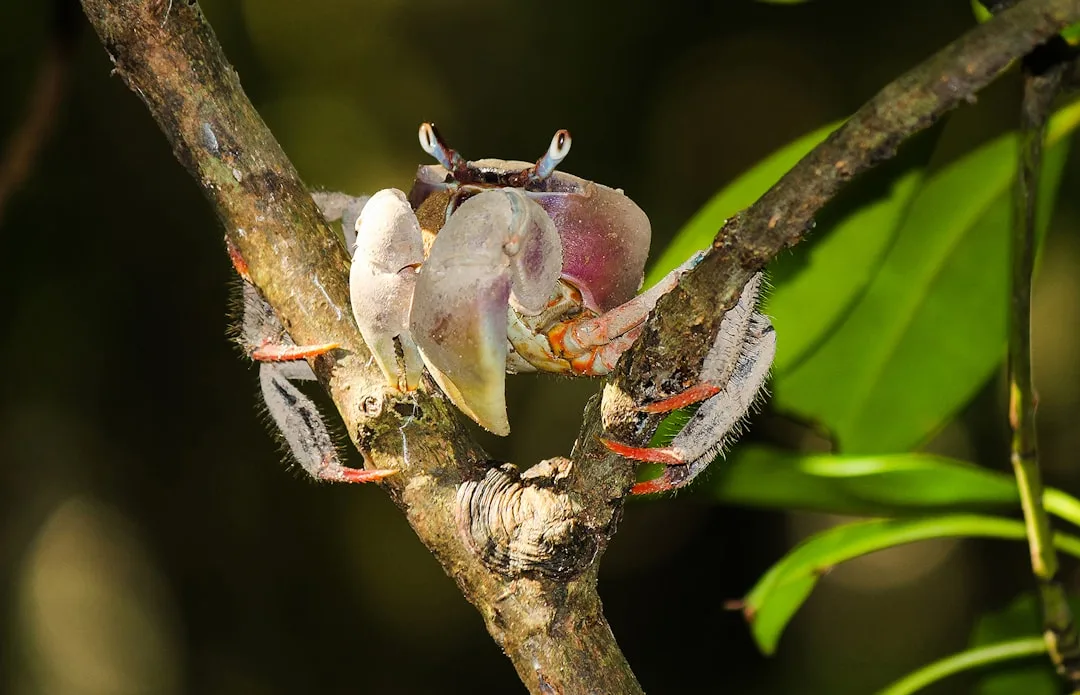
The coconut crab is the largest terrestrial arthropod alive on Earth today. A fully grown Birgus latro can span a metre from claw tip to claw tip, weigh four kilograms, crush a ripe coconut with a single pinch, climb vertical palm trees, live for more than sixty years, and drown in the ocean its ancestors came from. Everything about this animal is extreme, and everything about it is a paradox.
It is a hermit crab that lost its shell, a sea creature that cannot swim, a vegetarian-leaning omnivore that will scavenge bone and cannibalise its own kin, and a slow, lumbering land-dweller that nevertheless holds the record for the strongest pinching force ever measured in the animal kingdom.
This guide covers the full biology and ecology of the coconut crab: taxonomy, anatomy, sensory systems, the legendary claw, diet and feeding behaviour, tree-climbing, life cycle, island distribution, conservation status, and the strange cultural stories that have gathered around this species over the centuries. It is a reference entry, not a summary, so expect specifics - newtons, metres, decades, and islands by name.
Etymology and Classification
The scientific name Birgus latro combines a Greek-derived genus name with a Latin species epithet meaning 'robber', a direct reference to the crab's well-documented habit of dragging off cooking pots, shiny metal utensils, and any other portable objects from human camps.
The English common name reflects its ability to husk and crack coconuts - a feat few other animals can match - while regional names across the Indo-Pacific emphasise different aspects of the crab: robber crab in English-speaking Pacific communities, palm thief in parts of Polynesia, kaveu in the Cook Islands, ayuyu in the Mariana Islands, and unga in Samoa.
The coconut crab's taxonomic position is more interesting than it first appears. The species belongs to the family Coenobitidae, which otherwise contains the land hermit crabs - small animals that carry borrowed snail shells to protect their soft abdomens. Birgus latro descends from a hermit crab ancestor and its juveniles briefly use borrowed shells, but the adult has lost this behaviour entirely.
In its place the coconut crab evolved a calcified, hardened abdomen that provides structural protection without requiring an external shell. This evolutionary move allowed the animal to grow far larger than any shell-bearing hermit crab could manage, because it is no longer limited by the size of available gastropod shells.
Genetic analysis places Birgus as the sister genus to Coenobita, the land hermit crabs. The lineage diverged tens of millions of years ago and today contains a single surviving species, making the coconut crab a true evolutionary one-off.
Size and Physical Description
Coconut crabs are built on a grand scale relative to any other land-dwelling invertebrate. A mature individual carries ten legs arranged in the standard decapod pattern: two large front claws (chelipeds), three pairs of walking legs used for locomotion, and a final small pair hidden near the rear of the body that the crab uses to groom the lung chamber.
Adult dimensions:
- Leg span (tip to tip): up to 1 metre
- Body length (carapace plus abdomen): up to 40 cm
- Carapace width: up to 20 cm
- Weight: typically 2-3 kg, maximum approximately 4 kg
- Front claw length: up to 15 cm on large males
Colouration:
Colour varies widely between populations and can shift with age and moult. Common morphs include deep blue, purple-black, orange-red, and rust-brown. Island populations often share a predominant colour phase - for example, the blue form dominates on many central Pacific atolls while the red-orange form is more common in the western Indian Ocean. The chelipeds are usually darker and more heavily calcified than the rest of the body.
The body is covered by a thick exoskeleton that must be shed to allow growth. Unlike most crustaceans, the coconut crab reabsorbs calcium from its old exoskeleton before moulting, then eats the discarded cuticle after moulting to recover the remaining minerals. This closes a nutrient cycle that would otherwise waste a significant mineral investment.
Anatomy and Physiology of a Land Animal
The coconut crab's most unusual anatomical feature is its respiratory system. The species is fully terrestrial as an adult and cannot survive long immersion in water, yet its lineage is marine. Evolution solved this problem by rebuilding the original branchial chamber into a functional lung.
Inside the carapace, the coconut crab carries a paired organ called the branchiostegal lung. The walls of this chamber are covered in spongy, highly vascularised tissue that functions much like the lung of a land vertebrate. Oxygen diffuses directly from the air into blood flowing through fine vessels in the tissue. A small pair of modified rear legs grooms this chamber to keep it clean and moist. The original gills have been reduced and can no longer support the animal in water.
Because the branchiostegal lung must remain moist for gas exchange, the crab cannot tolerate dry heat. It retreats to humid burrows or rock crevices during the hottest hours of the day, emerges at night when humidity rises, and is often found near freshwater seeps or coastal vegetation that traps dew. Conversely, full submersion is lethal within roughly an hour for a large adult because the lung cavity floods and cannot be cleared.
Other key physiological features include:
- Osmoregulation: the coconut crab drinks both fresh water and seawater and can process either. It uses seawater to recover salts and fresh water during moulting and egg production.
- Nitrogen excretion: unlike marine crustaceans that simply release ammonia into the sea, the coconut crab excretes uric acid, a trick shared with birds and reptiles that allows efficient water conservation.
- Cold tolerance: limited. The species is confined to tropical latitudes and does poorly below about 20 degrees Celsius.
The Strongest Claw Ever Measured
The most famous biomechanical feature of the coconut crab is the sheer force of its pinch. A 2016 study published in PLOS ONE used custom force sensors to measure claw strength across twenty-nine wild coconut crabs caught on Okinawa, Japan. The strongest individual produced a pinch of approximately 3,300 newtons.
Scaled to body mass, this figure is the highest pinching force ever recorded in any animal, comparable to the bite of a lion and several times stronger than the grip of an adult human using both hands.
Comparative force figures:
| Animal | Approximate bite or pinch force |
|---|---|
| Human bite | 700-900 N |
| Rottweiler dog bite | 1,500 N |
| Lion bite | 4,000 N |
| Coconut crab pinch | up to 3,300 N |
| Mantis shrimp strike | 1,500 N (peak, brief impact) |
The front claws are asymmetric: one is usually larger and heavier, used for cracking and crushing, while the smaller claw performs finer manipulation. The larger claw can belong to either side depending on the individual and is usually the dominant weapon against rival crabs. A coconut crab defending a food source or a burrow will often raise the major claw in warning and, if pressed, deliver a pinch powerful enough to remove a human fingertip.
The biomechanics behind this force come from a long internal lever arm, dense skeletal muscle packing the cheliped, and a tightly calcified exoskeleton that distributes load. The evolutionary driver is almost certainly coconut husking - the mature fruit of Cocos nucifera is defended by a tough fibrous husk that few other animals can defeat.
Diet and Feeding Behaviour
Despite the name, coconuts are not the only food item in the coconut crab's diet. The species is an opportunistic omnivore that will eat almost anything organic it can locate.
Regular food sources:
- Coconuts (both fallen and canopy-harvested)
- Pandanus fruit
- Figs, breadfruit, and other tropical fruit
- Carrion - fish, seabirds, rodents
- Smaller land crabs and hermit crabs
- Turtle hatchlings
- Seabird eggs and chicks
- Rats and mice
- Other coconut crabs (especially freshly moulted individuals)
- Their own discarded exoskeletons after moulting
Coconut crabs locate food primarily by smell. Their sensory antennae are dense with chemoreceptor neurons that function much like the olfactory system of an insect, a rare convergence between the crustacean and insect lineages. Experimental work has shown that the crab can orient to the scent of rotting meat, ripe fruit, or freshly cracked coconut from hundreds of metres downwind.
The coconut-cracking sequence:
- Strip the outer husk fibres one at a time using the smaller claw, usually starting at one of the three pores where the eyes of the coconut are thinnest.
- Jam the tip of a walking leg into a pore to weaken the shell.
- Strike the shell repeatedly with the major claw until it splits.
- Extract the flesh and drink the water.
This process can take hours or, on unhusked green coconuts, days. Younger or less experienced crabs often give up partway through, which is one reason adults are sometimes observed feeding at coconuts that a rival started. A faster alternative is tree-dropping: some individuals climb the palm, dislodge a fruit, drop it to the rocks below, and descend to collect the pre-broken prize.
Tree-Climbing and Terrestrial Agility
Coconut crabs are among the very few large arthropods that routinely climb vertical trunks. Mature individuals scale coconut palms and pandanus trees more than ten metres above the ground, hooking the sharp tips of their walking legs into the bark. On particularly tall, smooth palms a climb may take half an hour or more, and the descent is usually a half-controlled fall rather than a careful reverse.
Tree-climbing serves several functions:
- Accessing ripe coconuts and other fruit in the canopy
- Escape from larger rival crabs on the ground
- Avoiding temporary surface hazards such as storm surge or flooding
On the ground the coconut crab is slow but methodical. It uses a walking gait similar to a land hermit crab, with four of the six walking legs on the ground at any moment and the two front claws held forward or slightly elevated. Top speeds are modest - a metre or two per second at a brief sprint - but the animal can sustain a steady walking pace for hours across rough terrain.
Burrows are dug under rocks, between tree roots, or in loose volcanic soil, and a single individual may maintain several burrows within its home range.
Life Cycle and Reproduction
The coconut crab has one foot firmly in the sea even though the adult cannot survive there. Reproduction begins on land but the entire larval phase plays out in open ocean water.
Mating: Adults pair briefly on land, usually between May and September depending on latitude. Mating is rapid. Males may travel several kilometres to locate receptive females.
Egg carrying: A gravid female carries tens of thousands of fertilised eggs glued to the underside of her abdomen for several weeks. The eggs darken as they develop.
Release: When the eggs are ready to hatch, the female migrates to the shoreline, usually on a high tide during a dark phase of the moon, and releases the eggs directly into breaking surf. Females that misjudge and wade too deep can drown. The synchronised release across many females produces a brief larval pulse that probably swamps offshore predators.
Larval stages: The free-swimming zoea larvae drift in surface waters for three to five weeks, passing through four or five moults. They feed on plankton and are entirely marine.
Glaucothoe stage: After the zoea stages, larvae transform into a settling stage called the glaucothoe, which returns to shore and seeks out an empty gastropod shell for protection. At this point the juvenile coconut crab is functionally a small hermit crab.
Juvenile hermit phase: For the first year or two of terrestrial life, young coconut crabs live in borrowed shells. Some use empty coconut halves or split bamboo as substitute shelters when gastropod shells are scarce.
Adult transition: After the crab outgrows the largest available shells, it sheds the hermit lifestyle entirely. The abdomen calcifies and hardens, the posterior curl characteristic of hermit crabs straightens, and the animal adopts its final adult body plan.
Sexual maturity arrives at approximately five years. Growth continues through successive moults for decades. Reliable maximum age is uncertain because moult rings do not persist on arthropod exoskeletons and mark-recapture studies are rare, but credible wild lifespans span 40 to 60 years, and some remote-island individuals may live longer.
Distribution Across the Indo-Pacific
The coconut crab occupies a broad but fragmented range across tropical islands between roughly 30 degrees north and 30 degrees south. The species is almost never found on large continental landmasses, partly because of habitat preferences and partly because of hunting pressure wherever dense human populations exist.
Approximate regional distribution:
| Region | Representative island groups |
|---|---|
| Western Indian Ocean | Zanzibar, Aldabra, Seychelles, Chagos |
| Eastern Indian Ocean | Christmas Island, Cocos (Keeling) Islands |
| Southeast Asia | Parts of Indonesia and the Philippines |
| Micronesia | Mariana Islands, Marshall Islands, Caroline Islands |
| Melanesia | Solomon Islands, Vanuatu, parts of Papua New Guinea |
| Polynesia | Cook Islands, Tuamotu, Gambier, Pitcairn |
The largest surviving populations are on islands without significant human settlement or with strong hunting regulations. Christmas Island in the eastern Indian Ocean is among the most studied and most densely populated coconut crab habitats on Earth, with estimates of several hundred thousand adults across its small land area. At the other extreme, many once-productive islands in Southeast Asia and the South Pacific now support only remnant populations or have lost the species entirely.
Conservation Status and Threats
The IUCN Red List classifies Birgus latro as Vulnerable with a decreasing population trend, following a 2018 reassessment. The primary pressures on the species include:
- Hunting for food. Coconut crab meat is considered a delicacy across much of the range and commands premium prices in local markets and tourist restaurants. Large individuals are preferentially targeted, which removes the most reproductively valuable part of the population.
- Slow life history. Late maturity, infrequent moulting, low per-female reproductive output after hatching mortality, and high larval predation make the species intrinsically vulnerable to overharvest.
- Introduced predators. Rats, feral pigs, cats, and Indian mongooses prey heavily on juvenile crabs during the vulnerable post-settlement phase.
- Habitat loss. Coastal development, resort construction, and palm-plantation clearance remove burrow habitat and shoreline larval-release corridors.
- Light pollution. Electric lighting along shorelines disorients gravid females trying to time their spawning migrations, leading to failed releases or mortality.
- Vehicle strikes. On islands with road networks crossing migration paths, adult crabs suffer significant road mortality during spawning seasons.
Several countries have introduced minimum legal size limits, closed seasons, or export bans. Christmas Island, Guam, and the Mariana Islands have some of the strongest local protections. Enforcement is difficult on remote atolls and illegal harvest persists wherever monitoring is thin.
Coconut Crabs and Humans
Human relationships with the coconut crab span the gulf from reverence to exploitation. In many Pacific island cultures the crab is a traditional food reserved for ceremonial occasions and constrained by customary harvest rules. Elsewhere it is an unregulated bushmeat. The species' remarkable size, strength, and longevity make it a focus of folklore, tourism, and occasional sensational stories.
One of the more famous speculations involves the 1937 disappearance of aviator Amelia Earhart. A persistent hypothesis places her final landing at Nikumaroro, an uninhabited atoll in the central Pacific. Researchers who have visited the atoll describe large coconut crab populations that readily scavenge any carrion.
If Earhart did reach Nikumaroro alive and later died there, coconut crabs would almost certainly have dispersed her remains, a theory sometimes used to explain the fragmentary bone evidence recovered from the island. The connection is speculative rather than proven, but it has embedded the coconut crab in one of the twentieth century's great unsolved mysteries.
Documented attacks on living humans are extremely rare but not unheard of. Handlers who mishandle a large coconut crab risk severe pinch injuries, and there are accounts of crabs pinching hard enough to break small bones in fingers. The species is not aggressive by default - most encounters end with the crab retreating into cover.
Related Reading
- Crustaceans: The Armoured Wonders of the Ocean
- Mantis Shrimp: The Fastest Punch in the Sea
- Pistol Shrimp: The Loudest Animal on Earth
- Mantis Shrimp
References
Information in this entry draws on IUCN Red List assessments for Birgus latro (2018), peer-reviewed studies including Oka, Tomita and Miyamoto (2016) on pinching force published in PLOS ONE, ecological surveys from Christmas Island National Park, research programmes in Okinawa and the Cook Islands, and decades of published work on Coenobitidae biology in journals such as the Journal of Crustacean Biology and Zoological Science.
Population estimates and range descriptions reflect the most recent consolidated assessments available through the coconut crab specialist community.
Frequently Asked Questions
How big are coconut crabs?
The coconut crab (Birgus latro) is the largest terrestrial arthropod alive today. Fully grown adults reach a leg span of approximately one metre from claw tip to claw tip, a body length of up to 40 centimetres, and a body mass of up to four kilograms. Most mature individuals weigh between two and three kilograms, with the largest specimens historically recorded from remote islands where hunting pressure is low. Males grow larger than females on average.
Growth is slow - a coconut crab reaches sexual maturity around five years of age and continues to grow incrementally for decades after that.
How strong is a coconut crab's claw?
A 2016 study published in PLOS ONE measured the pinching force of coconut crab claws and found values reaching 3,300 newtons in the largest individuals. That is the strongest pinching force ever measured in any animal. For context, the force is in the same range as the bite of a lion and significantly exceeds the grip force a human adult can generate with both hands. The claw force scales with body mass, so larger crabs pinch harder.
The front claws are asymmetric: one is usually larger and is used for cracking hard objects like coconuts, bones, and tough fruit, while the smaller claw handles finer manipulation.
Why do coconut crabs drown in water?
Adult coconut crabs are obligate air-breathers. Although the species evolved from marine hermit crabs and retains larval stages that develop in seawater, the adult respiratory system is built around a modified branchiostegal lung - a cavity lined with spongy, vascularised tissue that functions much like a terrestrial lung. The original gills have been reduced and can no longer extract enough oxygen from water to keep a large, active animal alive.
If a coconut crab is held underwater for more than roughly an hour, the lung cavity floods and the animal suffocates. Paradoxically, it also cannot let the lung dry out, so the crab must seek humid burrows during the hottest hours of the day.
Where do coconut crabs live?
Coconut crabs are distributed across tropical islands of the Indo-Pacific, from the western Indian Ocean (Zanzibar, Aldabra) through Southeast Asia, Australasia, and Polynesia as far east as the Gambier Islands and Pitcairn. The total range includes an estimated 1,500 islands, although populations on large inhabited landmasses have been severely reduced by hunting.
The crabs favour coastal forest with loose soil for burrowing, rocky outcrops, and coconut palm groves. They require proximity to the sea because female crabs must return to the shoreline annually to release larvae, but they cannot tolerate persistent immersion and avoid beaches during daylight.
What do coconut crabs eat?
Coconut crabs are opportunistic omnivores with an exceptionally broad diet. Their best-known food source is the coconut - adults can crack green coconuts using their massive front claws after stripping off the husk with their secondary claws, a process that can take hours or days.
They also eat other fruit (pandanus, figs, fallen tropical fruit), carrion from fish and seabirds, turtle hatchlings, smaller crabs, rats, seabird eggs, and the moulted exoskeletons of other coconut crabs to recycle calcium. Cannibalism of smaller or freshly moulted individuals is documented. Their sense of smell is highly developed and they can locate carrion from hundreds of metres downwind.
Can coconut crabs really climb trees?
Yes. Coconut crabs are among the very few large arthropods that routinely climb vertical trunks. They ascend coconut palms and other tropical trees, sometimes more than ten metres above the ground, using the hooked tips of their walking legs to grip bark. There are two main motivations: accessing ripe coconuts and other fruit in the canopy, and escape from rivals or threats on the ground.
Crabs have been observed intentionally dropping coconuts from height to break them open on the rocks below - an efficient shortcut around the laborious husking process - although whether this is deliberate problem-solving or accidental behaviour remains debated among researchers.
How long do coconut crabs live?
Coconut crabs are extremely long-lived for an arthropod. Under good conditions in the wild they reach at least 40 to 60 years of age, and some researchers suspect that the largest individuals on lightly hunted islands may exceed these figures. Growth is slow throughout life because, like all arthropods, the animal must moult its exoskeleton to grow, and large coconut crabs moult only once every year or two.
Moulting is extremely dangerous: the freshly moulted crab is soft and vulnerable for several weeks and usually retreats into a sealed burrow during this period. Sexual maturity arrives at about five years and adult size is reached only after decades.
Are coconut crabs endangered?
The IUCN Red List classifies Birgus latro as Vulnerable with a decreasing population trend. The primary threat is hunting for food - coconut crabs are considered a delicacy across much of their range and their slow growth and low reproductive output make populations easy to overharvest.
Habitat loss from coastal development, introduced predators (rats, feral pigs, mongooses) that prey on juveniles, and light pollution that disorients ocean-bound females also contribute to declines. Several countries have imposed minimum size limits, seasonal closures, or outright hunting bans, but enforcement on remote islands is difficult and illegal harvest for local and tourist consumption remains widespread.