
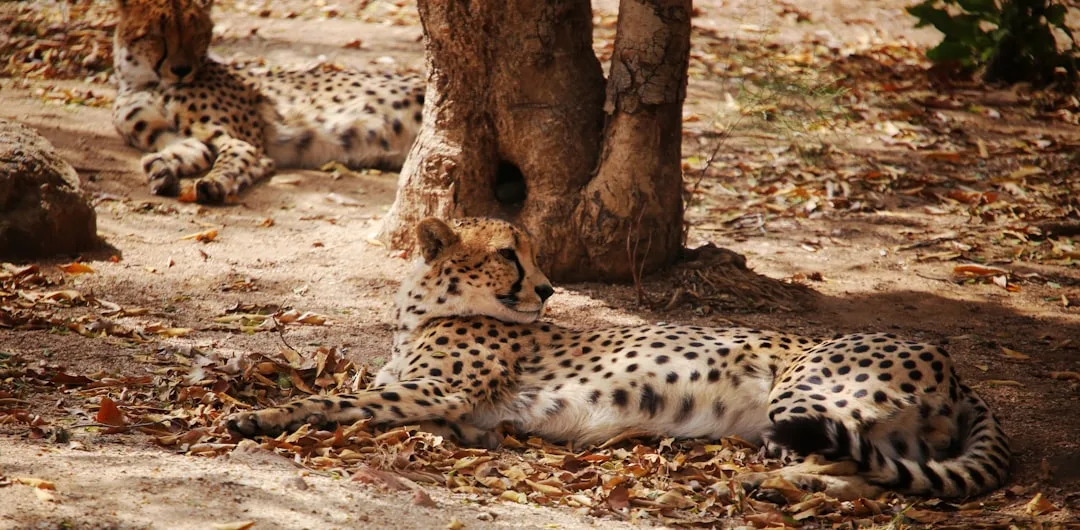
The cheetah is the fastest land animal alive and the most anatomically distinct member of the cat family. Every structure in its body - from the flexible spine to the enlarged nasal passages, from the semi-retractable claws to the rudder-like tail - has been tuned by evolution for one specific job: catch small to medium antelopes in a short, explosive chase across open country.
Acinonyx jubatus is not just a big cat that happens to run fast. It is a specialist sprinter that gave up almost every other felid trait to do so.
This guide covers every major aspect of cheetah biology and ecology: sprint mechanics, hunting, diet, social life, reproduction, the genetic bottleneck that still shapes the species today, conservation status, and the relationship between cheetahs and humans. It is a reference entry, not a summary - so expect specifics: kilograms, kilometres, populations, verified records, and the odd anatomical detail that separates the cheetah from every other cat on Earth.
Etymology and Classification
The genus name Acinonyx comes from Greek roots meaning 'without-move claw', a reference to the cheetah's semi-retractable claws that stay exposed even when the cat is walking. The species name jubatus is Latin for 'maned' or 'crested', describing the mantle of long fur that young cubs wear along the back and shoulders. The English word 'cheetah' comes from the Hindi chita, which in turn derives from the Sanskrit chitraka meaning 'speckled' or 'spotted one'.
The cheetah sits alone in the genus Acinonyx within the cat family Felidae. Molecular studies place it closest to the puma (Puma concolor) and the jaguarundi (Herpailurus yagouaroundi) in the Puma lineage, not among the big cats of the Panthera lineage despite its size. The cheetah branched off from its common ancestor with pumas roughly 6.7 million years ago.
Four subspecies are currently recognised:
- Acinonyx jubatus jubatus - southern Africa, the most numerous population
- Acinonyx jubatus fearsoni - east Africa, formerly A. j. raineyi
- Acinonyx jubatus hecki - northwest Africa, critically endangered
- Acinonyx jubatus venaticus - Asiatic cheetah, surviving only in Iran
A fossil lineage once referred to as the 'giant cheetah' (Acinonyx pardinensis) roamed Eurasia during the Pleistocene at roughly twice the mass of the modern species.
Size and Physical Description
Cheetahs are the slimmest and most elongated of the large cats. Size differences between males and females are modest compared with lions or tigers.
Males:
- Body length: 1.1-1.5 metres
- Tail length: 60-80 centimetres
- Shoulder height: 70-90 centimetres
- Weight: typically 29-72 kg, most adults 45-55 kg
Females:
- Body length: 1.1-1.4 metres
- Weight: typically 21-55 kg, most adults 35-45 kg
- Generally around 10-15% lighter than males at the same age
Cubs at birth:
- Length: roughly 30 centimetres
- Weight: 250-425 grams
- Eyes closed, fur marked with a silvery-grey mantle that fades by three months
The cheetah's body is a study in sprint specialisation. The skull is small and domed, reducing wind resistance and housing enlarged nasal passages that allow heavy oxygen intake during a chase. The chest is deep, the waist narrow, and the hips almost aerofoil-lean. The heart is oversized relative to body mass and can beat up to 250 times per minute during sprint exertion. The lungs, liver, and adrenal glands are all proportionally larger than in any other cat.
The legs are long, the tibia and fibula elongated, and the shoulder blade loosely attached - essentially floating on muscle rather than locked to the ribcage - which gives each forward stride extra reach. The spine is extraordinarily flexible, extending and compressing like a drawn bow with every bound. At top speed a cheetah covers seven to eight metres per stride and spends more time airborne between paw contacts than on the ground.
The claws are semi-retractable. In every other cat species alive today, claws retract fully inside a protective sheath; in the cheetah, the claws stay partially exposed at all times. This costs the cheetah sharpness (cheetah claws are blunter than leopard claws) but gives the animal grip on loose soil and short grass, functioning like the spikes on a sprinter's running shoes.
The dewclaw on the inside of each forepaw remains fully curved and sharp, and is the tool a cheetah uses to hook a fleeing antelope's hindquarters during the final moments of a chase.
The famous black tear marks run from the inside corner of each eye down to the outside of the mouth. Biologists believe they reduce glare from strong sunlight and focus the cheetah's gaze on distant prey, similar in function to the eye-black worn by outfielders in baseball.
Built for the Sprint
The cheetah is the only land mammal that can exceed 100 km/h. The previous paragraph is not hyperbole; it is the upper boundary of vertebrate land locomotion.
Sprint data:
| Metric | Value |
|---|---|
| Typical hunting top speed | 93-98 km/h |
| Peak recorded burst | ~120 km/h (trained captive individuals) |
| Acceleration 0-100 km/h | Under 3 seconds |
| Stride length at full speed | 7-8 metres |
| Stride rate at full speed | ~3.5 strides per second |
| Typical sprint duration | 20-60 seconds |
| Distance of a typical chase | 200-300 metres |
| Post-sprint recovery time | 15-30 minutes |
Every one of those numbers comes at a cost. The cheetah's specialisations for speed trade off against almost every other trait valued in a cat. Its jaws are weaker, its canines shorter, its claws blunter, and its build lighter than those of a leopard of the same length. It cannot climb trees well. It cannot fight a hyena. It cannot defend a kill against a pair of lionesses. It cannot even hold its top speed for more than about a minute before internal heat forces it to stop.
Body temperature is the hard constraint. A sprinting cheetah's core temperature rises rapidly from around 38 degrees Celsius at rest to over 40 degrees during a chase, and heat dissipation lags well behind heat generation. The cheetah has no time to pant effectively while running at full stretch, so the heat builds up until metabolism forces a halt.
Once a cheetah stops, it needs 15 to 30 minutes of panting, head-down, to shed enough heat before it can eat. During that window rival predators often find the kill and take it.
Hunting and Diet
Cheetahs are obligate carnivores that specialise in small to medium-sized ungulates. Across most of the African range the primary prey weighs between 20 and 60 kilograms, which matches a solitary cheetah's ability to take down and eat quickly without sustained combat.
Primary prey:
- Thomson's gazelle (Eudorcas thomsonii) - keystone prey in east Africa
- Grant's gazelle (Nanger granti)
- Impala (Aepyceros melampus) - dominant prey in southern Africa
- Springbok (Antidorcas marsupialis) - key prey in the Kalahari and Namibia
- Young wildebeest and hartebeest
Secondary prey:
- Hares, young warthog, guineafowl, bustards
- Adult wildebeest and kudu (coalitions only)
- Ostrich (coalitions only)
- Newborn livestock in human-edge landscapes
Hunting technique. A typical hunt has three phases. In the stalk, the cheetah uses ant mounds, scrub, or simple distance masking to close to within 60-70 metres of the target. Cheetahs do not rush. A stalk can last 30 minutes of patient slow walking with pauses. In the sprint, the cheetah accelerates to full speed over two to three seconds and covers 100-300 metres in a tight arc behind the prey.
In the trip-and-bite phase, it uses the curved dewclaw to hook the prey's rump or flank, knocks the animal off balance, and delivers a suffocating bite to the throat. The killing bite can take 5 to 25 minutes to complete, during which the cheetah is itself vulnerable to larger predators.
Success rates are comparatively high by big cat standards. Published field studies place cheetah hunt success between 25% and 50%, considerably higher than lion or leopard averages. The cheetah compensates for loss rate with speed of hunting rather than force of killing.
Kleptoparasitism. Losing kills to larger predators is one of the largest drains on cheetah fitness. In the Serengeti roughly 10-15% of cheetah kills are stolen outright by lions, spotted hyenas, or leopards. Vultures also draw competitors in from a distance. A cheetah eats as fast as it can - up to 14 kg of meat in a single meal - and rarely defends or returns to a carcass.
Life Cycle and Reproduction
Cheetah reproduction does not follow a fixed season in most of the range. Females come into oestrus every few weeks through the year, with mating opportunities keyed to male coalition movements and prey availability.
Reproductive timeline:
- Oestrus: ~3 days, roughly every 12 days if not pregnant
- Gestation: 90-95 days
- Litter size: 3-5 cubs typically, up to 8 recorded
- Cub independence: 17-24 months
- Female first breeding age: 20-24 months
- Male first breeding age: ~36 months
Cubs are born in dense cover - tall grass, thicket, rocky outcrops - and the mother moves them to a new hiding spot every few days to reduce the scent trail for predators. Cubs are born with a long silvery-grey mantle of hair down the back and shoulders.
Biologists disagree on the exact function, but the dominant interpretation is that the mantle mimics the colouring of the honey badger, a small but famously aggressive predator that most carnivores avoid. The mantle fades gradually from about three months onward.
Cub mortality is brutal. In the Serengeti Cheetah Project's long-term dataset, only about 5% of cubs survive to independence in some cohorts, with lions responsible for the majority of deaths. Outside the Serengeti, where lion density is lower, cub survival rises substantially - some Namibian populations report 30-40% survival to independence.
Mothers teach hunting through direct practice. Once cubs are four to six months old, a mother will bring back live prey - most often a young Thomson's gazelle - and release it in front of the cubs. The cubs chase, miss, learn, and slowly refine the final suffocating bite over months. A female cheetah with cubs spends roughly twice as much time hunting as a solitary female, both because cubs need more food and because training sessions fail often.
Social Life and Coalitions
Cheetah social structure is unlike that of any other cat. Females are solitary and territorial over large, overlapping home ranges, often covering several hundred square kilometres. Males, by contrast, frequently form stable multi-year coalitions.
Coalition facts:
- About 30-40% of adult males live in coalitions
- Coalitions almost always form among littermate brothers
- A few coalitions include one unrelated bonded male
- Coalition sizes are usually two or three, rarely four
- Coalitions defend smaller, higher-quality territories
- Coalition males have substantially higher lifetime reproductive success than solitary males
The evolutionary logic of cheetah coalitions is straightforward once you understand the threat environment. A pair of brothers can hold a prime riverine territory against intruders, secure more mating opportunities, and bring down larger prey. A solo male gets displaced quickly, roams over huge distances, and often starves or is killed by rivals. Coalition brothers groom each other, rest in contact, and mount coordinated hunts on adult wildebeest or even ostrich.
Females do not form coalitions. A female's strategy is to hold a large home range that overlaps the territories of several coalitions, maximise prey access, and avoid both male cheetahs outside oestrus and all other predators year-round.
Range, Habitat, and the Iranian Population
Cheetahs have lost more than 90% of their historical range. Once spread across most of Africa, the Arabian peninsula, the Middle East, Central Asia, and into India, they now occupy fragmented patches of sub-Saharan Africa and a single relict area in Iran.
Contemporary distribution:
| Region | Approximate share | Key strongholds |
|---|---|---|
| Southern Africa | ~50% | Namibia, Botswana, South Africa, Zimbabwe |
| East Africa | ~35% | Kenya, Tanzania, northern Mozambique |
| West/Central Africa | ~10% | Chad, Niger, small fragments in the Sahel |
| Northwest Africa | < 5% | Algeria, Mali - A. j. hecki, critically endangered |
| Iran (Asiatic subspecies) | ~0.2% | Kavir, Turan, Miandasht protected areas |
The Asiatic cheetah (A. j. venaticus) is the most endangered large mammal in Iran. The most recent consolidated camera-trap surveys put the wild population at roughly twelve adults spread across a harsh, arid central plateau. Road kills along highways bisecting protected areas, low prey density, and inbreeding depression all threaten the population. A conservation breeding programme in Iran has produced a handful of cubs but no released individuals as of the latest reporting.
Reintroduction of cheetahs to India began in 2022 with southern African founder animals released in Kuno National Park. The programme has drawn both scientific criticism - the introduced cats are genetically distinct from the extinct Asiatic lineage - and cautious support for restoring a lost ecological role.
Conservation Status and Threats
The IUCN Red List classifies cheetahs globally as Vulnerable with a decreasing population trend. The Asiatic and northwest African subspecies are classified as Critically Endangered. Total wild adult population stands at roughly 7,100 individuals, with an additional 2,000 or so sub-adults and cubs.
Primary threats:
- Habitat loss and fragmentation. Cheetahs need large, connected home ranges and cannot live in small reserves safely because most small reserves also hold high-density lion populations that kill their cubs. Most of the remaining cheetah population lives outside formally protected areas, on mixed-use rangelands shared with livestock and people.
- Conflict with farmers. Cheetahs occasionally take livestock, especially calves and young goats. Retaliatory killing, poisoning, and trapping remain significant sources of mortality across the range. Livestock guardian dog programmes (notably the Anatolian Shepherd project run by the Cheetah Conservation Fund in Namibia) have measurably reduced conflict.
- Illegal cub trafficking. Cubs are illegally smuggled from the Horn of Africa to the Gulf states for the exotic pet trade. Estimates suggest hundreds of cubs enter the trade each year, and cub mortality during smuggling may exceed 75%.
- Bushmeat snaring. Indiscriminate snares set for antelopes kill cheetahs as bycatch across central and east Africa.
- Prey depletion. Where human hunting reduces gazelle and impala numbers, cheetahs cannot compensate by switching prey the way leopards do.
- Genetic limitations. The Pleistocene bottleneck continues to affect cheetahs today through reduced sperm quality, high cub mortality from congenital defects, and vulnerability to disease outbreaks.
Conservation responses include transboundary protected area networks (the Kavango-Zambezi Transfrontier Conservation Area is the single largest), livestock guardian dog programmes, community-based rangeland conservancies in Namibia and Kenya, and cross-border law enforcement against cub smuggling routes. International trade is restricted under CITES Appendix I.
The Genetic Bottleneck
Cheetahs have less genetic diversity than any other large mammal studied in comparable detail. Skin grafts exchanged between unrelated cheetahs - a standard immunology test - are accepted without rejection, meaning the immune system of one cheetah cannot reliably tell another cheetah's tissue apart from its own. Lab mice bred specifically for genetic uniformity over decades of captive breeding show more diversity than wild cheetahs.
The cause is a severe population bottleneck around 10,000 years ago at the end of the last Ice Age. For reasons still debated, the global cheetah population crashed to a handful of individuals. Every cheetah alive today descends from that tiny founder group. Subsequent population expansion was not enough to rebuild diversity because genetic variation is lost fast and rebuilt slowly.
The practical consequences:
- Sperm quality in wild and captive males is unusually poor, with high proportions of malformed sperm
- Cub mortality from congenital defects is higher than in other big cats
- Disease outbreaks (notably feline infectious peritonitis in captive populations) can sweep through unusually fast
- The species is vulnerable to a single emerging pathogen in a way that more genetically diverse cats are not
Despite all of this, cheetahs continued to live, hunt, and reproduce across Africa for 10,000 years after the bottleneck. Low genetic diversity is a long-term risk factor rather than an immediate extinction driver.
Cheetahs and Humans
The cheetah has the longest documented relationship with humans of any big cat. Ancient Egyptian tomb paintings from the Fifth Dynasty (c. 2500 BCE) show cheetahs on leashes. Mughal emperor Akbar reportedly kept a thousand cheetahs for hunting in the 16th century and trained them to run down blackbuck and gazelle on command.
The cheetah is the only large cat that can be trained to hunt cooperatively with people, partly because the species is comparatively non-aggressive toward humans and partly because its natural prey drive focuses narrowly on small ungulates rather than on anything that moves.
Unlike leopards and lions, cheetahs are not considered dangerous to people. No verified fatal attack on a human by a wild cheetah has been documented in modern times. Captive cheetahs occasionally injure handlers, usually during defensive reactions, but the species simply does not view humans as prey.
Tourism generates meaningful revenue for cheetah conservation in Namibia, South Africa, Kenya, and Tanzania, supporting ranger salaries, livestock guardian dog programmes, and community conservancies. Some private farmland in Namibia now holds higher cheetah density than neighbouring national parks because lion density is lower and therefore cub mortality is lower.
Related Reading
- Cheetah: Fastest Land Animal
- Lion: King of the Savanna
- Leopard: Silent Stalker
- Big Cats of the World
References
Relevant peer-reviewed and governmental sources consulted for this entry include IUCN Cat Specialist Group status reports (2023, 2024), the Cheetah Conservation Fund annual population assessments, Range Wide Conservation Program for Cheetah and African Wild Dog (RWCP) regional strategies, and published research in Biological Conservation, Journal of Zoology, PeerJ, and PLoS ONE.
Iranian population figures follow the Iranian Department of Environment and the Conservation of Asiatic Cheetah Project's most recent camera-trap census. Sprint biomechanics figures are drawn from published telemetry studies of wild cheetahs in Botswana (Wilson et al.) and captive trials at the Cincinnati Zoo.
Frequently Asked Questions
How fast is a cheetah really?
Wild cheetahs (Acinonyx jubatus) have been measured in the field at 93-98 km/h, with peak bursts from trained captive individuals recorded at 120 km/h over short stretches. The cat accelerates from a standstill to 100 km/h in under three seconds - comparable to a high-performance sports car.
Top speed is only sustainable for 20-60 seconds before overheating forces the animal to stop, which is why most successful hunts involve a stalk within 60-70 metres of the prey before the sprint begins.
Where do cheetahs live?
Roughly 90% of the global cheetah population lives in sub-Saharan Africa, with strongholds in Namibia, Botswana, South Africa, Kenya, Tanzania, and a trans-boundary population across the Kgalagadi. Smaller, fragmented groups persist in Zimbabwe, Zambia, and parts of the Sahel.
A critically endangered Asiatic subspecies hangs on in the arid mountains and salt flats of central Iran, where only around twelve adults were confirmed in the most recent camera-trap surveys. Cheetahs favour open savanna, semi-arid grassland, and open woodland where line-of-sight and running space matter more than dense cover.
What do cheetahs eat?
Cheetahs are obligate carnivores specialising in small to medium-sized ungulates. Thomson’s gazelle, Grant’s gazelle, impala, springbok, and young wildebeest make up the bulk of the diet across most of the range. Solitary females and single males typically target 20-60 kg prey, while male coalitions of two or three brothers can bring down larger animals such as adult wildebeest, kudu, or ostrich.
A cheetah eats quickly after a kill because it almost always loses carcasses to lions, leopards, hyenas, or vultures - roughly 10-15% of kills are stolen outright.
Why can't cheetahs roar?
The roaring big cats - lions, tigers, leopards, jaguars - share a specialised voice box with an elongated, elastic hyoid apparatus that allows low-frequency sound production. Cheetahs lack this structure and instead have a rigid hyoid similar to that of domestic cats. As a result, their vocal range sits in higher frequencies: chirps, yips, churrs, stutter-barks, and purrs.
The contact chirp used between mothers and cubs is loud enough to carry more than a kilometre across open country. Cheetahs are one of the few cat species that can purr continuously on both inhale and exhale.
How long do cheetahs live?
Wild cheetahs typically live 10-12 years. Females often outlive males because males face higher mortality from territorial fights and from lion predation. Cubs have extremely high mortality: in the Serengeti, studies have recorded cub survival to independence as low as 5% in some years, with lions accounting for most losses. Captive cheetahs in good zoo care can reach 17-20 years, but captive lifespans do not reflect wild ecology.
Females begin breeding at 20-24 months, males at around three years, and a wild female that reaches adulthood may raise two or three successful litters across her life.
Are cheetahs endangered?
The IUCN lists cheetahs as Vulnerable globally, with the Asiatic subspecies (Acinonyx jubatus venaticus) listed as Critically Endangered and the northwest African subspecies (A. j. hecki) listed as Critically Endangered. Total wild population stands at roughly 7,100 mature adults and is decreasing.
Primary threats include habitat loss and fragmentation, conflict with livestock farmers, illegal cub trafficking for the exotic pet trade in the Gulf states, bushmeat snaring, and reduced prey availability. Cheetahs have disappeared from more than 90% of their historical range.
What is the cheetah genetic bottleneck?
Around 10,000 years ago, at the end of the last Ice Age, the cheetah population crashed to a handful of individuals. Every cheetah alive today descends from that tiny founder group. The result is an almost unprecedented lack of genetic diversity: cheetahs from opposite ends of Africa are genetically more similar to each other than laboratory mice bred for twenty generations.
Skin grafts exchanged between unrelated cheetahs are accepted without rejection, demonstrating how little genetic variation exists across the species. The bottleneck leaves cheetahs vulnerable to disease outbreaks, reduces sperm quality, and raises cub mortality from congenital defects.
Do cheetahs hunt in groups?
Females hunt alone except when teaching cubs, which she does for 15-18 months. Males often form coalitions - stable groups of two or three, usually littermate brothers, occasionally unrelated bonded males - that stay together for life. Coalitions defend larger territories, hold prime habitat longer, mate with more females, and can take down prey well beyond the reach of a single cheetah, including adult wildebeest and ostrich.
About 30-40% of all male cheetahs live in coalitions. Solo males hold smaller ranges and are more often displaced or killed by coalitions.