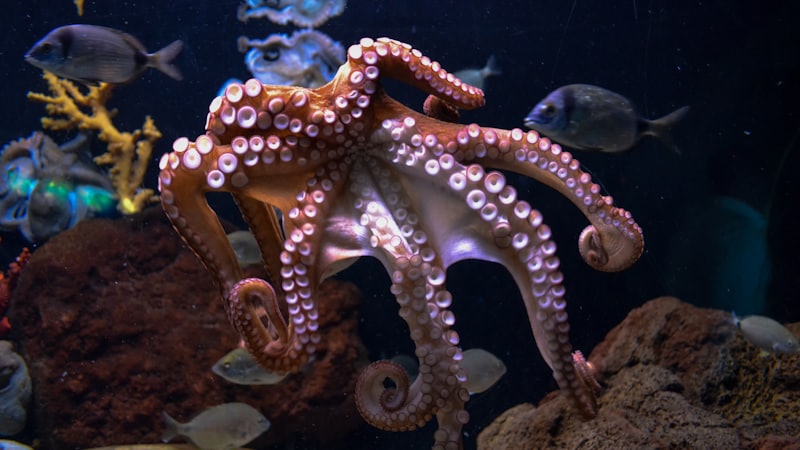
Octopus: Three Hearts, Nine Brains, Blue Blood
The Most Alien Biology on Earth
If you wanted to design an alien, you could do worse than start with an octopus. Three hearts. Nine brains. Blue blood. Skin that sees color. Eight arms that think for themselves. A body with no bones that can squeeze through any hole bigger than its beak. An intelligence as sophisticated as a crow or a dog, evolved along a branch of the tree of life so different from our own that it is almost impossible to imagine what it is like to be one.
The octopus is the closest thing to an extraterrestrial intelligence we will ever find on this planet. Everything about it is strange, and almost all of it is true.
Three Hearts: The Oxygen Delivery Problem
Octopuses have three hearts.
Two of these, called branchial hearts, sit at the base of the gills. Their job is to pump blood through the gill tissue, where oxygen from seawater diffuses into the bloodstream.
The third, the systemic heart, is the central pump that pushes oxygenated blood from the gills out through the rest of the body. This is functionally equivalent to a vertebrate heart, but smaller and weaker.
Why three hearts instead of one?
Octopus blood is inefficient at carrying oxygen. The molecule they use -- hemocyanin -- binds less oxygen per volume than the hemoglobin found in vertebrates. To keep an active, fast-moving animal's tissues supplied, the octopus needs extra pumping capacity. Dedicating two small hearts to the gills accelerates oxygen uptake, and the systemic heart distributes the resulting high-oxygen blood.
There is a strange trade-off in this design. When an octopus swims by jetting water through its siphon, its systemic heart actually stops beating. Swimming is metabolically expensive for octopuses and hard on their circulatory system, which is why octopuses almost always prefer crawling over swimming when they can. A long swim exhausts them because the heart pauses during it.
Nine Brains: Distributed Intelligence
Octopuses have one central brain between the eyes, arranged around the esophagus in a donut shape. It contains about 180 million neurons -- roughly the same as a dog or a cat.
Each of the eight arms contains its own smaller brain, called a ganglion, with approximately 40 million neurons. Together, the eight arm-brains contain over 320 million neurons -- almost twice as many as the central brain.
Total neuron count: around 500 million. For comparison:
| Species | Total Neurons |
|---|---|
| Human | 86 billion |
| Dog | 530 million |
| Octopus | 500 million |
| Cat | 250 million |
| Frog | 16 million |
| Ant | 250,000 |
The octopus puts more neurons in its arms than in its head. This is not a design error -- it is a different strategy for processing the world.
What Each Arm Can Do
Each octopus arm operates with significant autonomy. Experiments at the Hebrew University of Jerusalem and elsewhere have shown that arms can:
- Reach for objects independently when presented with food on the opposite side of a glass barrier. The arm finds its own path around the obstacle.
- Continue reacting after severance. A severed octopus arm will continue to reach, grip, and respond to stimuli for up to an hour. If food is placed near it, the arm tries to pass the food toward where the mouth would be.
- Distinguish chemical information through receptors on the suckers. Each sucker has taste receptors that let the arm "taste" what it is touching without the central brain being involved.
- Coordinate with neighboring arms without central brain input. Arms can hand objects off to each other, grip cooperatively, and solve simple problems as a team.
The central brain primarily issues general commands -- "reach toward that object," "grip that food," "propel away from that threat." The arms handle the detailed motor control and sensory processing locally.
This distribution has a practical evolutionary reason. The octopus body is so flexible that tracking every joint position of every arm from a central brain would require enormous computing resources. Offloading motor control to the arms frees the central brain to focus on strategy, learning, and decision-making.
Blue Blood: Copper Instead of Iron
Human blood is red because hemoglobin, the oxygen-transport molecule in our red blood cells, contains iron. Iron-oxygen complexes absorb blue and green light and reflect red, giving our blood its characteristic color.
Octopus blood is blue because it uses a different oxygen-transport molecule called hemocyanin, which contains copper instead of iron. Copper-oxygen complexes absorb red and yellow light and reflect blue.
Hemocyanin has several interesting properties:
It works better in cold water. Hemocyanin binds and releases oxygen efficiently at temperatures where hemoglobin becomes sluggish. Most cephalopods live in cold deep water or polar seas, and hemocyanin gives them an advantage in those environments.
It works better in low-oxygen environments. The deep ocean often has low dissolved oxygen levels. Hemocyanin efficiently extracts oxygen at these concentrations.
It is much larger than hemoglobin. A single hemocyanin molecule is approximately 3,000 times larger than a single hemoglobin molecule. Hemocyanin floats freely in the blood plasma rather than being packaged inside red blood cells.
The larger molecule size is one reason octopus blood circulation requires three hearts. Pushing all those enormous molecules through narrow blood vessels takes more force than pushing smaller hemoglobin-filled blood cells.
Skin That Sees Color
Here is where octopus biology becomes almost unbelievable.
Octopuses are color-blind in their eyes. Their retinas contain only one type of photoreceptor, which means they cannot distinguish colors the way humans do.
Despite this, octopuses are the most color-accurate camouflage experts in the animal kingdom. They match their background color precisely, switching between patterns in fractions of a second. They blend with coral, sand, rock, and even brightly colored tropical fish while remaining invisible.
How do they match colors they cannot see?
Research by the Hanlon Lab at Woods Hole Oceanographic Institution suggests octopus skin is photoreceptive. Their skin contains opsin proteins -- the same light-sensitive proteins found in eyes -- distributed throughout the body. These skin-based photoreceptors may allow octopuses to detect the color of their surroundings directly through their skin, bypassing their color-blind eyes entirely.
If confirmed, this would make octopuses the only animals known to see with their skin. They would experience visual information through their entire body surface, not just through their eyes.
Shape-Shifting and Squeezing
Octopuses have no bones. The only rigid structure in the entire body is the beak, a parrot-like mouth piece made of chitin.
This bonelessness has consequences most vertebrates cannot imagine:
Octopuses can squeeze through any hole larger than their beak. A Giant Pacific Octopus weighing 30 kg can pass through a hole 7 cm wide -- the diameter of its beak.
Octopuses can change body shape radically. They can flatten themselves to slip under rocks, compress into narrow crevices, or expand to look larger.
Octopuses can mimic other animals. The mimic octopus (Thaumoctopus mimicus) of Indonesia can impersonate over 15 different species, including flounders, lionfish, sea snakes, and jellyfish. It changes shape, posture, skin texture, and color to match each mimicked species.
The cost of bonelessness is that octopuses cannot move quickly on land. They need buoyancy to support their body weight, so a stranded octopus quickly loses the ability to breathe or move effectively.
Problem-Solving and Tool Use
Octopuses are the only invertebrates scientifically documented to use tools.
Coconut shell shelters. Veined octopuses (Amphioctopus marginatus) in Indonesia collect discarded coconut shells, stack them, and carry them around the ocean floor. When threatened, the octopus climbs inside the stacked shells and closes them up. The octopus is not simply using a found object -- it is collecting, transporting, and assembling multiple objects for future defensive use. This is tool use by any reasonable definition.
Jar-opening. Octopuses in aquariums routinely unscrew jars with their suckers to retrieve food inside. They can solve jars with multiple rotating lids, childproof caps, and latches. Octopuses have been recorded opening jars both from the outside (to get in) and from the inside (to escape).
Escape artistry. Octopuses are the most notorious escape artists of any marine animal. At the New Zealand National Aquarium, Inky the octopus escaped his tank in 2016 by climbing out at night, crawling across the floor, and sliding down a drainpipe back to the ocean. At the Santa Monica Pier Aquarium, octopus Ink escaped and flooded the entire facility by turning on a valve. These are not instinctive behaviors -- they represent problem-solving in novel situations.
Recognizing individual humans. Octopuses can distinguish between individual people and treat them differently. At the Seattle Aquarium, researchers documented octopuses that consistently squirted water at specific staff members they disliked while ignoring others.
The Short Life
Despite all this complexity, octopuses live only 1 to 5 years depending on species. The common octopus lives about 18 months. The Giant Pacific Octopus lives 3 to 5 years, the longest of any common species.
This shortness is a consequence of semelparity -- reproducing once and dying. Female octopuses spawn thousands of eggs and then guard them for weeks or months without eating. They starve while fanning fresh water over the developing eggs. By the time the eggs hatch, the mother is dying. Male octopuses typically die within weeks of mating.
The evolutionary puzzle is profound. Intelligence normally evolves alongside long life, because complex cognition is an investment that pays off across many years of experience. An octopus has the intelligence of a dog or crow but lives as long as a mouse.
Theories for why include:
- Octopus cognition is built for one lifetime of rapid learning rather than decades of accumulating wisdom.
- The ancestor of modern octopuses was semelparous, and the body plan has not yet evolved away from it despite increased intelligence.
- Short lifespans allow rapid generational evolution, which octopuses have exploited to diversify into hundreds of species occupying every marine niche.
No theory fully explains it. The question of why a mind this sophisticated evolved in a body that barely has time to use it remains one of the great unsolved puzzles of marine biology.
Independent Intelligence
Octopuses and humans share a common ancestor, but that ancestor lived approximately 600 million years ago. It was a simple flatworm-like organism with at most a nerve net, not a brain. All the cognitive sophistication of both lineages has evolved entirely independently since then.
This matters because it means octopus intelligence is a completely separate evolutionary experiment from vertebrate intelligence. It is the only example on Earth of complex cognition evolving through a fundamentally different neural architecture.
Studying octopuses tells us what intelligence fundamentally requires -- if complex problem-solving can emerge from centralized and distributed nervous systems, from camera eyes and skin-embedded photoreceptors, from one brain or nine, then intelligence is not about any specific body plan. It is about what nervous systems can compute, regardless of shape.
The octopus is the closest thing to an alien mind we will ever encounter. It shares our planet, our oceans, and in small ways our curiosity. But it thinks in ways we cannot easily imagine, through a body distributed across eight semi-autonomous arms, sensing the world through skin that may be able to see colors its eyes cannot.
When you look into an octopus's eye, you are looking at an intelligence that evolved along a completely separate path from your own. What it sees when it looks back is something we may never fully understand.
Related Articles
- Octopus Intelligence: Problem Solving and Escape Artists
- Octopuses: The Alien Intelligence of the Ocean
- Are Dolphins Smarter Than Humans?
Frequently Asked Questions
Do octopuses really have three hearts?
Yes, octopuses have three hearts. Two branchial hearts pump blood through the gills to oxygenate it, and one systemic heart pumps the oxygenated blood through the rest of the body. This arrangement is necessary because octopus blood carries oxygen inefficiently compared to vertebrate blood -- they need extra pumping power to supply their highly active tissues. Curiously, the systemic heart stops beating when an octopus swims, which is one reason octopuses prefer crawling over swimming. Long swims can exhaust the animal because its central heart essentially pauses during locomotion.
Why do octopuses have nine brains?
Octopuses have one central brain between their eyes plus eight additional smaller brains (called ganglia) -- one in each arm. This distributed nervous system allows each arm to process information, solve problems, and take actions semi-independently from the central brain. Approximately two-thirds of an octopus's 500 million neurons are located in the arms rather than the central brain. An octopus arm can continue to reach for food, grip objects, and react to stimuli even after being severed from the body for up to an hour. Researchers at the University of Washington have shown that an octopus's central brain sends general instructions like 'reach toward that object,' while each arm independently figures out the detailed motor control.
Why is octopus blood blue?
Octopus blood is blue because it uses hemocyanin to transport oxygen instead of the hemoglobin used by vertebrates. Hemoglobin contains iron and turns red when oxygenated. Hemocyanin contains copper and turns blue when oxygenated. Hemocyanin is less efficient at carrying oxygen at warm temperatures, but it works well in cold, low-oxygen environments -- which is why most cephalopods live in deep or polar waters. Hemocyanin is also much larger than hemoglobin and floats freely in the blood plasma rather than being packaged inside blood cells. This larger size is another reason octopus circulation requires three hearts to push blood efficiently through the circulatory system.
How intelligent are octopuses compared to other animals?
Octopuses are the most intelligent invertebrates on Earth and rival some vertebrates in problem-solving ability. They can open jars by unscrewing lids, navigate mazes, use tools (coconut shells as portable shelters), recognize individual humans, and solve multi-step puzzles. What makes their intelligence particularly remarkable is that octopus cognition evolved completely independently from vertebrate cognition. Octopuses and humans last shared a common ancestor roughly 600 million years ago -- before any animal had a recognizable brain. This means octopus intelligence represents a second, independent evolution of complex cognition on Earth. Studying it helps scientists understand what intelligence fundamentally requires, versus what is specific to the vertebrate neural design.
How long do octopuses live?
Most octopus species live only 1 to 2 years, which is extraordinarily short for animals with such complex nervous systems. Giant Pacific octopuses live 3 to 5 years, the longest of any common octopus species. The reason for such short lifespans is semelparity -- octopuses reproduce once and die shortly after. Females spawn thousands of eggs and spend the following months guarding them without eating, starving themselves while the eggs develop. Males typically die within weeks of mating. The evolutionary pressure for more intelligence would normally also favor longer lifespans, but octopuses are stuck in a one-shot reproduction strategy that caps their lifespan. This is one of the great puzzles of cephalopod biology -- why intelligence evolved in an animal so short-lived.