
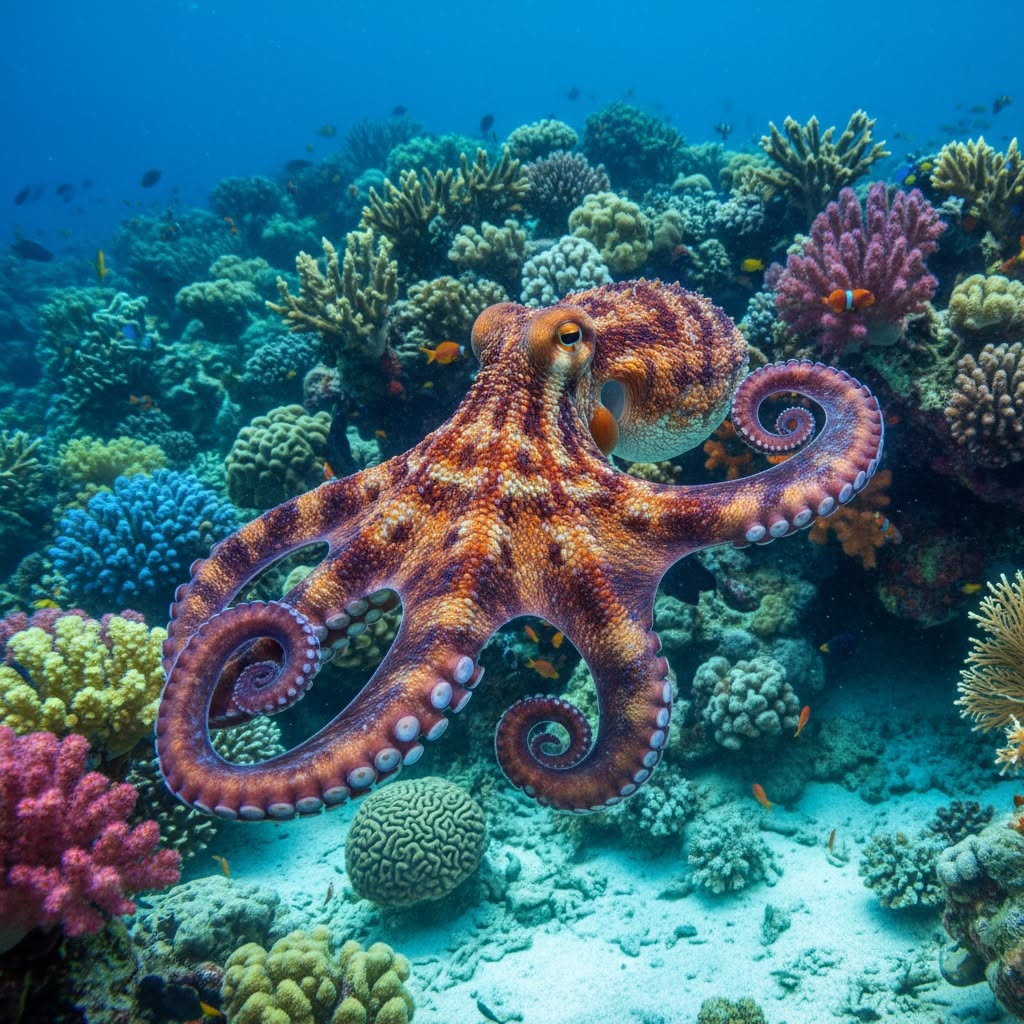
Why do octopuses have three hearts and blue blood?
Octopuses have three hearts because their copper-based blood, which uses hemocyanin instead of the iron-based hemoglobin found in vertebrates, is less efficient at transporting oxygen. Two branchial hearts pump blood through the gills to pick up oxygen, while a single systemic heart circulates oxygenated blood to the rest of the body.
If you wanted to design a truly alien intelligence - one that diverged from everything familiar about how brains, bodies, and minds are constructed - you would be hard-pressed to improve upon the octopus.
With three hearts pumping blue blood through a boneless body, two-thirds of its neurons distributed across eight semi-autonomous arms, and skin that can change color, pattern, and texture in a fraction of a second, the octopus is the closest thing to extraterrestrial life that Earth has produced.
It is an invertebrate that opens jars, escapes locked aquariums, recognizes individual human faces, and edits its own RNA at a rate unmatched by any other animal on the planet.
The philosopher and diver Peter Godfrey-Smith, who has spent decades studying cephalopod cognition, put it this way:
"If we can make contact with cephalopods as sentient beings, it is not because of a shared history, not because of kinship, but because evolution built minds twice over. This is probably the closest we will come to meeting an intelligent alien."
That observation, from his influential book Other Minds: The Octopus, the Sea, and the Deep Origins of Consciousness, captures what makes octopuses so extraordinary. They are not intelligent the way a chimpanzee or a dolphin is intelligent - sharing our vertebrate lineage, our centralized brains, our social structures.
Octopuses are intelligent in a fundamentally different way, shaped by 500 million years of separate evolutionary history, and understanding them forces us to reconsider what intelligence itself actually is.
Cephalopod Evolution: 500 Million Years of Innovation
The story of octopus intelligence begins in the Cambrian period, roughly 500 million years ago, when the first cephalopods emerged in ancient oceans. These early ancestors were small, shelled creatures - more closely resembling modern nautiluses than the soft-bodied octopuses we know today. For hundreds of millions of years, shelled cephalopods were among the dominant predators of the world's oceans.
The fossil record tells a story of extraordinary success. Ammonites, the spiral-shelled cephalopods whose fossilized remains are now collected worldwide, filled ecological niches across every ocean for over 300 million years. Orthoceras, a straight-shelled nautiloid, grew to lengths exceeding 4 meters and ruled Ordovician seas as an apex predator. During the Devonian period, roughly 380 million years ago, cephalopods occupied more predatory niches than fish.
Then, approximately 100 to 150 million years ago, something pivotal happened. A lineage of cephalopods began losing their external shells. The ancestors of modern octopuses internalized the shell (as in cuttlefish), reduced it to a vestigial structure (as in squid), or lost it entirely (as in octopuses). Without the protection of a shell, these soft-bodied cephalopods faced intense predation pressure from the bony fish that were diversifying rapidly during the Mesozoic era.
That predation pressure, many researchers believe, was the evolutionary engine that drove cephalopod intelligence. A naked, soft-bodied animal on a coral reef is essentially a mobile protein packet for every passing predator. Survival demanded rapid problem-solving, instantaneous camouflage, complex escape behaviors, and the ability to learn from experience.
Natural selection favored larger nervous systems, more sophisticated sensory processing, and behavioral flexibility. Over tens of millions of years, the octopus lineage developed one of the most remarkable brains in the invertebrate world.
The last common ancestor of octopuses and humans lived roughly 750 million years ago - a flatworm-like creature with perhaps a few hundred neurons. Everything about octopus intelligence evolved independently from everything about mammalian intelligence. The octopus brain is not a variation on our theme. It is a wholly separate invention.
Three Hearts and Blue Blood: The Physiology of an Alien
The octopus cardiovascular system is unlike anything found in vertebrate biology. Octopuses possess three separate hearts. Two branchial hearts, positioned at the base of the gills, pump deoxygenated blood through the gill capillaries where it picks up oxygen from seawater. The third heart, the systemic heart, receives this oxygenated blood and pumps it to the rest of the body.
This seemingly redundant system exists because octopus blood is fundamentally different from ours. Rather than relying on iron-based hemoglobin - the molecule that makes vertebrate blood red - octopuses use copper-based hemocyanin as their oxygen transport protein. When oxygenated, hemocyanin turns blue, giving octopus blood its distinctive and striking color. When deoxygenated, the blood is nearly colorless.
Hemocyanin is less efficient at binding and releasing oxygen than hemoglobin, particularly in warm, well-oxygenated waters. However, it performs significantly better in cold, low-oxygen environments - precisely the conditions found in the deep-sea habitats where many cephalopods evolved. The trade-off is that octopuses require more cardiac output to deliver adequate oxygen to their tissues, hence the need for three hearts rather than one.
There is a peculiar consequence of this physiology. The systemic heart stops beating when the octopus swims. Jet propulsion through the siphon temporarily shuts down the main circulatory pump, meaning that sustained swimming rapidly depletes the octopus's oxygen supply and leads to exhaustion. This is why octopuses overwhelmingly prefer crawling along the seafloor to swimming through open water. It is not laziness. It is cardiovascular necessity.
The blood of an octopus also operates at higher pressures than most invertebrate circulatory systems. The hemocyanin is dissolved directly in the plasma rather than contained within blood cells, creating a protein-rich fluid that must be pushed through a closed circulatory system - another feature that distinguishes cephalopods from most other mollusks, which have open circulatory systems.
500 Million Neurons and the Distributed Brain
The octopus nervous system contains approximately 500 million neurons. To put that in context, a fruit fly has roughly 100,000. A honeybee has about 1 million. A mouse has 70 million. A dog has approximately 530 million. The octopus, an invertebrate mollusk more closely related to a garden snail than to any vertebrate, possesses a nervous system of staggering complexity.
But the distribution of those neurons is what truly sets the octopus apart. Of the 500 million neurons, only about 180 million reside in the central brain - a donut-shaped structure that wraps around the esophagus. The remaining 320 million or so are distributed across the eight arms, with each arm containing a dense neural network capable of processing sensory information and executing motor commands semi-independently.
Each arm can taste through chemoreceptors in its suckers (an octopus literally tastes everything it touches), respond to tactile stimuli, and perform coordinated movements even when severed from the body. In laboratory experiments, a severed octopus arm will continue to respond to stimuli, grasp objects, and move in coordinated ways for up to an hour. The arm does not need the brain to function at a basic level.
This distributed architecture means the octopus brain operates more like a network than a hierarchy. The central brain issues high-level commands - approach this object, flee from that predator, explore this crevice - but the detailed execution is handled locally by each arm's own neural network. Sy Montgomery, author of The Soul of an Octopus, described it vividly:
"An octopus is more like a thinking, problem-solving network than a single, centralized intelligence. It is as if each arm has a mind of its own, and together they negotiate the world."
This raises profound questions about octopus consciousness. When an octopus explores a maze, is the experience unified the way it is for a mammal? Or does each arm contribute its own quasi-independent perceptual stream? Neuroscience does not yet have definitive answers, but the question itself reveals how alien octopus cognition truly is.
Camouflage: The Fastest Costume Change in Nature
The camouflage abilities of octopuses are, by any objective measure, the most sophisticated in the animal kingdom. An octopus can change its color, pattern, brightness, and three-dimensional skin texture in as little as 0.3 seconds - faster than a human blink.
This is achieved through a layered system of specialized cells in the skin, each performing a distinct optical function:
Chromatophores - The outermost layer consists of tiny elastic sacs filled with pigment (red, orange, yellow, brown, or black), each surrounded by a ring of radial muscles. When these muscles contract, the sac expands from a barely visible point to a flat disc up to 15 times its resting diameter, revealing the pigment. When the muscles relax, the sac shrinks and the color disappears. A single square centimeter of octopus skin can contain 200 or more chromatophores, and the octopus controls them individually through direct neural innervation - not hormonal signaling.
Iridophores - Beneath the chromatophores lies a layer of reflective cells containing stacks of thin protein platelets. These platelets act as biological Bragg reflectors, producing iridescent blues, greens, and silvers through structural coloration rather than pigment. By altering the spacing between platelet layers, the octopus can shift the reflected wavelength and change its iridescent display.
Leucophores - The deepest optical layer consists of cells that reflect ambient light in all directions, functioning as a broadband white reflector. Leucophores help the octopus match the overall brightness and diffuse color of its background, providing a neutral base upon which the chromatophores and iridophores create specific patterns.
Papillae - Beyond color, octopuses can alter the physical texture of their skin by raising or lowering muscular bumps called papillae. A smooth-skinned octopus resting on a coral head can, within milliseconds, erect papillae to perfectly mimic the bumpy, irregular surface of the coral. When it moves to a patch of smooth sand, the papillae retract and the skin goes flat.
Roger Hanlon, a senior scientist at the Marine Biological Laboratory in Woods Hole, Massachusetts, has spent over 30 years studying cephalopod camouflage. His research has revealed that octopuses achieve their camouflage through a surprisingly small number of base patterns - roughly three major categories (uniform, mottled, and disruptive) - that they mix and modulate to match virtually any visual environment.
Hanlon's high-speed video recordings have captured color changes propagating across the body as traveling waves, suggesting that the neural control of camouflage operates in a coordinated but decentralized fashion.
One of the most remarkable findings from Hanlon's laboratory is that octopuses appear to be colorblind. They have only a single type of photoreceptor in their eyes, which should theoretically limit them to monochrome vision. How, then, do they achieve such precise color matching?
Several hypotheses have been proposed: chromatic aberration in the oddly shaped pupil may allow limited wavelength discrimination; light-sensitive proteins (opsins) discovered in octopus skin may enable the skin itself to "see" color; or the octopuses may match brightness and contrast so precisely that color matching follows incidentally. The question remains one of the most intriguing unsolved problems in cephalopod biology.
Problem Solving and Escape Artistry
Octopuses are the Houdinis of the marine world. Their problem-solving abilities have been documented in hundreds of laboratory studies and countless anecdotal accounts from aquarium keepers worldwide.
Opening Containers
Octopuses routinely learn to open screw-top jars - from the inside. In standardized laboratory tests, octopuses presented with a transparent jar containing a crab learn to unscrew the lid within minutes on their first attempt, and subsequent attempts become progressively faster. They also open childproof pill bottle caps, pull plugs from drain holes, and dismantle equipment within their tanks.
The Inky Escape
Perhaps the most famous octopus escape story belongs to Inky, a common New Zealand octopus (Pinnoctopus cordiformis) housed at the National Aquarium of New Zealand in Napier. In April 2016, aquarium staff arrived one morning to find Inky's tank empty.
Investigation revealed that Inky had squeezed through a small gap at the top of his enclosure, dropped to the floor, crawled approximately 2.4 meters across the aquarium floor, and slid down a 50-meter-long drainpipe that led directly to Hawke's Bay and the open ocean.
The gap in his tank was barely the width of a tennis ball - but since an octopus has no skeleton, any opening larger than its beak (the only hard structure in its body) is a potential escape route.
The story made international headlines and became a cultural phenomenon. Inky was never recovered. Rob Yarrall, the aquarium's manager, told media outlets that Inky had always been an unusually curious and adventurous octopus, saying, "He was always watching. He was always testing things."
Recognizing Individual Humans
Research conducted at the Seattle Aquarium demonstrated that giant Pacific octopuses can distinguish between individual human faces and respond differently to people who have treated them well versus those who have been neutral or mildly aversive. In the study, one researcher consistently fed the octopus while another poked it gently with a bristly stick.
After just a few exposures, the octopus would jet water at the "irritating" person while reaching out to touch the "friendly" one - even when both were dressed identically.
The Mimic Octopus: Master of Impersonation
Discovered in 1998 off the coast of Sulawesi, Indonesia, the mimic octopus (Thaumoctopus mimicus) takes camouflage to an entirely different level. Rather than simply blending into the background, this species actively impersonates other animals.
Researchers have documented the mimic octopus convincingly imitating at least 15 different species, including:
- Lionfish - by spreading its arms outward and swimming with undulating, striped patterns
- Flatfish - by flattening its body and gliding along the seafloor with a rippling motion
- Sea snakes - by tucking six arms into a burrow and extending two arms in opposite directions, banded in black and white
- Jellyfish - by ascending to the surface and letting its arms trail downward limply
- Mantis shrimp, feather stars, stingrays, and sand anemones
What makes this behavior extraordinary is that the mimic octopus appears to select its impersonation based on the specific threat it faces. When approached by territorial damselfish, it mimics the banded sea snake - a known damselfish predator. The implication is not merely reactive camouflage but a form of context-dependent decision-making that requires recognizing the threat and selecting the appropriate defensive response from a repertoire of options.
The Blue-Ringed Octopus: Beautiful and Lethal
The blue-ringed octopus (genus Hapalochlaena) is among the most venomous animals on Earth. Comprising four confirmed species found primarily in tide pools and coral reefs of the Pacific and Indian Oceans, from Japan to Australia, these small octopuses - rarely exceeding 20 centimeters in total length - carry enough venom to kill 26 adult humans within minutes.
Their venom contains tetrodotoxin (TTX), the same paralytic neurotoxin found in pufferfish. Tetrodotoxin blocks sodium channels in nerve cells, preventing neurons from firing and rapidly inducing respiratory paralysis. There is no antivenom. The bite is often painless, meaning victims may not realize they have been envenomated until paralysis begins.
The only treatment is immediate and sustained artificial respiration (manual or mechanical ventilation) until the toxin metabolizes, which can take 15 to 24 hours.
The blue rings themselves serve as an aposematic warning signal. At rest, the octopus is a drab tan or beige. When threatened, it flashes approximately 50 to 60 iridescent blue rings across its body, each ring produced by specialized iridophores that activate through muscular contraction. This warning display is among the most vivid in the animal kingdom - and one of the most honest. Any predator that ignores it does so at fatal risk.
The Giant Pacific Octopus: The Largest of Them All
The giant Pacific octopus (Enteroctopus dofleini) is the largest octopus species on Earth. Adults routinely reach arm spans of 4 to 5 meters (13 to 16 feet) and weigh 20 to 50 kilograms (45 to 110 pounds). The largest reliably measured specimen had an arm span of approximately 6 meters (20 feet) and weighed 71 kilograms (156 pounds).
Found throughout the temperate and subarctic waters of the Pacific, from Alaska to Japan and south to California, the giant Pacific octopus inhabits rocky reefs, kelp forests, and sandy bottoms at depths ranging from the intertidal zone to over 200 meters. It is a voracious predator of crabs, clams, shrimp, and small fish, using its powerful arms and beak to crack open shells.
Despite its impressive size, the giant Pacific octopus lives only 3 to 5 years - a lifespan tragically short for an animal of such cognitive sophistication. This brevity is a defining constraint of octopus biology, driven by a reproductive strategy that culminates in the death of both parents.
| Feature | Giant Pacific Octopus | Common Octopus | Blue-Ringed Octopus | Mimic Octopus |
|---|---|---|---|---|
| Scientific name | Enteroctopus dofleini | Octopus vulgaris | Hapalochlaena spp. | Thaumoctopus mimicus |
| Arm span | Up to 6 m (20 ft) | Up to 1 m (3.3 ft) | Up to 20 cm (8 in) | Up to 60 cm (2 ft) |
| Weight | Up to 71 kg (156 lb) | Up to 10 kg (22 lb) | 10-100 g (0.35-3.5 oz) | ~2-5 kg (4.4-11 lb) |
| Lifespan | 3-5 years | 1-2 years | ~2 years | ~2 years |
| Habitat | North Pacific, temperate | Worldwide, tropical/temperate | Indo-Pacific tide pools | Indo-Pacific sandy bottoms |
| Notable trait | Largest octopus species | Most studied species | Lethal tetrodotoxin venom | Mimics 15+ species |
| Neuron count | ~500 million | ~500 million | ~500 million | ~500 million |
The Coconut Octopus: A Tool User on the Seafloor
The veined octopus (Amphioctopus marginatus), commonly known as the coconut octopus, provided one of the most striking examples of invertebrate tool use ever recorded.
In 2009, Julian Finn and Mark Norman of Museum Victoria in Melbourne published research in Current Biology documenting coconut octopuses in Indonesian waters collecting discarded coconut shell halves, cleaning them, stacking them for transport, and carrying them across the seafloor - an awkward, stilt-legged walk - to later assemble them into a protective shelter.
The behavior meets the formal definition of tool use: the octopus collects an object, transports it at a cost (the stilt-walking is slower and more exposed than normal movement), and deploys it later for a specific functional purpose. This was the first definitively documented case of tool use in an invertebrate and challenged the long-standing assumption that tool use required a large, centralized, vertebrate-style brain.
The coconut octopus has also been observed using clam shells in the same fashion, and some individuals maintain collections of multiple shell halves, selecting the best-fitting pair for their current size. This suggests not only tool use but tool selection - an additional cognitive step that implies evaluation and comparison.
Senescence: The Tragedy of Octopus Biology
Perhaps the most poignant aspect of octopus biology is the manner of death. All octopus species are semelparous - they reproduce once and then die. The process, known as senescence, is among the most dramatic in the animal kingdom.
After mating, the female octopus lays her eggs - tens of thousands in many species - and broods them obsessively. She stops eating entirely. In the case of the giant Pacific octopus, the female tends her eggs for six to seven months, gently aerating them with jets of water, cleaning them of algae and parasites, and defending them against predators. She does not leave the den. She does not hunt. Her body slowly consumes itself.
This self-destruction is driven by the optic gland, a small endocrine organ located between the eyes. In 1977, Jerome Wodinsky demonstrated that removing the optic gland from a female octopus after egg-laying prevented senescence - the octopus resumed eating, grew, and lived for months beyond its normal lifespan.
The optic gland, functionally analogous to the pituitary gland in mammals, releases signaling molecules that trigger a cascade of tissue degradation, immune suppression, and behavioral changes that constitute a biochemical suicide program.
Recent research led by Z. Yan Wang at the University of Washington has identified specific molecular pathways activated by the optic gland, including cholesterol metabolism and steroid hormone production. The gland essentially reprograms the octopus's physiology from "survive and grow" to "reproduce and die." Males undergo a parallel process after mating, though the timeline is less predictable.
This programmed death means that each generation of octopuses starts from scratch. There is no parental teaching, no cultural transmission, no accumulated wisdom passed from mother to offspring. Every octopus must learn everything about its environment within its brief 1-to-5-year lifespan. The cognitive abilities they display are all the more remarkable for being self-taught.
RNA Editing: Rewriting the Genetic Script
In 2017, a research team led by Joshua Rosenthal at the Marine Biological Laboratory and Eli Eisenberg at Tel Aviv University published a groundbreaking discovery in Cell. Coleoid cephalopods - octopuses, squid, and cuttlefish - edit their RNA at rates vastly exceeding any other animal group.
RNA editing is a process in which the cell chemically modifies messenger RNA after it has been transcribed from DNA, changing the instructions before they are translated into proteins. Most animals perform RNA editing at a handful of sites. Humans edit RNA at roughly 1 percent of coding sites. Octopuses edit RNA at tens of thousands of sites - recoding the amino acid sequences of proteins involved in neural function, including ion channels, neurotransmitter receptors, and cytoskeletal proteins.
The implications are profound. Most organisms evolve new protein functions through DNA mutations, which are inherited across generations and shaped by natural selection over long timescales. Octopuses appear to supplement this process with real-time RNA recoding, potentially allowing individual animals to fine-tune their neural proteins in response to environmental conditions such as temperature changes.
The trade-off, Rosenthal and Eisenberg found, is that cephalopod genomes evolve more slowly at the DNA level - the regions around heavily edited sites are conserved to preserve the editing machinery.
This discovery suggests that octopuses have, in a sense, traded genomic evolution for transcriptomic flexibility. They cannot rely on accumulated DNA changes across generations (especially given their semelparous lifecycle), so they edit their proteins on the fly. It is a fundamentally different strategy from the one vertebrates employ, and it may be one of the keys to their cognitive sophistication.
My Octopus Teacher and the Cultural Moment
The 2020 Netflix documentary My Octopus Teacher, directed by Pippa Ehrlich and James Reed, brought octopus intelligence into mainstream consciousness in a way no scientific paper ever had. The film follows South African filmmaker Craig Foster as he spends a year visiting a single wild common octopus in a kelp forest of the Cape Peninsula, building an extraordinary interspecies relationship.
The documentary won the Academy Award for Best Documentary Feature at the 93rd Academy Awards and has been viewed by tens of millions worldwide. It depicts the octopus hunting, evading sharks, losing and regenerating an arm, mating, laying eggs, and ultimately dying - the complete arc of an octopus life compressed into one hour and 25 minutes.
The film's cultural impact was substantial. Public interest in octopus welfare increased markedly in its wake. Several countries, including the United Kingdom, moved to include cephalopods under animal welfare legislation following the documentary's release and a concurrent review of cephalopod sentience evidence by the London School of Economics.
The review, published in November 2021, concluded that there is "strong scientific evidence" that octopuses are sentient - capable of experiencing pain, pleasure, and emotional states.
The documentary also reignited public debate about octopus farming. At the time of its release, plans were underway in Spain to build the world's first commercial octopus farm, a facility projected to house and slaughter approximately one million octopuses per year.
Conservation groups, ethicists, and many marine biologists opposed the project, arguing that farming an animal of such demonstrated cognitive complexity raises ethical concerns fundamentally different from farming conventional aquaculture species.
Why the Octopus Matters
The octopus is not merely an interesting animal. It is a philosophical challenge. It demonstrates that complex intelligence, flexible behavior, individual personality, and possibly subjective experience can arise from a biological architecture utterly unlike our own. Its nervous system is decentralized. Its lifespan is measured in months or a few years.
It has no social culture, no parental guidance, no accumulated tradition. And yet, within that brief and solitary life, it solves problems, plays, recognizes individuals, escapes confinement, and interacts with its environment in ways that demand we take its inner experience seriously.
The study of octopus intelligence is ultimately the study of what minds can be. Not all minds are built like ours. Not all intelligence requires a backbone, a cortex, or a social group. The octopus, with its three hearts and blue blood and 500 million neurons spread across a body that can squeeze through a gap the size of a quarter, is proof that nature has more than one way to build a thinking being.
References
Godfrey-Smith, P. (2016). Other Minds: The Octopus, the Sea, and the Deep Origins of Consciousness. Farrar, Straus and Giroux.
Montgomery, S. (2015). The Soul of an Octopus: A Surprising Exploration into the Wonder of Consciousness. Atria Books.
Hanlon, R. T., & Messenger, J. B. (2018). Cephalopod Behaviour (2nd ed.). Cambridge University Press.
Amodio, P., Boeckle, M., Schnell, A. K., Ostojic, L., Fiorito, G., & Clayton, N. S. (2019). "Grow Smart and Die Young: Why Did Cephalopods Evolve Intelligence?" Trends in Ecology & Evolution, 34(1), 45-56.
Liscovitch-Brauer, N., Alon, S., Porath, H. T., Elstein, B., Unber, R., Ziv, T., Admon, A., Levanon, E. Y., Rosenthal, J. J. C., & Eisenberg, E. (2017). "Trade-off between Transcriptome Plasticity and Genome Evolution in Cephalopods." Cell, 169(2), 191-202.
Finn, J. K., Tregenza, T., & Norman, M. D. (2009). "Defensive tool use in a coconut-carrying octopus." Current Biology, 19(23), R1069-R1070.
Birch, J., Burn, C., Schnell, A., Browning, H., & Crump, A. (2021). "Review of the Evidence of Sentience in Cephalopod Molluscs and Decapod Crustaceans." London School of Economics.
Wang, Z. Y., & Bhatt, D. K. (2020). "The Molecular Basis of Octopus Maternal Behaviors and Death." Neuroscience, 23, 1-15.
Frequently Asked Questions
Why do octopuses have three hearts and blue blood?
Octopuses have three hearts because their copper-based blood, which uses hemocyanin instead of the iron-based hemoglobin found in vertebrates, is less efficient at transporting oxygen. Two branchial hearts pump blood through the gills to pick up oxygen, while a single systemic heart circulates oxygenated blood to the rest of the body. The hemocyanin molecule turns blue when oxygenated, giving octopus blood its distinctive color.
This system evolved as an adaptation to cold, low-oxygen deep-sea environments where copper-based oxygen transport performs better than iron-based alternatives. Notably, the systemic heart stops beating when the octopus swims, which is why octopuses prefer crawling - swimming exhausts them quickly.
How intelligent are octopuses compared to other animals?
Octopuses possess approximately 500 million neurons - comparable to a dog - with roughly two-thirds of those neurons distributed across their eight arms rather than centralized in a brain. This gives each arm a degree of semi-autonomous control, allowing it to taste, touch, and make basic decisions independently.
Octopuses have demonstrated sophisticated problem-solving abilities including opening screw-top jars from the inside, navigating complex mazes, recognizing individual human faces, unscrewing childproof caps on pill bottles, and using tools such as coconut shell halves for portable shelters. They are the only invertebrates widely recognized as having individual personalities and the capacity for play behavior.
How fast can an octopus change color and how does camouflage work?
An octopus can completely change its color, pattern, and skin texture in as little as 0.3 seconds. This is achieved through a layered system of specialized skin cells. Chromatophores are pigment-filled sacs surrounded by tiny muscles that expand or contract to reveal or hide colors including red, orange, yellow, brown, and black. Beneath these sit iridophores, which reflect light to produce iridescent blues, greens, and silvers.
The deepest layer, leucophores, reflects ambient light to match background brightness. Octopuses can also raise or flatten small bumps called papillae to match surrounding textures such as coral, algae, or rocky surfaces. Research by Roger Hanlon at the Marine Biological Laboratory has shown that octopuses can match virtually any visual background despite being colorblind themselves.