Monarch Butterfly: The 4,800 km Migration
Danaus plexippusEastern monarchs fly up to 4,800 km to Mexico on a route encoded in their genes, flown by butterflies born in the north. Milkweed toxins make them poisonous.
 Strange Animals EditorialJuly 24, 2025·14 min read·Editorial standards ↗
The monarch butterfly is one of the most recognisable insects on Earth and almost certainly the most studied butterfly in existence. Its orange, black and white wings are a standard reference image in biology textbooks, a mascot for pollinator conservation and a cultural symbol across several countries.
Yet most of what makes the monarch extraordinary is invisible at a glance: a multigenerational migration covering thousands of kilometres, a chemical defence stolen from the plants it eats, a navigation system distributed between its eyes and antennae, and a long-lived "Methuselah generation" that exists on a biological clock unlike any other member of its species.
Morphology, life cycle, migration, chemistry, genetics, conservation and culture are all treated in this guide with the detail a reference entry requires. Readers will find centimetres, grams, generations, population estimates and verified records throughout.
Etymology and Classification
The scientific name Danaus plexippus was described by Carl Linnaeus in 1758. Both names come from Greek mythology: Danaus was a legendary king of Egypt whose fifty daughters are a classic mythological motif, while Plexippus was one of his nephews.
The common name "monarch" was suggested in 1874 by the entomologist Samuel Hubbard Scudder, who cited the butterfly's large size and the idea that it rules a vast domain. Alternative English names include "milkweed butterfly," "common tiger," and "wanderer."
Monarchs belong to the family Nymphalidae, the brush-footed butterflies and specifically to the subfamily Danainae, the milkweed butterflies. The monarch and its closest relatives, the southern monarch ( Danaus erippus ) and the Jamaican monarch ( Danaus cleophile ), make up the three monarch species.
Six subspecies have been described, including Danaus plexippus plexippus , the familiar migratory North American monarch, and Danaus plexippus megalippe , a non-migratory form found from Florida and Georgia southwards through the Caribbean and Central America to the Amazon River. Introduced monarch populations are established in Hawaii, Australia, New Zealand and parts of the Iberian Peninsula. Monarchs have spread globally since the 1800s.
Monarch Butterfly Size and Physical Description
Monarch butterflies are mid-sized nymphalids. Their measurements are consistent enough across their range that one individual barely differs from another in size, but colour and pattern can vary with diet and temperature during pupation.
Adults:
- Wingspan: 8.9-10.2 cm
Caterpillars at maturity:
- Length: 4-5 cm
Chrysalis:
- Length: about 2.5 cm
- Colour: jade green with a line of metallic gold spots
Wings display bright orange crossed by strong black veins and framed by a wide black margin punctuated with two rows of small white spots. The body remains black but bears fine white dotting. Sexually, males show subtle yet reliable differences with a small black scent patch, the androconium, on each hindwing vein, females have thicker black veins and no scent patches, and males are slightly larger than females.
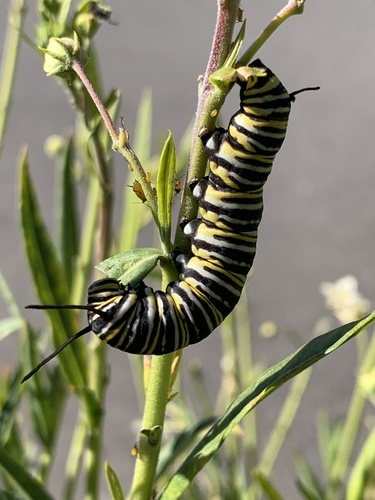
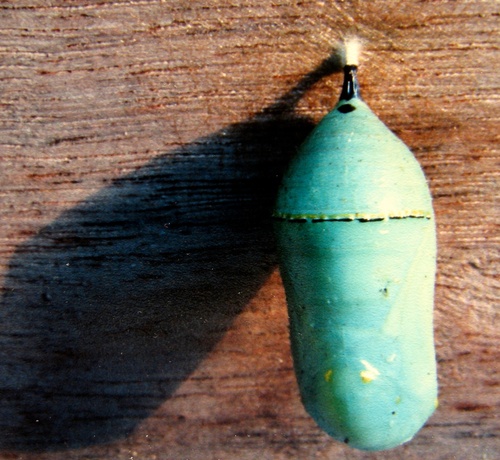
Caterpillars display unmistakable coloring, banded in yellow, black and white rings with two pairs of black filaments at each end. The filaments are not stingers and cannot inject anything, yet they twitch when the caterpillar is disturbed, which may deter parasitoid wasps. One of the most striking chrysalises in the insect world is this species', a smooth jade-green teardrop shaped like a tear with a horizontal row of gold spots running across it.
Milkweed, Toxicity, and Mimicry
Monarch caterpillars feed almost exclusively on plants in the genus Asclepias , the milkweeds and a few close relatives such as Cynanchum and Calotropis . Milkweeds secrete a sticky white latex rich in toxic compounds called cardenolides. These compounds bind to and disrupt the sodium-potassium ATPase pump that all animal cells use to maintain ionic balance. In vertebrates, cardenolide ingestion causes vomiting, disorientation, and, at higher doses, cardiac arrhythmia.
Monarch caterpillars evolved a modified sodium-potassium pump that resists cardenolide binding. Instead of being poisoned by milkweed, the caterpillars sequester the toxins in their own tissues. The chemicals persist through pupation into the adult butterfly, which is therefore toxic to most predators. A young bird that eats a monarch vomits within minutes and thereafter associates the distinctive orange-and-black pattern with illness.
Toxin concentration varies widely. Some milkweed species produce far more cardenolide than others, and monarchs raised on low-toxicity milkweeds may contain almost none. A predator that happens to sample these "weak" monarchs still learns the pattern, and the population as a whole benefits from automimicry, weakly defended individuals protected by the lessons predators learn from strongly defended ones.
The monarch shares its orange-and-black pattern with the viceroy butterfly, Limenitis archippus , a smaller nymphalid that feeds on willow and poplar. For most of the twentieth century, biologists described the relationship as a textbook case of Batesian mimicry: a palatable species imitating a toxic one for protection.
Careful feeding experiments published by Ritland and Brower in 1991 and confirmed since then showed that viceroys are also genuinely unpalatable to birds. The relationship is therefore Mullerian mimicry, two toxic species sharing a warning signal, which reinforces the lesson for predators rather than exploiting it.
The Four-Generation Migration
The monarch migration is one of the longest and most studied insect migrations on Earth. Its structure is so unusual that biologists still debate how it evolved.
Eastern North American cycle, season by season:
| Generation | Season | Lifespan | Role in the cycle |
|---|---|---|---|
| 1 | March-April | 2-6 weeks | Hatches in southern United States from returning migrants |
| 2 | May-June | 2-6 weeks | Breeds its way north into the Midwest |
| 3 | July-August | 2-6 weeks | Reaches the northern United States and southern Canada |
| 4 | September-March | 6-9 months | Flies south to Mexico, overwinters, begins return |
The eastern population's journey covers up to 4,800 kilometres one way.
The truly strange part is that no individual monarch completes the round trip. The fall-born Methuselah generation flies south, overwinters in Mexico and begins the return flight the following spring. Somewhere along the way, often in Texas or northern Mexico, they mate, lay eggs on emerging milkweed and die. Their children continue northward. The northward recolonisation takes two to three generations.
The monarchs that eventually arrive in Ontario or Minnesota in midsummer have never seen Mexico and are several generations removed from the last butterfly that did.
The western monarch population, breeding west of the Rocky Mountains, undertakes a shorter migration to coastal California, overwintering in groves of eucalyptus, Monterey pine and Monterey cypress from north of San Francisco south to Baja California. Historically, millions of butterflies clustered in these groves each winter. A low of 1,914 individuals was recorded in the winter of 2020.
The Methuselah Generation
Summer monarchs live two to six weeks. Fall-born monarchs, triggered by shortening day length and cooler nights, develop differently. Their reproductive organs fail to mature, a state called reproductive diapause and their bodies shift into a metabolically conservative mode. They stockpile lipids, their wings are slightly larger and more robust, and their lifespan extends to six or even nine months.
Biologists nicknamed them the "Methuselah generation" after the biblical patriarch said to have lived nearly a thousand years.
These butterflies do not reproduce until the following March. When they finally mate and lay eggs in Texas or Mexico, they are several months older than any of their relatives will ever be. They die shortly thereafter. The same environmental cues that triggered diapause in autumn trigger its termination in spring, released by lengthening days and warmer nights.
Research on the molecular basis of diapause has identified a small number of genes and hormones, particularly juvenile hormone and insulin-like signalling pathways, that flip the switch between short summer lives and the long migratory state.
Captive-raised monarchs have a much lower migratory success rate than wild monarchs.
Navigation: Sun Compass and Magnetic Backup
Monarchs navigate using a time-compensated sun compass. This is the same basic system used by many migratory birds: the butterfly tracks the sun's position in the sky and applies a correction based on the time of day, producing a stable compass direction even as the sun moves from horizon to horizon.
The unusual feature is the location of the clock. In most animals, the circadian rhythms that underpin a time-compensated compass reside in the brain. Experiments by Steven Reppert and colleagues in the 2000s showed that in monarchs, the critical circadian clock lives in the antennae.
Painting the antennae with enamel to block light input disrupted the butterflies' flight direction even when the brain clock remained intact. Removing the antennae entirely scrambled direction altogether. Two clocks, one in the brain, one in the antennae, work together.
On cloudy days, when the sun cannot be seen, monarchs fall back on a magnetic compass. Specialised photoreceptors in the eyes detect the inclination of Earth's magnetic field rather than its polarity, providing a backup heading that works even when the sky is completely overcast.
Genetic and circuit mapping has identified the specific neurons that integrate sun, time and magnetic inputs into a single directional output aimed, for fall migrants, at a narrow window of longitudes in central Mexico.
Crucially, no monarch learns this route. The butterflies flying south in September have never been to Mexico. Their parents died in the northern United States, and their grandparents and great-grandparents in turn. The migration programme is genetic, encoded in the nervous system and triggered by environmental cues experienced during development.
Life Cycle and Reproduction
Monarchs undergo complete metamorphosis through a four-stage process that all butterflies and moths share.
Egg. Females lay 300 to 500 eggs one at a time on the underside of milkweed leaves, usually choosing young tender growth. Each egg is about the size of a pinhead, oval and patterned with fine ridges. Eggs hatch in 3 to 8 days depending on temperature.
Caterpillar. The newly hatched larva eats its own eggshell before moving on to milkweed. Over 10 to 14 days it moults through five developmental stages called instars, increasing its mass roughly 2,000-fold. By the fifth instar it is fat, banded yellow-black-white and roughly 4 to 5 centimetres long. It feeds almost continuously during daylight and rests briefly between meals.
Chrysalis. When ready to pupate, the caterpillar crawls away from its milkweed plant, spins a small silk pad on a horizontal surface, and attaches itself upside down in a J-shape. Within a day it sheds its skin one final time to reveal the jade-green chrysalis. Inside, most of the caterpillar's tissues dissolve into a nutrient soup.
Small preserved clusters of cells called imaginal discs, present from the egg stage, use this soup to construct entirely new adult structures, wings, reproductive organs, compound eyes, long straw-like proboscis, from scratch. The process takes 10 to 14 days.
Adult. The chrysalis darkens in the final day before emergence as the orange-and-black wings become visible through the thinning cuticle. The adult breaks out head-first, pumps haemolymph into the expanding wings, and takes its first flight within a few hours. Summer-generation adults begin courting and mating within four to five days of emergence. Fall-generation adults enter diapause and do not reproduce for months.
Range, Habitat, and Overwintering Sites
Monarchs occur across most of the Americas. Breeding range for the migratory eastern population covers the United States east of the Rockies and southern Canada from Alberta to the Maritimes. The western migratory population breeds in the western United States. Resident non-migratory populations occupy the Caribbean, Central America and parts of South America.
The eastern migratory population's survival depends on about a dozen tiny groves of oyamel fir ( Abies religiosa ) in the Trans-Mexican Volcanic Belt, mostly in the states of Michoacan and Mexico. These groves provide a precise microclimate, cold enough to depress metabolism and conserve energy, but warm enough to prevent freezing.
Butterflies blanket the trunks and branches in layered curtains at densities of between six and sixty million individuals per hectare, bending the boughs under their weight.
The western population overwinters in coastal California groves dominated by non-native blue gum eucalyptus and native Monterey pine and cypress. Classic sites include Pacific Grove, Pismo Beach and Natural Bridges. Coastal fog, mild temperatures and wind shelter combine to produce suitable microclimates along a narrow coastal strip.
Population Status and Conservation
The IUCN added the migratory monarch butterfly to the Red List as Endangered in 2022. The assessment explicitly covers the migratory populations of Danaus plexippus plexippus rather than the species as a whole, since resident Central and South American populations remain relatively secure.
Population trajectory:
| Year / period | Eastern population (Mexico hectares occupied) | Western population (California count) |
|---|---|---|
| 1996-97 peak | 18.19 ha | ~1,200,000 |
| 2004-05 | 2.19 ha | n/a |
| 2013-14 low | 0.67 ha | n/a |
| 2020-21 crash | 2.10 ha | 1,914 |
| 2023-24 | 0.90 ha | ~233,000 |
Surveys in the winter of 2024-25 found the eastern wintering area to be about 10 per cent of that recorded in 1996-97. Western monarchs collapsed by more than 99 per cent before partial rebounds.
Primary threats:
- Milkweed loss. Widespread adoption of glyphosate-resistant corn and soybean cultivars in the United States Midwest since the late 1990s has eliminated milkweed from vast areas of farmland. Common milkweed once grew between crop rows and along field edges, blanket herbicide spraying removed it.
- Logging at overwintering sites. Illegal and legal logging inside and adjacent to the Mexican oyamel groves has opened gaps in the forest canopy, exposing overwintering butterflies to lethal cold and wet conditions. Severe winter storms, such as the one in 2002, have killed large numbers of overwintering butterflies.
- Climate change. Autumns warming delay migration triggers, extreme weather events kill overwintering butterflies and shifting climate zones could push oyamel forests uphill to elevations where trees cannot grow.
- Pesticides. Neonicotinoids and other systemic insecticides in agricultural and suburban landscapes contaminate milkweed leaves and nectar.
- Habitat fragmentation. Development, roadside mowing and suburban sprawl break up the continuous corridors of milkweed and nectar plants that monarchs depend on during migration.
Conservation responses include milkweed restoration programmes in the United States and Canada, designation of the Monarch Butterfly Biosphere Reserve in Mexico, a tri-national North American Monarch Conservation Plan, and community-level monitoring networks such as Journey North and the Western Monarch Thanksgiving Count.
Cultural Significance
Every year around Day of the Dead, central Mexico hosts the monarch butterfly migration. This coincides with the traditional 1-2 November observance that honors the departed. Local communities notice and appreciate this alignment: in indigenous Purepecha and Mazahua tradition, the returning butterflies are widely seen as the souls of ancestors coming home for the festival.
The butterfly festivals in towns like Angangueo and Ocampo blend pre-Columbian, Catholic and ecological traditions, and the monarch has become a fixture in Mexican cultural identity.
In the United States and Canada the monarch is a flagship species for pollinator conservation and has lent its image to everything from postage stamps to school curricula.
Schoolchildren across North America raise monarchs from caterpillars as a standard biology unit, an activity that raises conservation concerns when captive-bred monarchs fail to migrate normally.
Frequently asked questions
Adult monarchs (Danaus plexippus) have a wingspan of 8.9 to 10.2 centimetres. Males are slightly larger than females and carry a small black scent spot on a vein of each hindwing, which females lack. Females have thicker black wing veins.
Caterpillars reach a final length of 4 to 5 centimetres before pupating. The chrysalis is about 2.5 centimetres long.
Eastern North American monarchs undertake one of the longest insect migrations on Earth, flying up to about 4,800 kilometres from breeding grounds in the northern United States and southern Canada to overwintering sites in the oyamel fir forests of central Mexico.
The western population migrates shorter distances from inland breeding areas to coastal California overwintering groves. No individual monarch completes a full round trip: the spring northward journey is carried out by later generations, the children and grandchildren of the butterflies that flew south.
Monarch caterpillars feed exclusively on milkweed plants in the genus Asclepias, which contain bitter compounds called cardenolides that disrupt sodium-potassium pumps in vertebrate cells and cause vomiting or heart arrhythmia if ingested. Monarch caterpillars have evolved a modified sodium-potassium pump that resists these toxins, allowing them to sequester cardenolides in their bodies rather than metabolise them.
The toxins persist through metamorphosis into the adult butterfly. A bird that eats a monarch typically vomits within minutes and learns to avoid the species’ distinctive orange-and-black pattern. Toxin levels vary by milkweed species, and some monarchs contain almost no cardenolides.
Most monarchs live only two to six weeks as adults, just long enough to mate, lay eggs and die. The final generation of each year, born in late summer and early autumn, is physiologically different. Triggered by shortening day length and cooler temperatures, these butterflies enter a state called reproductive diapause: their reproductive organs remain undeveloped, their metabolism slows and they live six to nine months.
This ‘Methuselah generation’ is the one that flies to Mexico, overwinters in the oyamel firs and begins the return journey north in spring. Only after mating the following March do they finally reproduce and die, having lived roughly eight times longer than their summer ancestors.
Monarchs use a time-compensated sun compass, meaning they track the sun’s position in the sky while correcting for the time of day. The extraordinary part is where this calculation happens: the circadian clock that tells the butterfly what time it is lives in the antennae, not only the brain. Experiments that painted over the antennae disrupted navigation, while removing the antennae entirely scrambled the migration direction altogether.
On cloudy days when the sun is not visible, monarchs fall back on a magnetic compass. Specialised photoreceptors in the eyes detect the inclination of Earth’s magnetic field lines, providing a backup heading. Genetic and circuit mapping has identified the specific neurons that integrate these inputs into a single directional output.
The IUCN listed the migratory monarch butterfly as Endangered in 2022. The area occupied by the eastern North American population in Mexico in the winter of 2024-25 was only about 10 per cent of that recorded in 1996-97, while the western population crashed by more than 99 per cent, falling as low as 1,914 individuals in 2020 before partial rebounds.
Three threats dominate: loss of milkweed across the agricultural Midwest due to glyphosate-resistant crops that permit blanket herbicide spraying, illegal and legal logging in the tiny Mexican overwintering forests, and climate change, which disrupts migration timing, increases exposure to extreme weather and threatens the microclimates of the oyamel groves. Pesticides, habitat fragmentation and roadside mowing add further pressure.
Monarchs undergo complete metamorphosis in four stages. Eggs, laid individually on milkweed leaves, hatch in 3 to 8 days. Caterpillars feed almost continuously and moult through five developmental stages called instars over 10 to 14 days.
The caterpillar then spins a silk pad, attaches upside down in a J-shape and sheds its skin one final time to reveal a jade-green chrysalis decorated with metallic gold spots. Inside the chrysalis, most of the caterpillar’s tissues dissolve into a nutrient soup, small preserved clusters of cells called imaginal discs use this material to construct an entirely new body plan.
After 10 to 14 days, the adult butterfly emerges, pumps fluid into its wings and flies within a few hours.
The viceroy (Limenitis archippus) is a smaller, similar-looking butterfly that shares the monarch’s orange-and-black warning pattern. The simplest visual difference is a black line across the viceroy’s hindwings that monarchs lack.
For decades textbooks described the viceroy as a Batesian mimic, a palatable species mimicking a toxic one for protection. Research in the 1990s showed that viceroys are also unpalatable to birds, making the relationship a case of Mullerian mimicry, where both species are toxic and share a warning signal that reinforces the lesson for predators. Viceroy caterpillars feed on willow and poplar, not milkweed and sequester different defensive compounds.