
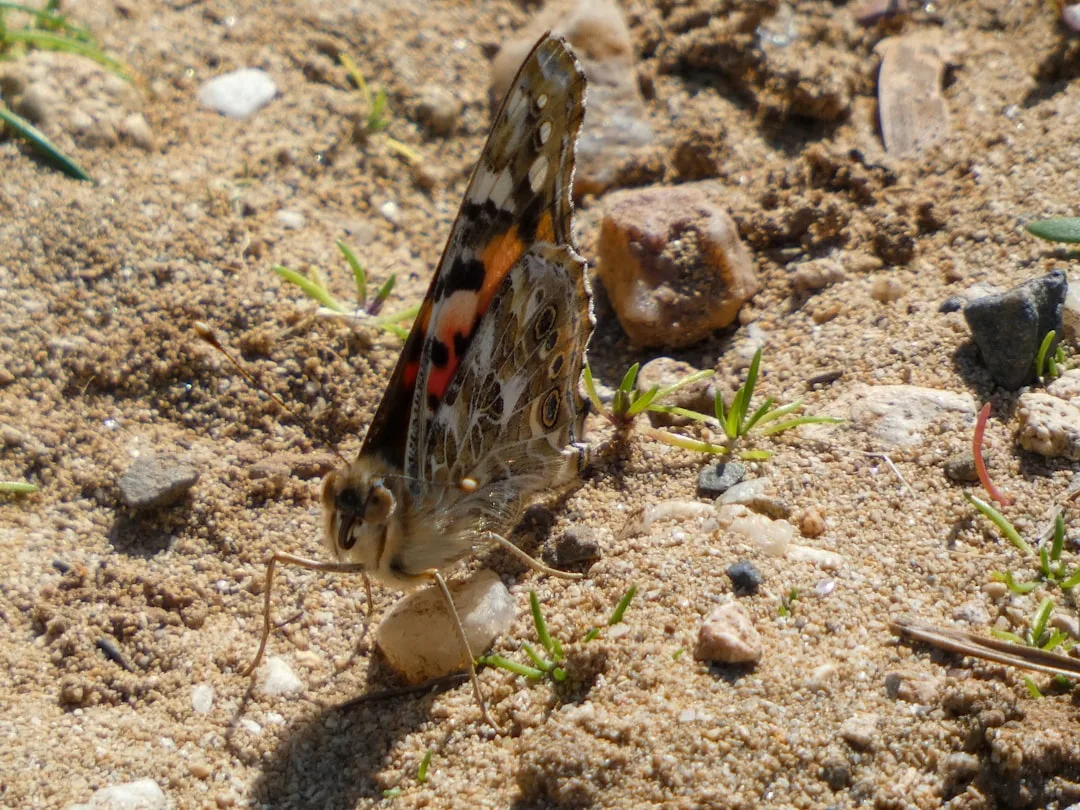
The painted lady is the most widespread butterfly on Earth. Found on every continent except Antarctica and South America, Vanessa cardui is the only butterfly species known to span six of the seven continents and the only insect confirmed to complete a multigenerational migration of roughly fifteen thousand kilometres between the Arctic Circle and Sub-Saharan Africa.
It is a small, orange-and-black nymphalid with a modest five-to-seven-centimetre wingspan, yet it quietly holds several world records - longest insect migration, broadest host-plant range, and largest continental reach of any lepidopteran.
This guide covers every aspect of painted lady biology and ecology: size, flight performance, caterpillar behaviour, the extraordinary migration cycle, isotope tracking, mass bloom events, and conservation. Expect specifics - centimetres, grams, generations, kilometres, population figures, and verified records - in the same depth you would find in a reference entry.
Etymology and Classification
The scientific name Vanessa cardui was coined by Carl Linnaeus in 1758. Vanessa is a Latinised poetic name with no standardised meaning in biology, while cardui is the genitive of the Latin word for "thistle" - a direct reference to the caterpillar's preferred host plant.
The common name "painted lady" has been used in English for at least four centuries, probably referring to the delicate brushstroke-like markings on the wings that reminded early naturalists of cosmetic painting. In French the species is called la belle-dame, in German Distelfalter ("thistle butterfly"), and in Spanish vanesa de los cardos.
The painted lady belongs to the family Nymphalidae, the brush-footed butterflies, and to the subfamily Nymphalinae. The genus Vanessa contains around twenty species distributed globally, including the red admiral (Vanessa atalanta), the American painted lady (Vanessa virginiensis), and the west coast lady (Vanessa annabella). The painted lady is sometimes called the cosmopolitan because of its planetary reach.
Several regional forms exist, but modern genetic work treats them as a single panmictic species with only minor population structure.
Molecular dating places the painted lady's continental migration behaviour at least as old as the last Ice Age. Rather than a learned route, the trans-Saharan round trip is an inherited behavioural programme encoded genetically. Populations that ceased migrating - on Hawaii, for example - retain the underlying capacity, and their descendants resume long-distance flight under the right triggers.
Size and Physical Description
Painted ladies are mid-sized nymphalids. Their dimensions are consistent across the species' vast range, though colour saturation and size vary slightly with temperature and host-plant quality during development.
Adults:
- Wingspan: 5-7 cm
- Body length: 2.5-3 cm
- Weight: 0.3-0.5 g
- Forewing length: 2.7-3.5 cm
Caterpillars at maturity:
- Length: 2.5-3 cm
- Colour: dark brown to black with yellow or greenish side stripes, covered in branched spines
- Mass gain during larval stage: roughly 100-fold
Chrysalis:
- Length: 2-2.5 cm
- Colour: pale brown, grey, or pinkish with metallic gold flecks
- Position: hanging from silk pad, head down
The upper wings are a warm orange-brown marked with black patches and white spots near the tip of each forewing. The undersides are more subdued - mottled browns, greys, and olives broken by small blue eye-spots along the rear edge of the hindwing. The eye-spots function as predator deflectors, drawing bird strikes away from the body.
Like all nymphalids, painted ladies have reduced forelegs that are held folded against the body and appear brush-like under magnification, giving the family its common name.
Males and females are nearly identical, though females tend to be slightly larger and paler. Both sexes have powerful flight muscles relative to body size, enabling sustained migratory flight at 25 to 30 kilometres per hour, with recorded speeds up to 50 kilometres per hour when assisted by tailwinds.
Built for Long-Distance Flight
The painted lady is built for flight on a scale no other butterfly matches. Its wings have a high aspect ratio and relatively narrow shape, reducing drag and allowing efficient gliding. Its thoracic flight muscles account for a larger proportion of body mass than in most butterflies, and its abdomen carries proportionally less fat because the insect refuels frequently on nectar rather than flying on stored reserves alone.
Flight performance features:
- Cruising airspeed: 25-30 km/h
- Maximum airspeed with tailwind: up to 50 km/h
- Typical migratory flight altitude: 500-1,500 m above ground
- Maximum recorded altitude: over 1,000 m in sustained flight
- Typical daily range during migration: 200-500 km
Unlike monarchs, which rely heavily on gliding in thermal columns, painted ladies use active flapping flight combined with high-altitude tailwind assistance. Radar studies across Europe and North Africa show migrating painted ladies rising to jet-stream heights at dawn, drifting hundreds of kilometres downwind, and descending in late afternoon to refuel at flowering plants. The strategy resembles avian migration more than that of most butterflies.
Painted ladies can cover more than four thousand kilometres in 2 to 3 weeks of adult life. For a butterfly weighing less than half a gram, this is a staggering energetic achievement, comparable in relative terms to a small songbird flying from pole to pole.
The 15,000 Kilometre Generational Migration
The defining feature of the painted lady is its annual migration, a round trip of roughly fifteen thousand kilometres between Sub-Saharan Africa and the Arctic Circle. This is the longest documented insect migration on Earth and almost twice the distance of the well-known monarch butterfly migration in North America.
No individual painted lady flies the full circuit. The round trip takes 6 successive generations, each covering a segment of the route, breeding along the way, and producing offspring that continue the journey.
The six-generation annual cycle:
| Generation | Approximate period | Primary movement |
|---|---|---|
| 1 | Feb-Mar | Hatches in Sub-Saharan Africa, flies north to Maghreb |
| 2 | Apr-May | Crosses Sahara and Mediterranean into southern Europe |
| 3 | May-Jun | Advances into central and northern Europe |
| 4 | Jun-Jul | Reaches Scandinavia, UK, and Arctic Circle |
| 5 | Aug-Sep | First southward generation, returning through Europe |
| 6 | Oct-Nov | Completes return to Sub-Saharan Africa |
The spring leg drives butterflies across the Sahara Desert, a barrier that kills many migrants but which enough survive to refill northern breeding grounds each year. The autumn return leg, long suspected but confirmed only in the last decade, carries the descendants south through a higher-altitude flight path that goes largely unnoticed from the ground.
Painted ladies have been completing this migration since at least the last Ice Age. The behaviour is genetically inherited rather than learned: each generation responds to photoperiod, temperature, and host-plant availability cues, orienting itself north or south even when no older butterflies are present to guide it.
Isotope Tracing and the 2021 Oxford Study
Tracking individual painted ladies across continents was long considered impossible. The insects are too small to carry conventional tags, and too short-lived to be recaptured in useful numbers. For decades the trans-Saharan migration was inferred from radar, coastal surveys, and citizen sightings but never confirmed at the individual level.
In 2021 a research team led by Gerard Talavera at the Institut Botanic de Barcelona and the University of Oxford solved the problem using stable isotopes. The chemistry of hydrogen and strontium in drinking water, soil, and host plants varies predictably across geography. When a caterpillar feeds, its tissues lock in the local isotope ratios. These ratios are preserved in wing scales throughout the adult butterfly's life.
The Talavera methodology:
- Capture adult butterflies at key sites across Europe and Africa
- Sample a small fragment of wing scale from each individual
- Measure ratios of hydrogen-2 to hydrogen-1 and strontium-87 to strontium-86
- Compare measured ratios against geographic reference maps
- Infer the birth location of each individual butterfly
The results confirmed that painted ladies caught in southern Europe in autumn had been born in northern and central Europe, while those caught in North Africa had migrated south from Iberia and the Mediterranean. Crucially, the study also documented individuals that had been born in Sub-Saharan Africa reaching the Maghreb and beyond, closing the geographic loop.
Isotope tracing has since been extended to questions of generational turnover, host-plant use, and climate-driven shifts in breeding ranges. It is one of the few tools that can trace the life history of an insect too small to tag.
Life Cycle and Reproduction
The painted lady runs through its complete life cycle in 6 to 7 weeks under favourable temperatures. Short generation times are what make the multigenerational migration possible.
Eggs:
- Size: roughly 0.7 mm, pale green, barrel-shaped with longitudinal ribs
- Number per female: 100-500 across her adult life
- Placement: single eggs on the upper surface of host-plant leaves
- Incubation: 3-5 days in warm conditions
Caterpillar stages:
- Duration: 12-18 days through 5 instar stages
- Host plants: thistles (Cirsium, Carduus), hollyhock (Alcea rosea), mallow (Malva), artichoke (Cynara), burdock (Arctium), and over 100 other species
- Behaviour: each caterpillar builds a silk tent on a leaf, pulling the edges together, and feeds from inside this refuge
- Colour change: early instars are small and black; later instars develop yellow or green side stripes and branched black spines
Chrysalis (pupal) stage:
- Duration: 7-10 days
- Position: suspended head-down from a silk pad, often on a host-plant stem or nearby structure
- Appearance: angular, pale brown or grey, with metallic gold flecks
Adult butterfly:
- Emergence: wings inflate and harden within about 30 minutes
- Lifespan: 2-4 weeks under good conditions
- First activity: nectar feeding within hours, mating within days
Females select host plants by a combination of visual cues and chemical sensing with their feet. Once a suitable plant is found, a female deposits one egg at a time and then flies on - a strategy that spreads offspring across many plants and reduces the risk of a single predator or parasitic wasp wiping out a clutch.
The caterpillar's silk tent is one of the species' signature adaptations. By pulling leaf edges together with silk, the larva creates a microhabitat that hides it from birds, shields it from direct sun, and makes life difficult for parasitic wasps like Cotesia that lay eggs inside caterpillars of other nymphalids.
Adaptability and Global Range
Few animals match the painted lady for habitat flexibility. The species is found on every continent except Antarctica and South America, occupying essentially every open ecosystem in between.
Habitat types:
- Meadows and grasslands
- Gardens, parks, and urban green space
- Agricultural land, including cereal and vegetable fields
- Deserts and semi-deserts with seasonal flowering
- Alpine pastures up to roughly 3,000 m elevation
- Coastal dunes and saltmarsh margins
- Woodland edges and clearings
Painted ladies thrive anywhere their caterpillar host plants grow and adults can find nectar. They are among the first insects to recolonise disturbed habitats. After the 2010 Eyjafjallajokull volcanic eruption in Iceland left large areas of northern Europe under ash, painted ladies were among the earliest butterflies to push back into affected regions, probably because their host thistles are themselves pioneer plants on disturbed ground.
The species is absent from dense tropical rainforest, where thistles and mallows do not grow, and from polar ice. Introduced or windblown populations have been recorded as far afield as Hawaii, Iceland, and remote Atlantic islands.
Continental status:
| Continent | Status |
|---|---|
| Africa | Resident, breeding grounds for winter generations |
| Europe | Seasonal migrant, breeding Apr-Sep |
| Asia | Resident and migrant, breeding across temperate zone |
| North America | Resident in south, migrant in north |
| Australia | Resident, widespread in temperate regions |
| Antarctica | Absent |
| South America | Absent from breeding records |
Bloom Events and Population Dynamics
Painted lady populations fluctuate enormously from year to year. The species is famous for episodic mass movements called bloom events, driven by unusually favourable rainfall in its Sub-Saharan and North African breeding zones.
The 2019 Morocco-Algeria bloom:
Heavy winter rainfall in late 2018 and early 2019 produced an explosion of thistle and mallow growth across Morocco, Algeria, and surrounding regions. Painted lady caterpillars fed on this abundance and matured in extraordinary numbers. By spring 2019 more than one million butterflies crossed the Mediterranean in a single broad front.
Observers across Spain, France, the UK, and Scandinavia reported dense clouds of butterflies passing through gardens, roads, and airports. In parts of southern England, density estimates reached over a thousand butterflies per hectare in early summer 2019. The event underlined how painted lady numbers track rainfall patterns thousands of kilometres from where they ultimately arrive, and how tightly insect populations can couple to atmospheric circulation.
Other recorded bloom years in Europe: 1879, 1948, 1966, 1996, 2003, 2009, 2019.
Between bloom years, painted lady numbers can drop so low that northern countries receive only a trickle of migrants. There is no reliable annual average - the population is a set of occasional surges interspersed with quieter years.
Flowers, Pollination, and Ecological Role
Adult painted ladies are broad-spectrum nectar feeders. They visit a wider variety of flower species than most butterflies, including more than 300 documented plant species across their range. This catholic taste makes them significant pollinators in many ecosystems, even where they are only seasonally present.
Favoured nectar sources:
- Thistles (Cirsium, Carduus)
- Buddleia (butterfly bush)
- Lavender
- Zinnias and asters
- Echinacea and rudbeckia
- Clover and lucerne
- Ivy in autumn
Because migrating painted ladies move across many biomes in a single generation, they transport pollen across regions that resident pollinators rarely link. The ecological consequences of this long-distance pollen transfer are only beginning to be studied, but it likely contributes to gene flow between plant populations separated by hundreds or thousands of kilometres.
Painted lady caterpillars are also a significant food source for insectivorous birds, parasitic wasps, and spiders. A spring thistle patch hosting hundreds of painted lady caterpillars can support measurable local increases in bird breeding success.
Conservation Status and Threats
The IUCN classifies the painted lady as Least Concern. Global populations are enormous, highly mobile, and recover quickly from local crashes because migrants refill depleted areas from elsewhere. The species is not listed on any major conservation watchlist.
Threats at regional scale:
- Pesticide use: Neonicotinoid insecticides applied to farmland can kill caterpillars and reduce adult lifespan even at sublethal doses.
- Habitat loss: Conversion of flowering meadows to monoculture farmland removes nectar sources and host plants.
- Climate shifts: Changing rainfall patterns in North Africa may alter the frequency and magnitude of bloom events.
- Light pollution: Artificial light disrupts nocturnal navigation in several migratory insects, including painted ladies.
- Thistle eradication: Agricultural and roadside weed-control programmes remove the species' primary caterpillar host plants.
None of these threats approach the scale required to endanger the species globally, but they can affect local abundance and the timing of seasonal arrivals. The painted lady's planetary range and short generation time provide a substantial buffer against localised declines.
Painted Ladies and Humans
Painted ladies are among the most familiar butterflies in gardens across temperate Eurasia, North America, and Australia. They visit cultivated flowers readily, are easy to photograph because of their habit of basking with wings spread, and are frequently reared in schools as an introduction to metamorphosis. Commercial butterfly kits sold for classroom use almost always contain painted lady larvae because of the species' adaptability, predictable life cycle, and safety in captivity.
The species has a long presence in European folklore and natural history writing. Late-Victorian naturalists documented several major painted lady irruptions in the nineteenth century and puzzled over where the butterflies came from and where they went. Only with radar studies in the late twentieth century and isotope tracing in the twenty-first did the full migratory picture emerge.
For citizen scientists, painted ladies offer one of the clearest windows onto global insect movement. Networks such as Butterfly Conservation in the UK and the Migratory Insects Atlas in mainland Europe rely on amateur reports to map bloom-year spread in real time.
Related Reading
- Monarch Butterfly: Generations and Migration
- Monarch Butterfly Migration Mystery
- Blue Morpho: The Iridescent Giant
- Butterflies and Moths: Metamorphosis and the Art of Transformation
References
Relevant peer-reviewed and governmental sources consulted for this entry include Talavera et al. (2021) "Round-trip across the Sahara: Afrotropical Painted Lady butterflies recolonize the Mediterranean region" in Biology Letters; Stefanescu et al.
(2013) "Multi-generational long-distance migration of insects: studying the painted lady butterfly in the Western Palaearctic" in Ecography; the IUCN Red List assessment for Vanessa cardui; Butterfly Conservation UK annual migration reports (2019-2024); and radar-based flight studies published in Current Biology and Proceedings of the Royal Society B.
Population figures and bloom-event data reflect consolidated citizen-science and radar observations from the 2019 mass migration across the Western Palaearctic.
Frequently Asked Questions
How big are painted lady butterflies?
Adult painted ladies (Vanessa cardui) have a wingspan of 5 to 7 cm and a body length of roughly 2.5 to 3 cm. They weigh less than half a gram. Mature caterpillars reach about 3 cm long and are spiny and dark with yellow or greenish side stripes. The chrysalis is 2 to 2.5 cm long, pale brown or grey with metallic gold flecks.
Size is broadly consistent across the species’ huge geographic range, though individuals raised in cooler conditions tend to be slightly larger and darker than those from warm regions.
Where do painted ladies live?
The painted lady is the most widespread butterfly in the world, occurring on every continent except Antarctica and South America. Its resident range covers North America, Europe, Asia, Africa, and Australia, with introduced or windblown populations reaching remote oceanic islands. Painted ladies exploit open habitats above all else: meadows, gardens, farmland, deserts, dunes, roadsides, and alpine pastures up to around 3,000 metres elevation.
They are absent only from dense tropical rainforest and polar ice. This adaptability is why the species tolerates such extreme variation in climate, altitude, and vegetation.
How far do painted ladies migrate?
Painted ladies complete a round-trip migration of roughly 15,000 km each year between Sub-Saharan Africa and the Arctic Circle. This is the longest known insect migration and outdistances even the famous monarch butterfly. No single butterfly flies the whole distance. Instead, 6 successive generations each cover part of the route, breeding along the way. Individual butterflies can cover more than 4,000 km in 2 to 3 weeks.
High-altitude flight at 500 to 1,500 metres, assisted by tailwinds, lets them travel 500 km or more in a single day.
What do painted lady caterpillars eat?
Painted lady caterpillars are specialists on thistles and related plants in the family Asteraceae, though they can use more than 100 different host plant species globally. Favoured hosts include spear thistle (Cirsium vulgare), creeping thistle (Cirsium arvense), artichoke (Cynara scolymus), mallow (Malva), hollyhock (Alcea rosea), and burdock (Arctium).
The caterpillar spins a silk tent on a leaf, pulling the edges together to form a shelter, then feeds from inside this refuge. Adult butterflies switch diet completely and feed on nectar from a very wide range of flowering plants, with recorded visits to more than 300 species including thistles, buddleia, lavender, zinnias, and asters.
How long do painted ladies live?
Adult painted ladies typically live 2 to 4 weeks. The complete life cycle from egg to death lasts around 6 to 7 weeks under favourable conditions. Eggs hatch in 3 to 5 days, the caterpillar feeds and grows for about 12 to 18 days through 5 instar stages, the chrysalis lasts 7 to 10 days, and adults then fly for a few weeks before dying or becoming prey.
Because the annual migration cycle spans 6 generations, each generation is effectively a short-lived relay runner in a global round trip that takes 12 months to complete.
Are painted ladies endangered?
The IUCN lists the painted lady as Least Concern. Global populations are enormous, highly mobile, and recover quickly from local crashes because migrants refill depleted areas from elsewhere. However, painted lady numbers are extremely variable from year to year.
Bloom events in North Africa - triggered by unusual rainfall patterns - can produce swarms with more than a million individuals, while other years see only a trickle of migrants reaching northern Europe. Habitat loss, pesticide use, and climate change affect the species locally but have not threatened its global status so far.
How did researchers track painted lady migration?
Tracking such small, short-lived insects across continents was impossible with conventional tags, so researchers turned to chemistry. A 2021 study by Gerard Talavera and colleagues at the University of Oxford and the Institut Botanic de Barcelona analysed stable isotopes of hydrogen and strontium locked in butterfly wing scales.
The isotope ratio in each scale reflects the water and rock chemistry of the caterpillar’s feeding site, giving researchers a geological fingerprint of where each butterfly was born. Combining isotope data with radar observations, citizen science sightings, and genetic markers, the team reconstructed the full trans-Saharan round trip and confirmed that painted ladies breed in Sub-Saharan Africa during winter before migrating north in spring.
What happened during the 2019 painted lady bloom?
Heavy winter rainfall across Morocco, Algeria, and surrounding regions in late 2018 and early 2019 caused an explosion of thistle and wild mallow growth. Painted lady caterpillars fed on this unusual abundance and matured in extraordinary numbers. By spring 2019 more than a million butterflies crossed the Mediterranean in a single broad front, producing one of the largest documented northward movements of the species in Europe.
Citizens across Spain, France, the UK, and Scandinavia reported dense clouds of butterflies passing through gardens, fields, and cities. The event underlined how painted lady populations track rainfall and vegetation thousands of kilometres from where they ultimately arrive.