
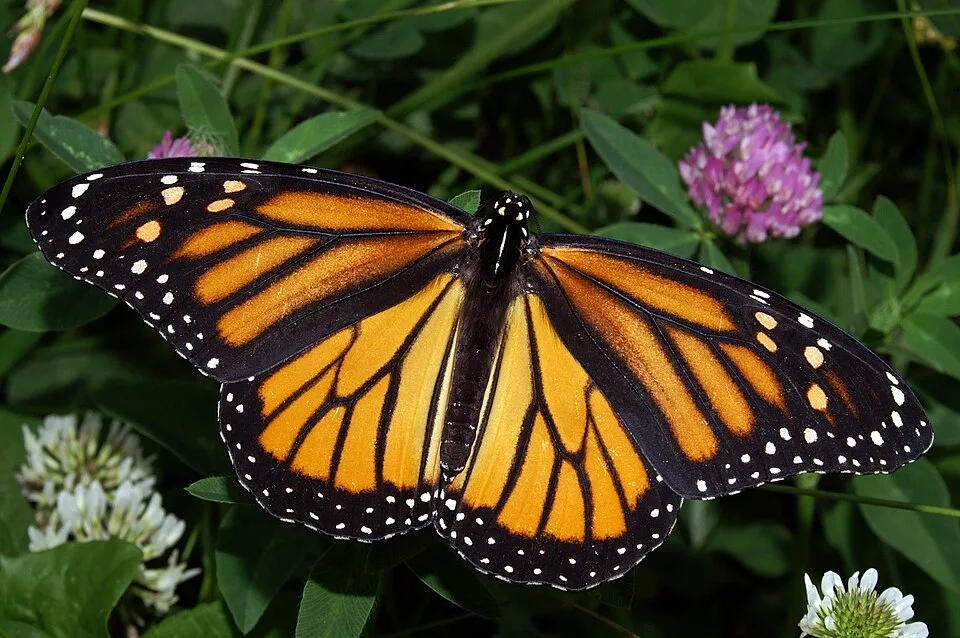
How do monarch butterflies navigate their 4,000-mile migration?
Among butterflies and moths, monarchs use a time-compensated sun compass located in their antennae combined with a magnetic compass sense to navigate up to 4,000 miles from southern Canada and the northern United States to overwintering sites in the oyamel fir forests of central Mexico.
There is a moment during the life of every butterfly and moth when the animal ceases to exist in any recognizable form. Inside the chrysalis or cocoon, the caterpillar - a crawling, leaf-eating tube of muscle and gut - dissolves itself into a biological soup. Organs liquefy. Muscles disintegrate. The creature that entered the pupal chamber is, by any functional definition, destroyed.
And from that destruction, something entirely new assembles itself: a winged adult with compound eyes, coiled proboscis, and scales that manipulate light at the nanometer level. It is not a renovation. It is a demolition followed by a complete rebuild, using the same raw materials.
This process - complete metamorphosis - is the defining miracle of the order Lepidoptera, the butterflies and moths. It is an order of staggering scale: over 180,000 described species and likely tens of thousands more awaiting formal description, making Lepidoptera the second-largest order of insects after Coleoptera (beetles). They inhabit every continent except Antarctica.
They range from the atlas moth, with a wingspan exceeding 25 centimeters, to micro-moths smaller than a grain of rice. They pollinate crops, produce silk, migrate thousands of miles, and sustain food webs from tropical rainforests to Arctic tundra.
Yet for all their familiarity - the monarch on the milkweed, the luna moth on the porch light, the silk moth in the Chinese mulberry grove - Lepidoptera remain among the most poorly understood insects relative to their ecological importance. Their decline, now well-documented across multiple continents, is a crisis that receives a fraction of the attention given to bees and other pollinators.
Understanding what butterflies and moths actually are, what they do, and what is happening to them requires looking past the aesthetic and into the biology.
Lepidoptera Diversity: A World Dominated by Moths
The name Lepidoptera comes from the Greek lepis (scale) and pteron (wing) - "scale-winged." Every butterfly and moth is covered in thousands of tiny overlapping scales, each a single modified hair cell, that produce the colors and patterns visible on their wings. This shared feature unites an otherwise extraordinarily diverse order.
Of the 180,000-plus known species, moths account for roughly 160,000 and butterflies for approximately 17,500. Moths outnumber butterflies by nearly 10 to 1. This ratio surprises most people, who tend to think of butterflies as the dominant group because they are diurnal and conspicuous, while the vast majority of moths fly at night and go largely unnoticed.
The distinction between butterflies and moths is, taxonomically, somewhat artificial. Butterflies are not a single evolutionary lineage separate from moths. Instead, the butterflies (superfamily Papilionoidea) are a relatively recent branch nested within the much larger and older moth radiation. In evolutionary terms, all butterflies are moths, but not all moths are butterflies - much as all squares are rectangles.
Butterfly vs. Moth: Key Differences
| Feature | Butterflies | Moths |
|---|---|---|
| Antennae | Thin, club-tipped | Feathery, tapered, or thread-like |
| Activity period | Mostly diurnal | Mostly nocturnal |
| Resting wing position | Folded vertically above body | Flat or tent-like against body |
| Body shape | Slender, relatively smooth | Stout, often densely furred |
| Pupation | Naked chrysalis | Often spun silk cocoon |
| Species count | ~17,500 | ~160,000+ |
| Color | Often brightly colored | Often cryptic (many exceptions) |
These distinctions hold as generalizations, but exceptions abound. The Madagascar sunset moth (Chrysiridia rhipheus) is among the most brilliantly colored Lepidoptera on Earth - rivaling any butterfly. The Australian regent skipper is a butterfly that looks and behaves more like a moth. Nature does not respect the categories we impose on it.
Metamorphosis: The Caterpillar Digests Itself
The metamorphosis of a caterpillar into a butterfly or moth is one of the most radical transformations in the animal kingdom. It is not a gradual reshaping. It is a process of near-total destruction followed by reconstruction from scratch, and understanding what actually happens inside the chrysalis or cocoon changes how one thinks about biological identity.
The process begins when the mature caterpillar, having consumed enough food to increase its body mass by as much as 3,000 times since hatching, stops eating and finds a suitable pupation site.
In butterflies, the caterpillar typically attaches itself to a branch or leaf with a silk pad and sheds its final larval skin to reveal the chrysalis - a hardened pupal case formed from the caterpillar's own exoskeleton. In moths, the caterpillar usually spins a cocoon of silk around itself before pupating inside.
What happens next is extraordinary. Specialized enzymes - primarily caspases and cathepsins - begin dissolving the caterpillar's body from the inside. Muscles break down. The digestive system disintegrates. The respiratory system, nervous system, and most internal organs are reduced to a protein-rich cellular soup. The caterpillar, as a functional organism, ceases to exist.
"The process of metamorphosis is not a gentle transition. The caterpillar's body is broken down into an almost amorphous mass of cells. It is, in a very real sense, a death and a rebirth within the same skin." - Bernd Heinrich, entomologist and author of The Homing Instinct (2014)
But within this soup, certain structures survive: imaginal discs. These are clusters of cells that have been present since the caterpillar first hatched from its egg but have remained dormant throughout the larval stage. Each imaginal disc is genetically programmed to develop into a specific adult structure.
There are discs for wings, discs for compound eyes, discs for legs, discs for antennae, discs for the proboscis, and discs for reproductive organs. Using the nutrient-rich liquid of the dissolved caterpillar as building material, these discs rapidly divide and differentiate, constructing the adult butterfly or moth from the molecular level up.
The entire process takes approximately 10 to 14 days in most temperate species, though it can range from a week to several months depending on species and environmental conditions. When the adult emerges - a process called eclosion - it pumps hemolymph (insect blood) into its crumpled wings, expanding them to full size, and waits for them to harden before taking its first flight.
Recent research has added a remarkable detail: some memories formed during the caterpillar stage appear to survive metamorphosis.
A 2008 study published in PLOS ONE by Georgetown University researchers demonstrated that tobacco hornworm moths trained as caterpillars to avoid a specific odor retained that aversion as adults - suggesting that at least some neural connections persist through the dissolution process [1]. How this is possible when most of the nervous system is rebuilt remains an open question.
The Monarch Butterfly: A Migration Beyond Belief
No butterfly has captured the human imagination more completely than the monarch (Danaus plexippus), and for good reason. The monarch undertakes one of the most extraordinary migrations in the animal kingdom - a journey of up to 4,000 miles (6,400 km) that spans multiple generations and requires navigational precision that science still cannot fully explain.
Each autumn, monarchs east of the Rocky Mountains begin flying south from their breeding grounds across southern Canada and the northern United States. They funnel through Texas and northeastern Mexico, eventually arriving at a handful of overwintering sites in the oyamel fir forests of the Transvolcanic Belt in central Mexico, at elevations of roughly 3,000 meters.
There, in an area spanning just a few dozen hectares, hundreds of millions of monarchs cluster on the branches of fir trees so densely that the trees bend under their weight and the forest floor becomes a carpet of orange and black wings.
The monarchs that arrive in Mexico in November are the "super generation" - individuals born in late summer that enter a state of reproductive dormancy called diapause, allowing them to live 8 to 9 months instead of the typical 2 to 6 weeks of summer generations. They do not breed during the overwintering period.
In March, as temperatures warm, they begin mating and flying north, laying eggs on milkweed plants in the southern United States before dying. Their offspring continue the northward journey, breeding and dying in succession, so that it takes 3 to 5 generations to repopulate the full breeding range by summer.
The autumn migrants that eventually return to Mexico have never been there before - they are the great-great-grandchildren of the butterflies that left Mexico the previous spring.
The navigational mechanism is extraordinary. Monarchs use a time-compensated sun compass - they track the position of the sun relative to the time of day, using circadian clocks located in their antennae. They also possess a magnetic compass that may serve as a backup during cloudy conditions. This dual navigation system allows them to maintain a consistent southwest bearing across thousands of miles of unfamiliar territory.
The Monarch Decline
The monarch migration is in crisis. Overwintering population surveys conducted by the World Wildlife Fund and the Mexican government have documented a decline of more than 80 percent since the mid-1990s. The overwintering population, measured by the hectares of forest occupied by roosting monarchs, peaked at approximately 18.19 hectares in the winter of 1996-1997. By the winter of 2013-2014, it had collapsed to just 0.67 hectares - the lowest ever recorded [2].
The primary driver of this decline is the loss of milkweed (Asclepias species) across the midwestern United States. Milkweed is the sole host plant for monarch caterpillars - female monarchs lay their eggs exclusively on milkweed, and the larvae feed exclusively on milkweed leaves.
The widespread adoption of herbicide-tolerant (Roundup Ready) crops in the early 2000s enabled farmers to apply glyphosate herbicide broadly across fields and field margins, eliminating milkweed from agricultural landscapes on a massive scale. Research published in Insect Conservation and Diversity estimated that milkweed in the Midwest declined by approximately 58 percent between 1999 and 2010 [3].
Additional threats include illegal logging in the Mexican overwintering forests, climate change (which alters the timing of migration and the availability of nectar sources), and severe weather events during migration. A single winter storm in March 2016 killed an estimated 6.2 million monarchs at overwintering sites.
"The monarch butterfly migration is a threatened phenomenon. The butterflies themselves are not yet endangered as a species, but the migration - one of the most spectacular natural events on the planet - is at genuine risk of disappearing." - Lincoln Brower, monarch butterfly researcher, University of Florida (2012)
Conservation efforts are now focused on milkweed restoration, with federal and state programs encouraging the planting of native milkweed species along roadsides, in gardens, and on conservation lands. The Monarch Joint Venture, a partnership of federal and state agencies and nonprofit organizations, has set a goal of restoring 1.8 billion milkweed stems across the monarch's breeding range.
Progress has been slow but measurable, with recent overwintering surveys showing modest recovery to approximately 2 to 3 hectares.
The Atlas Moth: The Largest Moth on Earth
The atlas moth (Attacus atlas) of Southeast Asia is the largest moth in the world by total wing surface area, with a wingspan reaching 25 to 30 centimeters (10 to 12 inches). The wing tips are curved and patterned in a way that closely resembles the head of a snake - a defensive adaptation believed to startle potential predators.
But the atlas moth's most striking biological feature is not its size. It is the fact that adult atlas moths have no mouth. They lack a functional proboscis entirely. They cannot eat. They cannot drink. The adult atlas moth survives entirely on the fat reserves accumulated during its caterpillar stage, and it lives for only 1 to 2 weeks as an adult - just long enough to find a mate and reproduce.
This is not a design flaw. It is an evolutionary strategy. By eliminating the need to feed, the adult atlas moth can dedicate all of its energy and behavior to reproduction. Males have enormous, feathery antennae capable of detecting female pheromones from distances of several kilometers. Once a male locates a female, mating occurs, the female lays her eggs on host plants, and both adults die shortly thereafter.
The entire adult phase is a sprint toward reproduction with no resources wasted on survival beyond the minimum necessary.
The Luna Moth: A Lime-Green Ghost
The luna moth (Actias luna) of eastern North America is one of the most visually striking insects on the continent. Its wings are a pale, luminous lime green, with long trailing tails on the hindwings and delicate eyespots. It has a wingspan of approximately 11 centimeters (4.5 inches) and a body covered in white fur.
Like the atlas moth, the adult luna moth has no functional mouthparts and does not eat. It lives for approximately one week as an adult, sustained entirely by larval fat reserves. Its sole purpose in the adult stage is to mate and lay eggs.
The luna moth's long hindwing tails serve a remarkable defensive function. Research published in the Proceedings of the National Academy of Sciences in 2015 demonstrated that the spinning tails create acoustic interference that disrupts the echolocation signals of hunting bats.
Bats targeting luna moths frequently strike at the tails rather than the body, tearing away the expendable wing extensions while the moth escapes unharmed [4]. This is one of the most elegant predator-prey adaptations documented in insects.
Luna moths were once common across the eastern United States but have become noticeably less abundant in many areas, likely due to light pollution (which disorients nocturnal moths and disrupts mating behaviors), pesticide use, and parasitism by the introduced tachinid fly Compsilura concinnata.
Hawk Moths: The Hummingbird Mimics
The family Sphingidae, the hawk moths (also called sphinx moths or hummingbird moths), comprises approximately 1,450 species distributed worldwide. They are among the most aerodynamically sophisticated insects on Earth.
Hawk moths hover in front of flowers with a precision that makes them nearly indistinguishable from hummingbirds at first glance. They extend a proboscis that in some species exceeds 30 centimeters (12 inches) in length - far longer than the moth's own body - to reach nectar deep inside tubular flowers.
Charles Darwin famously predicted the existence of such a moth in 1862 after examining a Madagascan orchid (Angraecum sesquipedale) with a nectar spur nearly 30 centimeters long. He reasoned that a moth with a correspondingly long proboscis must exist to pollinate it.
Forty-one years later, the Morgan's sphinx moth (Xanthopan praedicta) was described, confirming Darwin's prediction - one of the most celebrated examples of coevolution in biology.
Hawk moths are the fastest-flying Lepidoptera, with some species reaching sustained flight speeds of over 50 km/h (31 mph). The death's-head hawk moth (Acherontia atropos) - famous for the skull-like pattern on its thorax - can reach speeds of roughly 50 km/h and is one of the few moths capable of producing sound: it emits a loud squeak by forcing air through its proboscis.
Many hawk moth species are critical nocturnal pollinators. While bees and butterflies dominate daytime pollination, hawk moths fill the night shift, pollinating pale, fragrant flowers that open after dark - a syndrome called sphingophily. Jasmine, evening primrose, moonflower, and many orchid species depend heavily or entirely on hawk moth pollination.
Butterfly Wing Patterns: Structural Color and Evolutionary Strategy
The colors on butterfly and moth wings are produced by two fundamentally different mechanisms: pigmentary color and structural color.
Pigmentary colors result from chemical compounds in the wing scales that absorb certain wavelengths of light and reflect others. Melanins produce blacks and browns. Pterins produce whites and yellows. Ommochromes produce reds and oranges. These are "true" colors in the sense that they depend on the chemical composition of the scale.
Structural colors, by contrast, are produced not by chemistry but by physics. Nanoscale structures on the surface of the wing scales - ridges, layers, and photonic crystals spaced at intervals comparable to the wavelengths of visible light - create interference patterns that produce extraordinarily vivid, iridescent blues, greens, and purples.
The morpho butterflies of Central and South America are the most famous example: their wings contain scales with ridged nanostructures spaced approximately 200 nanometers apart, producing a metallic blue so intense that it is visible from hundreds of meters away. This blue is not a pigment. If you crushed a morpho wing into powder, the blue would vanish, because the nanostructures would be destroyed.
Eyespots and Mimicry
Wing patterns serve critical survival functions. Eyespots - circular patterns resembling vertebrate eyes - are found on the wings of numerous butterfly and moth species. Research has demonstrated that large eyespots on the forewings can startle predators by mimicking the eyes of an owl or other large animal, causing the predator to hesitate long enough for the butterfly to escape.
Smaller eyespots on the hindwings serve a different function: they deflect attacks toward the wing margins and away from the vulnerable body, sacrificing a piece of wing rather than life.
Mullerian mimicry among the Heliconius butterflies of the Neotropics is one of the most studied examples of co-evolution in entomology. Multiple Heliconius species, all genuinely toxic due to cyanogenic compounds accumulated from their passionflower host plants, have converged on nearly identical wing patterns.
This shared warning coloration - typically bold combinations of red, orange, yellow, and black - benefits all participating species because predators need to learn only one pattern to avoid all of them. When a bird eats a toxic Heliconius and becomes ill, it subsequently avoids every butterfly displaying that pattern, regardless of species. The result is a community of species that collectively educate predators, reducing per-species predation rates.
The Painted Lady: The World's Longest Insect Migration
While the monarch migration receives the most public attention, the painted lady (Vanessa cardui) may actually undertake the longest insect migration on Earth. Recent research using radar tracking, stable isotope analysis, and citizen science observations has revealed that painted ladies migrate from tropical Africa to the Arctic Circle and back - a round-trip distance of approximately 15,000 kilometers (9,300 miles), completed over 6 successive generations [5].
The painted lady is the most cosmopolitan butterfly in the world, found on every continent except Antarctica and South America. Unlike monarchs, which funnel to specific overwintering sites, painted ladies breed continuously as they move, with populations leapfrogging northward in spring and southward in autumn across a broad front.
The southward autumn migration was long overlooked because painted ladies fly at altitudes of 500 to 1,000 meters during the return journey - too high to be seen from the ground but detectable by entomological radar.
In some years, painted lady numbers are staggering. The 2009 migration across the Mediterranean saw an estimated 11 billion painted ladies crossing from North Africa into Europe.
Silk Moths: 5,000 Years of Sericulture
The domestic silk moth (Bombyx mori) is perhaps the most economically significant insect in human history after the honeybee. For over 5,000 years, beginning in Neolithic China, humans have cultivated silk moths for the production of silk - a practice called sericulture that shaped trade routes, empires, and global economics.
The silk itself is produced by the caterpillar (silkworm), which spins a cocoon of a single continuous thread of silk protein (fibroin coated in sericin) before pupating inside. A single cocoon contains approximately 900 meters (3,000 feet) of silk thread. To harvest the silk, the cocoon is typically heated to kill the pupa inside, then the thread is carefully unwound onto reels. Approximately 2,500 cocoons are required to produce a single pound of raw silk.
The domestic silk moth has been so thoroughly domesticated over millennia that it can no longer survive in the wild. Adult Bombyx mori have vestigial wings and cannot fly. The caterpillars cannot find food on their own and must be hand-placed on mulberry leaves. The species is entirely dependent on human care for its continued existence - a degree of domestication that exceeds even that of modern corn or wheat.
China dominated silk production for millennia, guarding the secret of sericulture so jealously that the penalty for smuggling silkworm eggs out of the country was death. According to tradition, the secret finally reached the Byzantine Empire around 550 CE when two Nestorian monks smuggled silkworm eggs out of China inside hollow bamboo canes. The Silk Road - the network of trade routes connecting China to the Mediterranean - derived its name from this single insect product.
Conservation: A Crisis Hidden in the Dark
The global decline of Lepidoptera is severe, accelerating, and disproportionately underreported. While bee declines have dominated public discourse on pollinator loss, butterflies and moths are declining at rates that are, in many regions, steeper.
A comprehensive study published in Science in 2019 found that the total biomass of flying insects in German nature preserves declined by 76 percent over 27 years - and Lepidoptera were among the hardest-hit orders [6]. In the United Kingdom, monitoring data spanning four decades shows that 41 percent of butterfly species experienced significant population declines between 1976 and 2019, and total moth abundance declined by approximately 33 percent over the same period [7].
The causes are multiple and synergistic:
Habitat loss is the primary driver. The conversion of meadows, grasslands, and hedgerows to intensive agriculture eliminates the diverse plant communities that caterpillars depend on as food sources and adults depend on for nectar.
Pesticides, particularly neonicotinoids, are devastating to Lepidoptera. These systemic insecticides are absorbed into all tissues of treated plants, including pollen and nectar, exposing butterflies and moths to sub-lethal doses that impair navigation, reproduction, and immune function. Research has linked neonicotinoid use to declines in multiple butterfly species, including the monarch.
Light pollution is a threat specific to moths and one that is growing rapidly. Artificial lights at night attract and disorient nocturnal moths, disrupting feeding, mating, and migration behaviors. Moths trapped in the orbit of a streetlight may exhaust themselves and die before reproducing, or they may become easy prey for bats and spiders that have learned to hunt near lights.
A 2021 study in Science Advances estimated that light pollution contributes to a 50 percent reduction in caterpillar populations in roadside grasslands compared to unlit areas.
Climate change is altering the timing of plant flowering and insect emergence in ways that create mismatches - butterflies may emerge before their host plants are available, or flowers may bloom before their moth pollinators are active.
The conservation of Lepidoptera requires a multi-front approach: preserving and restoring diverse native plant communities, reducing pesticide use in and around natural habitats, managing artificial lighting to minimize impacts on nocturnal species, and protecting specific critical habitats such as the monarch overwintering forests in Mexico and the migratory corridors used by painted ladies.
Every garden planted with native milkweed, every meadow left unmowed through autumn, every unnecessary outdoor light switched off after midnight is a small act of restoration in a world that desperately needs its moths and butterflies.
References
[1] Blackiston, D. J., Silva Casey, E., & Weiss, M. R. (2008). "Retention of Memory through Metamorphosis: Can a Moth Remember What It Learned as a Caterpillar?" PLOS ONE, 3(3), e1736.
[2] Semmens, B. X., Semmens, D. J., Thogmartin, W. E., et al. (2016). "Quasi-extinction risk and population targets for the Eastern, migratory population of monarch butterflies." Scientific Reports, 6, 23265.
[3] Pleasants, J. M., & Oberhauser, K. S. (2013). "Milkweed loss in agricultural fields because of herbicide use: effect on the monarch butterfly population." Insect Conservation and Diversity, 6(2), 135-144.
[4] Barber, J. R., Leavell, B. C., Keener, A. L., et al. (2015). "Moth tails divert bat attack: Evolution of acoustic deflection." Proceedings of the National Academy of Sciences, 112(9), 2812-2816.
[5] Hu, G., Lim, K. S., Horvitz, N., et al. (2016). "Mass seasonal bioflows of high-flying insect migrants." Science, 354(6319), 1584-1587.
[6] Hallmann, C. A., Sorg, M., Jongejans, E., et al. (2017). "More than 75 percent decline over 27 years in total flying insect biomass in protected areas." PLOS ONE, 12(10), e0185809.
[7] Fox, R., Dennis, E. B., Harrower, C. A., et al. (2021). "The State of Britain's Larger Moths 2021." Butterfly Conservation, Rothamsted Research, and UK Centre for Ecology & Hydrology.
Frequently Asked Questions
How do monarch butterflies navigate their 4,000-mile migration?
Monarch butterflies use a time-compensated sun compass located in their antennae combined with a magnetic compass sense to navigate up to 4,000 miles from southern Canada and the northern United States to overwintering sites in the oyamel fir forests of central Mexico.
Remarkably, the butterflies that make the southward journey in autumn have never been to Mexico before - they are the great-great-grandchildren of the monarchs that left Mexico the previous spring. This navigational information appears to be genetically encoded rather than learned, making the monarch migration one of the most extraordinary inherited behaviors in the animal kingdom.
What actually happens inside a chrysalis during metamorphosis?
Inside the chrysalis, the caterpillar essentially digests itself. Enzymes dissolve nearly all of the larval body into a nutrient-rich cellular soup, breaking down muscles, digestive organs, and most other tissues. However, clusters of previously dormant cells called imaginal discs survive this dissolution.
Each imaginal disc is pre-programmed to develop into a specific adult structure - one set for wings, another for eyes, another for legs, antennae, and so on. These discs use the protein-rich soup as raw material to build the entirely new body of the adult butterfly or moth. The entire process takes roughly 10 to 14 days in most species.
What are the main differences between butterflies and moths?
Butterflies typically have thin, club-tipped antennae, while moths generally have feathery or thread-like antennae. Butterflies are mostly diurnal and rest with their wings folded vertically above their bodies, while most moths are nocturnal and rest with wings flat or tent-like. Butterflies tend to have slender, less hairy bodies, whereas moths often have stout, furry bodies that help retain heat for nighttime flight.
However, these are generalizations with many exceptions - moths outnumber butterflies roughly 10 to 1 among the 180,000-plus known Lepidoptera species, and some moths are brightly colored day-fliers while some butterflies are drab and crepuscular.