
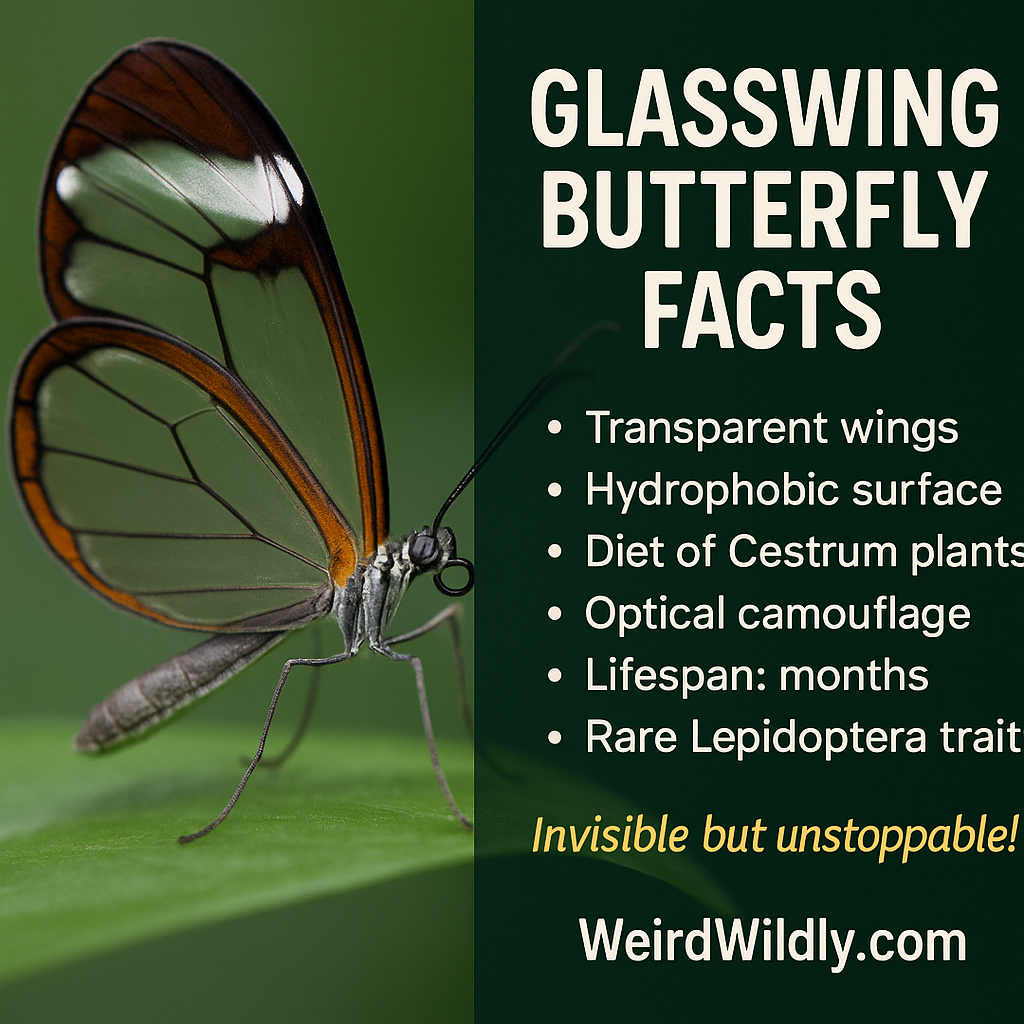
Quick Answer: The glasswing butterfly (Greta oto) is renowned for its transparent wings, which make it nearly invisible in its natural habitat. This remarkable adaptation results from unique wing structures that minimize light scattering, allowing the butterfly to evade predators. Native to Central and South America, the glasswing butterfly’s see-through wings have fascinated scientists and nature enthusiasts alike for their beauty and evolutionary significance.
The glasswing butterfly is one of the most striking examples of natural transparency among terrestrial animals. Its delicate wings, which appear almost invisible except for their dark brown edges, have inspired research in optics and biomimicry.
Unlike most butterflies, whose wings are covered in colorful scales, the glasswing’s wings lack pigmentation and are covered with microscopic structures that reduce reflection. This adaptation not only provides camouflage but also demonstrates the intricate interplay between form and function in evolution.
The species is found primarily in the tropical forests of Central and South America, especially from Mexico to Panama and into parts of Ecuador. Its preferred habitats include lowland rainforests, cloud forests, and forest edges where host plants are abundant. The glasswing butterfly’s lifecycle, feeding habits, and ecological interactions all contribute to its survival in these biodiverse environments.
Its transparent wings are not merely a visual marvel but a testament to the evolutionary pressures shaping the animal kingdom.
The Science Behind Transparent Wings
The glasswing butterfly’s most distinctive feature is its transparent wings. Transparency in animal wings is achieved through a combination of structural and chemical adaptations. In Greta oto, the wings are composed of chitin, like those of other butterflies, but they lack the dense, pigmented scales that give most butterflies their color.
Instead, the wings are sparsely covered with tiny, irregularly shaped scales and nanostructures that scatter light minimally, allowing most light to pass through.
These nanostructures are arranged in a way that reduces surface reflection, a phenomenon known as anti-reflective structuring. By minimizing reflected light, the wings become nearly invisible against a variety of backgrounds. This adaptation is particularly effective in the dappled light of forest understories, where the butterfly is most often found.
The unique wing structure has attracted attention from physicists and engineers interested in developing anti-reflective coatings for optical devices.
Key Insight: The glasswing butterfly’s wings transmit up to 80% of visible light, making them among the most transparent of any butterfly species.
Research into the microstructure of Greta oto’s wings has revealed that the scales are spaced irregularly and are much smaller than those of other butterflies. These scales are also covered with nanoscale pillars that disrupt light, further enhancing transparency. The combination of sparse scaling and nanostructuring is rare in Lepidoptera and is considered a remarkable evolutionary innovation. For more on the physics of transparency, see Britannica’s entry on butterfly wings.
The evolutionary advantage of transparency is primarily camouflage. Predators such as birds and lizards often rely on visual cues to locate prey. By blending seamlessly into the background, the glasswing butterfly reduces its risk of detection. This form of passive defense is complemented by other behaviors and adaptations, which will be explored in later sections.
Greta oto: Taxonomy and Distribution
Greta oto is a species within the subfamily Danainae, family Nymphalidae. The genus Greta comprises several species, but Greta oto is the most widely recognized due to its transparent wings. The species was first described in the 19th century and has since become a subject of interest in both scientific and popular literature. Its common name, glasswing butterfly, reflects its most notable physical characteristic.
The distribution of Greta oto extends from Mexico through Central America and into the northern regions of South America, including Colombia and Ecuador. The butterfly is typically found in tropical and subtropical forests, particularly in areas with abundant host plants for its larvae. The elevation range for this species varies, but it is most commonly observed at low to mid-elevations, up to about 1,500 meters.
A table summarizing key aspects of Greta oto’s taxonomy and distribution:
| Taxonomic Rank | Classification |
|---|---|
| Family | Nymphalidae |
| Subfamily | Danainae |
| Genus | Greta |
| Species | Greta oto |
| Common Name | Glasswing butterfly |
| Range | Mexico to Ecuador |
The glasswing butterfly’s range overlaps with a diverse array of other Lepidoptera, but its transparent wings make it uniquely adapted to its environment. The species is not currently listed as threatened, though habitat loss in some regions could impact local populations. The IUCN Red List provides updates on conservation status for many butterfly species, though Greta oto itself is not presently considered at risk.
Key Takeaway: Greta oto’s distribution across Central and South America reflects its adaptability to various forest habitats, provided that suitable host plants and microclimates are available.
Anatomy and Wing Structure
The anatomy of the glasswing butterfly is similar to that of other members of the Nymphalidae family, but its wing structure is highly specialized. The wings are elongated and delicate, with a span typically ranging from 5.6 to 6.1 centimeters. The most striking feature is the transparent central area, bordered by dark brown or orange margins. This contrast enhances the illusion of invisibility when the butterfly is at rest among foliage.
Butterfly wings are composed of two layers of chitinous membrane, supported by a network of veins. In Greta oto, the central wing areas lack the dense, pigmented scales found in most butterflies. Instead, the transparent regions are covered with minute, non-overlapping scales and nanostructures that reduce both pigmentation and light reflection. These adaptations are the result of evolutionary pressures favoring camouflage and predator avoidance.
The transparency is not absolute; under certain lighting conditions, the wings may appear slightly bluish or iridescent due to thin-film interference. However, in the dappled light of the forest, the wings are almost invisible. The dark borders serve to break up the outline of the wings, further aiding in concealment. This combination of transparency and disruptive coloration is rare among butterflies and has inspired biomimetic applications in materials science.
A closer look at the wing microstructure reveals:
- Sparse, irregularly shaped scales
- Nanoscale pillars that scatter light
- Minimal pigmentation in the transparent regions
- Robust veins providing structural support
Key Insight: The glasswing butterfly’s wing anatomy is a prime example of evolutionary adaptation for camouflage, combining structural and optical innovations.
The physical properties of the wings have been studied using electron microscopy and spectrophotometry, confirming their high degree of light transmission. These findings have implications for the design of anti-reflective materials and transparent coatings in technology. For further reading, see the Wikipedia page on Greta oto.
Life Cycle and Reproduction
The life cycle of the glasswing butterfly follows the typical pattern for Lepidoptera: egg, larva (caterpillar), pupa (chrysalis), and adult. Females lay their eggs singly or in small clusters on the leaves of specific host plants, primarily in the nightshade family (Solanaceae). The choice of host plant is crucial, as it provides both food and chemical defenses for the developing larvae.
Upon hatching, the caterpillars feed on the host plant leaves, ingesting toxic alkaloids that make them unpalatable to many predators. This chemical defense is retained through metamorphosis and provides some protection to the adult butterfly as well. The larvae are typically green with distinctive markings, allowing them to blend in with their surroundings. The pupal stage lasts about two weeks, after which the adult butterfly emerges with fully developed transparent wings.
A simplified overview of the glasswing butterfly’s life stages:
- Egg: Laid on host plants, hatches in about 5-7 days
- Larva: Feeds on leaves, accumulates chemical defenses
- Pupa: Undergoes metamorphosis, lasts 10-14 days
- Adult: Emerges with transparent wings, seeks nectar and mates
The reproductive strategy of Greta oto includes both chemical and behavioral defenses. Adults are known to participate in “puddling,” a behavior where butterflies seek out mineral-rich moisture to supplement their diet. Males, in particular, use these minerals to produce pheromones that attract females. The combination of visual camouflage and chemical deterrents enhances survival at each stage of the life cycle.
Key Takeaway: The glasswing butterfly’s life cycle integrates camouflage, chemical defense, and specialized behaviors to maximize reproductive success and survival in complex ecosystems.
Feeding Habits and Ecological Role
Adult glasswing butterflies feed primarily on nectar from a variety of flowering plants. Their long proboscis allows them to access nectar from deep or tubular flowers, making them effective pollinators in their habitats. In addition to nectar, adults may feed on rotting fruit, tree sap, and mineral-rich mud, behaviors that provide essential nutrients and support reproductive functions.
The larvae, as mentioned earlier, feed exclusively on host plants in the Solanaceae family. By ingesting toxic compounds from these plants, the caterpillars become distasteful to many predators. This chemical defense is a classic example of coevolution between insects and their host plants, with both parties influencing each other’s evolutionary trajectory.
The glasswing butterfly plays several important ecological roles:
- Pollinator: Facilitates the reproduction of flowering plants
- Prey species: Serves as food for birds, lizards, and other predators
- Chemical mediator: Influences plant-predator interactions through sequestration of toxins
Key Insight: The ecological role of Greta oto extends beyond its own survival, affecting plant communities and predator populations through its feeding and defensive strategies.
For more on butterfly ecology and pollination, see Britannica’s butterfly article.
Predator Avoidance and Defensive Strategies
Predation is a constant threat for butterflies, and Greta oto employs multiple strategies to avoid becoming prey. The primary defense is visual camouflage provided by the transparent wings. By reducing visibility, the butterfly can evade detection by visually hunting predators such as birds. The effectiveness of this camouflage is enhanced by the butterfly’s behavior, including slow, erratic flight and preference for shaded habitats.
In addition to visual defenses, chemical deterrence plays a significant role. As larvae, glasswing butterflies accumulate alkaloids from their host plants, which are retained in the adult stage. These compounds make the butterfly distasteful or even toxic to some predators. The combination of transparency and chemical defense is relatively rare among butterflies, making Greta oto an interesting subject for studies on predator-prey dynamics.
A summary of defensive strategies:
- Transparency: Reduces visual detection
- Chemical defense: Alkaloids deter predators
- Behavioral adaptations: Slow flight, selective habitat use
Key Takeaway: The glasswing butterfly’s survival strategy relies on a combination of physical, chemical, and behavioral defenses, illustrating the complexity of evolutionary adaptation.
Cultural Significance and Scientific Research
The glasswing butterfly has captured the imagination of people worldwide, inspiring art, literature, and scientific inquiry. Its transparent wings are often seen as symbols of fragility, invisibility, or transformation. In some cultures, the butterfly represents the soul or the fleeting nature of beauty, and Greta oto’s unique appearance has made it a popular subject in photography and natural history exhibitions.
From a scientific perspective, the glasswing butterfly is a model organism for research in optics, biomaterials, and evolutionary biology. Studies of its wing microstructure have led to advances in anti-reflective coatings and transparent materials.
The butterfly’s combination of transparency and chemical defense provides valuable insights into the evolution of multi-modal defense strategies in insects. For more on the cultural and scientific impact of butterflies, see the Wikipedia article on butterflies.
Key Insight: The glasswing butterfly exemplifies how natural adaptations can inspire technological innovation and cultural symbolism, bridging the gap between biology and human creativity.
Conservation Considerations
Although Greta oto is not currently considered endangered, its habitats are increasingly threatened by deforestation, agriculture, and urban development. The preservation of tropical forests in Central and South America is essential for maintaining healthy populations of glasswing butterflies and countless other species. Conservation efforts often focus on protecting critical habitats, promoting sustainable land use, and supporting community-based initiatives.
Habitat fragmentation can isolate populations and reduce genetic diversity, making species more vulnerable to environmental changes. The glasswing butterfly’s reliance on specific host plants also means that any decline in these plants could have cascading effects on butterfly populations. While Greta oto is adaptable, long-term survival depends on the health of entire ecosystems.
Key Takeaway: Protecting the glasswing butterfly requires a holistic approach to conservation, addressing both habitat preservation and the ecological networks that sustain biodiversity.
Glasswing Butterfly in Perspective
The glasswing butterfly stands out as a remarkable example of evolutionary ingenuity. Its transparent wings, chemical defenses, and specialized behaviors reflect the complex interplay between organisms and their environments. Greta oto’s adaptations have not only ensured its survival but have also provided inspiration for scientific and technological advancements.
The study of the glasswing butterfly continues to reveal new insights into the mechanisms of transparency, camouflage, and coevolution. As researchers uncover more about the genetic and developmental pathways underlying these traits, the butterfly remains a symbol of nature’s capacity for innovation. The ongoing fascination with Greta oto underscores the importance of preserving the natural world and supporting research that bridges biology, technology, and culture.
Final Thought: The glasswing butterfly invites us to look closer at the hidden wonders of the natural world, reminding us that even the most delicate creatures can have a profound impact on science, art, and conservation.
Frequently Asked Questions
How do glasswing butterflies achieve wing transparency?
Glasswing butterflies have wings with sparse scales and nanostructures that minimize light scattering, allowing most light to pass through and creating a transparent effect.
What plants do glasswing butterfly caterpillars feed on?
Glasswing butterfly caterpillars primarily feed on plants in the nightshade family (Solanaceae), which provide both nutrition and chemical defenses.
Are glasswing butterflies considered endangered?
Glasswing butterflies are not currently endangered, but habitat loss and deforestation in their native range could threaten local populations.
Why are glasswing butterflies important to their ecosystem?
Glasswing butterflies act as pollinators and serve as prey for various predators, playing a key role in maintaining ecological balance in tropical forests.
Can glasswing butterflies be found outside Central and South America?
Glasswing butterflies are native to Central and South America and are not found naturally outside this range.
What predators do glasswing butterflies face?
Birds, lizards, and some insects are common predators of glasswing butterflies, but transparency and chemical defenses help reduce predation.