
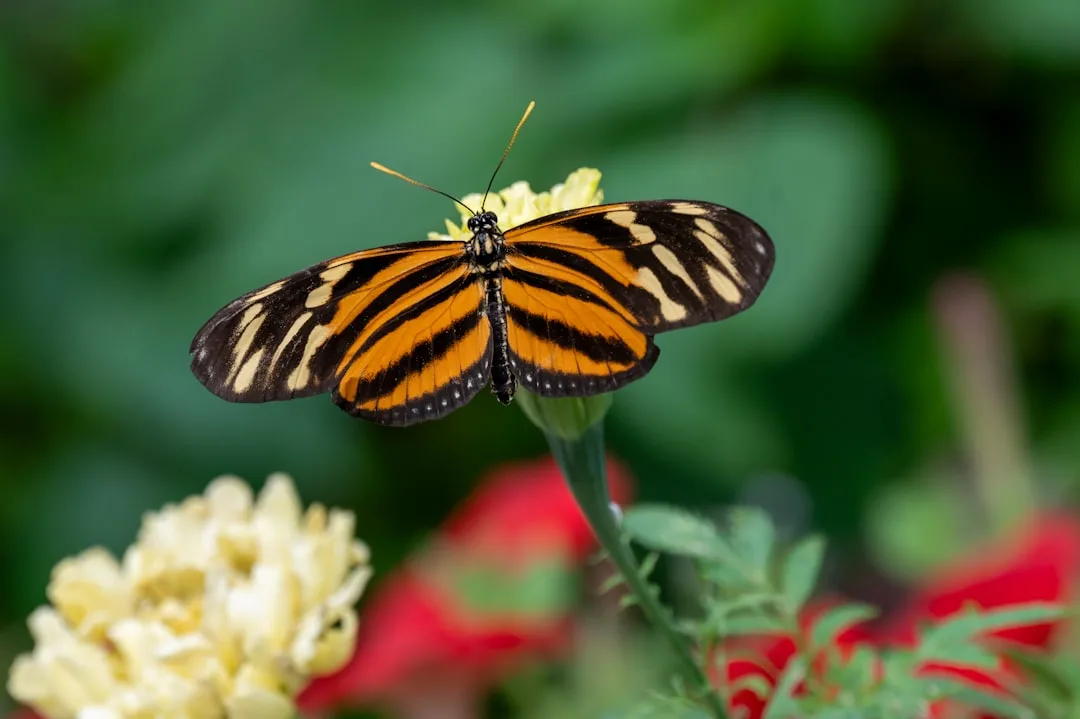
The eastern tiger swallowtail is one of the most familiar large butterflies of the Americas. Its yellow wings with bold black tiger stripes, its long hindwing tails, and its habit of sailing through suburban gardens on warm afternoons have made Papilio glaucus a defining insect of the eastern United States.
Six separate U.S. states have named it their official state butterfly - more than any other insect species has ever been honoured with.
Yet behind the recognisable adult lies a life history full of chemical warfare, disguise, and identity theft: caterpillars that pretend to be bird droppings, then snakes; females that split into two colour forms because one of them is pretending to be poisonous; males that drink from mud puddles to bribe their mates; and a hidden orange organ that every caterpillar can flip out of its own head when something grabs it.
This guide covers the full biology and ecology of the eastern tiger swallowtail: classification, physical description, the caterpillar's disguises, the osmeterium defence, the female dark morph, distribution, life cycle, hybrids with nearby species, behaviour, conservation status, and the cultural footprint that made P. glaucus a six-state symbol. It is written as a reference entry, so expect specific numbers - centimetres, days, percentages, states - rather than a breezy summary.
Etymology and Classification
The genus name Papilio is simply Latin for 'butterfly' and has been in use for the tiger swallowtails and their close relatives since Carl Linnaeus formally described the eastern tiger swallowtail in 1758. The species name glaucus refers to a pale, silvery, sea-like colour and reflects the pale ground colour seen in the type specimen. The common name 'swallowtail' comes from the long projections on each hindwing, which resemble the forked tail of a barn swallow.
The eastern tiger swallowtail sits in the family Papilionidae, which contains roughly 550 recognised species worldwide. That family includes the giant birdwing butterflies of Southeast Asia and the Pacific, the apollos of Eurasian mountains, and a number of tropical swallowtails. Within Papilionidae, the tiger swallowtails of North America form a tight group called the Papilio glaucus species complex. The full taxonomic placement is:
- Kingdom: Animalia
- Phylum: Arthropoda
- Class: Insecta
- Order: Lepidoptera
- Family: Papilionidae
- Genus: Papilio
- Species: P. glaucus
Closely related North American species in the same genus include the Canadian tiger swallowtail (Papilio canadensis) in the boreal north, the Appalachian tiger swallowtail (Papilio appalachiensis) in the southern mountains, and the western tiger swallowtail (Papilio rutulus) west of the Great Plains. These species were until recently lumped with P. glaucus and are still genetically close enough to produce fertile hybrids in their contact zones.
Size and Physical Description
The eastern tiger swallowtail is the largest butterfly native to the eastern United States. Wingspan in adults ranges from about 8 centimetres in small northern males to 14 centimetres in the largest southern females. The body is relatively slender - three to four centimetres long - and very light. An adult butterfly weighs only a few tenths of a gram, which is why a passing breeze can lift one the full way across a clearing.
The classic adult has a deep yellow ground colour on both wings, overlaid with four broad black 'tiger stripes' on each forewing and a heavy black border along the outer wing margin. The hindwings carry a blue band and a red or orange eyespot at the base of the tail, visible when the butterfly folds its wings over its back. The long black tail that gives the group its common name extends from each hindwing.
Males and yellow-form females look nearly identical at a glance, but close inspection shows sex differences:
- Males: Yellow ground colour, minimal blue scaling on the hindwings, thinner abdomen.
- Yellow-form females: Yellow ground colour, extensive blue iridescence along the inner edge of each hindwing, slightly broader abdomen.
- Dark-form females: Blackish wings with a faint ghost of the tiger stripes visible from certain angles, strong blue-and-orange markings on the hindwing, same body size as yellow females.
The caterpillar goes through five instars, each a radically different costume, discussed in its own section below.
The Caterpillar's Two Disguises
The eastern tiger swallowtail is famous among entomologists less for its adult wings than for what the caterpillar does over its three-week growth period. A newly hatched caterpillar is tiny, dark brown, and marked with a white saddle across the middle of its back. The pattern is not decorative. It is a near-perfect mimic of a fresh bird dropping: irregular dark-and-white smear, slight shine, about the right size.
Birds - which are the main daytime predator of caterpillars - tend to ignore bird droppings on leaves, and so they ignore the caterpillar too.
The bird-dropping disguise works only at small body sizes. Once the caterpillar grows past about two centimetres the illusion collapses, because real bird droppings do not grow that big. So P. glaucus swaps costumes. After the third moult the caterpillar becomes bright green, matching fresh foliage, and develops two enormous fake eyespots on the thorax.
Each eyespot is yellow with a black pupil, ringed with blue and white highlights. A dark band across the body between the eyespots mimics the gape of a mouth. Viewed from the front or from above, the caterpillar's head-end looks convincingly like the head of a small tree snake peering out from a leaf fold.
The intimidation effect is reinforced by the caterpillar's habit of resting in a silken pad on the top surface of a rolled leaf. From the perspective of a passing bird, a green snake's head is protruding from a dark shelter. Birds that specialise on caterpillars will typically shy away from anything with eyespots on that scale, and laboratory studies have shown that eyespot patterns alone - even on paper dummies - reduce bird attack rates significantly.
Just before pupating, the caterpillar changes colour again to dull brown, and its chrysalis mimics a broken twig, slightly curved and tan or grey. The chrysalis is the overwintering stage for the final brood of the year.
The Osmeterium: Chemical Defence at Will
Every swallowtail caterpillar, including P. glaucus, carries an extra line of defence that is not visible unless you scare one. Folded inside a transverse slit on the top of the first thoracic segment, just behind the head, is a forked, brightly coloured organ called the osmeterium. In the eastern tiger swallowtail it is bright orange.
When the caterpillar is grabbed, squeezed, or poked, it inflates the osmeterium using body fluid pressure. The organ flips inside out and extends upward like a V-shaped horn. Its surface is coated in a cocktail of volatile chemicals dominated by terpenes such as isobutyric and methylbutyric acids. To a human nose the smell is something between rancid cheese and strong citrus peel.
To small insect predators - ants, parasitoid wasps, mantises - it is repellent enough to send them backing off. Even birds frequently drop the caterpillar when the orange V appears.
The caterpillar can retract the osmeterium within a few seconds once the threat is gone. This is not a weapon the caterpillar uses casually - the chemicals are metabolically expensive to synthesise - but it is available on demand whenever the mimicry fails.
Osmeteria are a defining feature of the family Papilionidae. You will not find them in other butterfly families. In the field, flipping out a caterpillar's osmeterium with a gentle poke is one of the fastest ways to confirm that a suspect caterpillar is a swallowtail.
Female Dark Morph: Pretending to Be Poisonous
The eastern tiger swallowtail is one of the clearest living textbook examples of Batesian mimicry. Batesian mimicry is the phenomenon in which a harmless species copies the warning signals of a toxic one in order to scare off predators without paying the cost of actually being toxic.
In this case the model is the pipevine swallowtail (Battus philenor), a blackish butterfly with metallic blue hindwings and a wicked secret: its caterpillars feed on Dutchman's pipe vines in the genus Aristolochia, whose tissues contain aristolochic acids. The caterpillars store the toxin, the chrysalis keeps it, and the adult butterfly keeps it.
Birds that eat a pipevine swallowtail typically vomit within minutes and learn, permanently, to avoid anything that looks like one.
Female eastern tiger swallowtails come in two genetically controlled colour forms. The yellow form matches the male. The dark form drops most of the yellow and takes on a blackish colour with blue iridescence - a convincing imitation of the pipevine swallowtail.
The mimicry is not perfect (the dark female still shows a ghost of the tiger stripes under certain lighting), but it is close enough that naive birds shy away, and experimental studies have confirmed that dark-form females suffer fewer bird attacks than yellow-form females in areas where pipevine swallowtails are common.
The dark trait is controlled by a single gene on the W sex chromosome and is therefore inherited strictly from mother to daughter. The frequency of the dark morph tracks the range of the model species almost exactly. In Florida, Alabama, and Georgia - where pipevine swallowtails are abundant - dark females are common and may even be the majority. In New England and southern Canada - where pipevine swallowtails are absent - dark females are rare. Mimicry fades where the model disappears.
Habitat and Range
The eastern tiger swallowtail occupies a broad swath of eastern North America. Its northern limit runs through central Ontario and southern Quebec; the southern limit reaches central Florida. To the west it extends roughly to the edge of the Great Plains - eastern Texas, central Oklahoma, eastern Colorado, and eastern North Dakota - before giving way to the western tiger swallowtail.
Within that range, favoured habitats include:
- Deciduous and mixed forests with open canopies
- Forest edges and woodland clearings
- River and stream corridors with willows, cottonwoods, and ashes
- Orchards, parks, and suburban gardens
- Roadside verges with nectar-rich flowers
The species does not thrive in dense closed-canopy forest interiors (too dark for adult flight) or in treeless prairie (no host plants). It is remarkably tolerant of human-modified landscapes, and suburban neighbourhoods with mature trees and flowering gardens often hold strong populations.
Life Cycle and Reproduction
Papilio glaucus runs through a classic complete insect metamorphosis with four stages: egg, caterpillar, chrysalis, adult. The number of generations per year varies with latitude:
- Northern populations (Ontario, New England, Great Lakes): one generation per year
- Mid-latitude populations (mid-Atlantic, Midwest): two generations
- Southern populations (Gulf states, Florida): three generations
The egg is pale green, nearly spherical, about one millimetre across, and laid one at a time on the upper surface of a host-plant leaf. A female can lay up to about 250 eggs over her roughly two-week adult life. Eggs hatch in four to ten days depending on temperature.
The caterpillar grows through five instars over about three to four weeks. It starts as a bird-dropping mimic and transitions to a green snake mimic after the third moult, as described above. At the end of the fifth instar it changes colour to brown, wanders away from the host plant, and finds a twig or stem on which to pupate.
The chrysalis is roughly three centimetres long, mottled grey or brown, and shaped like a broken twig with subtle bumps. It is attached to the substrate by a silk pad on the tail end and a silk girdle around the middle. Summer chrysalises hatch in nine to eleven days. The final brood of the year overwinters as a chrysalis and hatches the following spring; some chrysalises can extend dormancy for a second winter if conditions are harsh.
The adult lives about two weeks. Its life consists of flight, nectar feeding, mud-puddling (males only), territory patrolling (males), and egg-laying (females). Courtship is brief and takes place in flight, with males locating females by visual pursuit of any large yellow or dark shape flying along edges.
The total life cycle from egg to adult is typically 30 to 60 days during warm months.
Mud-Puddling and Feeding Behaviour
Adult eastern tiger swallowtails feed almost exclusively from nectar. Favoured nectar sources include milkweeds, Joe-Pye weed, thistles, butterfly bushes, wild bergamot, and lilacs. The proboscis is a long coiled tube, up to two centimetres extended, that the butterfly unrolls to probe deep into flowers. At rest the proboscis spirals back up against the head.
One of the most striking behaviours of the species is mud-puddling. On warm afternoons male tiger swallowtails often gather in groups of five to thirty on patches of damp sand, mud, animal dung, or urine-soaked earth, sitting with wings held open. They are not drinking water. They are extracting dissolved sodium and amino acids that nectar alone cannot provide.
Sodium is a limiting nutrient for most butterflies, and male swallowtails need large amounts to produce the nutrient-rich spermatophore they transfer to females during mating. The female reroutes those minerals into her eggs, where they boost offspring survival.
Because females receive their sodium second-hand through mating, they rarely puddle themselves. A puddle cluster of tiger swallowtails is almost always an all-male gathering, and it is one of the most observable spectacles in eastern butterfly watching.
Hybrids and the Tiger Swallowtail Complex
The eastern tiger swallowtail sits at the centre of a group of closely related species that interbreed at their range boundaries:
| Neighbour species | Contact zone | Notes |
|---|---|---|
| Canadian tiger swallowtail | Southern Ontario, northern Great Lakes | Smaller, narrower forewing band |
| Appalachian tiger swallowtail | Southern Appalachian highlands | Intermediate size, later flight period |
| Western tiger swallowtail | Central Great Plains | Very limited contact, mostly parapatric |
Hybrids between P. glaucus and these neighbours produce intermediate wing patterns, intermediate flight periods, and occasional fertile offspring that blur the boundaries between the species. Genetic work has shown that the Appalachian tiger swallowtail is itself the product of ancient hybridisation between P. glaucus and P. canadensis, a textbook case of hybrid speciation in butterflies.
These contact zones are not static. Climate warming has shifted butterfly ranges north in recent decades, which is moving contact zones and altering hybrid frequencies. The eastern tiger swallowtail is therefore a live laboratory for studying how species respond to climate change at the level of gene flow.
Conservation Status
The IUCN Red List and national assessments list Papilio glaucus as Least Concern with a stable or slightly increasing population trend. The species benefits from:
- A broad range of acceptable host plants, which insulates it from local host declines
- Tolerance of suburban and edge habitats
- Wide geographic range spanning many climate zones
- No major parasitoid or pathogen threatening range-wide population
Localised pressures exist but none are pushing the species toward decline. Road mortality kills large numbers of butterflies in summer, particularly around breeding habitats. Pesticide drift from agriculture can reduce caterpillar survival near farmland. Climate shifts may compress or move contact zones with the Canadian and Appalachian swallowtails, which could alter the genetic structure of the species over decades.
Simple ways to support local populations include planting native host trees such as tulip tree, wild cherry, and ash; providing pesticide-free nectar flowers through the full flight season; leaving a patch of damp sandy soil for males to puddle; and leaving garden corners unraked through winter so that overwintering chrysalises are not destroyed.
Cultural Footprint: The Six-State Butterfly
No other insect in the United States carries as many official state symbols as the eastern tiger swallowtail. Six states have named it their official state butterfly or state insect:
- Georgia (state butterfly, adopted 1988)
- South Carolina (state butterfly, adopted 1994)
- Alabama (state butterfly, adopted 1989)
- Virginia (state insect, adopted 1991)
- North Carolina (state butterfly, adopted 2012)
- Delaware (state butterfly, adopted 1999)
The butterfly appears on state education materials, on postage, and on conservation signage across the southeast. Its selection reflects both its abundance and its sheer visual impact - a flash of ten-centimetre yellow-and-black wings sailing over a meadow is hard to miss. Its cultural ubiquity is matched by its ecological role: an abundant, generalist herbivore that feeds dozens of bird species through its caterpillar stage and pollinates hundreds of flower species as an adult.
The eastern tiger swallowtail is, in short, both a common backyard butterfly and an insect whose natural history rewards closer attention than most people give it. Between the bird-dropping caterpillar, the snake-eyed caterpillar, the orange osmeterium, the dark-form female pretending to be poisonous, the mud-puddle boys' club, and the six state legislatures that wrote it into law, Papilio glaucus is one of the richest small stories in North American entomology.
Related Reading
- Monarch Butterfly
- Blue Morpho
- Painted Lady
- Butterflies and Moths: Metamorphosis and the Art of Transformation
References
Relevant peer-reviewed and reference sources consulted for this entry include the Butterflies and Moths of North America (BAMONA) species account for Papilio glaucus, the Xerces Society pollinator conservation profiles, the IUCN Red List assessment for Papilio glaucus, and published research in the Journal of the Lepidopterists' Society, Evolution, and Ecological Entomology.
State butterfly adoption dates reflect the official statutes of Georgia, South Carolina, Alabama, Virginia, North Carolina, and Delaware.
Frequently Asked Questions
How big is the eastern tiger swallowtail?
Adult eastern tiger swallowtails (Papilio glaucus) have wingspans ranging from roughly eight to fourteen centimetres, or 3.1 to 5.5 inches, making them the largest butterfly native to the eastern United States. Females are generally a little larger than males, and southern populations average bigger than northern ones because warmer, longer summers allow caterpillars to feed longer before pupating.
Body length is usually three to four centimetres, and adults weigh only a few tenths of a gram - light enough that a gust of wind can carry them across a river valley. Caterpillars reach about five centimetres before pupating.
What do tiger swallowtail caterpillars eat?
Eastern tiger swallowtail caterpillars are generalist feeders that accept a wide variety of broadleaf trees. Favoured host plants include tulip tree (Liriodendron tulipifera), wild cherry (Prunus serotina), sweet bay magnolia, white ash, and several willow and birch species. Females test leaves by drumming with their forelegs, which carry chemosensory receptors, before laying a single pale green egg on the upper surface of a leaf.
The caterpillar eats that leaf and neighbouring leaves as it grows, rolling a leaf into a silk-lined shelter between feeding bouts. Adult butterflies do not chew at all - they drink nectar, sap, and occasionally fluids from dung or carrion through their coiled proboscis.
Where do eastern tiger swallowtails live?
Papilio glaucus occupies deciduous and mixed forests, forest edges, river corridors, parks, and flower-rich suburban gardens across eastern North America. The range stretches from central Ontario and southern Quebec south through the eastern United States to central Florida, and west roughly to the edge of the Great Plains - eastern Texas, eastern Colorado, and eastern North Dakota.
The species avoids dense closed-canopy forest interior and treeless prairie, preferring edges and openings where larval host trees and adult nectar plants both grow. In the south the butterfly produces three broods per year; in the north only one. Two closely related tiger swallowtails replace it at the northern (Canadian tiger swallowtail) and Appalachian high-elevation (Appalachian tiger swallowtail) edges of its range.
Why are some female eastern tiger swallowtails black?
Female Papilio glaucus come in two colour forms: the yellow form that matches the male, and a dark morph with blackish wings and faint blue iridescence along the hindwings. The dark morph is a Batesian mimic of the pipevine swallowtail (Battus philenor), whose caterpillars feed on toxic Aristolochia vines and store the poisons into adulthood.
Birds that have vomited after eating a pipevine swallowtail avoid anything that looks like one, including the harmless dark female tiger swallowtail. This mimicry is controlled by a single gene on the W chromosome and is inherited strictly from mother to daughter. Dark females are common in the southern United States where pipevine swallowtails actually live, and rare to absent in the north where the model species does not occur.
What is the osmeterium?
The osmeterium is a brightly coloured, fleshy, Y-shaped organ that all swallowtail caterpillars carry folded inside a slit just behind the head. When a caterpillar is grabbed, poked, or otherwise startled, it inflates the osmeterium with body fluid, everting the organ like a glove finger turning inside out.
The surface of the organ is coated with a cocktail of volatile terpenes that smell strongly of rancid butter or concentrated citrus to the human nose and are repellent to ants, small wasps, spiders, and birds. In the eastern tiger swallowtail the osmeterium is bright orange. The caterpillar can retract it within seconds once the threat has passed.
It is one of the most reliable field identification features for distinguishing a swallowtail caterpillar from any other butterfly family.
How long do eastern tiger swallowtails live?
Adult eastern tiger swallowtails live only about two weeks on the wing. That short adult life is spent almost entirely on reproduction - finding mates, feeding on nectar for energy, and, for females, laying up to about 250 eggs one at a time on scattered host plants. The whole life cycle from egg to adult takes roughly thirty to sixty days during warm months, so a southern population can cycle through three generations between spring and autumn.
The final autumn generation does not emerge as a butterfly at all; instead the caterpillar pupates and the chrysalis overwinters on a twig, hatching the following spring. Some chrysalises can remain dormant through two winters if conditions are harsh.
Why do eastern tiger swallowtails gather at puddles?
Male eastern tiger swallowtails are often seen clustering in groups of a dozen or more on wet sand, mud, dung, or the edges of shallow pools - a behaviour called ‘mud-puddling’. They are not drinking water. They are extracting dissolved sodium, nitrogen compounds, and amino acids that butterflies cannot get from nectar alone.
Males transfer a portion of these minerals to females in the spermatophore during mating, and the female routes the minerals into her eggs, where they boost offspring survival. Females rarely puddle because they receive their sodium second-hand. Puddling clusters are one of the most easily observed spectacles of butterfly behaviour and are an important lead if you are surveying swallowtail populations in the field.
Are eastern tiger swallowtails endangered?
The eastern tiger swallowtail is listed as Least Concern by the IUCN. Papilio glaucus remains abundant across the eastern United States and southern Canada, with no documented continent-wide decline. Its flexibility as a caterpillar - accepting many host trees - and its tolerance of suburban environments protect it from the kinds of habitat pressure that have pushed more specialised butterflies towards extinction.
However, some smaller threats apply: climate shifts may alter contact zones with the Canadian and Appalachian tiger swallowtails, road mortality kills large numbers of butterflies each summer, and pesticide drift from agriculture can affect caterpillar survival in farmland edges.
Gardeners can support local populations by planting native host trees and pesticide-free nectar flowers, and by leaving at least one corner of the yard unmowed through early spring so that overwintering chrysalises can hatch safely.