
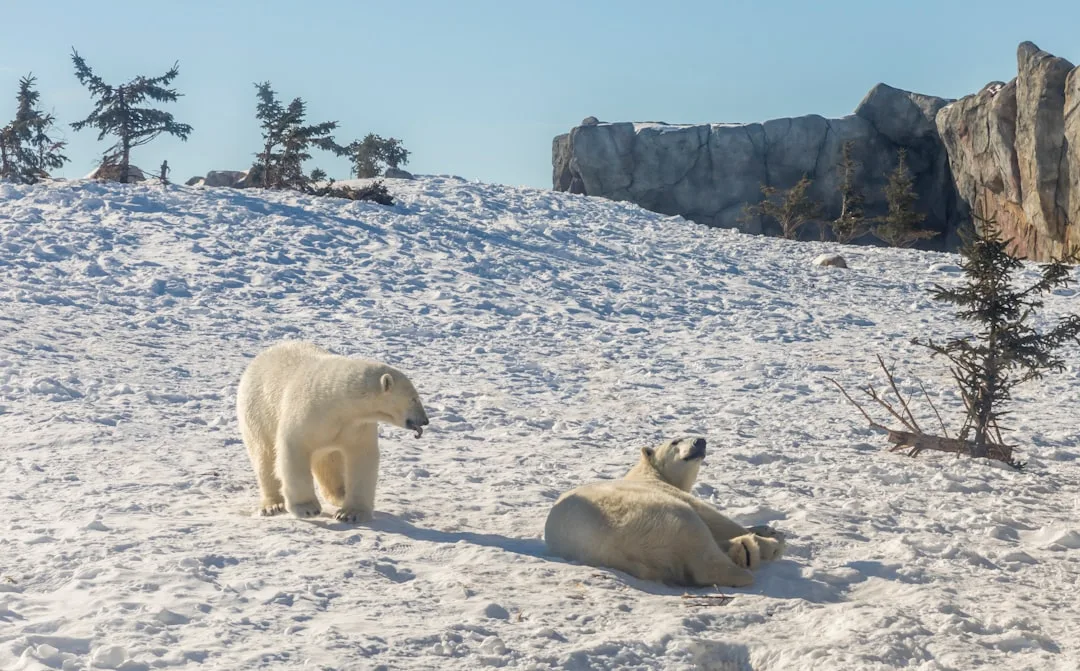
How dangerous are polar bears to humans?
Between 1870 and 2014, polar bears killed 20 people and injured 53 more across 73 documented attacks, according to Wilder et al. (2017) in the Wildlife Society Bulletin. The 15% fatality rate is roughly three times higher than for grizzly bears and seven times higher than for American black bears. Polar bears are the only bear species whose attacks are predominantly predatory rather than defensive, meaning the bear has actively chosen the person as a food source.
The Only Bear That Hunts You Back
Every bear on Earth is capable of killing a human. Only one routinely tries to eat one.
A grizzly that mauls a hiker is almost always surprised, protecting cubs, or defending a carcass. An American black bear that attacks usually wants to be left alone. Both species have lived alongside humans for thousands of years and learned, often painfully, that we are not worth the risk.
The polar bear, Ursus maritimus, did not get that lesson. It evolved on sea ice where the only large mammals in its world are seals, walruses, and whales. A seated researcher on tundra is, to an underfed polar bear in September, an unusually shaped seal. The bear processes the shape, notes the weight, and begins a purposeful stalk.
This is not a theoretical claim. It is the conclusion of the most comprehensive peer-reviewed survey of polar bear attacks ever assembled: James Wilder and a team of biologists from the United States Geological Survey, Parks Canada, and the Norwegian Polar Institute reviewed 144 years of attack records from every range state and published their findings in the Wildlife Society Bulletin in 2017.
This article unpacks those numbers, examines the case files, and explains the protocols that Arctic communities, research stations, and tour operators now use to keep both species alive. For the natural history of the animal itself, see our profile of the polar bear.
The Numbers: 73 Attacks, 20 Deaths, 144 Years
The Wilder et al. (2017) dataset is the anchor for every serious discussion of polar bear risk. Key totals:
- 73 documented attacks on humans between 1 January 1870 and 31 December 2014
- 20 fatalities and 53 non-fatal injuries
- Fatality rate: ~15% of all attacks
- Attacks recorded in all five range states: Canada, the United States (Alaska), Russia, Norway (Svalbard), and Greenland
- 15 of the 20 fatal attacks occurred between 1960 and 2014, tracking the post-war expansion of Arctic industry, research, and tourism
Attacks by Decade
The raw frequency has risen sharply since the 1960s. Part of this is better reporting. Part of it is real: more people in polar bear country, and, in the most recent decades, less sea ice keeping bears offshore.
| Decade | Documented Attacks | Fatal Attacks | Primary Driver |
|---|---|---|---|
| 1870-1959 | 13 | 4 | Historical expedition and Indigenous subsistence records; heavy under-reporting |
| 1960-1969 | 8 | 3 | Growth of Arctic oil exploration and research stations |
| 1970-1979 | 9 | 2 | Expansion of Inuit settlements and garbage-habituated bears |
| 1980-1989 | 7 | 1 | Community deterrent programmes begin in Churchill, Manitoba |
| 1990-1999 | 6 | 1 | Arctic tourism begins in Svalbard |
| 2000-2009 | 12 | 4 | Sea ice minimum records set; ice-free season lengthens |
| 2010-2014 | 15 | 5 | Steep rise; authors flag climate-driven conflict |
The 2010-2014 period alone accounted for more than one-fifth of all fatal attacks ever recorded, despite covering just 3% of the study window. Post-2014 events, including the 2018 Arviat fatality and the 2020 Svalbard fatality, suggest the trend has continued.
Attacks by Region
| Region | Attacks 1870-2014 | Notes |
|---|---|---|
| Canadian Arctic (Nunavut, NWT, Manitoba) | 24 | Largest subpopulation, most settlements |
| Svalbard (Norway) | 12 | High tourism pressure, small year-round population |
| Russian Arctic (Chukotka, Wrangel, Novaya Zemlya) | 19 | Likely under-reported; recent spike in Franz Josef Land |
| Alaska (USA) | 9 | Concentrated near Kaktovik and Utqiagvik |
| Greenland | 9 | Subsistence hunters most commonly affected |
Why Polar Bears Are Different
Wilder's team made a decisive finding that distinguishes their work from earlier summaries: the majority of polar bear attacks are predatory in motivation. The bear is hunting. It is not startled, protecting young, or defending food. The person is the food.
"Unlike brown and black bears, where most attacks are defensive, polar bear attacks on humans are primarily predatory. Bears in poor body condition were disproportionately represented among attackers, suggesting that food stress is a key driver."
- James Wilder et al., Wildlife Society Bulletin, 2017
Three biological and ecological factors explain this behaviour.
1. No Learned Fear of Humans
Black bears and grizzlies share their range with human hunters who have shot at them for millennia. Generations of selection pressure produced bears that run from the smell of people. Polar bears, living across remote sea ice and thinly populated coasts, never received this lesson in any consistent way. A sub-adult male encountering a human on a beach in August has no cultural memory telling him to flee.
He treats the encounter as he would any novel, pinniped-sized target: cautious interest, then assessment, then, if conditions allow, approach.
2. A Food-Scarce Environment
The Arctic produces very little per square kilometre. A polar bear must catch and eat roughly 43 ringed seals per year, or their caloric equivalent, to maintain mass and reproduce. Missing a single ice season can be fatal. Unlike grizzlies, polar bears cannot switch to berries, roots, salmon runs, or acorns at meaningful scale. When the ice leaves early, so does their food supply.
A hungry polar bear on land is not a curious scavenger. It is a carnivore running a deficit, and it will investigate any potential protein source with lethal attention.
3. Predatory Body Language
The behavioural cues that warn hikers in Yellowstone or the Great Smoky Mountains do not apply here. Polar bears do not huff, do not bluff charge, do not stand on hind legs to assess, and do not slap the ground. A stalking polar bear shows:
- Head held low, roughly at shoulder height, eyes locked on the target
- Ears flattened back against the skull
- Direct, purposeful approach in a straight line, often from downwind
- Absolute silence, with no vocalisation or warning
- Closing speed of 40 km/h once the stalk converts to a charge
If you see these signs, you have seconds, not minutes. For a broader comparison of how the two largest bear species handle humans, see polar bear vs grizzly bear.
Where Attacks Happen
Polar bear attacks cluster in three settings and one time of year.
The Ice-Free Summer (August to October)
Wilder et al. found that 69% of attacks occurred between July and December, with a sharp peak in August through October. This is precisely when sea ice retreats from coastlines, stranding bears ashore with no access to seals. A Southern Beaufort Sea bear that last ate in June is in an entirely different physiological state by late September.
Of the attackers whose body condition could be assessed, the majority were rated "thin" or "very thin". Bears in poor condition were roughly three times more likely to attack than bears at normal mass. More on the seasonal hunting cycle is covered in what do polar bears eat.
Settlements
Arctic communities draw bears for the same reason any human settlement draws wildlife: concentrated calories. Churchill, Manitoba, the self-styled polar bear capital of the world, experiences 30-50 bear encounters per autumn. Kaktovik, Alaska, sits beside the bowhead whale bone pile left by Inupiat hunters, and dozens of bears visit each fall.
Villages in Chukotka have recorded groups of 50-60 bears simultaneously, a situation unknown a generation ago. Most attacks on village residents occur at night, at the edge of the community, when someone is alone between buildings.
Research Stations and Field Camps
Science brings people into polar bear country in small, poorly defended groups. Field camps in Svalbard, on the Russian Arctic islands, and across the Canadian High Arctic have recorded multiple fatal attacks on researchers, students, and logistics staff.
Tourism
Expedition cruises, dog-sled trips, and ice-camping tours have placed tens of thousands of visitors in polar bear habitat since the 1990s. The 2011 Svalbard fatality, discussed below, involved a school expedition. Tour operators now routinely employ armed bear guards, but gaps remain.
Case Studies
These are not statistics. Each of the attacks below has a name attached and a family left behind. The details are drawn from coroner reports, official investigations, and contemporaneous press coverage.
Horatio Chapple - Svalbard, 5 August 2011
A British Schools Exploring Society expedition camped near Von Postbreen glacier on Spitsbergen. In the early hours, a large underweight male polar bear entered the camp. The group's tripwire alarm fence failed to detonate. The bear reached Horatio Chapple, a 17-year-old medical student bound for Cambridge, asleep in his tent and killed him before the group could respond.
The trip leaders fired a signal flare pistol that misfired, then engaged the bear with their rifle, killing it after four of the eight rounds fired failed to discharge. Four others suffered serious injuries. A post-mortem on the bear found badly worn teeth, low body fat, and no recent stomach contents, consistent with chronic food stress.
A 2013 coroner's inquest identified equipment failures and training gaps as contributing factors. The case remains the defining incident in Arctic expedition safety training.
Arviat, Nunavut - 3 July 2018
Aaron Gibbons, a 31-year-old father of three, was on a small island near Arviat on the western shore of Hudson Bay with his children when a polar bear approached. Gibbons placed himself between the bear and the children, shouted to his daughter to radio for help, and was killed. A relative arrived by boat and shot the bear. The attack occurred during the ice-free period and involved a bear in poor condition.
Western Hudson Bay is the most studied polar bear subpopulation in the world, and every metric, from cub survival to adult body mass, has been declining for three decades as sea ice forms later each year.
Ryrkaypiy, Chukotka - December 2019, and Franz Josef Land - 2021
The Russian Arctic has seen a sharp uptick in conflict. In December 2019 more than 50 polar bears converged on the village of Ryrkaypiy in Chukotka, feeding on walrus carcasses and prowling between houses. Schools were closed and residents were escorted by armed patrols. No human fatalities occurred in that incident, but the scale of the congregation, unthinkable a generation earlier, marked a shift.
In 2021 a meteorologist at a Russian research station on Alexandra Land in Franz Josef Land was seriously injured by a polar bear that entered the compound. Russian authorities increasingly attribute these incidents to the collapse of summer sea ice in the Barents and Kara Seas.
Wales, Alaska - 17 January 2023
A bear entered the community of Wales on the Seward Peninsula and killed a 24-year-old mother, Summer Myomick, and her one-year-old son Clyde Ongtowasruk outside the local school. Another resident shot the bear. The attack occurred during winter, not the typical August-October window, and involved a bear hundreds of kilometres from the nearest sea ice edge.
It was the first fatal polar bear attack in Alaska in more than 30 years and prompted a federal review of deterrent stocks and bear patrol funding in Bering Strait communities.
Deterrents: What Works in the Arctic
No protocol eliminates risk in polar bear country. The goal of modern Arctic safety is to layer deterrents so that each encounter has multiple chances to end without a dead bear or a dead human. The table below summarises the tools used by field operators in Canada, Svalbard, Alaska, and Greenland, with effectiveness ratings drawn from Wilder et al. (2017), the Polar Bear Technical Committee, and operator debriefs published by the Association of Polar Early Career Scientists.
| Deterrent | Typical Use Range | Field Effectiveness | Notes |
|---|---|---|---|
| Electric perimeter fence | Static camps | Very high when maintained | Must be tested daily; snow and frost can short the wire |
| Tripwire flare fence | Tent camps | Moderate | Failed in 2011 Svalbard; requires redundant charges |
| Bear dogs (Karelian, Greenland dog) | Settlements, remote camps | High, particularly for early detection | Trained dogs detect bears at 300-500 m |
| Cracker shells (bangers) | 30-80 m | Moderate to high | Effective on naive bears, less so on habituated ones |
| Rubber slugs from 12-gauge | 10-30 m | Moderate | Painful, non-lethal, can escalate aggression if misaimed |
| Flare pistol | 10-50 m | Low to moderate | Must ignite reliably; Svalbard misfire was a factor in 2011 |
| Bear spray (capsaicin) | 3-10 m | Data limited; effective in brown bear studies | Cold reduces spray range; not a primary defence in polar bear country |
| Large-calibre rifle (.30-06 or larger) | Last resort | Lethal when applied correctly | Required by Norwegian law outside Longyearbyen settlement area |
| Bear-resistant food storage | Static | Very high | Removes the initial attractant that draws bears in |
| Trained armed bear guard | Any group outside settlements | Highest overall | Standard practice for research and tourism operators |
The Order of Escalation
Every credible Arctic safety protocol, from Svalbard's Sysselmesteren rules to the Alaska North Slope Borough guidelines, follows the same escalation ladder:
- Detection. Keep watch. Use dogs, radar, and elevated observers. An encounter at 500 m is survivable; one at 10 m often is not.
- Deterrence at distance. Shout, cluster the group, fire cracker shells at roughly 30-40 m to turn the bear.
- Non-lethal contact. Rubber slugs and bear spray as the bear crosses into close range.
- Lethal defence. Large-calibre rifle fire to the chest or head, only if the bear continues to close and all other options have failed.
"The single most important factor in preventing fatal polar bear attacks is the presence of an alert, trained, and armed person on watch at all times when the group is in bear country. Equipment matters less than attentiveness."
- Polar Bears International, field safety briefing
What Does Not Work
- Running. Running triggers predatory pursuit. A polar bear reaches 40 km/h; no human outruns that. Details on polar bear running speed and swimming speed are in how fast can a polar bear run.
- Climbing trees. There are no trees in polar bear habitat. Ice hummocks and rocks provide no escape.
- Playing dead. Standard advice for a defensive grizzly encounter. It does not work with a predatory polar bear. The bear will begin to feed.
- Noise alone. Banging pots will drive off a startled black bear. A hungry polar bear may simply pause, reassess, and continue.
The Climate Connection
Polar bears are among the most visible casualties of Arctic warming, but the less photographed consequence is a measurable rise in human-bear conflict. The mechanism is direct. Less sea ice means longer summer fasts. Longer fasts mean thinner bears. Thinner bears are more willing to take risks. More risk-taking bears enter settlements, camps, and tourist routes.
Todd Atwood and colleagues at the United States Geological Survey have tracked this shift in the Southern Beaufort Sea subpopulation:
"Bears that spent more time on land during the ice-free period were in poorer body condition and more likely to be involved in human-bear interactions. As the ice-free season continues to lengthen, we expect the frequency of these interactions to increase."
- Todd Atwood, USGS Alaska Science Center, 2016
Andrew Derocher, who has studied polar bears at the University of Alberta for more than three decades, has made the same point in plainer language:
"A hungry polar bear is a dangerous polar bear. We are producing hungry polar bears faster than we are producing the tools to manage them."
- Andrew Derocher, Polar Bears: A Complete Guide to Their Biology and Behavior
The consequence is already visible in the statistics above: the five years from 2010 to 2014 saw more fatal attacks than the preceding three decades combined. For the broader picture of how sea ice loss is affecting the species, see why polar bears are endangered and polar bear populations and where they live.
Risk in Context
The risk of any given person being killed by a polar bear is, and remains, vanishingly small. There are roughly 22,000 to 31,000 polar bears on Earth and perhaps 4 million people living within their range. Fatal attacks average well under one per year globally. A traveller visiting Svalbard for a week is more likely to die from a snowmobile accident than a bear.
What the Wilder et al. data do show is that when an attack occurs, it is disproportionately lethal, and that the conditions producing attacks are becoming more common, not less. Arctic residents, researchers, and guides are not paranoid. They are calibrated. Their protocols evolved around real bodies.
If you plan to enter polar bear country, whether as a tourist, a researcher, or a journalist, the baseline requirement is an armed, trained, local guide who is awake when you sleep. Everything else, from bear spray to electric fences to flare pistols, is a secondary layer. The human who sees the bear first, at distance, in daylight, is the human who survives.
For comparison with other apex predators and the humans who share their range, you may also want to read grizzly bear: the North American predator and our coverage of tiger attacks on humans.
Readers interested in the cognitive testing and decision-making that keeps professional bear guards alive can explore situational awareness training resources at Whats Your IQ and expedition certification materials at Pass4-Sure. For lighter reading away from the Arctic, When Notes Fly covers music and culture.
Frequently Asked Questions
Are polar bears more dangerous than grizzly bears? Yes, on a per-encounter basis. Wilder et al. (2017) put the fatality rate for polar bear attacks at roughly 15%, compared with about 5% for grizzly attacks and 2% for American black bear attacks. The absolute number of attacks is far lower for polar bears because few humans share their range, but the outcome of those attacks is more severe. The predatory rather than defensive motivation explains the difference.
Do polar bears actually eat people they kill? In confirmed predatory attacks, yes. Multiple case files, including several Russian Arctic incidents and the 2018 Arviat attack, record the bear consuming portions of the victim before being shot or driven off. This is the single feature that distinguishes polar bears from every other North American bear species in the attack literature.
What is the warning sign of a polar bear stalk? Head held low at shoulder level, ears flattened back, a direct and silent approach from downwind, and closing distance in a straight line. If you see a polar bear doing this, it has already decided. Cluster the group, present as large, fire deterrents at 30-40 metres, and be prepared to use lethal force.
Can bear spray stop a polar bear? Bear spray has saved lives in grizzly encounters and probably works on some polar bears, but its short range (3-10 m), cold-sensitive propellant, and the predatory momentum of polar bear charges make it a secondary tool at best. Arctic operators carry spray but do not rely on it. A large-calibre rifle, handled by someone trained to use it calmly under pressure, is the decisive last line.
Are attacks increasing because of climate change? The evidence points that way. The most recent five-year window in the Wilder dataset (2010-2014) contained 15 attacks, more than any prior decade. Post-2014 fatal attacks in Nunavut, Svalbard, Russia, and Alaska have continued the trend. Atwood et al. (USGS) and Derocher (University of Alberta) have both linked the increase to lengthening ice-free periods and declining bear body condition.
References
- Wilder, J. M., Vongraven, D., Atwood, T., Hansen, B., Jessen, A., Kochnev, A., York, G., Vallender, R., Hedman, D., & Gibbons, M. (2017). Polar bear attacks on humans: Implications of a changing climate. Wildlife Society Bulletin, 41(3), 537-547. https://doi.org/10.1002/wsb.783
- Atwood, T. C., Peacock, E., McKinney, M. A., Lillie, K., Wilson, R., Douglas, D. C., Miller, S., & Terletzky, P. (2016). Rapid environmental change drives increased land use by an Arctic marine predator. PLOS ONE, 11(6), e0155932. https://doi.org/10.1371/journal.pone.0155932
- Derocher, A. E., Lunn, N. J., & Stirling, I. (2004). Polar bears in a warming climate. Integrative and Comparative Biology, 44(2), 163-176. https://doi.org/10.1093/icb/44.2.163
- Stirling, I., & Derocher, A. E. (2012). Effects of climate warming on polar bears: A review of the evidence. Global Change Biology, 18(9), 2694-2706. https://doi.org/10.1111/j.1365-2486.2012.02753.x
- Towns, L., Derocher, A. E., Stirling, I., Lunn, N. J., & Hedman, D. (2009). Spatial and temporal patterns of problem polar bears in Churchill, Manitoba. Polar Biology, 32(10), 1529-1537. https://doi.org/10.1007/s00300-009-0653-y
- Rode, K. D., Robbins, C. T., Nelson, L., & Amstrup, S. C. (2015). Can polar bears use terrestrial foods to offset lost ice-based hunting opportunities? Frontiers in Ecology and the Environment, 13(3), 138-145. https://doi.org/10.1890/140202
- Herrero, S., Higgins, A., Cardoza, J. E., Hajduk, L. I., & Smith, T. S. (2011). Fatal attacks by American black bear on people: 1900-2009. Journal of Wildlife Management, 75(3), 596-603. https://doi.org/10.1002/jwmg.72
- Molnar, P. K., Bitz, C. M., Holland, M. M., Kay, J. E., Penk, S. R., & Amstrup, S. C. (2020). Fasting season length sets temporal limits for global polar bear persistence. Nature Climate Change, 10(8), 732-738. https://doi.org/10.1038/s41558-020-0818-9
Frequently Asked Questions
How many people have been killed by polar bears?
Between 1870 and 2014, 73 documented polar bear attacks on humans killed 20 people and injured 53 more, according to the peer-reviewed survey by James Wilder and colleagues published in the Wildlife Society Bulletin in 2017 (DOI 10.1002/wsb.783). The fatality rate of roughly 15% is three times higher than for grizzly bears and seven times higher than for American black bears.
The authors caution that historical under-reporting from remote Arctic regions, especially Russia and Greenland, likely pushes the true total higher. Since 2014, further fatal attacks have been recorded at Svalbard (2020), Alaska (Wales, 2023), and in Nunavut (2018).
Do polar bears actually hunt humans as prey?
Yes. Polar bears are the only bear species that routinely treats humans as potential food rather than a threat. Wilder et al. (2017) classified the majority of attacks they analysed as predatory rather than defensive. Predatory polar bears approach from downwind with head held low, ears flattened, and a direct purposeful gait. They rarely huff, bluff charge, or vocalise first.
Grizzly and black bear attacks are overwhelmingly defensive, triggered by surprise encounters, cubs, or food sources. Polar bear attacks, in contrast, are typically initiated by a bear in poor body condition that has chosen the person as a calorie source.
How do you survive a polar bear encounter?
The first rule in polar bear country is never to be alone and never to be unarmed. Arctic field protocols require a trained bear guard with a large-calibre rifle, non-lethal deterrents such as rubber slugs, cracker shells, and flare pistols, plus bear-proof food storage and electric fencing around camps. If a polar bear approaches, do not run. Running triggers pursuit.
Cluster the group to appear larger, shout aggressively, fire warning deterrents at 30-40 metres, and escalate to lethal defence only if the bear continues to close. Playing dead, the standard advice for grizzly encounters, does not work with polar bears because the attack is predatory. Fight with anything available.