
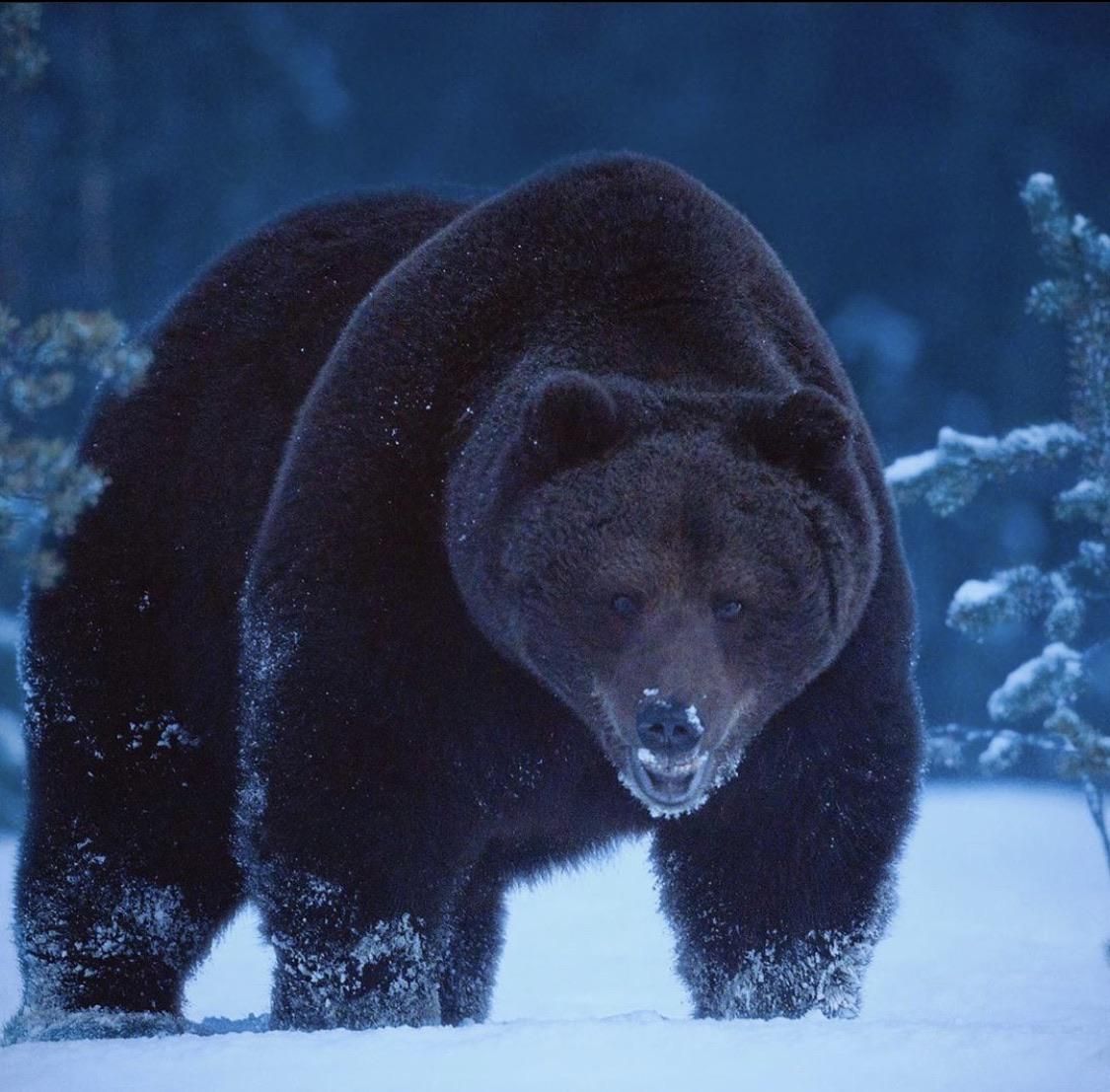
How big are grizzly bears?
Adult male grizzly bears weigh 180-360 kg (400-800 pounds) and stand 2-2. 8 meters when rearing on hind legs. Females are smaller at 130-180 kg and 1. 5-1. 7 meters standing. The largest grizzlies, particularly coastal Alaska brown bears (technically the same species), can exceed 450 kg. They stand about 1 meter tall at the shoulder on all fours.
360 Kilograms of Muscle and Jaw
A grizzly bear stands up on its hind legs in a Yellowstone meadow. Its full height reaches 2.5 meters. Its forelimbs end in 10-centimeter claws. Its jaw can exert 1,250 PSI of bite force. It weighs 300 kilograms.
Nothing else in Yellowstone can match it, not elk, not bison (though buffalo can escape via size and horns), not wolf packs (though wolves can harass it). The grizzly is the undisputed apex predator across most of its range.
It is also genuinely dangerous to humans who disturb it, which is why entire management systems have evolved around preventing human-grizzly conflict in bear country.
Size and Power
Grizzlies are among the largest land predators in North America.
Adult males:
- Weight: 180-360 kg (400-800 lbs)
- Standing height: 2-2.8 meters
- Shoulder height: 1 meter on all fours
- Largest subspecies (coastal Alaska): up to 680 kg
Adult females:
- Weight: 130-180 kg
- Standing height: 1.5-1.7 meters
- Significantly smaller than males
Key physical features:
Shoulder hump:
- Mass of muscle above shoulders
- Powers digging, fighting, and running
- Distinguishes grizzlies from black bears (which lack this)
Claws:
- 10 cm long on front paws
- Designed for digging and climbing
- Can puncture like knives
- Non-retractable (unlike cat claws)
Jaws:
- Bite force: ~1,250 PSI
- Comparable to adult lion
- 8x human bite force
- Can crush elk skulls
Running speed:
- Up to 55 km/h (34 mph) in short bursts
- Can outrun humans
- Slower than horses
- Can chase elk over short distances
Grizzly vs Brown Bear
Scientifically, "grizzly bear" and "brown bear" are different names for the same species.
The species:
Ursus arctos is the brown bear globally. Subspecies include:
- U. a. horribilis: grizzly bear (interior North America)
- U. a. middendorffi: Kodiak bear
- U. a. beringianus: Kamchatka brown bear
- U. a. arctos: Eurasian brown bear
- Many other subspecies
Naming convention:
- "Grizzly": interior North American bears (smaller, darker, grizzled fur)
- "Brown bear": broader term including coastal and European populations
- "Kodiak": specifically the largest North American subspecies
- "Peninsular giant": huge Alaskan coastal bears
All are genetically the same species. Differences result from geographic isolation and available food.
Size differences:
- Interior grizzlies: 200-300 kg (food-limited)
- Coastal brown bears: 400-700 kg (abundant salmon, seafood)
- Kodiak bears: 500-700 kg (largest subspecies)
Grizzly vs Black Bear
Grizzlies and American black bears are different species.
Physical differences:
| Feature | Grizzly | Black Bear |
|---|---|---|
| Size | 180-360 kg | 60-300 kg |
| Shoulder hump | Yes | No |
| Ears | Short, rounded | Tall, prominent |
| Claws | 10 cm | 4-5 cm |
| Facial profile | Dished | Straight |
| Color | Blonde to black | Black to blonde |
Behavior differences:
- Grizzlies: more aggressive, stand ground, defend cubs and food
- Black bears: more likely to flee, rarely aggressive unless cornered
- Grizzlies: require large wilderness areas
- Black bears: thrive in developed landscapes
Attack rates:
- Grizzly attacks on humans: <10 per year in North America
- Black bear attacks: <5 per year across larger range
- Fatalities: grizzlies disproportionate due to aggression
Where They Live
Grizzly bear range has dramatically contracted.
Historical range:
Western North America from Alaska to northern Mexico:
- Alaska (still present)
- Western Canada (still present)
- Rocky Mountains (reduced)
- Great Plains (extinct)
- Mexico (extinct)
- Contiguous US west (severely reduced)
Current US populations:
The lower 48 states have ~2,000 grizzlies in distinct ecosystems:
Greater Yellowstone Ecosystem:
- ~1,000 bears
- Wyoming, Montana, Idaho
- Recovered from ~200 in 1970s
- Best-studied grizzly population
Northern Continental Divide Ecosystem:
- ~1,000 bears
- Glacier National Park and surroundings
- Healthy breeding population
Smaller populations:
- Cabinet-Yaak (~50 bears)
- Selkirks (~50 bears)
- North Cascades (likely none, may be reintroduced)
Canada:
- ~25,000 grizzlies total
- British Columbia: largest population
- Yukon, Northwest Territories, Alberta: significant populations
- Protected status varies by province
Alaska:
- ~30,000 grizzlies
- Largest grizzly population in North America
- Coastal and interior variants
- Minimal threats, stable population
Hunting and Diet
Grizzly diets are extraordinarily varied.
Overall diet composition:
Approximately:
- 60-90% plant material
- 10-40% animal material
Plant foods:
- Berries (crucial in fall)
- Roots and tubers
- Grasses and forbs
- Pine nuts (critical in some regions)
- Acorns and other mast
Animal foods:
- Elk (calves especially)
- Deer
- Bison (rare but documented)
- Salmon (coastal populations)
- Trout
- Ground squirrels
- Insects (especially ants and bees)
- Carrion
- Occasional wolves or wolf kills
Seasonal variation:
Spring:
- Newly emerged grasses
- Spring berries
- Fish runs where available
- Winter-killed carrion
Summer:
- Berries become abundant
- Fish where seasonal
- Small mammals
- Insects
Fall (hyperphagia):
- Eat up to 20,000 calories daily
- Maximum berry consumption
- Pre-hibernation feeding
- Weight gain of 20-30% body weight
Winter:
- Hibernation (typically)
- Some activity in warmer climates
- Living off fat reserves
Hunting Behavior
Grizzlies hunt opportunistically but can target large prey.
Elk hunting:
When grizzlies kill elk, they typically:
- Approach resting herd
- Rush selected target (often calves or injured adults)
- Knock down with paw strikes
- Kill with bite to neck or head
- Cache remains for later consumption
Salmon fishing:
Coastal grizzlies during salmon runs:
- Wade into rivers
- Catch fish with mouth or claws
- May eat only choice parts (eggs, skin)
- Can eat 30+ salmon per day
Caching:
Grizzlies bury large kills:
- Covers carcass with dirt and vegetation
- Returns to eat over days or weeks
- Defends cache aggressively
- Sometimes share with offspring
Predation vs scavenging:
Studies show grizzlies vary:
- Some are active predators
- Others primarily scavenge kills from wolves/other predators
- Regional differences based on prey availability
- Age and size affect predatory capability
Behavior Around Humans
Most grizzly-human interactions end safely.
Typical encounters:
- Bear detects human, moves away
- Human sees bear at distance, departs safely
- No contact, no conflict
Surprise encounters:
Most dangerous scenario, humans surprising bears at close range:
- Stop, don't run
- Identify yourself as human (talk calmly)
- Back away slowly
- Do NOT make direct eye contact
- Give the bear space
Defensive aggression:
Bear may charge or bluff-charge to defend:
- Cubs
- Food cache
- Personal space
Predatory behavior:
Rare but more serious:
- Bear follows persistently
- Shows focused interest
- Ignores deterrents
- Approaches despite opposition
Bear spray:
- 98% effective at stopping attacks
- Range: 5-10 meters
- Aim for face
- Can stop both defensive and predatory attacks
Attack Survival
What to do if attacked depends on attack type.
Defensive attack (most common):
Bear is startled, protecting something, or feeling threatened:
- Play dead
- Lie flat on stomach
- Hands clasped behind neck
- Legs spread (prevent rolling)
- Remain still until bear leaves
- Wait even after bear seems gone
Predatory attack (rare):
Bear is stalking, sees you as prey:
- Fight back with everything
- Aim for face and eyes
- Use sticks, rocks, bare hands
- Don't play dead (this encourages the bear)
- Make yourself seem threatening
How to tell the difference:
Defensive bear:
- Sudden, angry-looking aggression
- Clear trigger (cubs, food, surprise)
- Attacks quickly and leaves
- Won't continue once target is "neutralized"
Predatory bear:
- Calculating, patient approach
- No apparent trigger
- Stalking behavior
- Continues attacking actively
Hibernation
Grizzlies spend winter in profound sleep.
When:
- Late October to early December (enter)
- March to April (emerge)
- Duration: 3-7 months depending on location
Preparation:
During fall hyperphagia:
- Eat 20,000+ calories daily
- Gain 20-30% body weight
- Build fat reserves for survival
- Finish den preparation
Den:
- Usually a cave or dug burrow
- Often on north-facing slopes (snow cover insulation)
- Entrance sealed by snow and bear positioning
- Uses same den sometimes multiple years
Physiological changes:
- Body temperature drops slightly (not dramatic)
- Heart rate drops 5-80 beats per minute
- Metabolism reduces 50-75%
- Urine/feces production ceases
- Can wake quickly if disturbed
Emerging:
- Males typically emerge first
- Females with newborn cubs emerge later
- Immediately seek food
- Gradual return to normal activity
Reproduction
Grizzly reproduction is slow and complex.
Basics:
- Sexual maturity: 4-6 years
- Gestation: 180-270 days (with delayed implantation)
- Cubs per litter: 1-3 typical, 4 rare
- Birth: during hibernation (January)
- Dependence: cubs stay with mother 2-3 years
Delayed implantation:
Bears mate in summer but eggs don't implant until fall. If female isn't fat enough, embryos reabsorb and no cubs born.
Hibernation births:
Cubs born tiny (300-500 g) during mother's hibernation:
- Mother wakes briefly to nurse
- Cubs grow rapidly on rich milk
- Emerge in spring weighing 7-10 kg
Cub mortality:
- Very high in first year (~50%)
- Predation by male bears (infanticide)
- Starvation if mother inadequate
- Various diseases
Conservation Status
Grizzlies face complex conservation challenges.
US Lower 48:
Listed as Threatened under Endangered Species Act since 1975.
- Greater Yellowstone: recovered, petitions to delist
- Northern Continental Divide: recovered
- Cabinet-Yaak: small population, listed
- Selkirks: small population, listed
- North Cascades: nearly extinct
Alaska:
Not listed. Stable population ~30,000.
Canada:
Not listed federally. Various provincial protections.
Threats:
- Habitat loss and fragmentation
- Vehicle collisions
- Conflicts with livestock operations
- Human-caused mortality
- Climate change affecting food
- Poaching
Conservation efforts:
- Habitat protection (designated wilderness)
- Population monitoring
- Conflict prevention programs
- Research into bear behavior
- Public education
Delisting debate:
Greater Yellowstone Ecosystem grizzlies have been delisted and relisted multiple times. The debate involves:
- Population viability
- Genetic diversity
- Connection between populations
- Climate change impacts
- Hunting management
Cultural Importance
Grizzlies hold strong cultural positions.
Indigenous cultures:
Many Native American tribes held grizzlies in high regard:
- Spiritual beings
- Models of strength and wisdom
- Featured in creation stories
- Subjects of hunting ceremonies
- Symbols of warrior traditions
Western culture:
- California state symbol (ironic given extinction there)
- Widely featured in Western literature and movies
- Symbol of American wilderness
- Subject of major conservation debates
- Popular in nature documentaries
Scientific importance:
- Icons of conservation biology
- Study subjects for ecology, behavior, hibernation
- Models for understanding large predator recovery
- Tests of wildlife management theory
Living With Grizzlies
Successful coexistence requires specific practices.
In bear country:
- Hike in groups
- Make noise while hiking
- Carry bear spray and know how to use it
- Proper food storage (bear-proof containers)
- Watch for bear sign (tracks, scat, digs)
- Know the difference between defensive and predatory bears
- Respect bears from distance
Home and community:
- Secure garbage
- Store food properly
- Remove attractants (bird feeders, pet food)
- Report bear conflicts
- Support conflict prevention programs
Development impacts:
Growing human development in bear country:
- Subdivisions in grizzly habitat
- Recreational pressure
- Road construction
- Energy development
- Tourism growth
All create conflict opportunities. Bear-human coexistence requires ongoing management and adaptation.
The Recovery Story
Grizzly bears represent a major conservation success with ongoing challenges.
1900:
Estimated 50,000+ grizzlies in contiguous US.
1975:
Estimated 1,000 grizzlies in contiguous US. ESA listing saved the species from US extinction.
2024:
~2,000 grizzlies in contiguous US. Yellowstone ecosystem recovered.
Ongoing work:
- Maintaining connectivity between populations
- Reducing human-caused mortality
- Climate change adaptation
- Continued habitat protection
- Managing human encounters
Grizzlies are one of the few large carnivores to have recovered significantly in the US Lower 48. Their recovery demonstrates that wildlife conservation, habitat protection, and species management can work even for large, dangerous predators.
Whether this recovery continues, or population levels begin declining again under modern pressures, depends on continued commitment to grizzly conservation across federal, state, and local levels.
Each grizzly in Yellowstone, Glacier, or elsewhere represents both evolutionary heritage and conservation achievement. Seeing one in the wild is experiencing an animal that 50 years ago was nearly extinct in the US - and still requires human choices to persist.
Grizzly Subspecies and Regional Variation
The brown bear (Ursus arctos) is distributed across the Northern Hemisphere and shows remarkable regional variation in size, coloration, and behavior. The Kalenux Team compiled the major subspecies data from peer-reviewed mammalogy literature.
| Subspecies | Common Name | Weight (males) | Primary Range |
|---|---|---|---|
| U. a. horribilis | Grizzly bear | 180-360 kg | Western North America |
| U. a. middendorffi | Kodiak bear | 360-680 kg | Kodiak Archipelago, Alaska |
| U. a. gyas | Peninsular brown bear | 400-750 kg | Alaska Peninsula |
| U. a. arctos | Eurasian brown bear | 100-300 kg | Europe, western Siberia |
| U. a. beringianus | Kamchatka brown bear | 250-600 kg | Kamchatka, Russia |
| U. a. lasiotus | Ussuri brown bear | 300-500 kg | Russian Far East, northern China |
| U. a. isabellinus | Himalayan brown bear | 150-250 kg | Himalayas, Karakoram |
| U. a. syriacus | Syrian brown bear | 90-240 kg | Caucasus, Middle East |
"The Kodiak bear is essentially a coastal grizzly that has had access to salmon for the last 10,000 years. The protein-rich diet and the isolation of the Kodiak islands has produced the largest-bodied subspecies of brown bear on Earth. A large male Kodiak bear weighs more than twice as much as a similarly aged interior grizzly." - Charles Robbins, Washington State University Bear Center, Ecological Monographs, 2015 [1]
Salmon availability is the primary driver of regional body size. Coastal bears with access to salmon grow two to three times as large as interior bears with the same genetics. This illustrates how a single ecological factor - access to high-calorie marine protein - can drive enormous phenotypic variation within a single species.
Grizzly-Polar Bear Hybrids: The Pizzly
One of the most striking consequences of climate change on arctic wildlife is the emergence of grizzly-polar bear hybrids, colloquially known as "pizzlies" or "grolar bears." As grizzlies expand northward into traditional polar bear territory and polar bears spend more time on land due to sea ice loss, the two species increasingly encounter each other during mating season.
"We have now documented at least eight confirmed hybrid grizzly-polar bears in Canadian Arctic populations since 2006. All are descended from a single female polar bear who apparently chose to mate with a migrating grizzly male rather than compete for her own species' limited mates. The hybrids are fertile and have produced second-generation offspring." - Geoff York, Polar Bears International, Arctic Science, 2022 [2]
The hybrids show an intermediate appearance, with creamy-white fur, slightly hunched shoulders, and intermediate skull morphology. They behave more like grizzlies than polar bears, feeding on land prey and showing less specialization for ice hunting. Whether hybridization will become common enough to produce a stable new lineage is unknown, but the phenomenon illustrates how climate change is blurring boundaries between species that diverged hundreds of thousands of years ago.
The Yellowstone Case Study
Yellowstone National Park and the surrounding ecosystem have become the most intensively studied grizzly population in the world. The Interagency Grizzly Bear Study Team, established in 1973, has tracked individual bears through radio-collar and GPS telemetry, monitored population demographics through DNA fingerprinting, and documented ecological interactions from salmon runs (now extinct in the region) to whitebark pine seed availability.
The Yellowstone population has grown from approximately 136 bears in 1975 to more than 1,000 today. This recovery is among the most successful in the history of the Endangered Species Act. However, the population remains isolated from other grizzly populations, raising long-term concerns about genetic diversity.
Researchers have proposed corridors connecting Yellowstone to grizzlies in the Northern Continental Divide Ecosystem, but implementing such corridors requires cooperation across state lines, private land, and Native American reservations.
The delisting debate continues. Scientists disagree about whether the Yellowstone population is large enough and genetically healthy enough to withstand removal from federal protection. The issue has been litigated multiple times and remains unresolved.
References
- Robbins, C. T., et al. (2015). "Salmon availability and brown bear body size." Ecological Monographs, 85(3), 453-475.
- York, G., Rode, K. D., and Thiemann, G. W. (2022). "Confirmed cases of grizzly-polar bear hybrids in the Canadian Arctic." Arctic Science, 8(3), 555-567.
- Pyare, S., Cain, S., Moody, D., Schwartz, C., and Berger, J. (2004). "Carnivore recolonisation: reality, possibility and a non-equilibrium century for grizzly bears in the southern Yellowstone ecosystem." Animal Conservation, 7(1), 71-77.
- Mattson, D. J., Blanchard, B. M., and Knight, R. R. (1991). "Food habits of Yellowstone grizzly bears, 1977-1987." Canadian Journal of Zoology, 69(6), 1619-1629.
- McClelland, C. J. R., et al. (2022). "Large carnivore response to global environmental change." Conservation Biology, 36(4), e13921.
Related Articles
Frequently Asked Questions
How big are grizzly bears?
Adult male grizzly bears weigh 180-360 kg (400-800 pounds) and stand 2-2.8 meters when rearing on hind legs. Females are smaller at 130-180 kg and 1.5-1.7 meters standing. The largest grizzlies, particularly coastal Alaska brown bears (technically the same species), can exceed 450 kg. They stand about 1 meter tall at the shoulder on all fours. Males continue growing throughout life, while females reach peak size around age 8-10.
Their distinctive shoulder hump is a mass of muscle that powers their digging and fighting. Their claws reach 10 cm long - specifically adapted for digging, climbing, and prey capture. Their jaws can generate approximately 1,250 PSI bite force (8x human bite), enough to crush elk skulls. Despite their bulk, they can run 55 km/h (34 mph) for short distances.
They swim well, climb trees as juveniles (less so as heavy adults), and are among the most physically impressive land mammals in North America.
What's the difference between grizzly and black bears?
Grizzly bears (Ursus arctos) and black bears (Ursus americanus) are distinct species despite overlapping ranges. Grizzlies are larger (typically twice the size), have a distinctive shoulder hump (black bears have straight backs), shorter rounded ears (black bears have prominent ears), longer claws (grizzlies up to 10 cm, black bears 4-5 cm), and dished facial profile (black bears have straight profiles).
Color varies greatly in both species - grizzlies range from blonde to black, black bears can be black, cinnamon, white, or blonde. Color alone doesn’t distinguish them. Grizzlies are more aggressive and dangerous to humans - they’re more likely to stand their ground or attack. Black bears generally flee from humans when possible.
Grizzlies are currently listed as Threatened in the US (outside Alaska), while black bears remain abundant throughout their range. Grizzlies require large, undisturbed wilderness habitats - they can’t coexist with heavy human development like black bears can. In areas where ranges overlap (Rocky Mountains, Alaska), both species can coexist because their ecological niches differ.
How do you survive a grizzly bear encounter?
Surviving a grizzly encounter depends on the specific situation and bear behavior. The general rule is ‘don’t run’ - running triggers predatory chase response. Stay calm. If the bear hasn’t seen you, quietly retreat without turning your back. If the bear sees you but isn’t approaching, speak calmly in a low voice and back away slowly. If the bear is approaching aggressively, use bear spray if available (most effective defense, 98% success rate).
If attacked by a grizzly that acts defensively (protecting cubs, food, or startled), play dead - lie flat on stomach with hands clasped behind neck, legs spread to prevent rolling. The bear usually leaves once it considers you neutralized. If attacked by a grizzly that acts predatorily (stalking, stalking with intent, not defensive) - fight back with everything available. Aim for the face and eyes. Use rocks, sticks, bare hands - anything.
Predatory attacks are rare but more dangerous because the bear intends to eat you. Know the difference: defensive = suddenly angry; predatory = calculating and stalking.
Where do grizzly bears live?
Grizzly bears historically ranged across western North America from Alaska to northern Mexico, but their current range is much reduced. In the contiguous United States, major populations exist only in the Greater Yellowstone Ecosystem (Montana, Wyoming, Idaho), the Cabinet-Yaak Ecosystem (Montana/Idaho), Selkirk Mountains (Idaho/Washington), Northern Continental Divide Ecosystem (Montana), and the North Cascades Ecosystem (Washington).
Alaska has approximately 30,000 grizzlies - the largest population. Canadian populations total approximately 25,000 across western provinces and territories. Mexico has no surviving population. They prefer diverse habitats including tundra, high mountains, forests, meadows, and coastal environments. Alaska’s Kodiak Island grizzlies are the largest subspecies, reaching 450+ kg. Coastal grizzlies grow larger than interior bears due to abundant salmon runs.
Interior grizzlies depend on berries, meat, and vegetation across the seasons. Habitat loss from development, oil/gas extraction, and recreation pressure threaten remaining populations. Climate change affects their food supplies including berry crops and salmon runs.
Do grizzly bears hunt humans?
Healthy grizzly bears rarely hunt humans. Most attacks occur when bears feel threatened or protect cubs, not from predatory motivation. Predatory attacks on humans (where the bear actively hunts a human as prey) happen approximately 1-3 times per year in North America across the entire grizzly range. Most grizzly-human encounters end with the bear fleeing or avoiding conflict.
Statistics show fewer than 3 fatal grizzly attacks per year across North America, with most attacks causing injury but not death. Risk factors include solo hiking in bear country, bear attractants near campsites, surprise encounters at close range, sudden movements near cubs, and certain individual bears that have become habituated to humans. Proper precautions (bear spray, group travel, food storage, noise while hiking) prevent most encounters.
Scientific studies of bear attacks show that bears spotted before contact rarely attack; attacks happen when humans and bears surprise each other at close range. Understanding bear behavior significantly reduces attack risk - most bear encounters in which both parties detect each other at distance end safely for both.