
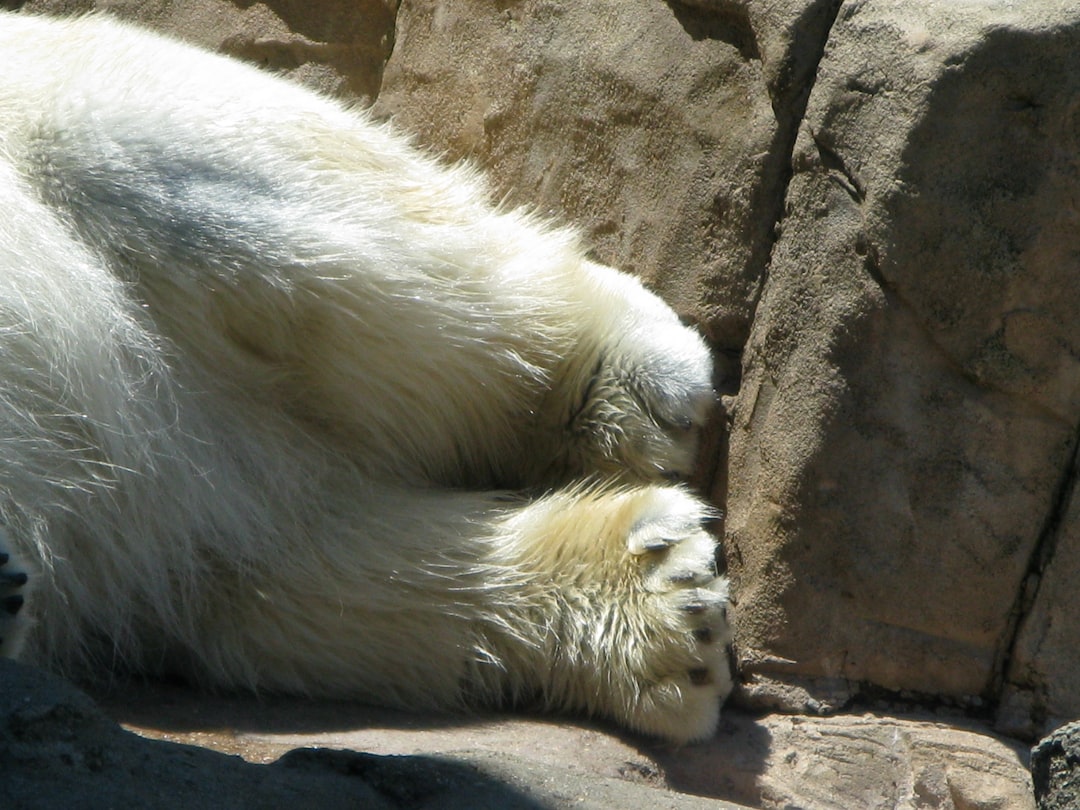
A polar bear cub is born in total darkness, under two meters of packed snow, to a mother who has not eaten for four months and will not eat for four more. It weighs less than a bag of sugar. It cannot see, cannot hear, and has fur so thin the skin underneath shows pink through it. Outside the den, the Arctic is somewhere between minus 30 and minus 50 degrees Celsius. Inside, against the mother's belly, the cub is already gaining weight on milk so rich it would clog a human artery.
This is how the largest land carnivore on Earth produces its offspring. The polar bear reproductive strategy is a physiological extreme, built around a fast that no other bear species attempts at this scale, and it is the part of the polar bear life cycle most directly threatened by sea ice loss. Everything downstream of denning, population recruitment, juvenile survival, long-term range stability, depends on a mother reaching the den fat enough and the ice reforming early enough for the family to walk back to the seals.
The Long Road to a Pregnant Female
Polar bear reproduction does not begin in the den. It begins on the spring sea ice, roughly eight months earlier, when a male tracks a female's scent trail for days across breaking floes. Mating peaks in April and May. A single female may be followed by two or three males, and fights over estrus females leave scars that persist for life, especially on the neck and shoulders.
What happens next is unusual. Fertilized eggs develop to the blastocyst stage and then stop. They float free in the uterus, neither implanting nor degrading, for roughly four to five months. This is delayed implantation, also called embryonic diapause, and it exists in several carnivores but rarely with the precision polar bears show. Implantation occurs in September or October, triggered by declining day length and, critically, by maternal fat reserves. A female who did not reach adequate body condition over the summer will reabsorb the blastocyst. No implantation, no cubs, no wasted fast.
"Delayed implantation is a go/no-go switch. If a female has not reached the body mass threshold by October, her body simply cancels the pregnancy rather than invest in a litter she cannot support through denning." -- Nicholas Lunn, Environment and Climate Change Canada
Once implantation occurs, effective gestation is short: roughly 60 days of active fetal development. From fertilization to birth, however, the total elapsed time is 195 to 265 days, among the widest gestation windows recorded in any mammal. This flexibility lets the species align birth with snow-denning season regardless of when spring mating occurred.
Finding a Den: Terrain, Snow, and Site Fidelity
Not every pregnant female dens in the same kind of place. Roughly 80 percent of maternity dens across the Arctic are excavated in snow drifts, typically on south-facing slopes where wind-packed snow accumulates to depths of three meters or more. The remaining 20 percent, concentrated in the Beaufort Sea and Svalbard, are dug into earthen banks or pack ice that then gets buried by drifting snow. Wrangel Island in the Russian Arctic hosts the densest known denning concentration on Earth, with over 400 dens in some years.
A mother does not dig randomly. Satellite-tracked females return to denning regions they have used before, sometimes to within a few kilometers of previous sites, suggesting either learned preferences or inherited landscape cues. In the Southern Beaufort Sea, the proportion of females denning on sea ice rather than land has dropped from roughly 60 percent in the 1980s to under 20 percent today, a shift attributed directly to thinning multiyear ice that can no longer support a stable den through winter.
Den construction takes several days. The female digs a tunnel, typically one to two meters long, that leads up and then into a chamber positioned slightly above the entry. This inverted configuration traps body heat and prevents warm air from escaping. As she sleeps and breathes inside, snow from above continues to accumulate, sealing the chamber.
Den dimensions and microclimate
The chamber itself is roughly the size of a small closet. Measurements from abandoned dens, typically excavated in late spring after the family has left, show consistent dimensions regardless of location.
| Parameter | Typical range | Notes |
|---|---|---|
| Chamber length | 1.5 -- 2.5 m | Large enough for mother plus cubs |
| Chamber width | 1.2 -- 1.8 m | Slightly narrower than length |
| Chamber height | 0.9 -- 1.4 m | Mother can sit but not stand |
| Entry tunnel length | 1.0 -- 3.0 m | Slopes upward into chamber |
| Snow depth above | 1.5 -- 3.0 m | Insulates to minus 2 C inside |
| Internal temperature | -2 to +2 C | While ambient is -30 to -40 C |
| Internal CO2 | 2 -- 4 percent | Elevated but non-toxic |
| Humidity | 95 -- 100 percent | Near saturation from respiration |
The thermal gradient is remarkable: outside the den, ambient air can reach minus 45 Celsius. Inside, the temperature holds near freezing. That 40 to 50 degree differential comes from two meters of snow and a single sleeping bear.
"You can walk across a maternity den in February and have no idea it is there. A meter and a half of wind-packed snow completely hides the breathing hole, and the mother's exhalation doesn't cut through because it refreezes as frost near the ceiling. We have found dens only because the satellite collars on the females stopped moving." -- BJ Kirschhoffer, Polar Bears International, Den Cam program
Birth: 600 Grams in the Dark
Cubs are born between late November and early January, with the peak in the last week of December. The timing is consistent across populations, which is why Inuit knowledge holders in Nunavut sometimes refer to December as "the month the bears come." Birth itself is not dramatic by mammalian standards. The mother is already sedentary. Labor is brief. Cubs emerge one at a time, separated by minutes to hours.
At birth, a polar bear cub is:
- Weight: 500 to 700 grams, roughly the size of a guinea pig
- Length: 28 to 32 centimeters from nose to tail
- Eyes: closed, opening around 30 days
- Ears: closed, opening around 26 days
- Fur: present but short and thin, skin visible through it
- Teeth: none at birth, erupting from two months
- Movement: capable of crawling toward warmth, but unable to thermoregulate
The mother cradles the cubs against her belly, where fur density is highest and body temperature warmest. For the first few weeks, cubs do almost nothing except nurse and sleep. A newborn polar bear consumes milk every one to two hours, drifting between feeds.
What makes polar bear milk extreme
Polar bear milk has the highest fat content of any carnivore, averaging 31 to 33 percent during early lactation. For comparison, human milk is about 4 percent fat, cow milk 3 to 4 percent, and even grizzly bear milk only 22 percent. This is not a minor difference; it is the entire reproductive strategy.
The milk must simultaneously:
- Keep the cub warm in ambient temperatures near freezing inside the den
- Fuel rapid growth, from 600 grams to 10 kilograms in 90 days
- Derive entirely from the mother's stored fat reserves, since she is not eating
A mother produces roughly two liters of milk per day across the denning period. Drawing that much energy from fat stores is why she loses so much weight: a female entering the den at 250 kilograms typically emerges at 140 to 150 kilograms, a loss approaching 43 percent of body mass. Few mammals survive that kind of catabolic deficit. The polar bear does it while gestating, giving birth, and nursing, all without drinking water. Her body recycles urea through gut bacteria and reabsorbs water from her own breath as it condenses on the den walls.
Growth Inside the Den: The Hidden Three Months
For roughly 90 days after birth, the family is invisible. No researcher has ever directly observed a polar bear birth in the wild; everything known about early cub development comes from captive births, acoustic monitoring of wild dens, and data from den-cam projects that use infrared cameras placed near known den sites.
Growth is rapid and predictable.
| Age | Weight | Milestone | Inside or outside den |
|---|---|---|---|
| Birth (Dec-Jan) | 500 -- 700 g | Blind, deaf, thin fur | Inside den |
| 2 weeks | 1.0 -- 1.2 kg | Fur thickening, vocalizing | Inside den |
| 4 weeks | 1.8 -- 2.5 kg | Ears begin to open | Inside den |
| 6 weeks | 3 -- 4 kg | Eyes open, teeth beginning | Inside den |
| 8 weeks | 5 -- 6 kg | Walking, exploring chamber | Inside den |
| 10 weeks | 7 -- 9 kg | Playing, short excursions to tunnel | Inside den |
| 12 weeks / emergence | 10 -- 12 kg | First sunlight | Exiting den (Mar-Apr) |
| 6 months | 25 -- 40 kg | On sea ice, beginning to eat seal | Outside |
| 1 year | 80 -- 110 kg | Still nursing, following mother | Outside |
| 2 years | 150 -- 200 kg | Near adult female weight (if female) | Outside |
| 2.5 years (weaning) | 180 -- 250 kg | Independence | Outside |
The growth curve between birth and emergence represents a 15- to 20-fold weight gain in three months. Converted to human scale, it would be equivalent to a newborn reaching 60 kilograms by kindergarten. The fuel for every gram of that growth came out of the mother's body.
Emergence: March, April, and the First Sunlight
Sometime between early March and late April, depending on latitude and local weather, the mother breaks through the den roof or excavates a new entrance. She does not lead the cubs out immediately. For roughly 10 to 15 days, the family makes short trips, minutes at first, then hours. Cubs play in the snow near the entrance, tumble back inside to nurse, and gradually acclimate to light, wind, and the full cold of the Arctic spring.
The first emergence is the first time the cubs have ever experienced:
- Temperatures below zero Celsius
- Direct sunlight (their eyes adjust over several days)
- Wind, including the sound of it
- Space larger than a snow chamber
- Any non-mother animal, plant, or landscape feature
During this staging period, the mother does not travel far. She is still fasting; her reserves are nearly gone. Once she judges the cubs ready for the walk, the family departs for the sea ice. In Hudson Bay, this means a southbound trek of 20 to 80 kilometers. In the Beaufort Sea, a shorter walk onto landfast ice. In Svalbard, often a direct traverse of fjord ice to hunting grounds offshore.
Her first seal after emergence is the most important meal she will ever take. Without it within days of reaching the ice, lactation fails.
First-Year Mortality: Why 40 to 60 Percent Die
The first year of life for a polar bear cub is the mortality chokepoint of the entire species. Estimates vary by population and year, but across longitudinal studies, first-year mortality runs 40 to 60 percent. In climate-stressed years, researchers have documented cohort losses above 70 percent.
The main causes of cub death, ranked by frequency in Western Hudson Bay data:
- Maternal condition failure. The mother runs out of fat before lactation ends, milk supply drops, cubs die in the den or within weeks of emergence. This is the single largest cause and is directly linked to summer ice conditions the previous year.
- Cold exposure during early emergence. A March cold snap during the staging period, when cubs have thinner fur and poor thermoregulation, can kill an entire litter.
- Male infanticide. Adult males kill and consume cubs, particularly during food stress. Documented in every studied population. Families travel in patterns that explicitly avoid male scent trails.
- Drowning during long swims. Increasingly common as ice fragments. Cubs do not have the fat reserves for prolonged swimming; they hypothermia out within a few hours.
- Accidents. Falls into crevasses, collapses of unstable sea ice, and separation from mother during blizzards.
- Predation and disease. Wolves occasionally take cubs on land. Disease is poorly documented in the wild.
"The mother is doing everything right. She fasted for eight months, she produced twins, she emerged on time. But if the ice she needs is not there when she reaches the coast, her cubs die anyway. That disconnect between maternal effort and cub survival is what makes the current trajectory so troubling." -- Andrew Derocher, University of Alberta, in Arctic (2016)
A 2020 modeling study in Nature Climate Change projected that cub recruitment in Western Hudson Bay would fall below replacement by the 2040s under current emission trajectories, a finding consistent with demographic data already showing recruitment declines of 30 to 40 percent since the 1980s. For broader context on the species-level decline, see the overview of why polar bears are endangered.
The 2.5-Year Apprenticeship
Cubs stay with the mother for 2.5 years in most populations. Weaning around 1.5 years does occur, mostly in Western Hudson Bay where nutritional stress is highest and mothers can no longer sustain extended dependency. Both variants have ecological costs: early-weaned cubs enter independence at lower body weight and face higher second- and third-year mortality.
During the dependency period, cubs learn:
- Still-hunting at breathing holes: the core seal-hunting technique. Cubs watch for hundreds of hours before succeeding.
- Stalking on ice: approaching basking seals downwind, using pressure ridges for cover.
- Swimming: cubs can swim from about two months of age but develop endurance only across year two.
- Ice reading: which floes hold, which crack, where currents concentrate seals.
- Avoidance: of adult males, human settlements, and open water gaps too wide to swim.
The mother does not actively teach in the human sense. Cubs observe, mimic, and eventually attempt. Failed hunts outnumber successful ones by roughly 20 to 1 in young bears, and the caloric cost of those failures is subsidized by continued nursing and shared kills. What polar bears eat is almost entirely ringed seal, with bearded seal as a secondary prey, and juveniles require roughly three years of practice to hunt efficiently on their own.
At the end of year 2.5, the mother abruptly breaks the bond. She may chase cubs away, often violently. The cubs, now 180 to 250 kilograms, are suddenly independent. They rarely reunite. The mother, having lost half her body weight across three years of cub-rearing, now has roughly one year to rebuild condition before she may den again.
Denning Failures and Climate
The denning phase is where climate pressure hits polar bear reproduction hardest. Three mechanisms are well documented:
Late freeze-up. Pregnant females in Hudson Bay historically reached denning areas by early November. With ice now forming three weeks later, some females cannot reach traditional denning grounds and either fail to den or den in suboptimal coastal terrain.
Rain-on-snow events. Warm spells during denning cause snow to melt and refreeze, collapsing den chambers or sealing exits. Cubs have been found dead in collapsed dens in Svalbard and Hudson Bay.
Early breakup. Even if denning succeeds, the mother needs to reach ice with live seals by late April. Where ice breakup now happens earlier, she faces a shortening window before ice-free summer strands her ashore with growing cubs. For more on how sea ice structures the seasonal cycle, the coverage of polar bear populations and where they live describes the subpopulation-level variation.
Researchers at the Alaska Science Center have also documented a shift from sea-ice denning to land denning in the Southern Beaufort population. Land dens are more stable than degrading pack ice, but they force longer journeys back to seals and expose families to higher rates of human contact and male encounter.
"The thermodynamics of the den used to be the most reliable part of polar bear life history. You could predict emergence within a two-week window for any population. That reliability is breaking. We now see emergence dates shifting by weeks, and rain events that never occurred in January historical records." -- Oecologia, polar bear denning synthesis (2021)
What the Cub Phase Reveals
The polar bear reproductive strategy evolved for a very specific environment: predictable freeze-up in October, stable snow-loading through winter, reliable breakup in May, and reliable seal abundance on spring ice. Every element of cub development, from the 500-gram birth weight to the 31 percent milk fat to the 2.5-year dependency, is a solution to that environment. For comparison with a more generalist bear strategy, see how the brown bear approaches denning and cub-rearing in a temperate-to-subarctic range, and how bears hibernate across species.
When the environment shifts faster than physiology can follow, reproductive output is the first demographic variable to crack. Adult polar bears can survive a bad year on reserves. Cubs cannot. They are born at the thinnest possible margin, and the margin has narrowed. A cub born in Western Hudson Bay in 2025 faces roughly half the survival odds of a cub born in the same region in 1985.
The species is not adaptable in the timeframe required. Delayed implantation, den-site fidelity, and milk-fat chemistry are deep-time traits, not behavioral choices. This is also why the thermal biology of adult polar bears matters so much, covered in polar bear fur and black skin explained. What can change is the rate of ice loss. For readers curious about related patterns in animal intelligence and survival, aggregators like whats-your-iq.com and long-form nature reporting at whennotesfly.com occasionally cover cognitive and behavioral research on Arctic species. For writing and research tools on reporting environmental science accurately, evolang.info is a useful reference.
A pregnant polar bear digging a snow den in October is performing one of the oldest reproductive routines in the Ursidae family. Whether that routine persists into the next century depends on ice, and ice depends on us.
References
- Amstrup, S. C., & Gardner, C. (1994). Polar bear maternity denning in the Beaufort Sea. Journal of Wildlife Management, 58(1), 1-10. DOI: 10.2307/3809542
- Derocher, A. E., Andersen, M., & Wiig, O. (2005). Sexual dimorphism of polar bears. Journal of Mammalogy, 86(5), 895-901. DOI: 10.1644/1545-1542(2005)086[0895:SDOPB]2.0.CO;2
- Robbins, C. T., Lopez-Alfaro, C., Rode, K. D., Toien, O., & Nelson, O. L. (2012). Hibernation and seasonal fasting in bears: the energetic costs and consequences for polar bears. Journal of Mammalogy, 93(6), 1493-1503. DOI: 10.1644/11-MAMM-A-406.1
- Molnar, P. K., Bitz, C. M., Holland, M. M., Kay, J. E., Penk, S. R., & Amstrup, S. C. (2020). Fasting season length sets temporal limits for global polar bear persistence. Nature Climate Change, 10(8), 732-738. DOI: 10.1038/s41558-020-0818-9
- Lunn, N. J., Servanty, S., Regehr, E. V., Converse, S. J., Richardson, E., & Stirling, I. (2016). Demography of an apex predator at the edge of its range: impacts of changing sea ice on polar bears in Hudson Bay. Ecological Applications, 26(5), 1302-1320. DOI: 10.1890/15-1256
- Rode, K. D., Wilson, R. R., Douglas, D. C., Muhlenbruch, V., Atwood, T. C., Regehr, E. V., et al. (2018). Spring fasting behavior in a marine apex predator provides an index of ecosystem productivity. Global Change Biology, 24(1), 410-423. DOI: 10.1111/gcb.13933
- Arnould, J. P. Y., & Ramsay, M. A. (1994). Milk production and milk consumption in polar bears during the ice-free period in western Hudson Bay. Canadian Journal of Zoology, 72(8), 1365-1370. DOI: 10.1139/z94-181
- Stirling, I., & Derocher, A. E. (2012). Effects of climate warming on polar bears: a review of the evidence. Global Change Biology, 18(9), 2694-2706. DOI: 10.1111/j.1365-2486.2012.02753.x