
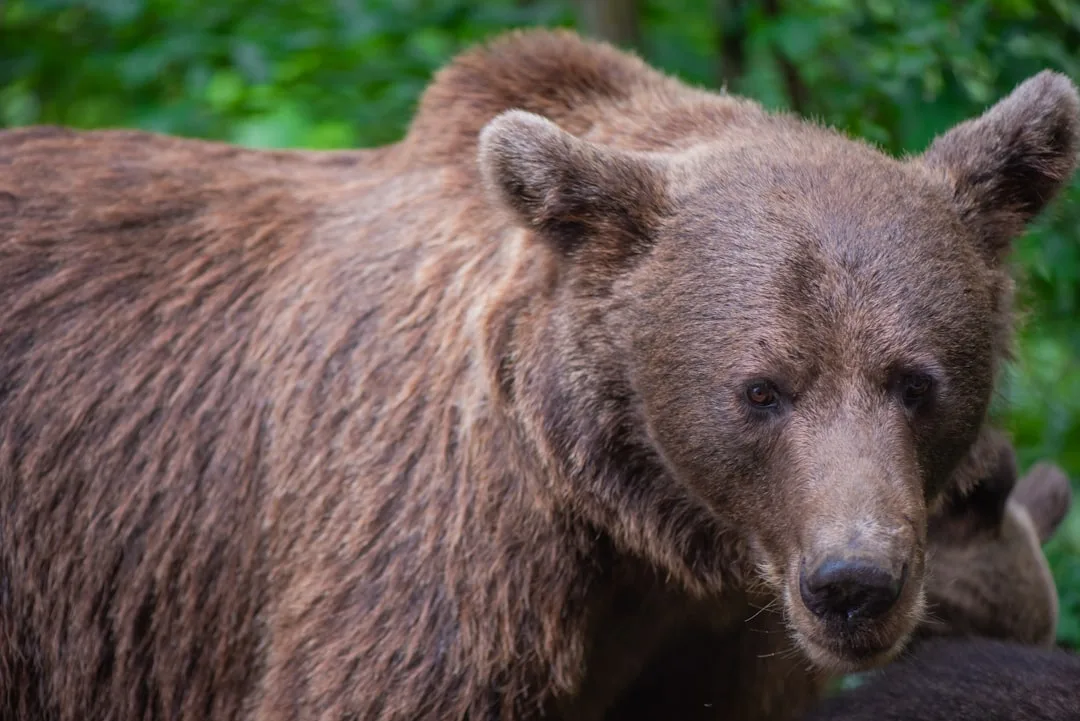
The brown bear is the most widely distributed bear on Earth and one of the most variable large mammals alive. A single species, Ursus arctos, stretches from the oak forests of the Cantabrian mountains in Spain to the Kamchatka coast in eastern Russia, and from the Alaskan salmon rivers down into the Rocky Mountains and the Italian Apennines.
The same species that produces 600 kg Kodiak giants also produces 90 kg Gobi desert bears that rarely see another of their kind. No other bear matches this geographic reach or physical range.
This guide covers the full biology and ecology of Ursus arctos: its taxonomy and subspecies, size and anatomy, hunting and foraging strategy, hibernation, reproduction, movement, conservation status, and the long and complicated relationship between brown bears and the humans who share their ranges. It is a reference entry rather than a summary, so expect specifics - kilograms, kilometres, percentages, and verified records - rather than generalities.
Etymology and Classification
The scientific name Ursus arctos is a tautology of sorts. Ursus is the Latin word for bear, and arctos is the Greek word for bear. Carl Linnaeus formalised the binomial in 1758. The English word 'brown bear' simply reflects the dominant coat colour across the species' range, but individual brown bears vary from near-black through cinnamon and blonde to silver-tipped grizzly.
The North American name 'grizzly' derives from the grizzled white hair tips common in older interior bears, not from any behavioural difference.
Brown bears belong to the family Ursidae, which contains eight living species. Within that family, brown bears sit in the genus Ursus alongside the American black bear (U. americanus), the Asiatic black bear (U. thibetanus), and the polar bear (U. maritimus). Genetic analysis shows that polar bears diverged from a brown bear ancestor between 150,000 and 500,000 years ago. Brown bears and polar bears remain close enough genetically to produce fertile hybrids when their ranges overlap.
Full taxonomy:
- Kingdom: Animalia
- Phylum: Chordata
- Class: Mammalia
- Order: Carnivora
- Family: Ursidae
- Genus: Ursus
- Species: U. arctos
Subspecies and Regional Variation
Biologists have historically described more than a dozen brown bear subspecies. Modern genetics has collapsed many of these, but several remain widely recognised on the basis of morphology, behaviour, or geographic isolation.
| Subspecies | Common name | Range | Notable features |
|---|---|---|---|
| U. a. arctos | Eurasian brown bear | Europe, western Russia | Medium size, dark brown coat, the nominate subspecies |
| U. a. horribilis | Grizzly bear | Interior North America | Silver-tipped fur, prominent shoulder hump |
| U. a. middendorffi | Kodiak bear | Kodiak archipelago, Alaska | Largest living brown bears, up to 600+ kg |
| U. a. syriacus | Syrian brown bear | Middle East, Caucasus | Small, pale coat, critically reduced range |
| U. a. isabellinus | Himalayan brown bear | High Himalaya | Reddish-brown, long fur, high-altitude specialist |
| U. a. gobiensis | Gobi bear | Mongolian Gobi desert | Critically endangered, possibly fewer than 40 individuals |
| U. a. yesoensis | Ussuri brown bear | Hokkaido, Russian Far East | Dark coat, strong salmon specialisation |
| U. a. pruinosus | Tibetan blue bear | Tibetan Plateau | Possible inspiration for yeti reports |
| U. a. crowtheri | Atlas bear | North Africa | Extinct since late 1800s, the only bear species wiped out from a continent in historical times |
The wide morphological spread between subspecies is driven primarily by diet and climate rather than deep genetic divergence. A coastal bear eating salmon will grow roughly twice the mass of an inland bear of the same lineage eating roots and berries. A high-altitude desert bear in Mongolia will be smaller, paler, and leaner than a European forest bear. This plasticity is one of the reasons brown bears have been able to colonise nearly every northern habitat type.
Size and Physical Description
Brown bears are among the largest living land carnivores, surpassed only by the polar bear among modern species. Size varies dramatically by population.
Typical males:
- Length: 1.8-2.8 m from nose to tail
- Shoulder height: 0.9-1.5 m on all fours
- Standing height: 2.4-3 m on hind legs
- Weight: 180-360 kg inland, 300-600 kg coastal, record individuals over 750 kg
Typical females:
- Length: 1.5-2.3 m
- Weight: 90-200 kg inland, 200-350 kg coastal
- Roughly 30-50% lighter than males of the same population
Cubs at birth:
- Length: 23-30 cm
- Weight: 340-680 grams - smaller than a loaf of bread despite a 300 kg mother
The brown bear silhouette is distinctive. Brown bears have a dish-faced profile - a concave forehead that dips between the eyes and the muzzle - while American and Asiatic black bears have flatter, straighter facial profiles. A single glance at a skull or a clear side-on photograph is enough to tell the two apart in nearly all cases.
Brown bears also carry a muscular shoulder hump made of pure digging muscle, which powers the forelimbs during excavation. Black bears have no such hump; their highest point is the rump.
The feet are large and plantigrade, meaning the bear walks on the full sole rather than on its toes. Front claws are long - often 8-10 cm in grizzlies - and are primarily digging tools rather than weapons, although they are effective at both. Rear claws are shorter. The dental formula is adapted for omnivory: powerful canines for killing and shearing meat, combined with broad flat molars for grinding roots, seeds, and berries.
The coat is a double layer of dense underfur topped with longer guard hairs. Colour varies from nearly black through chocolate, cinnamon, sandy blonde, and silver-grizzled. Cubs are often born with a white natal collar that fades within a year or two.
Built for Power and Endurance
A brown bear's body plan trades speed for raw strength and all-terrain mobility. A healthy adult can flip stones weighing several hundred kilograms while searching for insects, pull a full-grown moose carcass hundreds of metres uphill, and snap mature tree trunks to get at beehives or scent-mark territory. The shoulder hump provides the leverage that makes this possible; the muscles there attach to the forelegs and drive the digging and pulling force that defines the species.
Despite their bulk brown bears are surprisingly fast. A sprinting grizzly can reach roughly 50 km/h over short distances - faster than any human and faster than many horses. They cannot sustain that speed for long, but they do not need to: most prey pursuits are short ambushes, and most territorial chases are over in seconds.
Brown bears are strong swimmers. They routinely cross wide rivers, fjords, and lakes, and individuals in coastal populations swim several kilometres between islands during salmon season. They swim with the front paws paddling and the hind legs kicking steadily; their thick fat layer provides both insulation and buoyancy.
Their senses are tuned for finding food over long distances. Vision is roughly comparable to a human's, perhaps slightly better in low light. Hearing covers a wider frequency range than humans. The dominant sense is smell. The brown bear's olfactory surface area is more than a hundred times that of a human, and it is estimated to detect scents roughly seven times better than a bloodhound. Bears track salmon spawning streams, ripe berry patches, and buried carcasses by scent from kilometres away.
Diet and Foraging
Brown bears are opportunistic omnivores whose diet is dominated - usually overwhelmingly - by plant material. Across the species' range roughly 70-90% of food by weight is vegetation, with the proportion rising in interior forests and falling in salmon-rich coastal habitats.
Typical food categories:
- Grasses, sedges, and forbs in spring
- Roots, tubers, and bulbs excavated year-round
- Berries (blueberry, buffaloberry, crowberry, cloudberry) in mid-to-late summer
- Nuts, acorns, pine seeds, and whitebark pine nuts in autumn
- Insects - ants, wasps, bees and their larvae and honey
- Ground squirrels, marmots, and other small mammals dug from burrows
- Ungulate calves (moose, elk, caribou, red deer) in spring
- Adult ungulates, usually weak or winter-killed
- Carrion at every opportunity
- Salmon and other migrating fish during runs
Coastal salmon specialists. Brown bears that reach salmon runs exploit one of the richest calorie sources in any ecosystem. A productive Alaskan or Kamchatkan stream during peak run may host dozens of bears spaced along a few kilometres of river. Individuals kill between ten and thirty salmon per day and selectively consume the fattiest parts: brain, skin, and roe.
The rest is often abandoned, fertilising the surrounding forest with marine nitrogen. Coastal Kodiak and Kamchatka bears reach their extreme body mass entirely because of this seasonal windfall.
Hyperphagia. Before hibernation brown bears enter a state of voluntary overeating known as hyperphagia. For six to ten weeks in late summer and autumn, they feed almost continuously, often sleeping only four to six hours a day. Daily calorie intake can reach 20,000 kcal and a bear may gain up to 2 kg of pure fat per day. Hyperphagic bears follow the ripening sequence of available foods - berries, nuts, salmon, carcasses - and may range over tens of kilometres daily to hit peak production sites.
Hibernation
Brown bears hibernate, though biologists disagree about whether their pattern should be called 'true' hibernation or something closer to 'torpor'. What is certain is that it is an extraordinary physiological feat.
Hibernation basics:
- Duration: 5-7 months typically, sometimes as little as 3 months in mild coastal climates
- Den types: excavated hillside burrows, hollow trees, rock crevices, natural caves
- Temperature drop: only 4-5 degrees Celsius below normal body temperature
- Heart rate: falls from about 40 beats per minute to 8-12
- Metabolic rate: falls by roughly 50-75%
- Waste: bears do not urinate, defecate, eat, or drink for the entire denning period
The shallow temperature drop distinguishes bear hibernation from the deep torpor of small hibernators like ground squirrels, whose body temperatures can drop below freezing. Because bears stay relatively warm, they can rouse quickly if disturbed - a hibernating bear is not a safe bear to approach.
The urea recycling system is of particular interest to medical researchers. A human would die within days from the uraemia of fasting for months without urinating, and would lose muscle mass rapidly from disuse. Hibernating brown bears do neither. Their bodies convert the nitrogen in urea into amino acids and re-use them to maintain muscle protein.
They emerge from their dens in spring slimmer but not measurably weaker. Understanding this chemistry has implications for kidney failure treatment, long-duration spaceflight, and long-term bedridden patients.
Reproduction and Life Cycle
Brown bears mate during a short early-summer window, typically May through July. Males roam widely in search of receptive females, and male-male combat over access to oestrous females is frequent and often injurious. Mating is promiscuous on both sides. A single female may mate with several males, and a litter can contain cubs with different fathers.
Once mated, brown bears enter delayed implantation. The fertilised egg divides a few times and then pauses, floating in the uterus without attaching to the uterine wall for up to five months. Implantation is triggered only if the female has accumulated enough body fat during autumn hyperphagia to support gestation and lactation. If fat reserves are insufficient, the embryo is reabsorbed. This system matches reproductive investment to food supply: a bad berry year means fewer cubs next spring.
Denning and birth schedule:
- October to November: female enters the den
- November to December: implantation, if fat reserves allow
- January to February: cubs born inside the den during hibernation
- March to May: mother and cubs emerge
Cubs weigh only 340-680 grams at birth - roughly the mass of a grey squirrel - despite mothers that may weigh 300 kg. They are born blind, toothless, and almost hairless, and nurse from a mother who is simultaneously fasting and hibernating. By the time the family emerges in spring, cubs weigh 4-10 kg depending on subspecies and litter size.
Cubs remain with their mother for 2.5 to 3.5 years. She teaches them what to eat, how to hunt, where the productive streams and berry patches are, and how to avoid adult males - who are the single largest cause of cub mortality. Adult male brown bears regularly kill cubs; this behaviour brings the mother back into oestrus and allows the male to father her next litter. Females defend their cubs fiercely, and mother-defence is the context of about 70% of serious brown bear attacks on humans.
Females reach reproductive maturity at 4-7 years and typically produce one litter every 2-4 years. Litters average two cubs, with one to four recorded. Males mature slightly later, around 5-7 years, and often do not breed successfully until their larger, older rivals weaken or die.
Movement, Range, and Territory
Brown bears are not territorial in the strict sense. Individuals maintain large home ranges that overlap heavily with those of other bears. Dominance is established through body language, scent marking, and occasional fights rather than through defended boundaries.
| Metric | Typical value |
|---|---|
| Male home range | 200-2,000 km^2 (interior), 50-300 km^2 (coastal) |
| Female home range | 50-500 km^2 |
| Daily travel | 5-25 km, up to 50+ km during hyperphagia |
| Sprint speed | ~50 km/h |
| Swimming speed | 6-10 km/h |
Coastal bears with salmon access live at the highest densities of any terrestrial carnivore - up to one bear per square kilometre on some Alaskan islands during salmon runs. Interior bears live at much lower densities, sometimes one bear per 50-100 km^2. Dispersal distances are substantial: young males may travel hundreds of kilometres to establish new ranges, and several documented individuals have crossed entire European countries.
Conservation Status
The IUCN Red List classifies Ursus arctos as Least Concern overall, with an estimated global population of roughly 200,000 individuals. The trend is stable or slightly increasing at the species level, helped by large intact populations in Russia (which holds about half the world total), Alaska, and western Canada.
That reassuring headline masks serious regional collapses. Several subspecies and isolated populations are critically reduced or extinct.
Critically reduced populations:
- Gobi bear (U. a. gobiensis): possibly fewer than 40 individuals in Mongolia
- Marsican brown bear (Apennine, Italy): roughly 50-60 individuals
- Cantabrian population (Spain): around 370 individuals, recovering slowly
- Pyrenean population (France/Spain): around 80 individuals, reintroduced from Slovenia
- Syrian brown bear: reduced to tiny relict pockets in Iran, Iraq, Turkey, and the Caucasus
- Contiguous U.S. grizzly (U. a. horribilis): around 2,000 individuals, federally Threatened
- Atlas bear (U. a. crowtheri): extinct, late 1800s
Primary threats:
- Habitat loss and fragmentation from roads, agriculture, and resource extraction
- Vehicle strikes on highways crossing bear habitat
- Poaching for gallbladder and bile products in some regions
- Human-bear conflict and defence-of-life-and-property kills
- Climate-driven changes in food availability, especially whitebark pine decline in North America
- Inbreeding depression in small isolated populations
Conservation measures vary by country. Russia regulates hunting with quota systems and large protected reserves. North America combines federal protection in the contiguous United States with managed hunts in Alaska and Canada. Europe has mostly shifted toward full protection and reintroduction, with ongoing debate about compensation for farmers who lose livestock and bee hives.
Coexistence programmes - bear-proof rubbish containers, electric fencing around apiaries, carcass removal along highways - have reduced conflict in several range states.
Brown Bears and Humans
Brown bears have shared landscapes with humans for as long as modern humans have existed, and the relationship is older and more entangled than with almost any other large carnivore. Prehistoric cave art in Chauvet and Lascaux depicts brown bears. Bear-worship traditions have been documented among Ainu, Sami, Finnish, Tungus, Slavic, and many Indigenous North American peoples. The domesticated dog is thought to have first assisted humans in part by providing warning of bears at night.
Modern conflict is usually about food and space. Bears drawn to rubbish, fruit orchards, bee hives, or livestock are often shot under defence-of-property laws. Hikers and hunters encountering bears at close range account for most serious injuries, and female bears defending cubs account for most of those.
Research from Alaska and Scandinavia consistently finds that bear spray is more effective at stopping an attacking brown bear than firearms are, partly because bears charge from cover at close range and partly because spray cones are more forgiving of aim than bullets.
Tourism built around brown bear viewing generates significant income in Alaska, Kamchatka, Finland, Slovenia, and Romania. Done well - with professional guides, set distances, and clean camps - such tourism provides strong economic incentives for conservation. Done badly, it habituates bears to humans and ends in shot animals.
Related Reading
- Polar Bear: The Arctic's Apex Predator in a Warming World
- How Bears Hibernate
- Bears of the World: Power, Intelligence, and Survival
- Grizzly Bear: North American Predator
References
Relevant peer-reviewed and governmental sources consulted for this entry include IUCN Bear Specialist Group assessments for Ursus arctos (2017, updated 2023), the U.S.
Fish and Wildlife Service Grizzly Bear Recovery Plan, Scandinavian Brown Bear Research Project publications, Russian Academy of Sciences Kamchatka population surveys, and research published in Journal of Mammalogy, Ursus, Wildlife Biology, and Conservation Genetics.
Specific figures on hibernation physiology draw on studies of captive and wild denning bears by Lynne Nelson, Oivind Toien, and colleagues published in Science and Physiological and Biochemical Zoology.
Frequently Asked Questions
How big are brown bears?
Brown bears (Ursus arctos) vary enormously across their range. Eurasian brown bears and interior grizzlies typically weigh 180-360 kg as males and 90-200 kg as females. Coastal populations with access to salmon - particularly Kodiak bears in Alaska and Kamchatka bears in Russia - are far larger, with adult males commonly reaching 450-600 kg and record individuals exceeding 750 kg.
Body length ranges 1.5-2.8 m from nose to tail, with shoulder heights of 0.9-1.5 m on all fours. Standing upright a large male can reach 2.8-3 m. Females are roughly 30-50% smaller than males of the same population, one of the most pronounced sexual dimorphisms in any bear species.
What is the difference between a brown bear and a grizzly bear?
A grizzly bear is a brown bear. ‘Grizzly’ is the common name in North America for the interior subspecies Ursus arctos horribilis, named for the grizzled silver-tipped fur on older individuals. All grizzlies are brown bears, but not all brown bears are grizzlies. Coastal Alaskan brown bears are usually not called grizzlies, and neither are Kodiak bears (U. a. middendorffi), Eurasian brown bears (U. a. arctos), or any of the Asian subspecies.
The species Ursus arctos is a single animal genetically; the subspecies names reflect regional morphology, diet, and isolation rather than sharp genetic breaks.
What do brown bears eat?
Brown bears are omnivores with diets that are typically 70-90% plant material by weight, even in populations that also eat meat. They consume grasses, sedges, roots, tubers, bulbs, berries, nuts, and pine seeds according to season and location.
Animal protein comes from insects (ants, wasps, and bee larvae are major calorie sources in some regions), ground squirrels and marmots excavated from burrows, moose and elk calves in spring, and carrion at any time of year. Coastal populations exploit massive salmon runs during summer and autumn, with individual bears killing dozens of fish per day and selectively eating the fattiest parts - brain, skin, and roe - while discarding the rest.
Before hibernation bears enter hyperphagia and may eat almost continuously for weeks.
Where do brown bears live?
Brown bears are the most widely distributed bear species on Earth, inhabiting a broad belt across Eurasia and North America.
Major populations exist in Russia (which holds roughly half the global population), Alaska, western Canada, the Rocky Mountains of the contiguous United States, Scandinavia, the Carpathian range (especially Romania), the Balkans, Turkey, Iran, Central Asia, the Himalayas, northern China, Mongolia, Hokkaido in Japan, and a few small isolated pockets in Spain, Italy, and France.
Their habitats span alpine meadows, boreal forest, temperate forest, tundra, subarctic coasts, and arid mountain steppe. They have been extirpated from North Africa, the British Isles, much of central and western Europe, and Mexico.
How long do brown bears hibernate?
Brown bears hibernate for 5-7 months depending on latitude, climate, and food availability. Northern populations and those in food-poor interior ranges may stay denned from late October through April or even May. Warmer and food-rich populations - such as coastal Alaskan bears with salmon access - den for shorter periods, sometimes as little as three months, and occasional individuals in mild southern ranges may not hibernate at all.
During hibernation body temperature drops only about 4-5 degrees Celsius (unlike small hibernators that drop far more), heart rate falls from about 40 to 8-12 beats per minute, and the bear does not eat, drink, urinate, or defecate. Pregnant females give birth and nurse during hibernation while fasting.
Are brown bears endangered?
Globally the IUCN lists Ursus arctos as Least Concern, with an estimated worldwide population around 200,000 and stable or increasing overall. That headline number hides enormous regional variation. Several subspecies and isolated populations are critically endangered or extinct. The Atlas bear (U. a. crowtheri) went extinct in the 19th century.
The Marsican brown bear in Italy, the Cantabrian population in Spain, the Gobi bear (U. a. gobiensis) in Mongolia, and the Pyrenean population in France all number in the low dozens to low hundreds and are in serious risk of local extinction. The contiguous U.S. grizzly population is federally listed as Threatened under the Endangered Species Act. Habitat loss, road mortality, human-bear conflict, and poaching are the main regional threats.
Are brown bears dangerous to humans?
Brown bears can be dangerous but attacks are uncommon given the species’ wide range. Roughly 40 fatal brown bear attacks have been recorded globally per decade in recent years, with most occurring in Russia, Romania, and Alaska. The dominant attack scenario is a surprised female defending cubs, which accounts for around 70% of serious incidents. Predatory attacks, in which a bear actively hunts a person, are far rarer but more often fatal.
Hikers and hunters reduce risk by making noise on trails, storing food properly, carrying bear spray (documented to be more effective than firearms), avoiding carcasses, and never running from an encountered bear. Most brown bears actively avoid humans when given the chance.
Can brown bears and polar bears interbreed?
Yes. Brown bears and polar bears (Ursus maritimus) diverged from a common ancestor only 150,000 to 500,000 years ago and remain genetically close enough to produce fertile hybrids. Wild hybrids have been confirmed in Canada’s western Arctic since 2006, when DNA tests on a shot bear showed mixed ancestry.
The hybrids, informally called ‘pizzly’ or ‘grolar’ bears, show intermediate features: creamy fur, longer necks than brown bears but smaller than polar bears, and mixed behaviour. Hybridisation events are expected to increase as warming pushes grizzlies further north and shrinks the sea ice that separates polar bears from the mainland.