
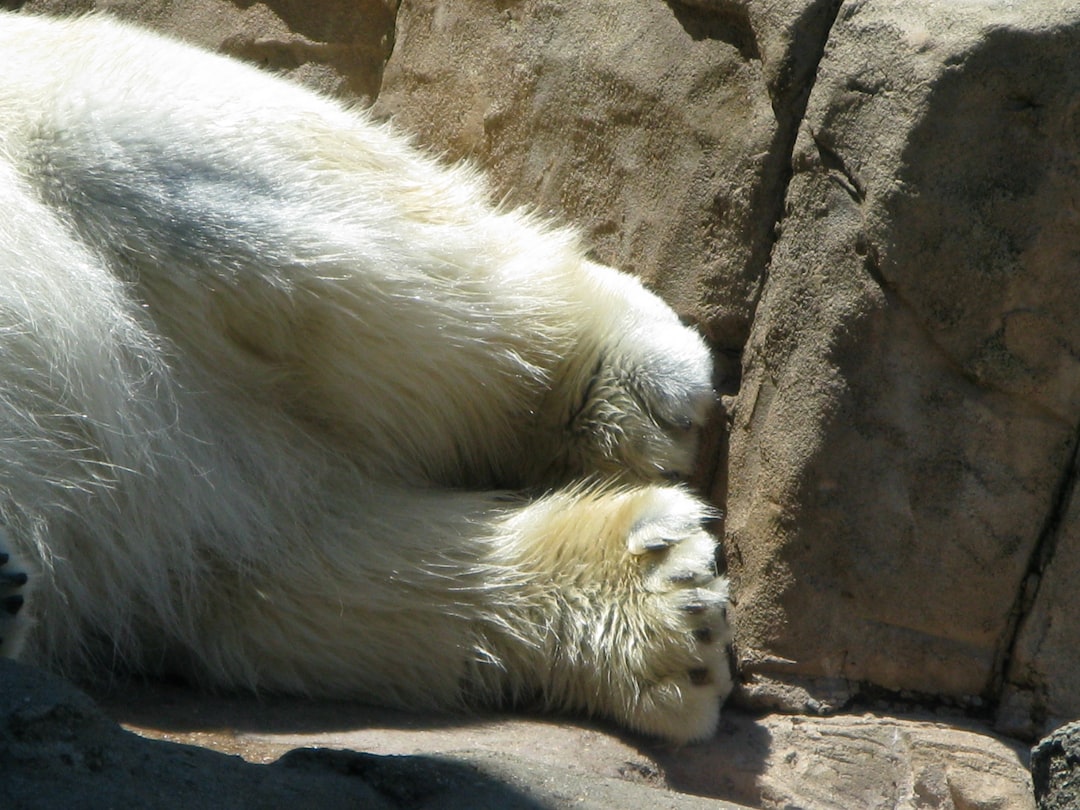
Walk up to a polar bear in a natural-history museum, run a gloved hand across the pelt, and you are touching one of the most misunderstood materials in zoology. The coat looks white. The hairs feel coarse and greasy. The skin beneath is jet black. Every one of these observations is tangled up with decades of half-true science, viral misconceptions, and a beautiful piece of physics that the internet usually gets wrong.
This article strips the polar bear's coat down to its actual structure and explains what each layer really does. We cover the hollow keratin tube that every guard hair is, the dense underfur beneath it, the Tyndall-style scattering that makes the whole assembly look white, the melanin-saturated black skin underneath, the famous "fibre-optic fur" myth that physicist Daniel Koon took apart in 1998, and the thermodynamics that make polar bears almost invisible to infrared cameras. By the end you will have a clear answer to the question your grandchildren will eventually ask you: are polar bears actually white?
If you want the full species profile first, our reference entry on the polar bear covers size, diet, population, and behaviour. This article is the physics-heavy companion.
The Short Answer to "Are Polar Bears White?"
No. A polar bear's fur contains no white pigment because no mammal actually produces white pigment in the way most people imagine. The apparent whiteness is an optical illusion generated by clear, hollow hair shafts scattering visible light in every direction. Remove the illusion and three facts remain:
- Each hair is transparent, like colourless glass fibre, not white.
- The skin underneath is black, saturated with melanin.
- The coat looks white only because scattering dominates what your eyes receive.
The same optical trick makes salt grains, crushed ice, foamed milk, and cumulus clouds appear white even though the underlying material is transparent or very lightly coloured. If you have ever wondered why shaved ice looks dazzling white while a single solid ice cube looks clear, you already intuitively understand the polar bear coat.
"Polar bear hairs are not pigmented and they are not perfect light pipes. They appear white for the same reason snow appears white. Light scatters."
-- Daniel W. Koon, physicist, St. Lawrence University, Applied Optics commentary on the fibre-optic myth, 1998.
Hair Anatomy: What a Polar Bear Guard Hair Really Looks Like
Pull a single guard hair from a polar bear pelt, mount it on a slide, and look down a microscope. You will not see a solid strand of keratin. You will see a roughly cylindrical tube with a hollow core called the medulla, bounded by a translucent cortex of compact keratin, wrapped in a thin overlapping cuticle of scales.
The medulla is the interesting part. In most mammals the medulla is either narrow, absent, or filled with irregular cells. In polar bears it occupies a substantial fraction of the total shaft diameter and is mostly empty. Air fills the core. The walls of the medulla are not smooth either. They are pitted and irregular at the micron scale, which is what turns an otherwise ordinary hollow hair into a spectacular scatterer of visible light.
Numbers that matter:
- Guard hair length: 5 to 15 cm on the back and flanks, shorter on the face and paws.
- Guard hair diameter: roughly 150 to 250 micrometres, with considerable variation along the shaft.
- Medulla fraction: 30 to 65 per cent of the cross-section, depending on body region and season.
- Hair density in winter pelage: around 60,000 to 100,000 hairs per square centimetre across the densest body regions, counting both guard hairs and underfur.
The underfur is a second layer of much finer, shorter hairs packed tightly against the skin. Underfur hairs are wavier, more tangled, and carry only a narrow medulla, but the sheer density of them is what creates a still, warm air pocket at the skin surface. Guard hairs shed water, block wind, and anchor the optical show. Underfur does the thermal heavy lifting.
Keratin Chemistry
Polar bear hair is not chemically exotic. It is made of the same alpha-keratin protein family found in your own fingernails, a rhino's horn, and a horse's mane. What differs is the architecture, not the molecule. Evolution has not invented a new protein for Arctic life. It has simply arranged an ancient one into a particularly clever hollow tube.
The keratin walls are mildly hydrophobic, which is why a polar bear can shake itself dry after a swim in roughly four to eight seconds. Water beads on the cuticle scales rather than wicking down the shaft. Seal oil, in contrast, binds readily to the keratin surface, which is why summer bears emerging from oily carcass feeds often develop a yellow or even rust-coloured tint along the neck and shoulders.
Tyndall Scattering: Why Transparent Hair Looks White
When a beam of visible light enters one of these hollow hairs, it does not travel in a clean straight line. It strikes the irregular interior walls of the medulla, refracts through the keratin cortex, re-enters the medulla, reflects off scale overlaps in the cuticle, and eventually exits in a direction almost unrelated to where it came in. Multiply that process across the thousands of hair shafts a photon interacts with on its way through the pelage, and the result is diffuse reflectance across the entire visible spectrum.
That diffuse, spectrally balanced reflection is what your visual system interprets as white. Snow is white for the same reason. So is a glass of milk. Individual droplets of milk fat are translucent and nearly colourless, but billions of them collectively scatter light in every direction and your brain labels the aggregate "white".
The formal physics name for this class of effect is Mie scattering when the scattering particles are similar in size to the wavelength of light, and Tyndall scattering in the broader sense of light scattered by irregular structures or colloidal-scale features. Polar bear fur sits somewhere on that spectrum. The coat is essentially a biological version of a reflective polymer foam.
"The coat of the polar bear functions optically as a diffuse reflector in the visible band and a near-complete absorber in the infrared. It is a masterclass in selective radiative behaviour."
-- Editorial commentary, Optik -- International Journal for Light and Electron Optics, on biological photonics in large mammals.
The Black Skin Underneath
If you part the fur on a living polar bear and look at the skin, you see coal-black dermis. The nose, lips, eyelids, and foot pads show the same colour because fur is absent or sparse there. The pigment responsible is eumelanin, the same molecule that makes human hair and skin brown or black.
Why black skin under white-looking fur? The textbook answer used to be: to absorb solar radiation efficiently. That answer is still partly correct, but it has been heavily revised over the last thirty years.
The modern picture looks like this:
- Most of the solar energy arriving at the polar bear's body surface is scattered back out by the fur before it ever reaches the skin.
- A small percentage, mostly in the near-infrared band and the low-wavelength visible, does penetrate the pelage down to the skin.
- That remaining fraction is absorbed by the melanin-saturated dermis and converted to heat at the surface, which the surrounding fat layer and fur then slow from escaping.
- Black skin is therefore not a primary heat source but a backstop absorber. It captures the crumbs of solar energy that the coat did not already reflect.
Black skin also protects against ultraviolet damage. Polar bears spend months each year on vast reflective sheets of sea ice, receiving both direct sunlight and a near-equal dose bounced up from below. The UV load at the surface can exceed what a human endures on a glacier. Melanin blocks UV photons that would otherwise damage DNA in skin cells.
The Fibre-Optic Fur Myth
During the 1970s and 1980s a seductive hypothesis circulated in both popular science writing and peer-reviewed journals: that polar bear guard hairs function as fibre-optic cables, channelling ultraviolet light down their hollow cores directly to the black skin, where it is absorbed for warmth. The idea was intuitively beautiful. It also turned out to be wrong.
In 1998, physicist Daniel W. Koon of St. Lawrence University published a careful optical analysis of polar bear hair in Applied Optics. He measured the actual transmission efficiency of hair shafts at ultraviolet wavelengths and found that:
- Transmission through the hair is extremely low, on the order of a fraction of one per cent per centimetre.
- The hair acts far more as a scattering element than a waveguide.
- The rough interior walls of the medulla disperse light rather than channel it.
- Even if the hair were a perfect waveguide, the amount of UV reaching the skin in polar habitats is too small to contribute meaningfully to the bear's heat budget.
Koon's conclusion was direct: polar bear fur is a scatterer, not a light pipe. The fibre-optic story had emerged from a misreading of early microscopy images and a confusion between the geometry of a hollow shaft and the performance characteristics of an actual optical fibre. A real optical fibre requires an inner core of higher refractive index than the surrounding cladding, together with very low surface scattering. A polar bear hair has neither.
"A decent optical fibre transmits more than ninety per cent of the incident light over lengths of metres. A polar bear guard hair barely transmits a measurable fraction over a centimetre. The analogy was always weak, and the measurements end it."
-- Paraphrasing Daniel W. Koon, St. Lawrence University, on why the fibre-optic hypothesis fails.
The myth still surfaces in wildlife documentaries, museum placards, and textbook chapters written before the late 1990s. The best modern summary: fur scatters light outward, skin absorbs what little remains, and no cable physics is required.
Fur Properties at a Glance
The table below summarises the optical and physical properties of polar bear fur against two other thick-coated mammals, to put the coat in context.
| Property | Polar Bear | Arctic Fox | Muskox |
|---|---|---|---|
| Guard hair structure | Hollow, transparent | Solid, pigmented white | Solid, pigmented brown-black |
| Medulla fraction | 30-65 per cent | 10-20 per cent | Variable, often narrow |
| Underfur hairs per cm squared (winter) | 60,000-100,000 | 20,000-30,000 | Very dense qiviut underlayer |
| Guard hair length | 5-15 cm | 4-6 cm | Up to 60 cm on the skirt |
| Skin colour | Jet black | Dark grey | Dark grey |
| Coat appearance | White (scattering) | White (pigmented) | Brown-black with grey skirt |
| UV reflection | Low, transmitted | High | Low |
| Summer discolouration | Yellow from oxidation, green from algae in captivity | Sheds to brown summer coat | Sheds qiviut in patches |
The same transparent hollow hair architecture that scatters visible light so effectively is what lets polar bear fur absorb UV rather than reflect it, which is why a bear photographed with a UV-sensitive camera looks like a black silhouette with a white head.
Insulation and R-Values
The second job of the coat, after optical camouflage, is thermal insulation. The standard engineering measure here is the R-value, which expresses how well a layer of material resists heat flow. Higher is better.
Polar bear fur, measured on living animals and on prepared pelts, returns an R-value of roughly 0.22 degrees Celsius per square metre per watt per centimetre of pile depth. Multiplied by the 5 to 15 cm depth of a winter coat, that puts the whole pelage at an R-value comparable to premium synthetic insulation in a high-end expedition parka.
| Animal or Material | Effective R-value (approximate) | Comment |
|---|---|---|
| Polar bear fur (winter, 10 cm depth) | 2.0-2.5 | Comparable to a premium down parka |
| Arctic fox winter coat | 1.5-1.8 | Exceptional for body size |
| Muskox qiviut underwool | 1.8-2.2 | Among the warmest natural fibres |
| Reindeer fur (hollow hairs) | 1.5-2.0 | Also hollow, hence buoyancy |
| Standard polyester fleece (10 mm) | 0.3-0.5 | Very low compared to pile coats |
| Rigid polyurethane foam (per cm) | 0.28-0.33 | Structural, not biological |
The table tells an uncomfortable story for engineers. Polar bears, arctic foxes, muskoxen, and reindeer all converge on similar insulation values by four completely different anatomical strategies. Hollow hair, dense underfur, fine woolly fibres, and compact trapped air all end up in the same thermal neighbourhood. Evolution has landed on the same target from different angles.
Because the coat is so good at its job, polar bears routinely overheat during exertion. A bear running at 30 km/h on pack ice can push core body temperature past 39 degrees Celsius within twelve minutes. This is the reason polar bears hunt by ambush rather than chase, and why a healthy adult has to pause and pant to shed heat after any extended sprint.
Thermal Imaging: Why Polar Bears Disappear on Infrared
One of the strangest consequences of high-quality fur insulation is that polar bears are almost invisible to infrared cameras. A thermal imager detects radiation in the long-wave infrared band, roughly 8 to 14 micrometres. Any warm surface in that wavelength range glows brightly on the sensor. A polar bear should, in principle, glow like a beacon. It does not.
Field thermal imagery shows polar bears as faint outlines against the surrounding ice. Their breath, eyes, nose, and the inside of the ears show up clearly. The bulk of the body shows surface temperatures within one or two degrees of ambient, sometimes indistinguishable from a fresh snowdrift. The coat radiates almost nothing because almost nothing is escaping from the skin through it.
"Infrared surveys routinely miss polar bears entirely. The surface temperature of the fur is close enough to the surrounding snow that standard aerial thermal methods cannot reliably distinguish bear from background."
-- Andrew E. Derocher, University of Alberta polar bear biologist, summarising difficulties with thermal aerial population surveys.
For aerial population surveys this is a practical headache. Helicopter-mounted thermal cameras designed to pick out bears on sea ice have repeatedly underperformed compared to visual observers with binoculars. Denning females inside snow dens are invisible to the same technology, because the roof of the den and the surrounding snow are all at similar temperatures. Denning polar bears and their cubs remain one of the hardest subjects in wildlife monitoring.
Summer Yellowing, Algae, and Oil Spills
Walk through a zoo in July and you may notice polar bears that look anything but white. Depending on habitat and diet they can range from butter yellow to apricot to, in humid exhibits, a startling pea-green. None of these is the natural coat colour. All of them are explicable through the physics and biology already covered.
Three processes dominate summer discolouration:
- Oxidation of trapped oils. Seal blubber is roughly eighty per cent fat by weight. A bear that has just fed is covered in a thin film of seal oil. That oil oxidises slowly in sunlight and oxygen, developing yellow carbonyl compounds and shifting the coat's apparent colour.
- Algae inside the hollow hair shaft. In humid captive environments freshwater algae can colonise the medulla itself. The bear becomes a living terrarium. Green tint in zoo bears almost always traces to Aphanocapsa or similar cyanobacteria thriving inside the hair core.
- Staining from the environment. Dirty pack ice, mud at haul-out sites, soot from Arctic communities, and rust from steel shipping infrastructure can all leave colour on the guard hairs.
The same fur that hides oil spills from the human eye can make them catastrophic for the bear. Oil coats the hollow hair shafts, disables the scattering geometry, and the pelt loses both its optical white and much of its thermal performance. A heavily oiled bear can die of cold in hours, not days.
"Polar bear fur is a precision optical and thermal instrument. Contaminate the surface and you break both functions at once. An oiled bear is not just a cosmetic disaster, it is a biomechanical one."
-- Polar Bears International, briefing on oil-spill vulnerability in the Beaufort Sea.
Related species like the brown bear do not face the same coupled failure mode because their coats do not rely on hollow-hair scattering for colour. A muddy grizzly is still an insulating grizzly. An oiled polar bear is neither white nor warm.
The Annual Molt
Polar bears shed their coats once a year in a slow, continuous molt that runs from May through August. Unlike arctic foxes, which switch between a white winter coat and a brown summer coat, polar bears keep the same colour year-round and simply replace the worn, yellowed, broken shafts with fresh transparent ones.
During molt you can sometimes see bears with patchy coats, loose tufts snagged in willow scrub, or flanks that look shaggy and unbalanced. Fur found on snow and ice is routinely collected for genetic sampling, because each shed hair carries a root with analysable DNA. Researchers studying population connectivity across the Chukchi and Beaufort seas rely heavily on shed-hair DNA to track movement between subpopulations.
Cub fur follows a slightly different timetable. Spring cubs emerge from the den already covered in a thin, soft baby coat that is white in the same optical sense as the adult pelage. Their first proper molt happens at about fifteen months, after which the coat takes on full adult properties.
Fur, Swimming, and Buoyancy
Hollow hairs are not only a scattering trick. They are also mildly buoyant. Trapped air in the medulla, combined with air trapped between guard hairs and underfur and the thick blubber layer, means a polar bear is essentially a self-foaming swimmer. Polar bears routinely swim for days at a time, and their coat helps them stay on the surface without active effort.
On emerging from a swim the bears shake themselves with a motion that throws water in sheets. Within seconds the guard hairs are dry enough to shed a handshake. The underfur takes longer to dry and can hold residual moisture for hours, which is why a bear that has just hauled out often rolls in dry snow. Snow acts as a desiccant, pulling water from the coat without stealing heat.
In true open-water sprints a polar bear can cruise at about 10 km/h. On a long haul of 50 to 100 km the buoyancy advantage is small compared to the metabolic cost. The real prize of the hollow-hair architecture is insulation, not flotation, but the flotation bonus is nonzero.
How Polar Bear Fur Compares to Other Arctic Animals
Polar bears, arctic foxes, muskoxen, reindeer, and even beluga whales each solve the cold-water or cold-air problem differently. Belugas skip fur entirely and rely on a ten-centimetre blubber layer. Muskoxen layer long outer guard hair over qiviut, which is finer than cashmere. Reindeer, like polar bears, evolved hollow hair, but with a very different medulla structure tuned more for buoyancy than scattering.
No single strategy wins. The table above shows that multiple very different architectures converge on similar thermal values. What polar bears uniquely combine is optical camouflage against ice, strong insulation, and low infrared signature, all from the same hair shaft. That triple-duty optimisation is why they are hard to spot from a plane, invisible to thermal cameras, and still comfortable at minus forty degrees Celsius.
If you are curious about the broader Arctic predator guild, our article on what polar bears eat and the detailed polar bear reference cover the ecological side of this same biology.
Frequently Asked, Briefly Answered
Is polar bear fur pigmented at all? No white pigment. Minor yellowing can come from keratin chemistry changes during ageing.
Could a polar bear overheat with such good fur? Yes, routinely. Above roughly 10 degrees Celsius even resting bears begin to show heat stress.
Why are polar bear noses black but their fur clear? The nose has no fur to scatter light, so the underlying melanin in the skin dominates what you see.
Do polar bears lose their fur in summer? They molt gradually from May to August, replacing damaged hairs rather than switching colour.
Is polar bear fur warmer than human-made insulation? Per centimetre of depth, it performs on par with premium synthetic and down insulation. Commercial advantage comes from the combination of insulation, waterproofing, and UV handling in a single material.
Recommended Reading on Strange Animals
- Polar bear reference entry
- How fast can a polar bear run?
- Polar bears and swimming: a marine mammal on four legs
- Polar bear vs grizzly bear
- Brown bear species guide
If the physics side of perception interests you, visit whats-your-iq.com for material on how your brain decodes colour and light. For more long-form writing on the science of the natural world, evolang.info publishes accessible essays on biology and cognition. And if you enjoy off-beat science alongside music, whennotesfly.com is worth a look.
References
- Koon, D. W. (1998). Is polar bear hair fiber optic? Applied Optics, 37(15), 3198-3200. https://doi.org/10.1364/AO.37.003198
- Tributsch, H., Goslowsky, H., Kueppers, U., & Wetzel, H. (1990). Light collection and solar sensing through the polar bear pelt. Solar Energy Materials, 21(2-3), 219-236. https://doi.org/10.1016/0165-1633(90)90056-6
- Simonis, P., Rattal, M., Oualim, E. M., Mouhse, A., & Vigneron, J.-P. (2014). Radiative contribution to thermal conductance in animal furs and other woolly insulators. Optics Express, 22(2), 1940-1951. https://doi.org/10.1364/OE.22.001940
- Preciado, J. A., Rubinsky, B., Otten, D., Nelson, B., Martin, M. C., & Greif, R. (2002). Radiative properties of polar bear hair. ASME International Mechanical Engineering Congress and Exposition, IMECE2002-32473. https://doi.org/10.1115/IMECE2002-32473
- Metusalach, L., Brown, J. A., & Shahidi, F. (1997). Variability in fatty acid composition of seal oils and implications for predator fur contamination. Journal of Food Lipids, 4(3), 181-196. https://doi.org/10.1111/j.1745-4522.1997.tb00092.x
- Durner, G. M., Whiteman, J. P., Harlow, H. J., Amstrup, S. C., Regehr, E. V., & Ben-David, M. (2011). Consequences of long-distance swimming and travel over deep-water pack ice for a female polar bear during a year of extreme sea ice retreat. Polar Biology, 34(7), 975-984. https://doi.org/10.1007/s00300-010-0953-2
- Khattab, M. Q., & Tributsch, H. (2015). Fibre-optical light scattering technology in polar bear hair: A re-evaluation and new results. Journal of Advanced Biotechnology and Bioengineering, 3(2), 38-51. https://doi.org/10.12970/2311-1755.2015.03.02.2
- Stirling, I., & Derocher, A. E. (2012). Effects of climate warming on polar bears: A review of the evidence. Global Change Biology, 18(9), 2694-2706. https://doi.org/10.1111/j.1365-2486.2012.02753.x
- Rosing-Asvid, A. (2006). The influence of climate variability on polar bear (Ursus maritimus) and ringed seal (Pusa hispida) population dynamics. Canadian Journal of Zoology, 84(3), 357-364. https://doi.org/10.1139/z06-002