
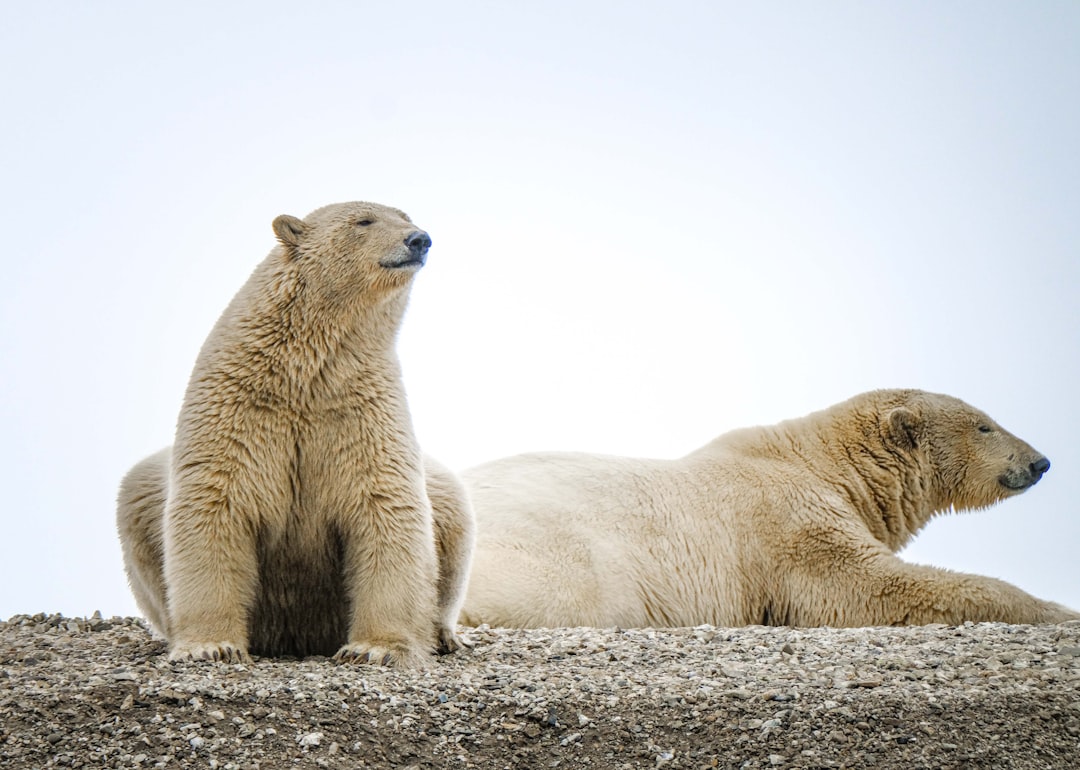
Where do polar bears live?
Polar bears (Ursus maritimus) live across the circumpolar Arctic in five countries: Canada, the United States (Alaska), Russia, Norway (Svalbard), and Greenland. The global population of 22,000 to 31,000 animals is split into 19 recognised subpopulations. Canada holds roughly 60 percent. They do not live at the North Pole, which lacks seals and continental-shelf productivity.
One Species, Nineteen Populations, Five Nations
Most people picture a polar bear as a single continuous species roaming a single continuous ice cap. That image is wrong in almost every detail. The Arctic Ocean is not one habitat. It is a patchwork of coastal shelves, straits, island archipelagos, and deep-water basins, and polar bears treat these pieces as genuinely separate neighbourhoods. Tagging and genetic sampling over the past four decades has shown that the species divides itself into 19 distinct subpopulations, each with its own seasonal movements, denning grounds, demographic trajectory, and, increasingly, its own climate fate.
The polar bear is a marine mammal by law and by ecology. Its entire life revolves around productive sea ice over shallow seas. That fact alone dictates the species' odd-looking distribution map. Bears do not live where ice is thickest. They live where ice meets shelf, where seals breed, where currents keep leads open in winter. Everything else is either transit corridor or empty water.
This article walks through the full range state by state, then subpopulation by subpopulation, with current estimates and trends. It also explains why several hundred thousand square kilometres of apparently suitable Arctic ice host almost no bears at all.
The Five Range States
The five polar bear nations are defined by the 1973 Agreement on the Conservation of Polar Bears, a rare Cold War-era environmental treaty signed in Oslo. It remains in force. The signatories share roughly this distribution:
| Range state | Approximate population | Share of global total | Subpopulations |
|---|---|---|---|
| Canada | ~16,000 | ~60% | 13 (most shared) |
| United States (Alaska) | ~3,000 | ~11% | 2 (both shared) |
| Russia | ~3,000-5,000 | ~13% | 4 (all shared) |
| Greenland | ~3,000-4,000 | ~12% | 3 (all shared) |
| Norway (Svalbard) | ~300 exclusive, ~3,000 shared Barents | ~1-10% | 1 (shared with Russia) |
Shares add above 100 because several subpopulations straddle borders. Bears do not respect maritime boundaries, and management agreements have had to be written to account for bears that den in Russia and hunt in Alaska or den in Canada and summer in Greenland.
Canada is the undisputed heartland. Its combination of the Hudson Bay complex, the Arctic Archipelago, and the Beaufort Sea coast gives it more productive polar bear habitat than the other four states combined. Alaska shares the Chukchi and Southern Beaufort populations with Russia and Canada respectively. Russia holds the longest Arctic coastline of any country, but its populations are the least surveyed, with the Laptev subpopulation in particular being an effective data black hole. Greenland contributes its northwest, east, and Baffin Bay sides to three transboundary populations. Norway governs the Svalbard half of the Barents Sea subpopulation, which is the most climate-stressed on the planet.
"Polar bears are not distributed evenly across the Arctic. They are concentrated where sea ice overlies productive continental shelves. Roughly 25 percent of the Arctic Ocean supports essentially no bears." -- IUCN Polar Bear Specialist Group, Global Status Review, 2021
Why the Central Arctic Basin Is Empty
The single most misunderstood fact about polar bear geography is that the central Arctic Ocean, including the North Pole itself, is not polar bear habitat. Satellite tracks of tagged bears rarely reach higher than 85 degrees north, and those that do are transient.
Two physical realities explain the exclusion. The first is bathymetry. Polar bears do not hunt ice; they hunt seals that hunt fish that feed on plankton. Plankton productivity collapses beyond the continental shelf, which drops from roughly 200 metres depth to 4,000 metres in the Arctic Basin. Ringed seals (Pusa hispida) and bearded seals (Erignathus barbatus) concentrate over the shelf edge. Beyond it, the food chain thins to nothing a polar bear can use.
The second reality is ice quality. Multi-year pack ice, which dominates the basin in winter, is too thick and unbroken for seals to maintain breathing holes or birthing lairs. Seals need first-year ice, thin enough to claw through. Ironically, the central Arctic is too icy for polar bears to hunt, not too unicy.
The result is a ring-shaped distribution. Imagine a doughnut with its hole centred on the Pole. The doughnut is the polar bear's world. The hole, thousands of kilometres wide, is biologically empty. For details on how this drives hunting strategy, see what polar bears eat.
The 19 Subpopulations
The IUCN Polar Bear Specialist Group (PBSG) recognises 19 subpopulations. Boundaries are defined primarily by satellite telemetry showing limited interchange, secondarily by genetic distance. Below is the complete list with current status as of the PBSG's most recent assessment.
| # | Subpopulation | Range state(s) | Estimate | Trend | Notes |
|---|---|---|---|---|---|
| 1 | Arctic Basin | International (shared drift ice) | Unknown | Data deficient | Transient only, no residents |
| 2 | Baffin Bay | Canada, Greenland | ~2,800 | Stable/increasing | Recently revised upward |
| 3 | Barents Sea | Norway (Svalbard), Russia | ~3,000 | Data deficient, likely declining | Fastest-warming habitat on Earth |
| 4 | Chukchi Sea | USA (Alaska), Russia | ~2,900 | Stable, robust body condition | Benefits from productive shelf |
| 5 | Davis Strait | Canada, Greenland | ~2,000 | Likely stable | Large ice-free summer period |
| 6 | East Greenland | Greenland | Unknown | Data deficient | Recently discovered isolated subgroup |
| 7 | Foxe Basin | Canada | ~2,580 | Stable | Hudson Bay system |
| 8 | Gulf of Boothia | Canada | ~1,525 | Stable/likely stable | Central Canadian Arctic |
| 9 | Kane Basin | Canada, Greenland | ~360 | Likely increasing | Smallest population, warming benefits briefly |
| 10 | Kara Sea | Russia | Unknown (~3,000 estimate dated) | Data deficient | Heavy industrial pressure |
| 11 | Lancaster Sound | Canada | ~2,540 | Stable | Core Arctic Archipelago |
| 12 | Laptev Sea | Russia | Unknown | Data deficient | Almost no recent surveys |
| 13 | M'Clintock Channel | Canada | ~716 | Recovering after over-harvest | Was over-hunted to ~280 in 2000 |
| 14 | Northern Beaufort Sea | Canada | ~980 | Stable | Shares range with Southern Beaufort |
| 15 | Norwegian Bay | Canada | ~203 | Likely declining | Tiny, surrounded by thick ice |
| 16 | Southern Beaufort Sea | USA (Alaska), Canada | ~900 | Declining | ~40% drop 2001-2010 |
| 17 | Southern Hudson Bay | Canada | ~1,119 | Declining | Body condition worsening |
| 18 | Viscount Melville Sound | Canada | ~161 | Data deficient | Remote and thick-iced |
| 19 | Western Hudson Bay | Canada | ~618 | Declining, ~30% since 1987 | Best-studied population worldwide |
Several numbers carry asterisks. The Arctic Basin entry is more of a boundary condition than a true population: bears pass through but do not reside. The Barents Sea estimate is held over from 2015 aerial surveys, and a follow-up has been repeatedly delayed. The Russian populations (Kara, Laptev, parts of Chukchi and Barents) collectively account for much of the global uncertainty band.
"We can count bears in the Canadian Arctic to within a few percent using mark-recapture. In the Russian Arctic we are lucky to have an order-of-magnitude guess. That asymmetry shapes every headline about global polar bear trends." -- Eric Regehr, University of Washington, quoted in Conservation Letters commentary, 2019
The Canadian Thirteen
Because Canada hosts the majority of the world's polar bears, any meaningful global trend is really a Canadian average. Thirteen subpopulations, each with its own story:
- Western Hudson Bay is the poster child of climate decline. Ice-out now comes three weeks earlier than in the 1980s, compressing the hunting season. Counts dropped from an estimated 1,200 in the late 1980s to 842 in 2011 to roughly 618 today, a decline of about 30 percent. This is the population around the town of Churchill, Manitoba, which has built an entire ecotourism economy around bears pushed onto land by early melt.
- Southern Hudson Bay follows the same trajectory a decade behind.
- Foxe Basin, Davis Strait, Baffin Bay, Lancaster Sound, and Gulf of Boothia together form the Arctic Archipelago core, holding roughly 11,000 bears, with most populations currently stable under modestly worsening ice conditions.
- Kane Basin and Norwegian Bay are tiny, cold, and in the short term may actually benefit from more open water (more seals, more access) before they cross the same thresholds that already punished Western Hudson Bay.
- M'Clintock Channel is a rare recovery story. Heavy subsistence harvest dropped it to roughly 280 bears by 2000. Quota reductions allowed it to climb back to around 716 as of the most recent estimate.
- Northern Beaufort Sea, Viscount Melville Sound, and the Canadian portion of Southern Beaufort Sea round out the thirteen.
Canadian Indigenous communities co-manage most of these populations through land claim agreements. Nunavut alone accounts for the largest share of the legal worldwide polar bear harvest, and its quota system is tied directly to PBSG-reviewed science.
The Russian Arctic: The Data Gap
Russia's Arctic coast stretches roughly 24,000 kilometres from the Kola Peninsula to the Bering Strait. On a map, it looks like premier polar bear habitat. In reality, the last rigorous abundance surveys for the Laptev and Kara Seas date to the Soviet era. What we know comes from denning counts at Wrangel Island, coastal observations, and limited satellite collaring.
Wrangel Island, a UNESCO World Heritage site in the Chukchi Sea, is the single most important denning ground on Earth. Up to 400 female polar bears den there in some years, more than any equivalent-sized area in the circumpolar range. The Russian biologist Nikita Ovsyanikov, who spent more than 20 field seasons on Wrangel, documented unique behaviours including large aggregations of bears feeding on walrus carcasses, a density unimaginable in most of the species' range.
"On Wrangel Island I have watched fifty bears feed peacefully on a walrus haul-out. That tolerance, that density, exists almost nowhere else. It is what the Arctic coast must have looked like before industrial whaling and sealing." -- Nikita Ovsyanikov, Polar Bears: Living with the White Bear
The Russian contribution to the global total is almost certainly between 3,000 and 5,000 bears. Beyond that, numbers are guesses. This matters because headlines about global trends often smooth over a glaring fact: a fifth of the world's polar bears have not been meaningfully counted in a generation.
The Svalbard Story
The Barents Sea subpopulation, straddling the Svalbard archipelago and Russian Franz Josef Land, lives in the fastest-warming region on the planet. Winter temperatures in Svalbard have risen more than four degrees Celsius since 1971, roughly four times the global average. Sea ice that used to reach Svalbard reliably every December now sometimes fails to form near the western coast until February, or never at all.
The behavioural response has been dramatic. Females that historically denned on sea ice off eastern Svalbard now increasingly den on land, concentrating on a handful of islands such as Kongsoya and Hopen. Genetic work suggests partial fragmentation between a smaller landfast-resident group and a larger pelagic group following the drifting ice.
Body-condition data collected by Jon Aars and the Norwegian Polar Institute through 2024 show Svalbard bears are leaner than their Hudson Bay counterparts despite still breeding successfully, a precarious balance. For context on how swimming factors into survival here, see polar bears as marine mammals.
The Commute: Summer Land to Winter Ice
Polar bear annual cycles vary by latitude, but every subpopulation follows some version of a seasonal commute between ice-hunting grounds and land-based fasting or denning refuges.
Low-latitude bears (Hudson Bay, southern Beaufort, Barents):
- Ice breaks up in late June or July. Bears come ashore.
- Land fast of up to 4 months. Body mass drops 1-2 kg per day.
- New ice forms in November. Bears return to the ice.
- Hunting season November to June. Peak fat gain in April-May with ringed seal pup births.
High-latitude bears (Arctic Archipelago, Kane Basin):
- Year-round ice cover historically meant no summer land phase.
- Bears hunted continuously across annual ice, with denning on land or sea ice.
- Multi-year ice losses since 2000 are forcing increasing summer land use here too.
The ability to fast for long periods is why a polar bear can survive at all in this climate. A female entering denning without adequate fat cannot produce the milk her cubs need. Cub survival, covered in detail in polar bear cubs, denning, and survival, is the demographic linchpin: drop the fat stores and the next generation fails before it gets to the ice.
Decline, Stability, and the Occasional Increase
A persistent myth holds that "polar bears are increasing" or conversely that "polar bears are all crashing." Neither caricature matches the data. The 19 subpopulations divide roughly into thirds:
- Declining or likely declining (4-6 populations): Western Hudson Bay, Southern Hudson Bay, Southern Beaufort Sea, likely Barents Sea, likely Norwegian Bay.
- Stable (5-7 populations): Chukchi, Foxe Basin, Gulf of Boothia, Lancaster Sound, Northern Beaufort, Davis Strait.
- Increasing or recovering (2-3 populations): Kane Basin, M'Clintock Channel, possibly Baffin Bay (after revision).
- Data deficient (5-6 populations): Arctic Basin, Kara, Laptev, East Greenland, Viscount Melville, parts of Barents.
The pattern is not random. Declines cluster at the southern edge of the range, where the balance between ice-on and ice-off has shifted most. Stable or increasing populations sit further north, where enough ice still forms each winter to support a full hunting season. This is exactly what climate projections predicted two decades ago. For the overarching threat analysis, see why polar bears are endangered.
"Polar bears respond not to average annual temperature but to the number of ice-free days over shallow shelf water. Once that threshold crosses roughly 180 days, cub recruitment collapses. We have already seen it happen in Western Hudson Bay." -- Andrew Derocher, University of Alberta, Polar Bears: A Complete Guide
Range Overlap With Other Bears
Polar bear range has been remarkably stable until very recently. One modern shift is worth flagging: climate-driven northward expansion of the grizzly bear has produced documented hybrid zones in the western Canadian Arctic, where polar and grizzly territories now overlap for the first time in human memory. The consequences are covered in polar bear vs grizzly bear. Separate from hybridisation, the Eurasian brown bear has historically never pushed onto the ice, and there is no evidence of Eurasian range overlap with polar bears.
How the 19 Are Managed
Polar bears are protected under the 1973 Oslo Agreement, the US Marine Mammal Protection Act (1972) and Endangered Species Act (2008 listing as threatened), the Canadian Species at Risk Act, Russian federal law (Red Data Book listing), Norwegian legislation banning harvest since 1973, and Greenlandic quota rules. The PBSG serves as the scientific coordinator, with delegates from all five range states plus independent scientists.
Subsistence harvest continues legally in Canada, Greenland, and Alaska. Norway and Russia ban all hunting. The total annual harvest is approximately 800 bears, nearly all from stable or increasing Canadian and Greenlandic subpopulations where quotas are tied to PBSG-reviewed abundance estimates.
Polar bear science has become a case study in cross-border conservation. Bears collared in Alaska have denned in Russia. Bears tagged in Svalbard have been shot by hunters in East Greenland. Managing a species that respects no maritime boundaries requires five governments to agree on numbers, trends, and thresholds. The fact that this works at all is quietly remarkable. Curious readers can dig into broader science communication at whats-your-iq.com and explore habitat writing craft at evolang.info.
The Map That Still Matters
If you were to lay a world map flat and mark every polar bear on Earth, the dots would form a broken ring hugging the shelves of five countries. You would see Canada light up like a constellation. You would see a gap over the North Pole that stretches across roughly a quarter of the Arctic Ocean. You would see declining dots thickening in Hudson Bay and thinning in the Barents, and you would see a few bright concentrations: Wrangel Island, the Canadian Archipelago, the mouth of Lancaster Sound, the fjords of East Greenland.
That map is the species' actual home. It has room in it. Managed well, it will keep 20,000 to 30,000 bears for generations. Managed poorly, it shrinks first at its southern edges, population by population, until the ring contracts to a polar cap of high-latitude refugia. The difference between those two futures is written in the trend column of a single table, 19 rows long. For the wider story of what lives on that map and why it matters, the polar bear remains the anchor article. Readers interested in adjacent Arctic storytelling can also find thoughtful long-form work at whennotesfly.com.
References
- Wiig, O., Amstrup, S., Atwood, T., Laidre, K., Lunn, N., Obbard, M., Regehr, E., Thiemann, G. (2015). Ursus maritimus. The IUCN Red List of Threatened Species. https://doi.org/10.2305/IUCN.UK.2015-4.RLTS.T22823A14871490.en
- Regehr, E. V., Laidre, K. L., Akcakaya, H. R., Amstrup, S. C., Atwood, T. C., Lunn, N. J., Obbard, M., Stern, H., Thiemann, G. W., Wiig, O. (2016). Conservation status of polar bears (Ursus maritimus) in relation to projected sea-ice declines. Biology Letters, 12(12). https://doi.org/10.1098/rsbl.2016.0556
- Lunn, N. J., Servanty, S., Regehr, E. V., Converse, S. J., Richardson, E., Stirling, I. (2016). Demography of an apex predator at the edge of its range: impacts of changing sea ice on polar bears in Hudson Bay. Ecological Applications, 26(5), 1302-1320. https://doi.org/10.1890/15-1256
- Amstrup, S. C., DeWeaver, E. T., Douglas, D. C., Marcot, B. G., Durner, G. M., Bitz, C. M., Bailey, D. A. (2010). Greenhouse gas mitigation can reduce sea-ice loss and increase polar bear persistence. Nature, 468, 955-958. https://doi.org/10.1038/nature09653
- Aars, J., Marques, T. A., Lone, K., Andersen, M., Wiig, O., Fløystad, I. M. B., Hagen, S. B., Buckland, S. T. (2017). The number and distribution of polar bears in the western Barents Sea. Polar Research, 36(1). https://doi.org/10.1080/17518369.2017.1374125
- Rode, K. D., Regehr, E. V., Douglas, D. C., Durner, G., Derocher, A. E., Thiemann, G. W., Budge, S. M. (2014). Variation in the response of an Arctic top predator experiencing habitat loss: feeding and reproductive ecology of two polar bear populations. Global Change Biology, 20(1), 76-88. https://doi.org/10.1111/gcb.12339
- Laidre, K. L., Stern, H., Kovacs, K. M., Lowry, L., Moore, S. E., Regehr, E. V., Ferguson, S. H., Wiig, O., Boveng, P., Angliss, R. P., Born, E. W., Litovka, D., Quakenbush, L., Lydersen, C., Vongraven, D., Ugarte, F. (2015). Arctic marine mammal population status, sea ice habitat loss, and conservation recommendations for the 21st century. Conservation Biology, 29(3), 724-737. https://doi.org/10.1111/cobi.12474
- Molnar, P. K., Bitz, C. M., Holland, M. M., Kay, J. E., Penk, S. R., Amstrup, S. C. (2020). Fasting season length sets temporal limits for global polar bear persistence. Nature Climate Change, 10, 732-738. https://doi.org/10.1038/s41558-020-0818-9
Related Articles
- Polar Bear: The Complete Guide to Ursus maritimus
- Why Polar Bears Are Endangered
- What Do Polar Bears Eat
- Polar Bear Cubs, Denning and Survival
- Polar Bears as Marine Mammals: Swimming the Arctic
- Polar Bear vs Grizzly Bear
- Grizzly Bear: North American Predator
- Brown Bear