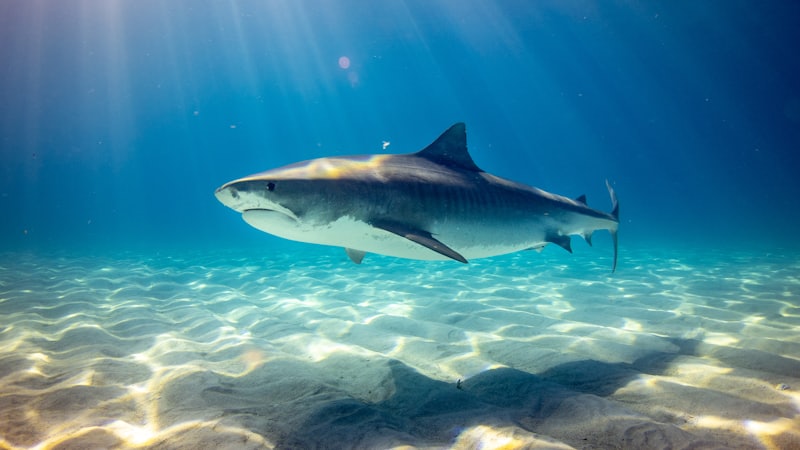
Do Sharks Actually Attack Humans?
The Fear and the Facts
In 1975, Jaws taught a generation to be afraid of the ocean. The film grossed $470 million and reshaped how the entire world thinks about sharks. Beach attendance dropped at coastal resorts around the world. Shark populations were deliberately reduced in many regions through organized hunting campaigns. The phrase "a shark-infested waters" entered common usage.
All of this was based on a false premise. Sharks kill approximately 6 humans per year globally. Humans kill 100 million sharks per year. The real danger, by every statistical measure, runs in exactly the opposite direction from what Jaws portrayed.
The Actual Statistics
The Florida Museum's International Shark Attack File has tracked shark attacks systematically since 1958 and backdated records to 1580. The numbers are not what most people expect.
Annual averages (2014-2023):
- Total unprovoked shark attacks: 64 per year globally
- Fatal shark attacks: 6 per year
- Survival rate of shark attack victims: approximately 90 percent
For context, annual global deaths from:
| Cause | Deaths per Year |
|---|---|
| Mosquitoes | 725,000+ |
| Snakes | 100,000 |
| Lightning strikes | 24,000 |
| Dogs (rabies) | 25,000 |
| Falling coconuts | ~150 |
| Hippopotamuses | 500 |
| Lions | 200 |
| Crocodiles | 1,000 |
| Sharks | 6 |
Sharks kill fewer people than vending machines tipping over (approximately 13 deaths per year in the U.S. alone). They kill fewer people than falling coconuts. They kill fewer people than champagne corks (approximately 24 deaths per year globally).
For scale: Your lifetime odds of being killed by a shark are approximately 1 in 3.7 million. Your lifetime odds of being killed by a cow are approximately 1 in 20,000 (cattle kill 20-22 people per year in the United States).
The Three Most Dangerous Shark Species
Of the approximately 500 known shark species, only a few routinely attack humans. The vast majority of sharks are either too small to pose a threat, live in environments that do not overlap with humans, or have no predatory interest in humans.
Three species account for the bulk of serious shark attacks:
Great White Shark
The great white (Carcharodon carcharias) has the highest absolute number of attacks and highest total fatalities. Historical records list approximately 350 attacks with 57 fatalities since 1580.
Great whites are visual hunters that often investigate unfamiliar objects by biting once and releasing. Many great white attacks on humans involve a single bite followed by the shark leaving -- suggesting the shark tasted the human, recognized it was not a seal (its preferred prey), and moved on.
This "investigative bite" pattern is why great white attacks have a relatively high survival rate. A single bite, while devastating, is often non-fatal if the victim reaches medical care quickly.
Tiger Shark
The tiger shark (Galeocerdo cuvier) has the highest fatality rate per attack. Historical records show approximately 138 attacks with 39 fatalities.
Tiger sharks have a more catholic diet than great whites, eating almost anything -- seals, turtles, seabirds, rays, fish, and essentially any animal they encounter. They are less discriminating about prey than great whites, which makes them more likely to consume humans deliberately after biting.
Tiger sharks are responsible for most shark attacks in Hawaii and parts of the western Pacific. They prefer warmer water than great whites.
Bull Shark
The bull shark (Carcharhinus leucas) is often considered the most dangerous shark for ecological rather than biological reasons. Bull sharks can tolerate freshwater and have been documented in rivers hundreds of kilometers inland. They are the only large shark species that regularly enters freshwater systems.
Bull shark populations exist in the Mississippi River, the Zambezi, the Amazon, and even in Lake Nicaragua -- a freshwater lake with no direct connection to the ocean. Bull sharks can live in freshwater for months at a time.
Because bull sharks live in rivers where humans swim and bathe, they encounter humans more frequently than purely marine sharks. Historical records list approximately 121 bull shark attacks with 27 fatalities. The actual numbers are probably much higher because many bull shark attacks in developing countries are not reported to the International Shark Attack File.
The Mistaken Identity Theory
Why do sharks attack humans at all, given how rarely humans are on their menu?
The leading scientific explanation is mistaken identity. A surfer on a surfboard, seen from below with silhouetted arms and legs moving, looks remarkably similar to a seal from a shark's visual perspective. Great whites specifically target seals by approaching from below and striking upward -- the same attack pattern observed in many shark-on-human incidents.
Research by Dr. Laura Ryan at Macquarie University used 3D modeling to simulate how great white sharks perceive objects on the surface. The simulations showed that seals, surfers, and swimmers produce nearly identical visual silhouettes from the shark's underwater viewing angle. A shark deciding to investigate a possible seal cannot always distinguish a seal from a human until the investigation is already in progress.
This is consistent with observed attack behavior:
- Great whites often bite once and release, matching "investigative bite" rather than "predatory consumption"
- Attack rates are higher near seal colonies where sharks are hunting
- Surfers are disproportionately attacked compared to swimmers, because surfboards more strongly resemble seal shapes
- Most great white attacks occur at dawn or dusk when light conditions limit the shark's ability to distinguish prey
Why Fear Exceeds Reality
The disconnect between actual shark danger and public perception of shark danger is one of the most thoroughly studied cases of cognitive bias in risk perception.
Availability bias. Shark attacks are memorable and widely reported. A single shark attack generates international news coverage, while the 725,000 annual mosquito deaths go largely unreported. This creates the impression that shark attacks are more common than they actually are.
Dread risk. Humans instinctively fear dangers that are dramatic, uncontrolled, and involve loss of body integrity. Being eaten by a shark activates deep primate fears of predation. Dying of heart disease at 75 does not activate the same emotional response, even though it is vastly more likely.
Cultural reinforcement. Jaws created a cultural template for shark behavior that bears little resemblance to real sharks. Subsequent films, TV shows, and even "educational" documentaries have reinforced this template. Most people form their beliefs about sharks from fiction, not from scientific study.
Geographic concentration. Shark attacks occur only in specific regions (coastal waters with shark populations). People in those regions see local news coverage of every attack, magnifying the perceived frequency.
The result is that many people are terrified of sharks while being completely indifferent to risks that are thousands of times more likely to kill them.
How Humans Kill Sharks
If the danger is measured by deaths caused, sharks are vastly less dangerous than humans.
Annual shark deaths from human activity:
- Commercial fishing (bycatch): approximately 50-70 million sharks per year
- Shark fin soup industry: approximately 17 million sharks per year
- Targeted fishing for meat, liver oil, cartilage: approximately 10-15 million sharks per year
- Recreational fishing: approximately 1-2 million sharks per year
Total: approximately 100 million sharks killed by humans per year.
For every human killed by a shark, humans kill approximately 16,666,666 sharks.
The Shark Fin Trade
The Asian shark fin soup industry is the single largest driver of shark mortality. Shark fins sell for up to $300 per kilogram, making them one of the most valuable seafood products by weight.
Fishing vessels catch sharks primarily for their fins. In the most brutal practice ("finning"), sharks are caught, their fins are sliced off while the shark is still alive, and the shark is thrown back into the ocean to die. The shark sinks to the bottom and drowns or bleeds to death because it cannot swim to move water across its gills.
The practice has declined in many countries due to legislation, but it continues at large scale in international waters. Approximately 73 million sharks per year are still killed primarily for their fins.
Population Collapse
The cumulative effect on shark populations is catastrophic. Since 1970:
- Oceanic whitetip sharks have declined by approximately 98 percent
- Scalloped hammerheads have declined by approximately 99 percent
- Atlantic thresher sharks have declined by approximately 80 percent
- Mako sharks have declined by approximately 60 percent
Approximately 37 percent of all shark species are now threatened with extinction, and multiple species are critically endangered. The Lost Shark (Carcharhinus obsoletus) was declared likely extinct in 2019, the first modern extinction of a shark species documented in real time.
The Ecological Cost
Sharks are apex predators in most marine ecosystems. Removing them cascades through the food web in ways that damage ocean health broadly.
Examples of shark removal effects:
Chesapeake Bay, USA. The local shark population collapsed in the late 20th century. Cownose rays, which sharks eat, increased dramatically. The rays then overfed on scallops and oysters, collapsing those fisheries. An entire commercial fishing industry was destroyed by the loss of predator control.
Coral Reefs. Reef sharks control populations of medium-sized predatory fish that in turn control populations of herbivorous fish. Remove the sharks and the herbivores decline, allowing algae to overgrow the coral. Healthy reefs have abundant sharks. Collapsed reefs usually do not.
Seagrass Meadows. Tiger sharks control sea turtle and dugong populations in tropical seagrass meadows. Without shark pressure, these herbivores overgraze the seagrass, destroying nursery habitat for commercially important fish species.
Sharks are infrastructure for ocean ecosystems. Their role cannot be easily replaced, and their decline has measurable effects on fisheries, tourism, and coastal economies.
What To Do If You Encounter a Shark
If you spend time in the ocean in regions where sharks live, you may eventually encounter one. Here is what to do:
In the Water
Do not panic or splash. Thrashing movements trigger predatory interest. Move calmly and deliberately.
Face the shark. Sharks prefer to attack from angles where prey cannot see them. Keeping eye contact makes you less attractive as a target.
Make yourself look bigger. Extend arms and legs. Do not curl into a ball.
Move slowly toward safety. Swim deliberately toward shore, a boat, or a reef. Do not attempt to swim fast -- you cannot outpace a shark, and frantic movement suggests wounded prey.
If contact occurs: Strike the eyes, gills, or tip of the snout. These are the most sensitive areas. Do not punch the shark's body; the skin is coated with abrasive dermal denticles that will cut your hand.
Preventive Measures
Avoid sharks when possible. Do not swim at dawn or dusk (peak shark activity). Do not swim in murky water. Do not swim near fishing boats or seal colonies. Do not wear reflective jewelry.
Swim in groups. Sharks rarely attack groups of people.
Leave the water if blood is present. Sharks can detect blood from approximately 400 meters away. Anyone bleeding should exit the water immediately.
Pay attention to local warnings. Coastal areas with shark populations post warnings when recent attacks have occurred or when environmental conditions favor shark presence.
After an Attack
Shark bites have a 90 percent survival rate with prompt medical care. The priorities are:
- Exit the water as calmly as possible to avoid further investigation
- Apply pressure to any wounds to control bleeding
- Call emergency services immediately
- Get to a hospital -- shark bites often require surgery to clean and close
Most shark bite fatalities result from blood loss, not the direct injury of the bite. Rapid medical attention is usually the difference between surviving and not.
The Honest Conversation
Sharks are not dangerous to humans in any statistically meaningful sense. The fear of sharks is real, and it has consequences -- for individuals who avoid the ocean, for regional economies that lose beach tourism revenue, and for shark species driven to extinction by fishing pressure that is partly justified by public fear.
The honest conversation about sharks starts with the numbers. Six human deaths per year. Ten out of 500 shark species that pose any meaningful risk to humans. A survival rate of 90 percent even when attacks occur. And 100 million shark deaths per year at human hands.
The problem is not that sharks are dangerous to humans. The problem is that humans are exterminating sharks. If this continues, most of the world's large shark species will be functionally extinct within the lifetime of readers under age 40. That outcome would be catastrophic for ocean ecosystems, for fisheries, and for the broader health of the planet's seas.
The next time you hear about a shark attack in the news, do the math. Count the sharks killed by humans during the same week. The ratio will tell you what the actual story is.
Related Articles
- How Many People Do Sharks Kill Per Year?
- Sharks: The Ocean's Most Misunderstood Predators
- Megalodon vs Great White Shark
Frequently Asked Questions
How many people do sharks kill per year?
Sharks kill approximately 6 people per year globally, with roughly 60-80 unprovoked shark attacks recorded annually according to the Florida Museum's International Shark Attack File. Most shark attacks do not result in fatalities -- the survival rate is approximately 90 percent even for attacks by large species like great whites or bull sharks. The 6 annual deaths represent the outer limit of shark lethality across all seven billion humans on the planet. For comparison, lightning strikes kill approximately 24,000 people annually, vending machines falling over kill 13 per year in the United States alone, and mosquitoes kill 725,000 people per year through disease transmission. Sharks are among the least dangerous animals on Earth by deaths caused, despite their fearsome cultural reputation.
Which sharks are most dangerous to humans?
Three species account for the majority of unprovoked fatal shark attacks: the great white shark (Carcharodon carcharias), the tiger shark (Galeocerdo cuvier), and the bull shark (Carcharhinus leucas). The International Shark Attack File records approximately 350 great white attacks (57 fatal), 138 tiger shark attacks (39 fatal), and 121 bull shark attacks (27 fatal) since records began in 1580. Bull sharks are particularly concerning because they can tolerate freshwater and have been documented in rivers hundreds of kilometers inland -- including the Mississippi River and the Zambezi. Great whites rank highest in absolute attacks but have the lowest fatality rate because they typically release human prey after investigation, recognizing that humans are not their preferred meal. Most other shark species, including hammerheads, makos, and even tiger sharks in some populations, rarely attack humans at all.
Why do sharks attack humans?
Most shark attacks on humans are cases of mistaken identity rather than deliberate predation. A surfer on a surfboard, seen from below, presents a silhouette remarkably similar to a seal -- the primary prey of great whites and tiger sharks. The shark investigates by biting, realizes the target is not a seal, and typically releases the human. This is why most shark attacks are single bites with the shark then departing, rather than sustained attacks. Deliberate predation on humans is extraordinarily rare and generally limited to bull sharks in murky water where visibility is poor. Shark attacks are also sometimes defensive -- people who grab shark tails, swim aggressively toward sharks, or spear-fish too close to sharks can trigger defensive bites that are not predatory at all.
How many sharks do humans kill per year?
Humans kill approximately 100 million sharks per year through commercial fishing, shark finning, and bycatch. This is roughly 17 million sharks per year just for the shark fin soup industry, with the remainder dying in fishing nets meant for tuna, swordfish, and other species. The ratio of humans killing sharks versus sharks killing humans is approximately 16,666,666 to 1. Of the 500+ known shark species, approximately one-third are threatened with extinction, and several large shark species have declined by over 90 percent from historical populations. Great white shark populations off the coast of California are considered a recovery success story -- they increased from fewer than 400 adults in 1990 to approximately 2,500 in 2025 following protection. But most shark species globally are still in significant decline.
What should you do if a shark approaches you?
If a shark approaches, remain calm and maintain eye contact. Sharks prefer to attack prey from behind or below, where the prey cannot defend itself. Face the shark directly. Do not splash, thrash, or try to swim away rapidly -- these behaviors signal distress and can trigger predatory interest. Move slowly and deliberately toward the shore or a boat. If the shark makes physical contact, aim strikes at the eyes, gills, or snout -- the most sensitive areas. Do not attempt to strike the shark's body; shark skin is reinforced with tiny tooth-like structures called dermal denticles that will abrade your hand. Most shark encounters end with the shark simply leaving after curiosity is satisfied. If bitten, exit the water as calmly as possible, control bleeding immediately, and seek medical attention -- shark bites, while traumatic, are survivable in 90 percent of cases with prompt medical care.