
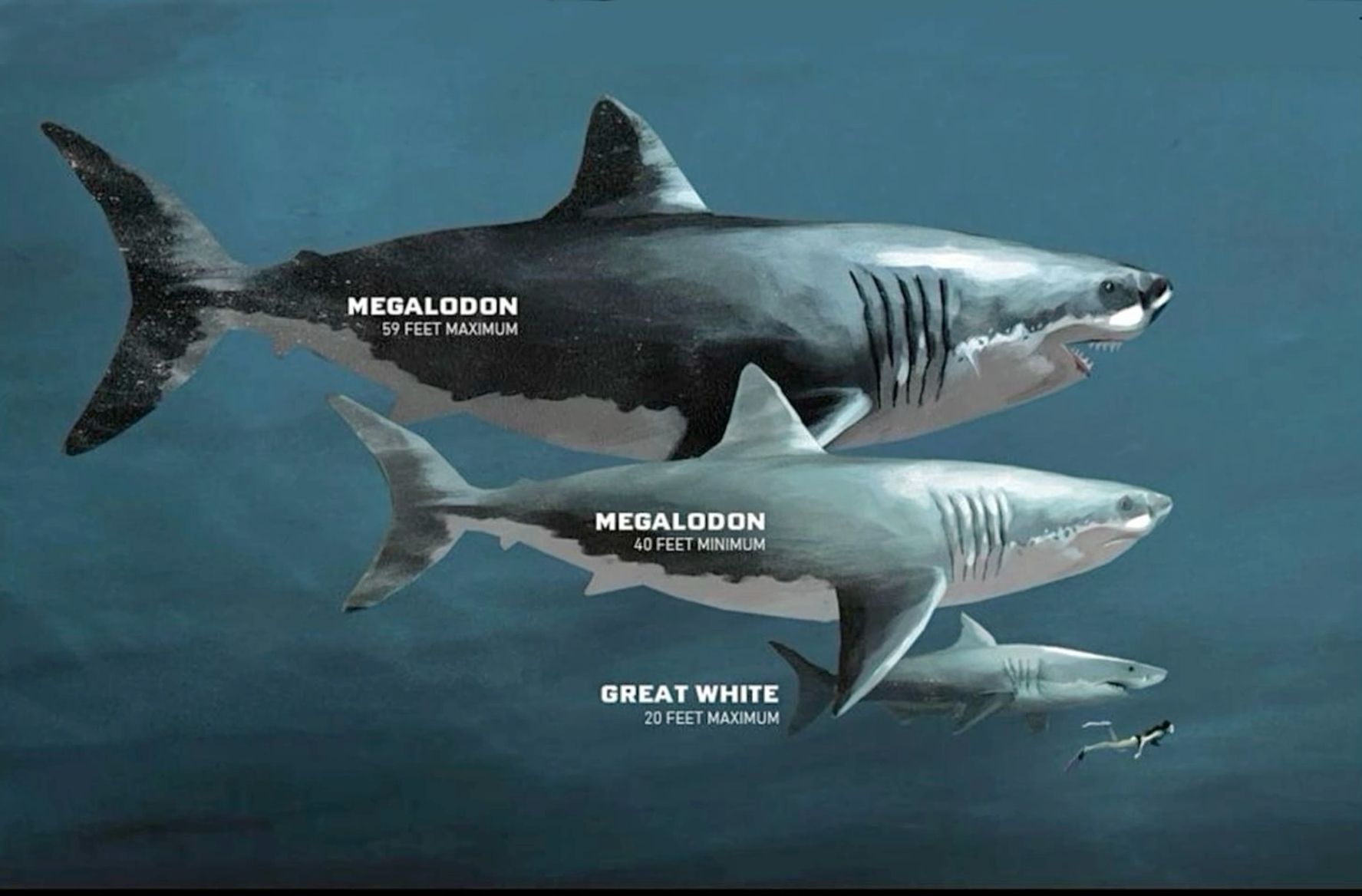
How big was megalodon compared to a great white shark?
Megalodon was roughly three times larger than a great white shark. Modern estimates place adult megalodon at 15 to 20 meters (50 to 65 feet) long and weighing 50 to 100 tonnes. A large great white shark reaches 6 meters (20 feet) and 2 tonnes.
The Giant That Ruled the Seas
For twenty million years, one animal sat at the absolute top of the ocean's food chain. Otodus megalodon - the "big tooth" - was a shark so enormous that a full-grown great white shark would have been a reasonable meal. It patrolled warm coastal waters across every ocean on Earth, hunting whales, dolphins, and anything else foolish enough to come near a coastline. Then, roughly 3.6 million years ago, it vanished forever.
The question "megalodon vs great white" is really a question about scale, time, and what Earth's oceans were like before modern predators took over. Both species are sharks. Both are apex predators. But comparing them is like comparing a fighter jet to a propeller plane.
Size: The Most Famous Difference
The single most astonishing fact about megalodon is its size.
Modern estimates for adult megalodon:
- Length: 15 to 20 meters (50 to 65 feet)
- Weight: 50 to 100 tonnes
- Tooth length: up to 18 cm (7 inches)
- Mouth gape: approximately 3.4 meters (11 feet) wide
Adult great white shark:
- Length: 4 to 6 meters (13 to 20 feet)
- Weight: 680 to 2,000 kg (1,500 to 4,400 lb)
- Tooth length: up to 7.5 cm (3 inches)
- Mouth gape: approximately 1 meter (3.3 feet) wide
A megalodon was roughly three times longer and twenty to fifty times heavier than a great white. Its teeth alone were bigger than an adult great white shark's entire head. When paleontologist Bashford Dean reconstructed a megalodon jaw for the American Museum of Natural History in 1909, he built it 3.4 meters wide - six grown men could stand inside the mouth.
Even more remarkable: megalodon is no longer considered the largest size estimate scientists have ever proposed. Dr. Kenshu Shimada's 2021 study, based on detailed analysis of tooth proportions and newly discovered vertebral columns from Peru, suggests the largest individuals may have approached 20 meters in length - making megalodon the largest predatory fish that has ever existed on Earth.
Bite Force: Stronger Than T. rex
Bite force measurements in extinct animals come from biomechanical modeling of skull anatomy and tooth wear patterns. For megalodon, the numbers are staggering.
Estimated megalodon bite force: 108,500 to 182,200 newtons (around 40,000 PSI at the tooth tip).
Great white shark bite force: approximately 18,000 newtons (about 4,000 PSI).
Tyrannosaurus rex bite force: approximately 35,000 newtons (about 12,800 PSI).
Saltwater crocodile bite force: approximately 16,000 newtons (about 3,700 PSI).
Megalodon bit roughly ten times harder than a great white and three to five times harder than T. rex. For context, that bite force could easily crush a modern car flat and powder the vertebrae of the largest baleen whales.
Fossil evidence confirms this firepower was used on exactly the prey it sounds like. Whale bones from the Pliocene epoch, found across Europe, the Americas, Africa, and Australia, show massive bite marks that match megalodon tooth spacing. Some whale vertebrae have actual megalodon teeth embedded in them, snapped off during the bite and healed over by new bone growth as the whale - incredibly - survived the encounter.
Hunting Strategy: Different Predators for Different Worlds
Great whites and megalodons both ambush, but they operated at completely different scales.
Great white hunting strategy:
- Cruise below the surface
- Identify a silhouetted target from below
- Accelerate vertically at up to 25 mph (40 km/h)
- Deliver a single massive bite
- Retreat and wait for the prey to bleed out
- Return to feed once the animal is weakened
This breach attack works on seals, sea lions, and similar-sized prey. The great white is a specialist in surprise and a single decisive strike.
Megalodon hunting strategy (reconstructed from fossil evidence):
- Ambush whales in coastal nursery grounds
- Target the flippers and tail to immobilize prey
- Deliver a series of crushing bites to the rib cage
- Consume the entire carcass over hours or days
Fossil whales with megalodon damage show a consistent pattern: bites to flippers and tails first, then crushing bites to the chest. This is exactly how modern orcas hunt large prey - disable the animal's propulsion, then kill it. Megalodon appears to have used similar tactics but on a vastly larger scale.
Where They Lived
Megalodon was global. Teeth have been found on every continent except Antarctica, and in every ocean basin. The species preferred warm, shallow coastal waters rich in marine mammal prey - the exact environments where whales gave birth and raised calves. Megalodon likely ambushed juvenile whales in these nursery grounds and fed on the enormous calories they provided.
Great whites are also global but favor cooler temperate waters. The three largest populations today are off California, South Africa, and southern Australia. Great whites tolerate tropical waters but do not specialize in them.
This is a critical ecological difference. Megalodon depended on warm, shallow coastal waters. When those environments disappeared - more on that below - the species had nowhere to go.
Why Megalodon Went Extinct
Megalodon did not die in a single catastrophic event. It starved slowly over millions of years as its world transformed around it.
1. Ocean cooling. Starting around 5 million years ago, Earth's climate cooled significantly. Warm tropical coastal waters shrank. The shallow seas where megalodon hunted whales contracted toward the equator.
2. Whale migration to colder waters. Baleen whales - megalodon's primary prey - evolved to exploit the nutrient-rich cold-water upwelling zones near the poles. Megalodon could not follow. As a large-bodied ectotherm (or mesotherm, per recent studies), it required warm water to maintain its metabolism.
3. Whale evolution. Whales themselves evolved larger body sizes and faster swimming speeds during the late Miocene and Pliocene. A juvenile whale of 4 million years ago was bigger and faster than one from 10 million years ago. Megalodon's ambush tactics became less effective as prey got harder to catch.
4. Orca arrival. Killer whales evolved during megalodon's decline. Orcas are smaller, faster, more intelligent, and hunt cooperatively in pods. They would have been direct competitors for the same prey and perhaps even predators on juvenile megalodons.
5. Great white competition. Modern great whites evolved around 6 million years ago. They are faster, more maneuverable, and less dependent on warm water than megalodon was. They likely outcompeted megalodon for smaller prey in cooler waters.
By 3.6 million years ago, megalodon was gone. The ocean had changed, its prey had moved, its competitors had arrived, and the ultimate predator could no longer feed itself.
Could Megalodon Still Be Alive?
This question comes up constantly because of the 2018 film The Meg and various pseudoscience documentaries. The short answer: no.
The long answer: we know this with extraordinary certainty.
Megalodon teeth are everywhere. They are among the most abundant shark fossils on Earth, shed constantly throughout life and preserved in ocean sediments for millions of years. Every continent has megalodon teeth. Every ocean basin has megalodon teeth. Yet no tooth younger than 3.6 million years has ever been found anywhere, by anyone.
Megalodon was not a deep-sea animal. It was a shallow-water coastal predator that ate warm-blooded marine mammals. Deep ocean trenches do not have the food sources megalodon required, and megalodon would not have evolved the physiology to survive at depth.
Modern whales show no megalodon bite marks. Living whales are examined constantly by researchers. None show injuries consistent with a giant shark predator. If megalodon were alive, we would see the evidence in whale populations, shipping incidents, and washed-up carcasses.
Large marine animals are hard to hide. We have identified and cataloged every living species of whale, large shark, and giant squid. A 20-meter predatory shark could not remain undiscovered.
The internet myths persist because megalodon is genuinely fascinating and because films profit from the ambiguity. But scientifically, the species is definitively extinct.
The Verdict
Megalodon was the apex predator of a different world. It was larger than any living shark, larger than any known predatory fish in Earth's history, and capable of killing prey that modern oceans no longer contain. A great white shark, by comparison, is smaller than a juvenile megalodon and specializes in entirely different prey.
If the two had ever truly met as equals, they would not have fought - megalodon would have simply eaten the great white. The great white only exists today because megalodon disappeared first, leaving an ecological opening that smaller, faster sharks could exploit.
Megalodon's extinction is a reminder that size is not invulnerability. The biggest predator that ever lived was also one of the most ecologically specialized. When its world changed, it could not change with it. The great white shark, smaller but more adaptable, inherited the seas.
Side-by-Side Biological Comparison
The proportional differences between megalodon and the great white shark are difficult to grasp from narrative description alone. Our research team assembled a side-by-side comparison using the most current scientific estimates from peer-reviewed sources.
| Trait | Megalodon (Otodus megalodon) | Great white (Carcharodon carcharias) |
|---|---|---|
| Maximum length | 15-20 m (estimated) | 6.1 m (verified) |
| Maximum mass | 30,000-65,000 kg | 2,268 kg |
| Tooth length (slant height) | Up to 18 cm | Up to 7.5 cm |
| Estimated bite force | 108,514-182,201 N | 18,216 N |
| Swimming speed | 18-19 km/h (estimated) | 56 km/h (burst) |
| Preferred prey | Baleen whales, sea cows | Pinnipeds, large fish |
| Geographic range | Global, warm and temperate | Global, temperate |
| Extinction or status | Extinct ~3.6 million years | Vulnerable, extant |
| Estimated lifespan | 88-100 years | 70+ years |
A 2020 study led by Jack Cooper at the University of Bristol, published in Scientific Reports, used body proportions of modern lamnid sharks to reconstruct megalodon anatomy in unprecedented detail. The study estimated that an adult 16-meter megalodon had a dorsal fin approximately the height of an adult human and a tail fin standing 3.85 meters tall [1].
The Timeline of Megalodon's Rise and Fall
Megalodon first appeared in the fossil record approximately 23 million years ago during the early Miocene, achieving peak global distribution during the Miocene-Pliocene boundary 5 to 10 million years ago. The species went extinct approximately 3.6 million years ago during the Pliocene, coinciding with the cooling of the Earth's oceans and the rise of modern cetaceans.
"Megalodon's extinction was the result of a perfect storm. The species was a warm-water predator of coastal cetaceans, and the Pliocene ocean cooling eliminated its preferred habitat. At the same time, true great whites were emerging as faster, more thermally flexible competitors for the same ecological role. Megalodon could not follow its prey into colder waters and could not compete with the emerging lamnid sharks in temperate zones." - Dr. Catalina Pimiento, Swansea University and Smithsonian Tropical Research Institute [2]
Pimiento's laboratory has conducted some of the most comprehensive paleogeographic analyses of megalodon fossil distributions, demonstrating a clear contraction of the species's range over the final three million years of its existence as it retreated from cooling high-latitude waters.
Reconstructed Bite Force and Predatory Capability
A 2008 biomechanical study by Steve Wroe and colleagues at the University of New South Wales, published in the Journal of Zoology, estimated megalodon bite force at up to 182,000 Newtons - roughly ten times the bite force of a great white shark and three times the bite force of any living predator [3]. For comparison, the bite force of a saltwater crocodile is approximately 16,000 Newtons and a spotted hyena delivers about 4,500 Newtons.
"The megalodon bite force estimates push against the limits of what vertebrate jaw architecture could have supported. To deliver forces in that range, the animal required skull reinforcements, jaw musculature, and dental attachments that have no parallel in any living shark. Even the great white, impressive as it is, generates bite forces an order of magnitude smaller." - Dr. Steve Wroe, University of New England, Australia [3]
Bite marks matching megalodon tooth profiles have been documented on fossil whale vertebrae, demonstrating the species's capacity to kill and dismember baleen whales up to 10 meters in length. The Calvert Cliffs locality in Maryland preserves multiple fossil whale specimens with distinctive megalodon-consistent tooth marks that have provided direct evidence of predatory behavior on marine mammals.
References
- Cooper, J. A., Pimiento, C., Ferron, H. G., & Benton, M. J. (2020). Body dimensions of the extinct giant shark Otodus megalodon: a 2D reconstruction. Scientific Reports, 10, 14596. DOI: 10.1038/s41598-020-71387-y
- Pimiento, C., & Balk, M. A. (2015). Body-size trends of the extinct giant shark Carcharocles megalodon: a deep-time perspective on marine apex predators. Paleobiology, 41(3), 479-490. DOI: 10.1017/pab.2015.16
- Wroe, S., Huber, D. R., Lowry, M., et al. (2008). Three-dimensional computer analysis of white shark jaw mechanics: how hard can a great white bite? Journal of Zoology, 276(4), 336-342. DOI: 10.1111/j.1469-7998.2008.00494.x
- Shimada, K., Bonnan, M. F., Becker, M. A., & Griffiths, M. L. (2023). Ontogenetic growth pattern of the extinct megatooth shark Otodus megalodon. Historical Biology, 35(5), 698-708. DOI: 10.1080/08912963.2022.2144287
- Griffiths, M. L., Eagle, R. A., Kim, S. L., et al. (2023). Endothermic physiology of extinct megatooth sharks. Proceedings of the National Academy of Sciences, 120(27), e2218153120. DOI: 10.1073/pnas.2218153120
Thermal Biology and Endothermy
A 2023 study published in Proceedings of the National Academy of Sciences used clumped isotope analysis of megalodon tooth enamel to reconstruct the body temperature of the extinct species. The research, led by Michael Griffiths at William Paterson University and Robert Eagle at UCLA, concluded that megalodon maintained body temperatures approximately 7 degrees Celsius above surrounding ocean water - confirming the species was endothermic like its modern lamnid relatives.
"The isotopic evidence from megalodon teeth tells us that this was a warm-blooded fish on a scale never seen before or since. Supporting a 50-ton body at elevated temperatures required an enormous food intake, and this metabolic cost may have contributed directly to the species's extinction when Pliocene climate change reduced the abundance of its preferred large-whale prey." - Dr. Robert Eagle, University of California, Los Angeles [5]
The endothermy finding reframes the classic narrative of megalodon extinction. Rather than being simply a size-specialized predator unable to compete with emerging great whites, megalodon was a high-metabolism apex predator whose energy requirements made it particularly vulnerable to declines in prey biomass. The combination of cooling oceans, shrinking whale populations, and metabolic inflexibility produced a perfect storm that no size or strength advantage could offset.
Growth and Size Reconstruction from Vertebrae
Megalodon vertebrae are much rarer than teeth in the fossil record because cartilaginous skeletons rarely preserve, but several well-preserved specimens have enabled growth rate reconstruction. A 2023 Historical Biology study by Kenshu Shimada analyzed a Belgian megalodon vertebral column and concluded that individuals grew approximately 16 centimeters per year during their first 46 years, with continued growth thereafter at reduced rates.
The analysis placed maximum megalodon lifespan at approximately 88 to 100 years, comparable to the maximum age of the modern Greenland shark and more than twice the lifespan of a great white. The long lifespan combined with slow sexual maturation made megalodon populations particularly vulnerable to environmental disruption, as recovery times after major mortality events would have exceeded a century.
Related Articles
- Sharks: The Ocean's Most Misunderstood Predators
- Prehistoric Marine Life: Monsters of the Ancient Seas
- How Many People Do Sharks Kill Per Year?
Frequently Asked Questions
How big was megalodon compared to a great white shark?
Megalodon was roughly three times larger than a great white shark. Modern estimates place adult megalodon at 15 to 20 meters (50 to 65 feet) long and weighing 50 to 100 tonnes. A large great white shark reaches 6 meters (20 feet) and 2 tonnes. Megalodon’s teeth alone were up to 18 cm (7 inches) long - bigger than an adult great white’s entire head.
The 2021 study by Kenshu Shimada at DePaul University, based on detailed tooth morphology and vertebral analysis, suggests the largest megalodons may have approached 20 meters, making them the largest predatory fish that ever lived.
How powerful was megalodon's bite force?
Megalodon’s estimated bite force was 108,500 to 182,200 newtons - roughly 40,000 PSI at the tip of the tooth. That is about ten times more powerful than a great white shark’s 4,000 PSI bite and approximately three times more powerful than a Tyrannosaurus rex. The only known comparable bite in Earth’s history belongs to certain pliosaurs and possibly the giant theropod Deinosuchus.
Megalodon could crush the vertebrae of whales, and fossil whale bones with megalodon bite marks have been found across every continent except Antarctica.
Is megalodon still alive somewhere in the deep ocean?
No, megalodon is definitively extinct and has been for approximately 3.6 million years. This conclusion is based on several independent lines of evidence. Megalodon teeth are among the most abundant shark fossils on Earth, yet no tooth younger than 3.6 million years has ever been found.
Megalodon was a coastal and shallow-water predator that fed primarily on whales and large marine mammals - it could not survive at the depths where humans have not yet explored. Modern whale populations show no bite marks consistent with megalodon predation. The viral internet claim that megalodon still lives in deep ocean trenches is a myth popularized by fictional films and pseudoscience documentaries, not supported by any evidence.
Why did megalodon go extinct?
Megalodon extinction was driven by a combination of climate change, prey loss, and competition. Starting around 5 million years ago, Earth’s oceans cooled significantly and shallow coastal seas where megalodon hunted began to shrink. The whales megalodon preyed on migrated to colder waters megalodon could not follow, or evolved larger body sizes and faster speeds that made them harder to catch.
At the same time, the newly evolved great white shark - a smaller, faster, more agile predator - began competing for the same remaining prey. By 3.6 million years ago, megalodon was gone, likely starved into extinction by ecological changes it could not adapt to.
Would a megalodon eat a great white shark?
Almost certainly yes. In megalodon’s time, it would have considered a great white shark a snack. Fossil evidence shows megalodon ate anything it could catch, from small dolphins to baleen whales the size of modern humpbacks. A 6-meter great white would have represented moderately sized prey for a 15-meter megalodon. Modern great whites themselves eat smaller sharks regularly.
In a direct encounter, the great white would have no realistic defense - megalodon’s size, bite force, and armored skin would overwhelm even the largest great white. Fortunately for great whites, they only evolved after megalodon began its decline, so the two species likely overlapped only briefly in the late Pliocene.