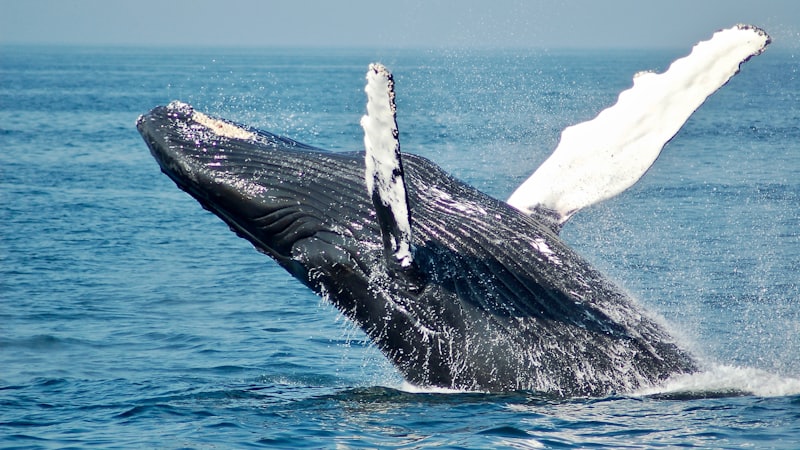
How Big Is a Blue Whale? Size Comparisons to Everything You Know
The Largest Animal That Has Ever Lived
The blue whale is not just the biggest animal alive today. It is the largest animal that has ever lived on Earth -- bigger than any dinosaur, bigger than any prehistoric marine reptile, bigger than any creature the fossil record has ever documented. It is, in the most literal sense, the outer limit of what animal life on this planet can achieve.
Understanding its size requires comparisons, because human intuition is not built to comprehend an animal that weighs as much as 30 elephants and is as long as a Boeing jet.
The Numbers
Adult blue whale:
- Length: 23 to 30 meters (75 to 98 feet) typical, up to 33.6 meters (110 feet) maximum
- Weight: 140 to 170 tonnes typical, up to 199 tonnes maximum
- Newborn calf: 7 meters (23 feet) long, 3 tonnes at birth
- Lifespan: 80 to 110 years
The longest blue whale ever accurately measured was a female caught by Norwegian whalers in the South Atlantic in 1909, measuring 33.58 meters. The heaviest reliably recorded was 199 tonnes, documented during the peak of commercial whaling.
These numbers are post-whaling. Before the 20th century's industrial killing of blue whales reduced the global population from roughly 330,000 to fewer than 10,000, the largest individuals may have been substantially bigger. Whaling preferentially killed the largest animals, removing the genetic template for maximum size from the population.
Compared to Dinosaurs
The general public believes the largest dinosaurs were bigger than blue whales. They were not.
Blue whale: 30 meters, 199 tonnes.
Patagotitan mayorum (longest known dinosaur): 37 meters, 70 tonnes.
Argentinosaurus huinculensis: 35 meters, 80-100 tonnes.
Dreadnoughtus schrani: 26 meters, 59 tonnes.
Tyrannosaurus rex: 12 meters, 9 tonnes.
The longest sauropod dinosaurs may have slightly exceeded the blue whale in length, but they weighed less than half as much. The blue whale's combination of length and mass produces a total body size no dinosaur approached.
The reason is water. Land animals are limited by gravity and skeletal strength. A sauropod's legs had to support its entire body weight on four pillars of bone, and even at 80 tonnes the skeletal engineering pushed the limits of what a land vertebrate could sustain.
Blue whales float. The ocean bears their full weight, and their skeleton needs only to hold the body together, not hold it up. Freed from gravity, blue whales grew to sizes that would collapse under their own weight on dry land. A beached blue whale actually crushes itself to death if left stranded long enough, because its lungs cannot inflate under the pressure of its own mass.
Compared to Human-Made Objects
A Boeing 737 aircraft: 32 to 39 meters long. A blue whale is roughly the same length as a passenger jet.
A London double-decker bus: 8.4 meters long. You could line up three and a half buses end-to-end and still not match the length of a large blue whale.
A basketball court: 28 meters long. A blue whale is longer than the court.
An Olympic swimming pool: 50 meters long. A blue whale is approximately 60 percent of the pool's length.
A Boeing 747 fuselage (not wingspan): 70 meters. One 747 fuselage equals approximately 2.3 blue whales.
Compared to Other Animals
African elephant: 6 tonnes. A blue whale outweighs 33 elephants combined.
Tyrannosaurus rex: 9 tonnes. A blue whale outweighs 22 T. rexes.
Orca (killer whale): 5 tonnes, 8 meters. A blue whale weighs 40 times more than an orca.
Great white shark: 2 tonnes, 6 meters. A blue whale is 5 times longer and 100 times heavier.
Megalodon (extinct): 50-100 tonnes, 18 meters. A blue whale outweighs even the largest extinct shark by a factor of two.
The Heart
Blue whale anatomy scales everything you know about mammals to absurd proportions.
The heart of a blue whale weighs approximately 180 kg (400 lb). It is roughly the size of a small car. A human could crawl through the aorta.
At the surface, the heart beats 8 to 10 times per minute. During deep dives, it slows to 2 beats per minute -- sustaining the whale's metabolism on radically reduced oxygen while it feeds hundreds of meters below the surface. A single heartbeat pumps 220 liters (58 gallons) of blood through the circulatory system.
The heartbeat is so powerful that researchers with specialized hydrophones can detect it from nearly 3 kilometers away underwater.
For comparison: an adult human heart weighs 300 grams and beats 60-100 times per minute. A blue whale heart is approximately 600 times heavier and beats 10 times slower.
The Mouth
A blue whale's mouth can open to approximately 90 degrees, creating a gape large enough to swallow a small car. During feeding, the whale lunges forward at up to 32 km/h (20 mph) with its mouth wide open, engulfing up to 100 tonnes of water and krill in a single gulp.
The lower jaw unhinges and expands outward. The throat pleats -- the series of grooves that run from chin to belly -- stretch enormously, turning the front half of the whale into an enormous water balloon. Then the whale closes its mouth and uses its tongue to force the water out through 300 baleen plates, trapping krill inside for swallowing.
Each lunge takes approximately 30 seconds and consumes enough energy that the whale must immediately surface to breathe. A feeding blue whale performs 50 to 100 lunges per day during peak feeding season in polar waters.
The Appetite
Blue whales eat essentially one thing: krill. These shrimp-like crustaceans measure 2 to 6 cm long and occur in massive swarms in nutrient-rich polar waters.
A blue whale consumes approximately 3.6 tonnes of krill per day, or about 40 million individual krill. The whale feeds continuously for 4 months each year in polar feeding grounds, then migrates to warmer equatorial breeding grounds where it fasts for the remaining 8 months, living off fat reserves built during feeding.
Total annual food intake: roughly 400 tonnes of krill per whale.
To support the blue whale population that existed before whaling, Earth's oceans produced -- and continue to produce -- billions of tonnes of krill annually. Krill populations themselves depend on phytoplankton blooms fueled by nutrients that upwell from the deep sea. The blue whale sits at the top of one of the shortest food chains in nature: phytoplankton to krill to blue whale.
The Song
Blue whales produce the loudest sustained sounds of any living animal. Their low-frequency calls -- mostly in the 10 to 40 Hz range, often below the threshold of human hearing -- register at up to 188 decibels at the source. For context, a jet engine at takeoff is 130 decibels.
Blue whale calls travel hundreds or even thousands of kilometers through the ocean via deep sound channels called SOFAR (Sound Fixing and Ranging). Two blue whales on opposite sides of an ocean basin can theoretically communicate, though whether they do in practice is still debated.
Curiously, blue whale songs have been dropping in frequency steadily since the 1960s. The reason is not fully understood. Some researchers suggest the lower frequencies are a consequence of population recovery -- larger whales produce deeper calls, and as the population grows, more large whales are present. Others suggest it is a response to ocean noise pollution, with whales shifting frequencies to avoid shipping noise.
The Near-Extinction
Before commercial whaling, the global blue whale population was approximately 330,000 animals. Between 1900 and 1966, when commercial blue whale hunting was finally banned internationally, over 360,000 blue whales were killed -- more than the total pre-whaling population, because whaling continued even as populations collapsed.
By 1970, fewer than 10,000 blue whales remained.
Blue whales reproduce slowly -- one calf every 2 to 3 years, reaching sexual maturity only at 10 to 15 years old. Recovery is therefore slow even under perfect conditions. Current population estimates range from 10,000 to 25,000 globally, with the Antarctic population (which was the hardest hit) still at less than one percent of pre-whaling levels.
The blue whale remains listed as Endangered by the IUCN.
What Bigness Means
The blue whale is the upper limit of animal size on Earth. No creature has ever been bigger, and no creature is likely to be bigger, for reasons that have to do with physics as much as evolution.
Beyond the blue whale's size, cellular and metabolic constraints begin to fail. Oxygen delivery to tissues becomes inefficient. Heat dissipation becomes impossible -- larger animals retain more body heat than they can shed. Food intake requirements exceed what any conceivable food source could sustainably provide.
Evolution occasionally produces enormous animals, but those animals tend to be specialists on energy-dense, abundant food sources. The blue whale's niche -- filter-feeding krill from super-productive polar waters -- is one of the only environmental arrangements on Earth that can support an animal this size.
To see a blue whale is to see biology pushing against its own ceiling. Every aspect of the animal, from its car-sized heart to its 40-million-krill appetite to its 200-decibel song, exists at the limit of what evolution has ever produced. There is nothing else like it alive now. There has never been anything quite like it before.
And for a century, we hunted it almost to extinction. The fact that any blue whales remain is a small miracle of policy and a reminder of how close we came to losing the largest animal that has ever lived.
Related Articles
- Blue Whale Facts: Largest Animal Ever Lived
- Whales and Dolphins: The Singing Giants of the Deep
- Marine Mammals: Giants of the Ocean
Frequently Asked Questions
How big is a blue whale?
Blue whales reach 30 meters (98 feet) long and weigh up to 199 tonnes, making them the largest animals that have ever lived on Earth -- larger than any dinosaur, any prehistoric marine reptile, and any creature in the fossil record. The longest blue whale ever accurately measured was 33.58 meters (110 feet), a female caught in the Antarctic in 1909. The heaviest reliably weighed blue whale was 199 tonnes, though scientists estimate the largest blue whales in the population before commercial whaling may have reached 190 tonnes and 34 meters. An adult blue whale is roughly the length of a Boeing 737 aircraft and weighs more than 30 African elephants combined.
Is a blue whale bigger than a dinosaur?
Yes, blue whales are significantly larger than any known dinosaur. The longest dinosaur ever described, Patagotitan mayorum, reached approximately 37 meters long but weighed only 70 tonnes. Argentinosaurus, Dreadnoughtus, and other giant sauropods weighed between 65 and 95 tonnes. A blue whale's 199 tonnes exceeds any dinosaur weight by a factor of two. The difference is water. Land animals are ultimately limited by the strength of their bones and the stress gravity places on their skeletons. Blue whales float in an ocean, with buoyancy supporting their entire body weight. They can grow to sizes that would collapse under gravity on land.
How big is a blue whale's heart?
A blue whale's heart is approximately the size of a small car -- about 180 kg (400 lb) and 1.5 meters (5 feet) long. The aorta is large enough that a human could crawl through it. The heart beats only 8 to 10 times per minute at the surface, dropping to 2 beats per minute during deep dives. A single heartbeat pushes 220 liters (58 gallons) of blood through the circulatory system. The heart sound is so powerful it can be detected from nearly 3 kilometers away underwater. For comparison, a human heart weighs about 300 grams -- a blue whale heart is 600 times heavier.
How much does a blue whale eat?
A blue whale eats approximately 3.6 tonnes (8,000 pounds) of krill per day during feeding season, equivalent to 40 million individual krill. The whale feeds by lunging at dense krill swarms with its mouth open, engulfing up to 100 tonnes of water and krill in a single gulp. It then forces the water out through 300 baleen plates, trapping the krill inside for swallowing. A blue whale feeds almost continuously for 4 months each year, then fasts for the remaining 8 months while migrating to warmer breeding grounds -- living off the enormous fat reserves built during feeding. The total annual food intake can exceed 400 tonnes of krill per whale.
How long do blue whales live?
Blue whales live 80 to 90 years on average, with the oldest documented individual estimated at 110 years. Scientists determine whale age by counting layers in ear wax plugs -- the whale's ear canal accumulates a layered plug of wax and sediment that grows annually, much like tree rings. Before commercial whaling, blue whales likely lived even longer on average because modern populations skew younger due to the loss of older individuals to hunting. The species reproduces slowly, with females giving birth to a single calf every 2 to 3 years after 10 to 15 years of sexual maturity. A healthy blue whale population takes a century or more to recover from collapse, which is why populations remain depressed decades after commercial whaling ended.