
How far can whale songs travel through the ocean?
Among whales, dolphins and ocean giants, humpback whale songs travel the greatest distances through the ocean. Under ideal conditions, low-frequency whale vocalizations can propagate up to 10,000 miles (16,000 km) through deep sound channels in the ocean known as the SOFAR channel. Blue whale calls, which register at up to 188 decibels, can be detected by other blue whales hundreds of miles away.
The Mammals That Returned to the Sea
Roughly 375 million years ago, the first vertebrates hauled themselves out of the primordial oceans and onto land. It was one of the most consequential transitions in evolutionary history. Yet tens of millions of years later, several lineages of mammals did something extraordinary - they went back. Whales descended from hoofed land animals related to modern hippos. Seals evolved from bear-like carnivores.
Manatees share ancestry with elephants. Each lineage independently abandoned terrestrial life and re-adapted to a marine existence, reshaping nearly every organ system in the process.
Today, marine mammals encompass roughly 130 species across three major orders: Cetacea (whales, dolphins, and porpoises), Carnivora (seals, sea lions, walruses, sea otters, and polar bears), and Sirenia (manatees and dugongs). They inhabit every ocean on Earth, from the tropics to the polar ice, and range in size from the 1-meter sea otter to the 30-meter blue whale - the largest animal that has ever lived.
Jacques Cousteau, the legendary ocean explorer, captured the essence of our fascination with these creatures when he observed:
"The sea, once it casts its spell, holds one in its net of wonder forever."
That spell is nowhere stronger than in our encounters with marine mammals - animals that breathe the same air we do, nurse their young, and maintain warm blood in frigid waters, yet have mastered an alien world.
Blue Whales: The Largest Animal in Earth's History
The blue whale (Balaenoptera musculus) is not merely the largest animal alive today. It is the largest animal that has ever existed on this planet, surpassing even the largest dinosaurs. An adult blue whale can reach 30 meters (98 feet) in length and weigh up to 190 tonnes - roughly the mass of 25 adult African elephants.
A Heart the Size of a Small Car
The blue whale's heart is legendary. Weighing approximately 180 kilograms (400 pounds), it is roughly the size of a golf cart. During dives, this enormous organ slows from a resting rate of about 8-10 beats per minute to as few as 2 beats per minute, a phenomenon known as bradycardia. When the whale surfaces and begins breathing rapidly, the heart rate can spike to 25-37 beats per minute.
Researchers at Stanford University in 2019 attached a suction-cup heart monitor to a blue whale for the first time and documented these astonishing fluctuations, finding that the heart was operating at its physiological limit during deep dives.
The aorta is wide enough for a human toddler to crawl through. Each heartbeat sends roughly 220 liters of blood surging through the circulatory system.
Feeding on the Smallest Prey
Paradoxically, the largest animal on Earth feeds almost exclusively on one of the smallest - Antarctic krill (Euphausia superba), each measuring only about 6 centimeters long. A blue whale consumes approximately 4 tonnes of krill per day during the feeding season, filtering massive volumes of seawater through its baleen plates. During a single lunge, a blue whale can engulf up to 110 tonnes of water and krill, expanding its throat pleats like an accordion.
Blue whale populations were devastated by 20th-century whaling. Pre-whaling populations numbered an estimated 250,000 individuals; today, roughly 10,000-25,000 remain. Recovery has been slow, as females produce only one calf every 2-3 years after a 10-12 month gestation.
Orcas: Apex Predators of the Ocean
The orca (Orcinus orca), commonly called the killer whale, is technically the largest member of the dolphin family. But there is nothing diminutive about these 8-meter, 6-tonne predators. Orcas are the ocean's undisputed apex predators, with no natural enemies and a diet that can include fish, squid, seals, sea lions, other dolphins, and even great white sharks and adult whales.
Pod Culture and Ecotypes
What makes orcas truly remarkable is their culture. Orca populations are divided into distinct ecotypes - genetically and behaviorally distinct groups that may eventually be classified as separate species. In the Pacific Northwest, three ecotypes coexist:
- Resident orcas specialize in salmon and live in large, stable matrilineal pods. Each pod has unique vocal dialects passed from mother to offspring.
- Transient (Bigg's) orcas hunt marine mammals using stealth tactics, traveling in smaller groups and maintaining near-silence to avoid alerting their prey.
- Offshore orcas target sharks and schooling fish in deep waters, and their teeth are often worn flat from the rough skin of sharks.
These ecotypes do not interbreed despite sharing the same waters. Their cultural traditions - hunting techniques, vocalizations, social structures - are transmitted across generations, making orcas one of the clearest examples of non-human culture in the animal kingdom.
Hunting Strategies
Orca hunting strategies are sophisticated and cooperative, rivaling those of wolves and humans:
Wave washing: In Antarctic waters, orcas have been filmed creating coordinated waves to wash seals off ice floes. A group of orcas will swim in formation toward a floe, generating a wave that either knocks the seal into the water or breaks the ice into smaller, less stable pieces. This behavior is taught to juveniles, who practice on empty ice floes.
Carousel feeding: In Norwegian fjords, orcas herd herring into tight "bait balls" near the surface. They swim in circles around the school, flashing their white undersides to frighten the fish inward, then take turns slapping the ball with their tail flukes to stun fish before feeding. This cooperative technique ensures the entire pod eats.
Beach hunting: In Patagonia, orcas intentionally strand themselves on beaches to snatch sea lion pups from the surf zone, then wriggle back into the water. Mothers push their calves onto the beach to train them in this dangerous skill.
Dolphins: Intelligence Beneath the Waves
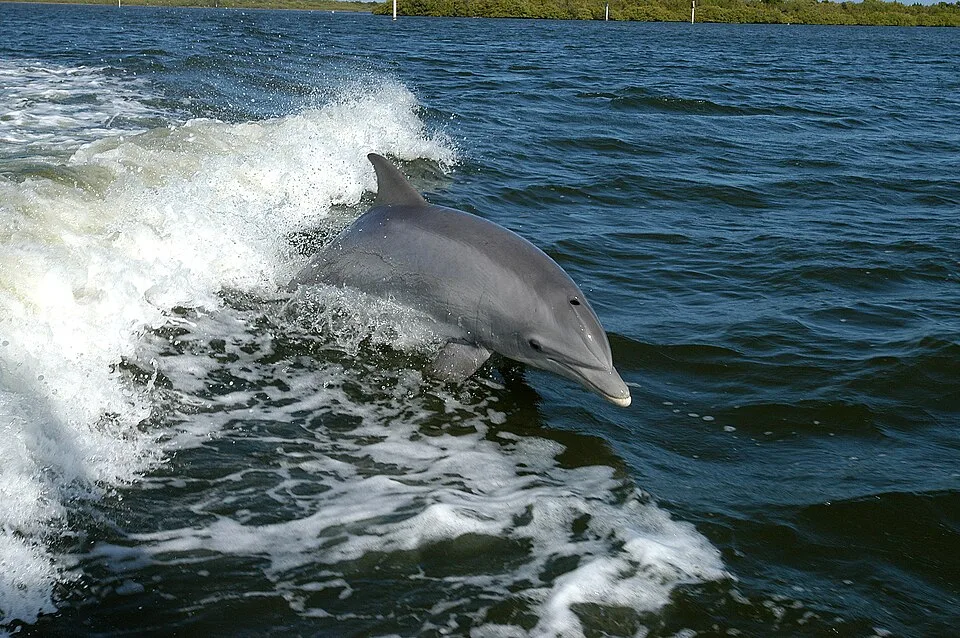
Dolphins are found in every ocean and in several major river systems. The roughly 40 species of oceanic dolphins (family Delphinidae) and 4 species of river dolphins represent some of the most cognitively advanced animals on Earth.
The Bottlenose Dolphin Studies
The bottlenose dolphin (Tursiops truncatus) has been the most extensively studied cetacean. Research conducted from the 1960s onward at facilities including the Dolphin Research Center in Florida and the Kewalo Basin Marine Mammal Laboratory in Hawaii has revealed extraordinary cognitive abilities:
- Mirror self-recognition: In 2001, researchers Diana Reiss and Lori Marino demonstrated that bottlenose dolphins can recognize themselves in mirrors, a capacity previously confirmed only in great apes and humans. Dolphins marked with non-toxic ink would orient their bodies to examine the marks in a mirror.
- Tool use: In Shark Bay, Australia, a population of bottlenose dolphins uses marine sponges as foraging tools, placing them over their rostrums (snouts) to protect against abrasion while probing the sandy seafloor for fish. This behavior, called "sponging," is passed from mother to daughter and represents cultural transmission.
- Syntactic comprehension: Dolphins trained with artificial languages can understand the difference between "bring the ball to the hoop" and "bring the hoop to the ball," demonstrating an understanding of word order and grammar.
- Cooperative problem-solving: Dolphins have been documented working together to solve novel tasks in experimental settings, and they engage in complex cooperative hunting in the wild, such as mud-ring feeding in Florida, where one dolphin circles a school of fish to create a ring of muddy water while others wait at the perimeter to catch fish that leap over the barrier.
Echolocation
Dolphins produce rapid-fire clicks at frequencies up to 130 kHz (well above the human hearing range of 20 kHz) through specialized structures in their foreheads called the melon. These clicks bounce off objects and return to the dolphin through its lower jaw, creating a detailed acoustic picture of the environment.
Dolphins can detect objects as thin as a human hair, distinguish between materials (aluminum vs. steel), and "scan" the internal anatomy of nearby fish - and even detect a human pregnancy.
Fungie: The Dingle Dolphin
Perhaps no individual dolphin better illustrates the bond between marine mammals and humans than Fungie, a solitary male bottlenose dolphin who took up residence in Dingle Harbour, Ireland, in 1983. For 37 years, Fungie became a beloved fixture of the small Kerry town, interacting daily with swimmers, kayakers, and boat passengers.
He was estimated to be over 40 years old when he disappeared in October 2020, prompting a national outpouring of grief. Marine biologists speculated that Fungie was a "sociable solitary dolphin" - a documented phenomenon in which individual dolphins separated from their pod seek companionship with humans or boats.
Fungie's decades-long residency brought an estimated 12 million euros annually to the Dingle economy and became a powerful symbol of human-cetacean connection.
Humpback Whales: Songs, Bubbles, and 10,000-Mile Journeys
The humpback whale (Megaptera novaeangliae) is among the most acrobatic and vocal of all marine mammals. Adults reach 14-17 meters in length and are known for their spectacular breaching behavior, complex songs, and extraordinary feeding strategies.
Bubble Net Feeding
Humpback whales in Alaska and Antarctica have perfected a cooperative hunting technique called bubble net feeding. A group of whales dives below a school of fish or krill. One or more whales swim in an upward spiral while exhaling a continuous stream of bubbles, creating a cylindrical "net" that concentrates the prey. Other whales vocalize loudly from below to drive the prey upward.
Then, on a coordinated signal, all the whales lunge upward simultaneously through the concentrated mass of prey with their mouths agape.
Research published in the journal Marine Mammal Science has shown that individual whales consistently take on the same roles during bubble net feeding - some are always the bubble blowers, others are always the vocalizers, and others are the lungers. This role specialization suggests a level of social coordination comparable to that seen in cooperative hunting among wolves or chimpanzees.
Songs That Travel Oceans
Male humpback whales produce the longest and most complex songs in the animal kingdom. A single song can last 10-20 minutes and be repeated for hours. All males in a given population sing roughly the same song, which gradually evolves over the course of a breeding season.
Remarkably, song innovations that originate in one population can spread across the Pacific Ocean over several years, as documented by researchers who tracked song elements moving from Australian populations eastward to French Polynesia.
Roger Payne, the biologist whose 1970 album Songs of the Humpback Whale catalyzed the modern whale conservation movement, described the experience:
"Listening to the humpback whale sing is like standing in a cathedral as the first notes of a great organ fill the space. The sound goes through you. You do not merely hear it; you feel it in your bones."
Under optimal conditions in the deep sound channel (SOFAR channel), low-frequency whale vocalizations can theoretically propagate over 10,000 miles, though the effective communication range is likely much shorter. Increasing anthropogenic ocean noise is steadily shrinking these ranges.
Seals and Sea Lions: The Pinnipeds
Pinnipeds ("feather-footed" in Latin) comprise 33 species divided into three families: Phocidae (true seals), Otariidae (eared seals, including sea lions and fur seals), and Odobenidae (the walrus). They are found from the Arctic to the Antarctic and everywhere in between.
True Seals vs. Eared Seals
| Feature | True Seals (Phocidae) | Eared Seals (Otariidae) |
|---|---|---|
| External ear flaps | Absent | Present |
| Locomotion on land | Undulating, caterpillar-like | Walk on all four flippers |
| Swimming propulsion | Hind flippers (side-to-side) | Fore flippers (wing-like strokes) |
| Examples | Elephant seal, Weddell seal, harbor seal | California sea lion, fur seal |
Deep Diving: The Elephant Seal
The southern elephant seal (Mirounga leonina) is the champion diver among pinnipeds and one of the most extreme divers of any air-breathing animal. These massive seals - males can weigh up to 3,700 kg - routinely dive to depths exceeding 1,500 meters and can reach a maximum recorded depth of 2,388 meters (7,835 feet). Dive durations commonly exceed 30 minutes, with a maximum recorded dive of approximately 2 hours.
To put these depths in perspective: 2,388 meters is deeper than most military submarines operate. At that depth, the pressure is roughly 240 times atmospheric pressure. The elephant seal's lungs collapse completely during deep dives, forcing air out of the alveoli and into the rigid trachea and bronchi - an adaptation that prevents nitrogen narcosis and decompression sickness.
Between foraging trips, elephant seals spend 80-90% of their time at sea submerged, surfacing for only 2-3 minutes between dives. Researchers at the University of California, Santa Cruz, have tracked individual seals that spent months at sea diving continuously, traveling thousands of kilometers across the Pacific.
Comparison of Major Marine Mammal Groups
| Group | Representative Species | Max Size | Max Dive Depth | Diet | Key Adaptation |
|---|---|---|---|---|---|
| Baleen whales | Blue whale, humpback | 30 m / 190 tonnes | 500 m | Krill, small fish | Baleen filter-feeding |
| Toothed whales | Sperm whale, orca | 20 m / 57 tonnes | 2,250 m (sperm whale) | Fish, squid, mammals | Echolocation |
| Dolphins | Bottlenose, spinner | 4 m / 650 kg | 300 m | Fish, squid | Advanced echolocation and cognition |
| True seals | Elephant seal, Weddell | 6 m / 3,700 kg | 2,388 m | Fish, squid, krill | Extreme bradycardia during dives |
| Eared seals | Sea lion, fur seal | 3.3 m / 1,000 kg | 482 m | Fish, squid | Fore-flipper propulsion |
| Sirenians | Manatee, dugong | 4 m / 590 kg | 10 m | Seagrass, algae | Continuously replacing teeth |
| Walrus | Pacific walrus | 3.6 m / 1,883 kg | 80 m | Clams, mussels | Tusks for ice-hauling |
Manatees: Gentle Giants Under Threat
Manatees (genus Trichechus) are large, slow-moving herbivores found in warm coastal waters, rivers, and estuaries of the Americas and West Africa. The three species - the West Indian manatee, the Amazonian manatee, and the African manatee - are the only fully aquatic members of the order Sirenia (along with the dugong).
Often called "sea cows," manatees graze on seagrass, algae, and freshwater vegetation, consuming up to 10-15% of their body weight daily. An adult manatee weighing 500 kg may eat 50-75 kg of plants per day. Their teeth are uniquely adapted to this abrasive diet: worn molars are pushed out at the front and replaced by new teeth growing in at the back, a conveyor-belt system shared with elephants - their closest living terrestrial relatives.
Boat Strikes: A Leading Cause of Death
The greatest human-caused threat to manatees is watercraft collision. In Florida, where approximately 8,800 West Indian manatees reside (as of recent aerial surveys), boat strikes consistently account for 20-25% of documented manatee deaths annually. Researchers can identify individual manatees by their scar patterns from propeller wounds - a grim testament to the frequency of these encounters.
The Florida Fish and Wildlife Conservation Commission recorded 800+ manatee deaths in the catastrophic 2021 die-off, primarily driven by starvation after pollution killed seagrass beds in the Indian River Lagoon, compounded by chronic boat-strike mortality.
Speed zone regulations in key manatee habitats have reduced collision mortality in some areas, but enforcement remains inconsistent, and the expansion of recreational boating continues to increase risk.
Narwhals: The Unicorn of the Sea
The narwhal (Monodon monoceros) is one of the most enigmatic marine mammals, dwelling year-round in the Arctic waters of Canada, Greenland, Norway, and Russia. Males - and rarely females - grow a single spiraling tusk that can reach 3 meters in length, earning narwhals the title "unicorn of the sea."
The Tusk: Sensory Organ, Not Weapon
For centuries, the narwhal's tusk was a mystery. Medieval Europeans believed narwhal tusks were unicorn horns, and they commanded prices exceeding their weight in gold. The tusk is actually an elongated upper left canine tooth that grows in a counterclockwise spiral.
Research led by Martin Nweeia of Harvard University revealed in 2014 that the tusk is a sophisticated sensory organ. Its surface contains up to 10 million nerve endings connected to the dental pulp, capable of detecting changes in water temperature, salinity, and pressure. High-speed drone footage has also documented narwhals using their tusks to tap and stun Arctic cod before eating them, a behavior published in the journal Arctic in 2017.
Approximately 80,000 narwhals remain in the wild. They are among the marine mammals most vulnerable to climate change, as their dependence on Arctic sea ice makes them highly sensitive to warming temperatures that alter ice extent and prey availability.
Adaptations: How Mammals Survive Underwater
The transition from land to sea required profound physiological changes. Marine mammals have evolved a suite of adaptations that allow them to hold their breath for extended periods, withstand crushing pressures, and maintain body temperature in near-freezing water.
Myoglobin: The Oxygen Warehouse
Myoglobin is an oxygen-binding protein found in muscle tissue. Marine mammals have myoglobin concentrations 10-30 times higher than terrestrial mammals. Sperm whales, for example, have the highest myoglobin levels of any mammal, giving their muscles a characteristically dark red, almost black, color. This enormous oxygen reserve allows sperm whales to dive for up to 90 minutes on a single breath.
Research published in Science by Michael Berenbrink and colleagues in 2013 demonstrated that marine mammal myoglobin has evolved a unique positive surface charge that prevents the proteins from clumping together at high concentrations - a molecular adaptation that was essential for the evolution of deep diving.
Bradycardia: Slowing the Heart
During a dive, marine mammals dramatically reduce their heart rate to conserve oxygen. A Weddell seal's heart rate drops from 60-70 beats per minute at the surface to as low as 4 beats per minute during deep dives. Blood flow is selectively redirected away from non-essential organs (skin, digestive system, kidneys) and toward the brain and heart, which cannot tolerate oxygen deprivation.
Spleen Contraction: The Oxygen Reserve
Many marine mammals, particularly deep-diving species, have evolved enlarged spleens that store oxygenated red blood cells. At the start of a dive, the spleen contracts and releases this reserve into the bloodstream, boosting the oxygen-carrying capacity of the blood by up to 20%. Weddell seals have spleens up to 15 times the relative size of a human spleen.
Collapsible Lungs and Flexible Ribcages
Deep-diving marine mammals exhale before diving, and their lungs and alveoli collapse at depth, forcing residual air into the non-absorptive airways. This prevents nitrogen from dissolving into the blood at high pressure, which would cause decompression sickness ("the bends") upon ascent. Their ribcages are flexible, with cartilaginous sternal ribs, allowing the thorax to compress without fracturing under extreme pressure.
Sylvia Earle, the pioneering marine biologist and National Geographic Explorer-in-Residence, has reflected on the marvel of these adaptations:
"No aquarium, no tank in a marineland, however spacious it may be, can begin to duplicate the conditions of the sea. And no one who has watched a whale dive into the blue abyss, holding its breath with absolute confidence for over an hour, can fail to feel humility before such perfection."
Hvaldimir: The Alleged Spy Whale
In April 2019, Norwegian fishermen near Hammerfest encountered a beluga whale wearing a tight harness fitted with a mount for a GoPro camera. The harness was inscribed with text reading "Equipment of St. Petersburg." The whale, quickly dubbed "Hvaldimir" (a portmanteau of "hval," the Norwegian word for whale, and Vladimir), was unusually comfortable around humans and boats, suggesting extensive prior human contact.
Norwegian intelligence officials speculated that Hvaldimir had been trained by the Russian Navy, which is known to maintain a marine mammal program at its Murmansk naval base. Russia, like the United States, has a decades-long history of training dolphins and beluga whales for military purposes, including harbor defense, mine detection, and equipment retrieval.
After his harness was removed by fishermen, Hvaldimir remained in Norwegian waters, moving slowly southward along the coast over subsequent years. He became a celebrity, attracting tourists and prompting the establishment of a dedicated monitoring organization (Marine Mind). Concerns about his welfare grew as he lingered near fish farms and populated harbors, where boat traffic and fishing gear posed threats.
He was found dead in August 2024 in southwestern Norway, sparking an investigation into the cause of death. Animal rights organizations suspected foul play, though official results pointed to a bacterial infection.
Hvaldimir's story captured global attention not only because of its espionage angle but because it highlighted the intelligence and social needs of beluga whales - animals that can live 60-70 years, maintain complex social bonds, and suffer profoundly from isolation.
Threats to Marine Mammals
Despite their remarkable adaptations, marine mammals face an array of human-caused threats that are accelerating in the 21st century.
Ship Strikes
Large whales are particularly vulnerable to collisions with commercial shipping vessels. The North Atlantic right whale, with fewer than 350 individuals remaining, faces ship strikes as a leading cause of mortality. Studies by NOAA have found that reducing vessel speeds to 10 knots in critical habitat areas reduces the risk of fatal strikes by 80-90%, yet compliance with voluntary speed zones remains low.
Noise Pollution
The ocean is an acoustic world, and marine mammals depend on sound for communication, navigation, foraging, and predator detection. Anthropogenic noise - from shipping, seismic surveys, military sonar, and construction - is drowning out these vital signals.
Military mid-frequency active sonar (1-10 kHz) has been linked to mass strandings of beaked whales. A landmark study published in Nature in 2003 by Jepson et al. documented gas-bubble lesions in stranded beaked whales exposed to naval sonar exercises in the Canary Islands, suggesting a mechanism similar to decompression sickness. Subsequent research has confirmed that sonar can cause cetaceans to alter their dive behavior, surface too rapidly, and develop fatal gas embolisms.
Chronic noise from commercial shipping has doubled ambient ocean noise levels every decade since the 1960s. Research by Clark et al. (2009) estimated that the communication range of North Atlantic right whales has been reduced by approximately 90% compared to pre-industrial conditions.
Entanglement
An estimated 300,000 cetaceans die annually from entanglement in fishing gear worldwide. Fixed fishing gear such as gillnets, lobster pot lines, and trawl nets pose the greatest risk. Entanglement can cause drowning, starvation (when gear wraps around the mouth), chronic infections, and slow death from constriction injuries.
The vaquita, a small porpoise in Mexico's Gulf of California, has been driven to the brink of extinction - likely fewer than 10 individuals remain - almost entirely due to entanglement in gillnets set for the totoaba fish.
Climate Change
Rising ocean temperatures are reshaping marine mammal habitats in profound ways:
- Arctic species such as narwhals, polar bears, and walruses are losing critical sea ice habitat. Walruses are increasingly forced to haul out on land rather than ice, leading to fatal stampedes when large groups are startled.
- Prey shifts: Warming waters are altering the distribution and abundance of key prey species. North Atlantic right whales have shifted their feeding grounds northward into Canadian waters as their copepod prey moves in response to warming, exposing them to new shipping lanes and fishing gear.
- Harmful algal blooms: Warmer ocean temperatures fuel toxic algal blooms that produce domoic acid, which causes seizures and death in sea lions, seals, and whales. Mass mortality events linked to domoic acid have increased dramatically along the U.S. West Coast.
The Path Forward
The story of marine mammals is, in many ways, the story of humanity's relationship with the ocean. We drove many species to the brink of extinction through whaling, and their recovery - where it has occurred - stands as one of conservation's great successes. Humpback whale populations have rebounded from roughly 10,000 to over 80,000 since the 1966 moratorium on commercial whaling. Gray whales in the eastern Pacific have returned to near pre-exploitation levels.
But new threats are emerging faster than old ones recede. The challenge of the coming decades is to reconcile our expanding use of the ocean - for shipping, energy, fishing, and military purposes - with the needs of animals that have called it home for 50 million years.
Understanding marine mammals is not an academic exercise. These animals are sentinel species whose health reflects the health of the entire marine ecosystem. When dolphins accumulate mercury, when right whales starve because their prey has shifted, when beaked whales strand after sonar exercises, the ocean is sending a message.
Roger Payne, who spent his career decoding the songs of whales, put it simply:
"If we cannot save the whales, we cannot save anything."
References
Goldbogen, J. A., et al. (2019). "Extreme bradycardia and tachycardia in the world's largest animal." Proceedings of the National Academy of Sciences, 116(50), 25329-25332.
Reiss, D., & Marino, L. (2001). "Mirror self-recognition in the bottlenose dolphin: A case of cognitive convergence." Proceedings of the National Academy of Sciences, 98(10), 5937-5942.
Berenbrink, M., et al. (2013). "Evolution of oxygen secretion in fishes and the emergence of a complex physiological system." Science, 340(6130), 1234192. [Note: Berenbrink's 2013 myoglobin surface charge work was published separately in Science, 340(6138), 1303-1305.]
Jepson, P. D., et al. (2003). "Gas-bubble lesions in stranded cetaceans: Was sonar responsible for a spate of whale deaths after an ideological military exercise?" Nature, 425(6958), 575-576.
Clark, C. W., et al. (2009). "Acoustic masking in marine ecosystems: Intuitions, analysis, and implication." Marine Ecology Progress Series, 395, 201-222.
Nweeia, M. T., et al. (2014). "Sensory ability in the narwhal tooth organ system." The Anatomical Record, 297(4), 599-617.
Garland, E. C., et al. (2011). "Dynamic horizontal cultural transmission of humpback whale song at the ocean basin scale." Current Biology, 21(8), 687-691.
Frequently Asked Questions
How far can whale songs travel through the ocean?
Humpback whale songs can travel enormous distances through the ocean. Under ideal conditions, low-frequency whale vocalizations can propagate up to 10,000 miles (16,000 km) through deep sound channels in the ocean known as the SOFAR channel. Blue whale calls, which register at up to 188 decibels, can be detected by other blue whales hundreds of miles away.
However, increasing ocean noise pollution from shipping and sonar is reducing these communication ranges significantly.
How intelligent are dolphins compared to other animals?
Dolphins are among the most intelligent non-human animals on Earth. Bottlenose dolphins have an encephalization quotient (brain-to-body-size ratio) second only to humans among mammals. They demonstrate self-awareness in mirror tests, use tools such as sponges to protect their snouts while foraging, exhibit cultural transmission of learned behaviors, and can understand abstract concepts including syntax and grammar in experimental settings.
Research at the Dolphin Research Center and other institutions has documented problem-solving, cooperation, and even deceptive behavior.
How deep can seals dive and how long can they hold their breath?
Dive capabilities vary dramatically among pinniped species. The southern elephant seal holds the record among pinnipeds, reaching depths of over 2,388 meters (7,835 feet) and remaining submerged for up to 2 hours. Weddell seals can dive to 600 meters and hold their breath for over 80 minutes. Harbor seals typically dive to around 500 meters.
These extraordinary feats are enabled by adaptations including high myoglobin concentrations in muscles, oxygen-storing spleens, and bradycardia - a dramatic slowing of heart rate during dives.