
Are bats actually blind?
Bat echolocation is often misunderstood, starting with the myth that bats are blind. They are not - this is one of the most persistent myths in animal biology. All 1,400+ bat species have functional eyes, and many have excellent vision. Fruit bats (megachiropterans) have large eyes with color vision better than most mammals. Vampire bats can see in near-total darkness using low-light-sensitive retinas.
Seeing With Sound
A hunting bat darts through a forest at night at speeds of 50 km/h. The forest is pitch dark. Branches thread the air in thousands of positions the bat has never encountered before. A mosquito the size of a grain of rice is hovering somewhere in the black. The bat must find that mosquito, intercept it in flight, and eat it - all while avoiding branches, other bats, and every other obstacle in the darkness.
The bat does not see any of this. Its eyes work, but vision is useless in this condition. What the bat has is echolocation - a biological sonar system so refined that it can detect a human hair from a meter away, identify the species of moth by its wingbeat, and track dozens of moving objects simultaneously at high speed.
This is not a crude backup sense. It is arguably the most sophisticated real-time sensory system any animal has ever evolved, and understanding how it works reveals one of the most remarkable examples of convergent evolution in biology.
The Blindness Myth
First, the obvious correction: bats are not blind. The phrase "blind as a bat" is one of the most durable misconceptions in popular biology.
All 1,400+ bat species have functional eyes. Many have excellent vision:
Fruit bats (megachiropterans). Large eyes with color vision significantly better than most mammals. Fruit bats navigate primarily by sight in daylight.
Vampire bats. Specialized low-light vision that helps them find sleeping cattle at night.
Echolocating microbats. Smaller eyes but still functional. Bats use vision for long-distance navigation, predator detection, and social interactions.
The phrase "blind as a bat" appears to originate from 17th-century observations that bats flutter erratically in daylight. Pre-scientific observers assumed this was blindness rather than realizing bats are nocturnal animals disoriented by bright light. The myth persisted despite being demonstrably wrong.
Bats use vision, echolocation, smell, and in some species magnetic sensing - often combining multiple senses simultaneously. They are among the most sensory-rich mammals alive.
The Basic Mechanism
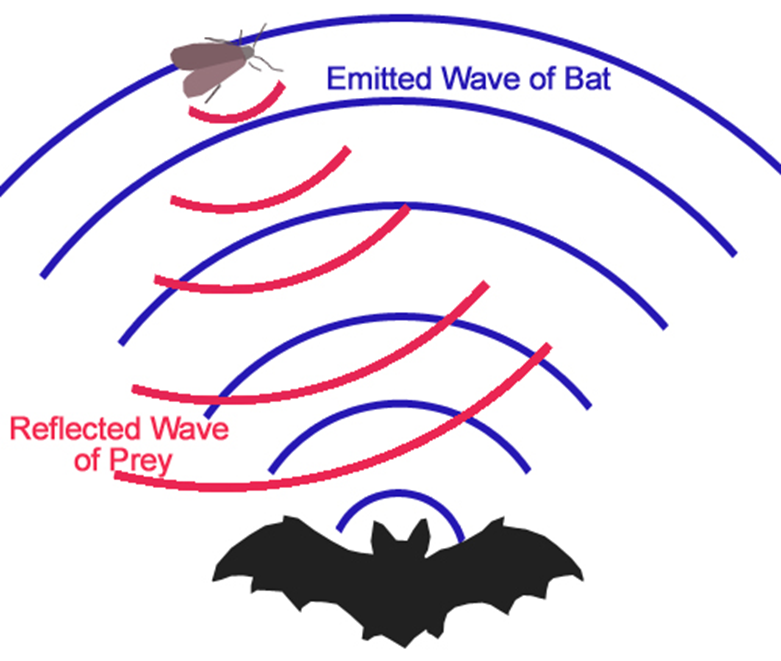
Echolocation works through a simple physical principle: sound travels at a known speed (343 meters per second in air), and echoes return predictably from solid surfaces.
Step 1: Emit a call. A bat produces a high-frequency ultrasonic sound, typically between 20,000 and 200,000 Hz. These frequencies are above the human hearing range (human adults hear up to about 20,000 Hz, declining with age). The call passes through the bat's mouth or nose.
Step 2: Sound propagates. The call travels outward from the bat at 343 m/s, spreading in a cone-shaped pattern.
Step 3: Echoes return. When the sound encounters a solid object, some of it bounces back as an echo.
Step 4: Processing. The bat's ears capture the returning echo. Specialized neurons in the brain calculate the time delay between call emission and echo return. A 10-millisecond delay means the object is 1.7 meters away. A 2-millisecond delay means 34 cm.
Step 5: Build the map. The bat's brain integrates hundreds of echoes per second from multiple directions, constructing a continuously updated 3D mental map of the surrounding space.
This is all real-time. A bat flying at 50 km/h covers 14 meters per second. It must process its environment fast enough to avoid collisions at that speed - which means processing echoes with millisecond precision continuously during flight.
The Doppler Effect
Echolocation is not limited to measuring distance. Bats also use the Doppler effect to determine velocity.
When a bat calls toward a moving object, the frequency of the returning echo shifts based on the object's motion:
- Object moving toward the bat: echo frequency is higher than the emitted call
- Object moving away from the bat: echo frequency is lower
- Stationary object: echo frequency matches the emitted call
This is the same principle that causes an ambulance siren to sound higher-pitched when approaching and lower-pitched when moving away. Bats exploit this effect to measure not just where objects are but also their velocities.
The Doppler information is critical for hunting. A moth fluttering its wings produces complex Doppler patterns. The frequency shifts modulate with the wingbeat, creating a "flutter signature" that reveals:
- The wing frequency (moths beat their wings at species-specific rates)
- The size of the insect (inferred from wing size)
- The orientation (is it moving toward or away from the bat?)
A hunting bat can identify the species of insect from the Doppler pattern alone, select whether to pursue it, and intercept it from several meters away - all in a fraction of a second.
Different Calls for Different Purposes
Bat echolocation is not one sound repeated endlessly. Different bat species produce different types of calls, and individual bats switch between call types depending on the hunting situation.
Constant-frequency (CF) calls. Long calls at a single frequency, typically around 60 kHz. Good for detecting moving objects because the Doppler shift shows clearly against the steady baseline. Bats using CF calls typically hunt small insects in cluttered forest environments.
Frequency-modulated (FM) calls. Short calls that sweep through a range of frequencies - for example, from 100 kHz down to 30 kHz in 2 milliseconds. FM calls provide better spatial resolution and are good for distinguishing nearby objects from background clutter. Most insectivorous bats use FM calls.
Combined CF-FM calls. Many bat species use both types in sequence, with the CF portion for detecting targets and the FM portion for precise localization as the bat closes in.
The feeding buzz. As a bat closes in on prey during the final attack, it dramatically increases the rate of calls - from roughly 10 calls per second during search to 200 calls per second in the last 100 milliseconds. This "feeding buzz" provides the temporal resolution needed to intercept moving insects. The increased call rate comes at an energy cost (each call requires muscle contractions and neural processing), so bats only use the feeding buzz during the terminal phase of attack.
What Bats Can Detect
The resolution of bat echolocation is extraordinary. Experimental studies have documented bats detecting:
Objects as small as a human hair at 1 meter distance. Bats can echolocate threads 0.06 mm in diameter from up to 1 meter away.
Texture differences. Bats can distinguish between smooth and rough surfaces, between different types of fabric, and between different leaf species from the quality of returning echoes.
Prey inside foliage. Some bat species specialize in hunting insects hidden within leaves. Their echolocation detects the air space around an insect, revealing prey that would be invisible to vision.
Fish near the water surface. Fish-eating bats detect the ripples from fish breathing at the water surface and can identify the size and position of prey they cannot see.
Pregnancy in other bats. Research has shown some bats can detect pregnancy in other bats through echolocation, apparently by sensing the fetus within the mother's body.
Wingbeat patterns. As mentioned above, bats can identify insect species by the Doppler signature of their wings.
This resolution exceeds the spatial resolution of most visual systems in low-light conditions. In darkness, a bat sees more clearly through sound than a cat can see through vision.
The Physical Limits
Echolocation is not unlimited. Several factors constrain what bats can detect:
Soft absorbent surfaces. Fresh snow, dense foliage, and certain fabrics absorb rather than reflect ultrasonic sound. Echoes from these surfaces are weak and difficult to process. Bats generally avoid foraging in heavy snow and struggle in dense understory.
Masking. When multiple sounds overlap, they can interfere with echo detection. A bat flying through a swarm of other bats must process dozens of echolocation calls from different individuals plus its own echoes - a signal-processing challenge that sometimes causes collisions.
Range limitations. Sound attenuates with distance. Echolocation typically works over ranges of 0-20 meters, depending on call frequency (lower frequencies travel farther). Beyond about 30 meters, echoes become too weak to distinguish from background noise.
Some moths fight back. Certain moth species have evolved anti-echolocation defenses - stealth fur that absorbs ultrasonic frequencies, making the moth acoustically invisible to hunting bats. Tiger moths have even evolved to produce their own ultrasonic clicks that jam bat echolocation. This is an acoustic arms race playing out in the air over temperate forests every night.
The Neural Machinery
The brain power required for real-time echolocation is enormous. Bats have evolved specialized neural architecture to handle it.
Auditory cortex. Bat auditory cortex is proportionally much larger than in non-echolocating mammals. It contains specialized regions for processing echo delay, frequency modulation, Doppler shifts, and amplitude variations.
Time-delay neurons. Some neurons in the bat brain fire only when echoes return within specific time windows. Thousands of these neurons, each tuned to different delays, collectively encode the 3D spatial position of objects.
FM-specific processors. Specialized neural circuits analyze the slope of frequency-modulated calls and their echoes, extracting precise spatial information from the frequency sweep pattern.
Doppler-specific circuits. Dedicated neurons detect frequency shifts and translate them into velocity information.
The processing happens so fast that bats are, in effect, analyzing a sonar return image hundreds of times per second while simultaneously flying, navigating, and making hunting decisions. The computational load exceeds what most non-echolocating vertebrates achieve even for visual processing.
Echolocation in Other Animals
Bats are not the only animals that echolocate. The ability has evolved independently multiple times in very different lineages.
Toothed whales. Dolphins, porpoises, orcas, sperm whales, and all other odontocetes use echolocation for underwater navigation and hunting. Their calls reach 230 decibels at the source - the loudest biological sounds on Earth. Water transmits sound much better than air, and whale echolocation can work over distances of hundreds of meters.
Sperm whale clicks are so loud that they can deafen or even kill small marine animals at close range. Researchers suggest sperm whales may use these powerful clicks to stun prey during hunting, though this is still debated.
Oilbirds and swiftlets. Certain cave-dwelling birds echolocate using audible clicks. Oilbirds (Steatornis caripensis) in South America and several swiftlet species in Southeast Asia navigate dark caves using click-based echolocation. Their resolution is lower than bats but sufficient to avoid collisions with cave walls.
Tenrecs and shrews. Some small insectivorous mammals produce ultrasonic clicks and may use them for short-range echolocation. The evidence is less conclusive than for bats and dolphins.
Humans. Blind humans can learn to echolocate using tongue clicks or finger snaps. Expert human echolocators can navigate complex environments, ride bicycles, and identify objects through echo patterns. Brain scans show the visual cortex activates during human echolocation, suggesting the brain treats echo information similarly to visual input. The most famous practitioner is Daniel Kish, who has taught echolocation to hundreds of blind people.
Echolocation is a more common biological capability than popular culture suggests, though bats and toothed whales have refined it to levels other lineages have not approached.
The Evolutionary Story
Bats are the only mammals that fly, and they appear to have evolved flight and echolocation together. The oldest known bat fossils are approximately 55 million years old, and they already have fully modern wings and echolocation capabilities. Scientists are still debating the order of evolution:
The "flight first" hypothesis. Ancestral bats evolved flight for feeding on flying insects. Echolocation later evolved as a navigation aid in darkness.
The "echolocation first" hypothesis. Ancestral bats evolved echolocation on the ground (useful for finding prey in dark environments), then evolved flight to pursue that prey.
The "simultaneous evolution" hypothesis. Flight and echolocation co-evolved, each making the other more effective.
Recent fossil discoveries, including Onychonycteris finneyi from 2008, suggest flight evolved first. This bat had wings but may not have had full echolocation capabilities, based on the structure of its inner ear. If confirmed, this would support the flight-first hypothesis.
Either way, the combination of flight and echolocation has been extraordinarily successful. Bats are the second most diverse order of mammals after rodents, with over 1,400 species occupying every continent except Antarctica and nearly every ecosystem on Earth.
The World Bats Experience
Try to imagine the world a bat experiences during flight.
Your eyes show only darkness or dim shapes. But through your ears, the space around you is filled with information arriving in overlapping waves. Every branch, every insect, every surface produces its own echo signature. The trunk of a tree ten meters ahead returns a different echo than a thin twig two meters away. A moth fluttering off to your left has a different signature than a beetle crawling on a leaf to your right.
You are not hearing isolated sounds the way humans do. You are experiencing a continuous acoustic panorama, updated hundreds of times per second, from which your brain constructs a perfectly detailed 3D map of everything within 20 meters.
This is a completely different way of perceiving the world than humans do. It is not a poor substitute for vision; it is a parallel sensory capability that, in its own way, may exceed what vision could accomplish in a bat's nocturnal environment.
Bats are arguably the most cognitively sophisticated nocturnal mammals on Earth. They fly through environments humans cannot safely walk through in daylight. They hunt prey too small and too fast for most predators to catch. They navigate caves containing millions of other bats without colliding. And they do all of it using a biological technology that we, with all our engineering, have not matched in miniaturized sonar devices.
The next time a bat flits past you at dusk, consider what it is doing: receiving detailed acoustic information about your face, your body, every object around you, the air currents, and dozens of other things you cannot perceive. In the bat's experience, you are not a vague shape in dim light. You are a detailed 3D acoustic portrait, far more precise than you would appear to the bat's own eyes.
Two Strategies: FM vs. CF Echolocation
Bats use two fundamentally different echolocation strategies, each suited to particular hunting conditions. The Kalenux Team compiled the comparative data from published acoustic analyses.
| Echolocation Type | Representative Species | Frequency Pattern | Prey Detection Strategy |
|---|---|---|---|
| Frequency-modulated (FM) | Most North American bats | Sweeping through frequencies | Precise distance and texture |
| Constant-frequency (CF) | Horseshoe bats (Rhinolophus) | Long tones at one frequency | Doppler shift from beating wings |
| Mixed FM-CF | Many species | Both strategies in same call | Versatility in varied habitats |
| Nose-leaf emission | Some tropical species | Directional emission through nose | Narrow beam focus |
| Tongue-click echolocation | Egyptian fruit bat | Brief clicks, not laryngeal | Low-resolution cave navigation |
"Constant-frequency bats hunt moths by listening for the Doppler shift caused by the moth's beating wings. The moth body itself produces only a weak echo, but the wings beating 40 times per second create a characteristic frequency modulation that horseshoe bats have evolved to detect. This is effectively a natural implementation of Doppler radar." - Gareth Jones, University of Bristol, Current Biology, 2006 [1]
The two strategies reflect different ecological niches. FM bats trade frequency resolution for range and texture discrimination, ideal for hunting in open air. CF bats trade some spatial resolution for exquisite sensitivity to moving targets, ideal for picking moths off backgrounds where the stationary echo of the substrate would otherwise mask the prey.
Auditory Cortex Organization
Bat brains devote extraordinary amounts of neural tissue to auditory processing. In some species, the auditory cortex occupies more than 30 percent of the entire cerebrum - proportions matched only by the visual cortex in highly visual mammals. Within the auditory cortex, neurons are organized into maps that represent specific echolocation parameters.
"In the mustached bat, we found discrete cortical areas specialized for analyzing target distance, target velocity, and the Doppler shifts caused by the bat's own flight speed. Each parameter has its own topographic map in the cortex. The bat brain is essentially a sonar signal processor dressed up in mammalian anatomy." - Nobuo Suga, Washington University, Scientific American, 1990 [2]
Suga's detailed work on mustached bats established that these animals have cortical neurons that respond maximally to specific combinations of emitted call and returning echo. Some cortical neurons fire only when the echo arrives exactly 5 milliseconds after the call, encoding distance to target.
Other neurons fire only when the echo frequency is shifted by a specific amount, encoding target velocity. Together, thousands of such specialized neurons reconstruct a full acoustic image of the bat's surroundings.
This neural organization is the biological foundation of a bat's acoustic "vision." No visual cortex does anything fundamentally different - human visual cortex also contains feature-detecting neurons mapped to specific image properties. The bat has simply applied the same cortical design principle to sound instead of light.
Why Bats Matter Economically
Bats provide enormous economic value through pest control and pollination services. Studies published by Justin Boyles and colleagues in Science estimated that North American bats save US agriculture between $3.7 billion and $53 billion per year in reduced pesticide use and crop loss from insect damage [3]. A single colony of Brazilian free-tailed bats in central Texas consumes an estimated 200 tons of insects per night during summer peak hunting.
Tropical bats pollinate hundreds of plant species including wild agave (the source of tequila), many tropical fruits, and important medicinal plants. Fruit bats disperse the seeds of hundreds more species, maintaining forest regeneration across Africa, Asia, and the Americas. Without bats, numerous tropical forest ecosystems would face slow decline through reduced seed dispersal and pollination failure.
These services are threatened by ongoing bat population declines driven by habitat loss, wind turbine mortality, white-nose syndrome in North America, and bushmeat hunting in parts of Africa and Southeast Asia. Conservation biologists have repeatedly made the economic case that protecting bats is cheaper than replacing the services they provide, but the message has been slow to reach policymakers.
What Animals Have Glow-in-the-Dark Eyes?
Bats do not produce glowing eyes, but many nocturnal mammals have eyeshine - reflective eye structures that glow green, yellow, or red in car headlights and flashlight beams. This comes from the tapetum lucidum, a reflective layer behind the retina that doubles the light hitting photoreceptors. Cats, dogs, deer, cattle, opossums, and crocodilians all show eyeshine.
Bats themselves have functional eyes - the "blind as a bat" phrase is wrong; all 1,400+ bat species see well, with fruit bats having large color-vision eyes and vampire bats having specialized low-light retinas. But bats rely primarily on echolocation at 20,000-200,000 Hz, not eyeshine, to navigate pitch-dark forests at speeds up to 50 km/h while tracking prey the size of a grain of rice.
Why Do Animals' Eyes Glow in the Dark?
Eyeshine occurs because of the tapetum lucidum, a reflective tissue layer behind the retina in many nocturnal and crepuscular animals. Light entering the eye passes through the retina, hits the tapetum, and reflects back through the retina a second time, effectively doubling the photons available to photoreceptors and dramatically improving low-light vision.
Different species show different colors: cats green-yellow, dogs typically green, cattle reddish, alligators red. Bats possess functional eyes but rely mainly on echolocation - producing ultrasonic calls between 20,000 and 200,000 Hz and processing returning echoes with millisecond precision to build a continuously updated 3D mental map.
A bat can detect a human hair at one meter and identify moth species by wingbeat. Echolocation, not eyeshine, is what lets bats hunt in complete darkness.
References
- Jones, G., and Holderied, M. W. (2007). "Bat echolocation calls: adaptation and convergent evolution." Proceedings of the Royal Society B, 274(1612), 905-912.
- Suga, N. (1990). "Biosonar and neural computation in bats." Scientific American, 262(6), 60-68.
- Boyles, J. G., Cryan, P. M., McCracken, G. F., and Kunz, T. H. (2011). "Economic importance of bats in agriculture." Science, 332(6025), 41-42.
- Griffin, D. R., Webster, F. A., and Michael, C. R. (1960). "The echolocation of flying insects by bats." Animal Behaviour, 8(3-4), 141-154.
- Simmons, J. A. (1973). "The resolution of target range by echolocating bats." Journal of the Acoustical Society of America, 54(1), 157-173.
Related Articles
- Bats: The Only Flying Mammals on Earth
- Dolphins: Self-Awareness and Consciousness in the Sea
- Are Dolphins Smarter Than Humans?
Frequently Asked Questions
Are bats actually blind?
No, bats are not blind - this is one of the most persistent myths in animal biology. All 1,400+ bat species have functional eyes, and many have excellent vision. Fruit bats (megachiropterans) have large eyes with color vision better than most mammals. Vampire bats can see in near-total darkness using low-light-sensitive retinas. Even echolocating microbats have functional vision that they use alongside echolocation for different purposes.
The phrase ‘blind as a bat’ appears to originate from 17th-century observations that bats navigate erratically in daylight, which was misinterpreted as blindness rather than as bats being nocturnal animals disturbed by sunlight. Modern research confirms bats use a combination of vision, echolocation, smell, and (in some species) magnetic sensing. They are among the most sensory-rich mammals alive.
How does bat echolocation actually work?
Bats echolocate by emitting high-frequency ultrasonic calls (20,000-200,000 Hz, above human hearing range) and listening for the echoes that bounce back from objects. The time delay between call emission and echo return indicates distance - a 10-millisecond delay means the object is approximately 1.7 meters away.
Frequency shifts in the returning echo reveal whether the object is moving toward or away from the bat (Doppler effect, the same principle that changes ambulance siren pitch as it passes). Different bat species emit different types of calls - some use constant-frequency calls for detecting movement, others use frequency-modulated calls for spatial mapping, and many combine both.
The bat’s brain processes hundreds of echoes per second in real time, constructing a 3D mental map of the surrounding space accurate enough to catch a mosquito in complete darkness at high speed.
What can bats detect with echolocation?
Bat echolocation can detect objects as small as a human hair from a meter away. A bat’s echolocation resolution is sufficient to distinguish between two insects placed 1 cm apart, identify the species of moth by wingbeat frequency, locate prey inside foliage by detecting the air space around it, and navigate cluttered forest environments at speeds over 50 km/h.
Some bats can detect the pregnancy status of other bats through echolocation by sensing the fetus. Fish-eating bats can detect ripples from small fish breathing near the water surface. The resolution is extraordinary for a sense based on sound waves, and it exceeds the spatial resolution of most visual systems in low-light conditions.
However, echolocation has limits - it does not work well against soft absorbent surfaces like fresh snow or dense foliage, and some moth species have evolved fur that muffles the returning echoes.
Do any other animals use echolocation?
Yes, echolocation has evolved independently in several animal lineages. Toothed whales (dolphins, porpoises, orcas, sperm whales) use echolocation for underwater hunting and navigation, with some species producing clicks at 230 decibels - the loudest biological sounds on Earth. Certain cave-dwelling birds use echolocation, including oilbirds in South America and swiftlets in Southeast Asia.
Blind humans can also learn to echolocate using tongue clicks or finger snaps - the practice is called human echolocation and expert practitioners can navigate complex environments, ride bicycles, and identify objects through echo patterns. Brain scans of expert human echolocators show visual cortex activation during echolocation, suggesting the brain processes echoes in ways similar to visual processing.
Echolocation is not as rare as popularly believed, though bats have refined it to the highest sensitivity of any land animal.
Can humans hear bat echolocation?
Most bat echolocation calls are above the human hearing range (above 20,000 Hz for adults), so we cannot hear them directly. However, some bat species produce calls at lower frequencies audible to humans, particularly the social calls bats use to communicate with each other rather than to echolocate. Spotted bats (Euderma maculatum) call at 10 kHz, within the audible human range.
Many large fruit bats produce calls at frequencies young children can sometimes hear. Electronic bat detectors work by translating ultrasonic calls into frequencies humans can hear - these devices have become popular among wildlife enthusiasts and researchers.
Using a bat detector, you can hear the dramatic acceleration of echolocation calls as a bat closes in on prey (the ‘feeding buzz’ reaches 200 calls per second in the final 100 milliseconds of the attack).