
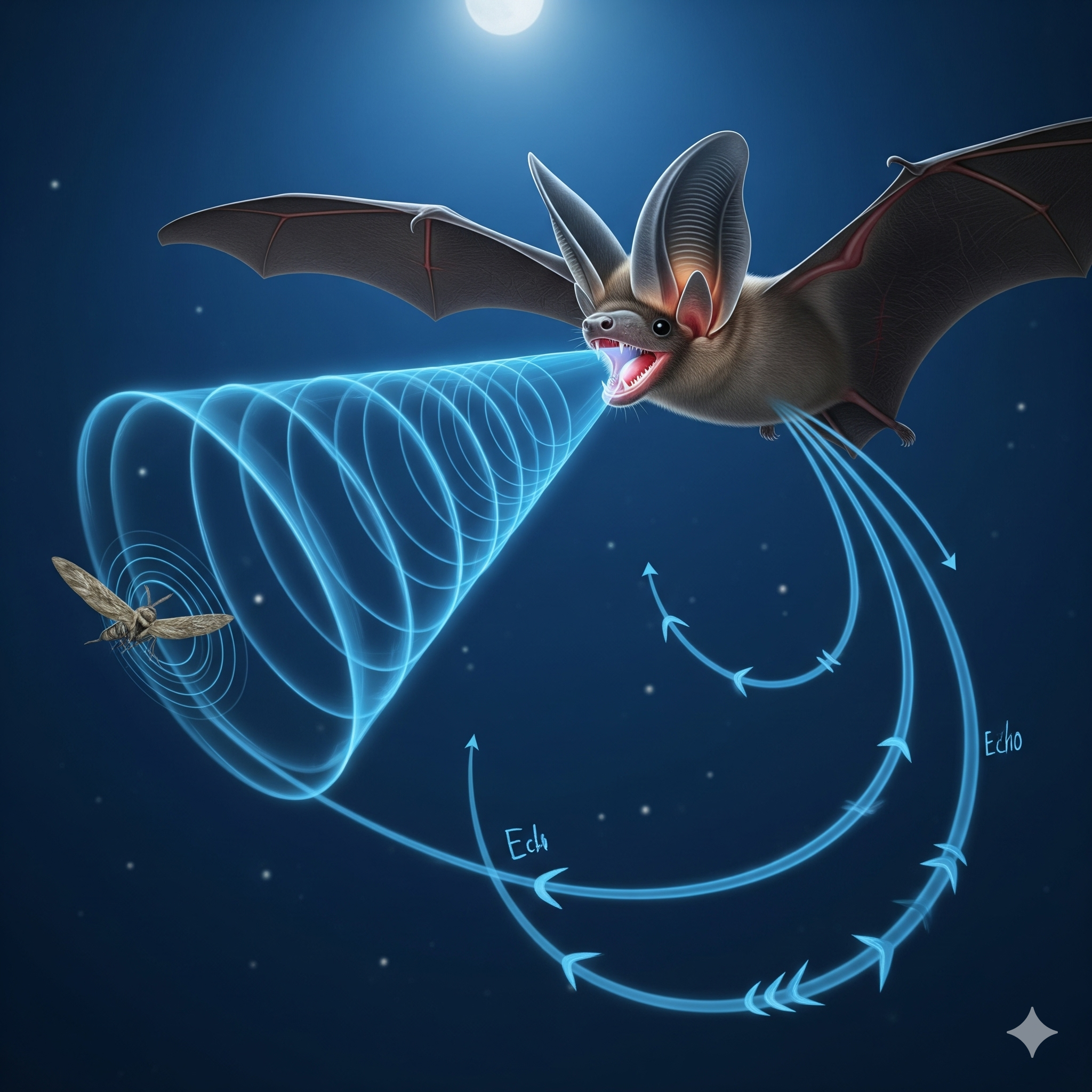
How does bat echolocation work?
Bats produce high-frequency sound pulses (ultrasonic, usually 20-200 kHz, well above human hearing range) through their mouths or noses, then listen for the echoes that return from surrounding objects. The time between pulse and echo tells the bat how far away an object is.
Seeing With Sound
A little brown bat chases a mosquito through a moonless forest. It flies at 25 km/h between tree branches that are invisible in the dark. It intercepts the mosquito - which is smaller than a grain of rice and also invisible - on the first attempt. Total elapsed time from initial detection to capture: about one second.
The bat cannot see in this darkness. Neither can the mosquito, but the mosquito is not trying to navigate. The bat is tracking prey, avoiding obstacles, and adjusting course based on sensory information collected entirely through sound.
This is echolocation, and it represents one of the most extraordinary sensory systems that evolved on Earth. Bats transform themselves into flying sonar platforms, producing and processing ultrasonic pulses at rates and precisions that engineered systems struggle to match.
The Basic Principle
Echolocation works like active sonar in submarines or radar in aircraft. The animal produces a sound pulse, then listens for the echo that bounces back from surrounding objects.
What echoes reveal:
- Distance: measured by time between pulse and echo return (sound travels at 343 m/s in air)
- Direction: determined by which ear hears the echo first and at what intensity
- Object size: inferred from echo strength
- Object shape: inferred from echo spectrum (frequency distribution)
- Object motion: measured by Doppler shift in returning echo frequency
- Object material: inferred from how the echo's spectrum compares to the original call
A bat's brain extracts all this information from each returning echo, in real time, while producing the next call.
The Call
Bat echolocation calls have specific acoustic properties optimized for the task.
Frequency:
Most bats echolocate in the ultrasonic range, from 20 kHz to over 200 kHz. This is well above human hearing (which tops out around 20 kHz).
Why ultrasonic?
- Higher frequencies produce shorter wavelengths (wavelength = speed of sound / frequency)
- Shorter wavelengths can detect smaller objects (sonar cannot resolve objects smaller than wavelength)
- Ultrasonic calls attenuate quickly in air, keeping detection range short (useful for avoiding predator attention)
Duration:
Echolocation calls are brief - typically 1-20 milliseconds per call. Short calls prevent the call itself from overlapping with returning echoes (which would confuse the bat about what is outgoing versus incoming sound).
Intensity:
Bat calls are extraordinarily loud at the source. Some big brown bat calls exceed 140 decibels, louder than a jet engine at close range. Humans cannot hear them only because we cannot perceive ultrasonic frequencies.
Call rates:
During general navigation, bats produce 5-20 calls per second. When closing on prey, the rate accelerates. During the "terminal buzz" in the final moments of prey capture, some bats produce 150-200 calls per second.
This acceleration reflects the need for higher-resolution information as prey gets closer. At 200 calls per second, the bat receives fresh positional data every 5 milliseconds.
Call Types
Different bat species use different call structures for different purposes.
Frequency-modulated (FM) calls:
Swept calls that start high and descend rapidly. Good for detecting small objects and precise distance measurement. Used by most small insectivorous bats.
Constant-frequency (CF) calls:
Calls that hold one frequency for most of their duration. Excellent for detecting Doppler shifts from moving prey. Used by horseshoe bats and some other species specializing on flying insects.
Combined FM-CF calls:
Calls with a constant-frequency segment followed by a frequency sweep. Combine advantages of both types.
Click-type calls:
Very brief, broadband calls used by some bat species. Similar in acoustic structure to dolphin echolocation clicks.
Each call type trades off different properties - range, resolution, prey-discrimination ability - and different species have evolved call structures matched to their ecological niche.
How the Ears Work
Bat hearing is specialized to match the calls they produce.
Frequency range:
Bats hear up to 200 kHz or higher in some species, extending far above the frequencies they produce. This extra range helps them detect echoes that have been frequency-shifted by Doppler effects.
Directionality:
Bat ears are often enormous relative to head size, with elaborate folding and internal structure. The shape focuses sound from specific directions, helping the bat localize echoes precisely.
Ultrasonic processing:
The cochlea (inner ear) of bats has been extensively modified. Specific regions are tuned to narrow frequency ranges, with enormous numbers of neurons dedicated to processing the specific frequencies the bat uses.
Middle ear protection:
When a bat calls, it produces a sound intense enough to damage its own hearing. The bat contracts middle ear muscles during call emission, temporarily dampening its own hearing. The muscles relax milliseconds later so the bat can hear the returning echo.
This rapid contract-relax cycle happens hundreds of times per second during fast call sequences. The middle ear muscles are among the fastest-contracting muscles in any vertebrate.
The Neural Computation
Bat brains dedicate enormous neural resources to echolocation processing.
Delay-tuned neurons:
In the bat auditory cortex, specific neurons respond only when an echo arrives at a particular delay after the call. One neuron fires for 2 ms delay (target at 34 cm), another for 4 ms delay (target at 68 cm), another for 8 ms delay (target at 1.4 m), and so on.
This delay-tuning creates a neural map of distance. When an echo returns, the pattern of which neurons fire tells the bat exactly how far away the target is.
Doppler-tuned neurons:
Other neurons respond only to specific frequency shifts in returning echoes. These measure target velocity. Relative to flying insect prey, the bat can determine whether the target is moving toward it (approaching prey) or away (fleeing prey).
Size-tuned neurons:
Still other neurons respond to specific echo amplitudes, mapping object size. A large echo means a large object or a closer small object; combined with distance information, the bat extracts target size.
Shape processing:
The spectral structure of the returning echo (how different frequencies reflect differently from object surfaces) reveals target shape and material. Bats can distinguish between species of moths based on echo spectra alone.
Integration:
The bat brain combines all this information in real time, producing a coherent acoustic image of the environment. This is not a visual image - it has its own structure - but it encodes enough information about surrounding objects that bats navigate complex environments with confidence.
Hunting a Moth
Bat-prey interactions showcase echolocation at its most refined.
Phase 1: Search (long-range detection).
The hunting bat produces long, widely-spaced calls while flying along patrol routes. Each call covers a wide volume of air. When an echo returns from a potential prey target, the bat begins tracking it.
Phase 2: Approach (medium-range tracking).
Call rate increases and calls become shorter. The bat gets positional updates more frequently, allowing precise tracking of prey movement. Course adjustments keep the bat on intercept path.
Phase 3: Terminal buzz (capture phase).
In the final 0.1-0.5 seconds before capture, call rate spikes to 150-200 per second. Calls become extremely brief. This high-rate burst provides millisecond-by-millisecond prey position updates essential for snatching a moving insect from midair.
Phase 4: Capture.
The bat catches the moth with its wings (using the wing membrane like a net) or directly with its mouth. The moth is passed to the mouth and consumed mid-flight.
The moth's countermeasures:
Moths evolved defenses against bat echolocation. Many species have ultrasonic-sensitive ears that detect hunting bats. When a moth detects a bat call, it dives erratically, often successfully evading capture. Some moths produce their own ultrasonic clicks that jam bat echolocation or startle bats into breaking off attacks.
Tiger moths in particular produce "acoustic aposematism" - ultrasonic clicks warning bats that the moths are toxic. Bats learn to avoid these sounds after a single bad experience.
Crowd Dynamics
When many bats echolocate simultaneously, the resulting cacophony seems like it should make echolocation impossible. How can a bat distinguish its own echoes from millions of other bats' calls?
Frequency shifting:
Bats adjust call frequency to avoid overlap with nearby neighbors. In crowded caves, each bat settles on a slightly different frequency, spreading the population across a range so no two bats use identical frequencies.
Self-recognition:
Each bat's brain recognizes its own call signature. Returning echoes that match the signature are processed; calls from other bats at different frequencies are filtered out.
Silent periods:
Some species pause calling when another bat is very close, avoiding the worst mutual interference conditions.
Example: Bracken Cave, Texas.
Bracken Cave is home to approximately 20 million Brazilian free-tailed bats. When they emerge at dusk to hunt, the sky for miles around is filled with bats. Each bat must echolocate through a storm of other bat calls.
Recordings show sophisticated coordination strategies. Bats within a few meters of each other shift frequencies to minimize overlap. Bats approaching head-on briefly pause calls to avoid confusion. Despite the chaos, collision rates are extremely low and hunting success remains high.
This coordinated acoustic behavior has no parallel in engineered sonar systems. Human-built sonars rapidly degrade when multiple units operate in the same area.
Echolocation Limits
Echolocation has specific constraints.
Range limits:
Ultrasonic calls attenuate quickly in air. Most bat echolocation works at ranges under 10 meters. Long-distance navigation (over hundreds of meters) requires other senses, including vision, magnetic field detection, and memory of familiar routes.
Weather sensitivity:
Rain, fog, and dense vegetation scatter ultrasonic signals. Bats echolocate less effectively in heavy rain and often shelter during storms.
Background noise:
Wind noise, water noise, and insect noise can mask echoes. Bats adjust call parameters in noisy environments but prefer to hunt in relatively quiet conditions.
Small object detection:
Objects smaller than roughly one wavelength of the call frequency produce very weak echoes. For typical bat calls (50 kHz, wavelength about 7 mm), objects smaller than a few millimeters are hard to detect.
Large object confusion:
Extremely large flat surfaces (like walls or ponds) produce strong echoes that can dominate the acoustic scene, potentially masking smaller objects.
Beyond Bats
Bats are the most famous echolocators but not the only ones.
Dolphins and toothed whales:
Use sophisticated echolocation with clicks in the 40-150 kHz range. Underwater echolocation works differently because sound travels faster and farther in water than in air.
Shrews:
Some shrew species use simple echolocation for close-range navigation in burrows.
Oilbirds and swiftlets:
Two groups of cave-nesting birds use echolocation to navigate in total darkness inside caves. Their calls are audible to humans (within our hearing range) and are cruder than bat or dolphin echolocation but still effective for cave navigation.
Human echolocation:
Some blind humans develop the ability to navigate using clicks or tongue snaps. This learned human echolocation is far less precise than bat or dolphin capabilities but demonstrates that primate brains can adapt to process echo-based information when needed.
The Evolution of Flight and Echolocation
Bats are the only mammals that achieve true powered flight. They evolved roughly 50-60 million years ago and diversified rapidly, becoming one of the most species-rich mammal groups (over 1,400 living species).
Whether flight or echolocation came first is still debated. Some evidence suggests early bats flew before developing echolocation, using vision to navigate and catching insects with their hands. Other evidence suggests echolocation developed alongside flight, with the combination being the key innovation.
Either way, the combination is what made bats extraordinarily successful. Flight opens access to nocturnal flying insects, which are abundant and under-exploited by most predators. Echolocation allows hunting in darkness when competing predators cannot see. Together, these adaptations let bats exploit an ecological niche that was essentially empty before their evolution.
Today, bats are the dominant nocturnal aerial predators worldwide, eating an estimated hundreds of billions of insects per night globally. The ecosystem services bats provide - pest control in agriculture, pollination of night-blooming plants, seed dispersal in tropical forests - are enormous, most of it enabled by a sensory system that humans can barely perceive.
Bat Call Parameters Across Species
Different bat species use echolocation calls tuned to their specific hunting strategies and habitats. The Kalenux Team compiled call parameters from acoustic identification guides and peer-reviewed bat biology literature.
| Species | Peak Frequency | Call Duration | Habitat | Target Prey |
|---|---|---|---|---|
| Big brown bat (Eptesicus fuscus) | 25-35 kHz | 5-10 ms | Open air | Large moths, beetles |
| Little brown bat (Myotis lucifugus) | 40-60 kHz | 2-5 ms | Forest edge | Small flying insects |
| Greater horseshoe (Rhinolophus ferrumequinum) | 83 kHz constant | 20-50 ms | Dense clutter | Moths on substrates |
| Mexican free-tailed (Tadarida brasiliensis) | 25-30 kHz | 5-15 ms | High altitude | Migratory moths |
| Greater bulldog bat (Noctilio leporinus) | 55-60 kHz | 10 ms | Over water | Small fish |
| Spix's disk-winged (Thyroptera tricolor) | 40 kHz | 1-2 ms | Furled leaves | Insects in foliage |
"Every bat species has an acoustic signature we can use to identify it from recordings alone. Automated acoustic monitoring has transformed bat surveys. We can now census populations of dozens of species simultaneously without capturing a single bat." - Elizabeth Braun de Torrez, Colorado State University, Journal of Mammalogy, 2018 [1]
Acoustic monitoring has become standard for bat population surveys. Detector networks at wind energy sites, agricultural research stations, and conservation reserves collect millions of bat calls per night; machine learning classifiers identify species and track population trends. This has proved critical for monitoring white-nose syndrome impacts and wind turbine mortality.
White-Nose Syndrome: A Conservation Emergency
Since 2006, North American bat populations have been devastated by white-nose syndrome, a fungal disease caused by Pseudogymnoascus destructans. The fungus was introduced from Europe, where native bat species had co-evolved with it. North American species had no resistance.
"The impact of white-nose syndrome has been catastrophic. In some hibernacula, we saw 99 percent mortality within three or four years of arrival. Species like the little brown bat, once one of the most abundant mammals in eastern North America, have declined by more than 90 percent across their range." - Winifred Frick, Bat Conservation International, Science, 2015 [2]
Seven bat species have been officially declared threatened or endangered as a result of white-nose syndrome. The northern long-eared bat, tricolored bat, little brown bat, and Indiana bat are all at risk of regional extinction in the eastern United States. Research is ongoing into fungal control strategies, including probiotic treatments and ultraviolet light applications. The disease continues to spread westward, now reaching the Pacific coast states.
Echolocation Arms Races
The evolution of bat echolocation has triggered counter-adaptations in prey. Many moth species have evolved ultrasonic hearing specifically to detect approaching bats, and some can perform evasive maneuvers that reduce capture rates by 40-60 percent. A smaller number of moth species - particularly tiger moths - actually emit their own ultrasonic clicks that appear to jam bat sonar.
| Prey Defense | Moth Family | Mechanism |
|---|---|---|
| Ultrasonic hearing | Noctuidae, Arctiidae | Two simple tympanal organs detect bat calls at 20-100 kHz |
| Evasive flight | Many moth families | Sudden diving, erratic turning on bat detection |
| Sonar jamming | Arctiidae (tiger moths) | Emit ultrasonic clicks that mask or confuse bat echoes |
| Aposematic warning | Toxic moths | Ultrasonic warning of unpalatability |
| Body scales that absorb sound | Bombycidae | Reduced echo return to bats |
This coevolutionary arms race has been ongoing for 50 million years and has produced some of the most sophisticated sensory counter-adaptations in the animal kingdom. Some bat species have evolved counter-counter-adaptations, using quiet calls ("stealth echolocation") or calls at frequencies moth ears cannot hear well.
References
- Braun de Torrez, E. C., et al. (2018). "Acoustic monitoring of bats: measuring activity with Anabat detectors." Journal of Mammalogy, 99(6), 1365-1378.
- Frick, W. F., Cheng, T. L., Langwig, K. E., Hoyt, J. R., Janicki, A. F., Parise, K. L., Foster, J. T., and Kilpatrick, A. M. (2017). "Pathogen dynamics during invasion and establishment of white-nose syndrome explain mechanisms of host persistence." Ecology, 98(3), 624-631.
- ter Hofstede, H. M., and Ratcliffe, J. M. (2016). "Evolutionary escalation: the bat-moth arms race." Journal of Experimental Biology, 219(11), 1589-1602.
- Jones, G., and Teeling, E. C. (2006). "The evolution of echolocation in bats." Trends in Ecology & Evolution, 21(3), 149-156.
- Simmons, J. A., and Stein, R. A. (1980). "Acoustic imaging in bat sonar: echolocation signals and the evolution of echolocation." Journal of Comparative Physiology, 135(1), 61-84.
Related Articles
- Vampire Bats: The Blood-Drinking Truth Behind the Myth
- Dolphin Echolocation: How Dolphins See With Sound
- How Owls Hunt in Total Darkness
Frequently Asked Questions
How does bat echolocation work?
Bats produce high-frequency sound pulses (ultrasonic, usually 20-200 kHz, well above human hearing range) through their mouths or noses, then listen for the echoes that return from surrounding objects. The time between pulse and echo tells the bat how far away an object is. The pitch changes (Doppler effect) in returning echoes tell the bat whether objects are moving toward or away.
The pattern of returning frequencies reveals object size, shape, and texture. Bats can detect a wire thinner than a human hair in complete darkness, distinguish between different species of insects in flight, and hunt mosquitoes while avoiding tree branches at 40 km/h. Some bats produce up to 200 calls per second during prey capture, with each call lasting just a few milliseconds.
Their brains process returning echoes faster than any other mammal - creating detailed acoustic images of their surroundings in real time.
Why can't humans hear bat calls?
Human hearing ranges from approximately 20 Hz to 20,000 Hz (20 kHz). Most bats echolocate between 20 kHz and 200 kHz - well above the upper limit of human hearing. This is called ultrasound. We evolved to hear sounds relevant to our daily life (speech, predators, environmental noise) in a specific frequency range. Higher frequencies are harder for our ear structures to detect and offer little survival benefit for a ground-dwelling primate.
Bats evolved to use frequencies that attenuate quickly in air (reducing the range their calls can be detected by predators or competing bats) and that produce detailed echoes from small objects. Specialized equipment called bat detectors converts ultrasonic calls to audible frequencies so humans can study bat behavior.
Some bat species - like the spotted bat of North America - do produce calls within human hearing range, making them audible to sharp-eared listeners.
Can bats see?
Yes, bats can see - the phrase ‘blind as a bat’ is completely false. Most bats have functional eyes and use vision in well-lit conditions. Their visual acuity varies by species, but many bats see better than humans in low light and some species rely primarily on vision for navigation. Fruit bats (megachiroptera) generally have excellent vision adapted to finding fruit in forest canopies, and most lack echolocation entirely.
The smaller insectivorous bats (microchiroptera) combine vision with echolocation - they see well enough in twilight to use vision for orientation and echolocation for prey capture. Complete darkness underground or inside dense foliage is where echolocation becomes essential. In open night sky or moonlit environments, bats use both senses simultaneously.
Research has shown that bats deprived of echolocation can still navigate familiar environments using vision alone, and bats deprived of vision can still hunt effectively using echolocation alone.
How fast can a bat's brain process echoes?
Bat auditory processing is among the fastest known in mammals. When a big brown bat produces a call and hears the echo return 10 milliseconds later, its brain extracts information about distance, direction, object size, and material properties within microseconds. During the ‘terminal buzz’ of prey capture, some bats produce 200 calls per second - meaning the brain must process one call every 5 milliseconds.
This includes not just hearing the echo but comparing it to the previous call’s echo to track prey movement. Specialized neurons in bat auditory cortex respond to specific echo delays, creating a neural map of distance. Other neurons track the pattern of frequency changes in returning echoes. The total processing speed is limited more by the physics of sound wave travel than by neural speed.
In bats, hearing and processing happen essentially in real-time at the fundamental limits of what sound-based sensing can achieve.
What happens when many bats echolocate at once?
Thousands of bats echolocating simultaneously in a cave or during emergence at dusk creates a cacophony of ultrasonic calls that seems like it should cause total chaos - each bat’s echoes should be drowned by other bats’ calls. Instead, bats use several strategies to avoid acoustic interference. Each individual bat shifts its call frequency slightly when crowded to avoid overlap with neighbors.
Bats recognize their own calls (and can distinguish their echoes from others’ calls) within milliseconds. Some species pause their calls when flying close to other bats. Research on Brazilian free-tailed bats at Bracken Cave in Texas - where 20 million bats emerge nightly - has shown sophisticated acoustic coordination strategies.
Despite the apparent chaos, bats navigate effectively in massive swarms because each individual has highly specialized hearing that tunes out other bats’ calls and focuses on its own returning echoes. This is an extraordinary feat of auditory processing not matched by any engineered sonar system.