
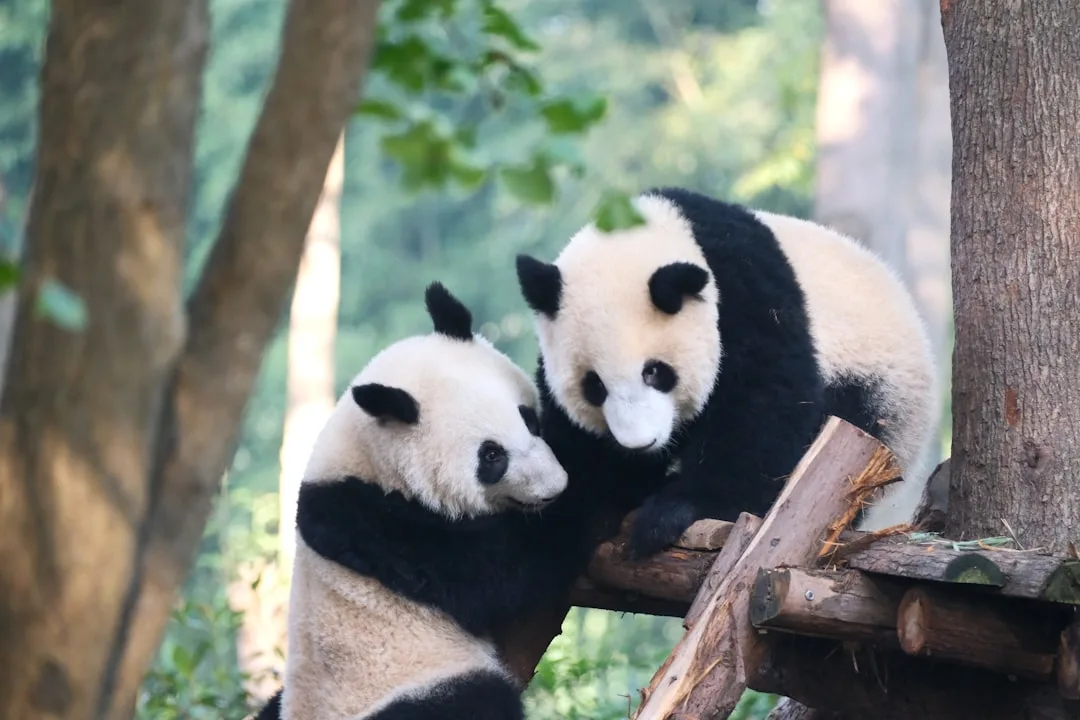
How were pandas saved from extinction?
The challenges in panda reproduction were only part of the problem. The giant panda (Ailuropoda melanoleuca) was pulled back from the brink by a stack of reinforcing measures. China passed the 1988 Wildlife Protection Law and backed the 1989 CITES Appendix I listing. The 1998 National Forest Protection Program halted commercial logging across most panda range. 67 nature reserves eventually covered roughly 70 percent of the wild habitat.
Captive breeding at Wolong, under Zhang Hemin, raised cub survival from around 10 percent in the 1980s to more than 90 percent by the 2020s. The wild population grew from 1,100 in 1988 to 1,864 in 2015, and the IUCN downlisted the species from Endangered to Vulnerable in 2016.
The Starting Point: A Species on the Edge
By the middle of the 1980s the giant panda was a symbol of imminent loss. Two decades of forest clearance in Sichuan, Shaanxi and Gansu had reduced bamboo habitat to an archipelago of fragments. The 1983 bamboo die-off, a synchronous flowering event across large areas of arrow bamboo in the Minshan and Qionglai ranges, killed dozens of pandas and exposed how thin the species' ecological buffer had become.
A 1985-88 national survey put the wild population at roughly 1,100 animals, a figure that was widely interpreted at the time as a terminal trajectory.
Two pressures stood out. The first was habitat loss. Commercial logging, collectivised during the 1950s and intensified through the 1970s, was removing the conifer overstory that panda bamboo needs to regenerate, and smallholder farming was eating into lower elevations where pandas fed in winter. The second was poaching. International demand for panda pelts, particularly through Japan and Hong Kong in the 1980s, supported a trafficking chain that reached inside the existing reserves.
The species profile, ecology and mountain range distribution are covered in depth at giant panda. This article is about how the trajectory was reversed.
The First Legal Pillar: 1988 and 1989
China's Wildlife Protection Law of the People's Republic of China, passed by the Standing Committee of the National People's Congress in November 1988, made killing a Class I protected animal a criminal offence punishable by up to ten years in prison, with the maximum penalty rising to life imprisonment for trafficking networks. The giant panda was placed at the top of the Class I list.
The law also criminalised the purchase, transport and possession of panda products, which closed the domestic leg of the pelt trade.
The international leg closed the following year. In 1989 the giant panda was moved to CITES Appendix I, which prohibits commercial international trade in wild-taken specimens.
The listing was overdue in formal terms, since China had acceded to CITES in 1981, but the Appendix I designation meant that any shipment crossing a border required a confiscation procedure rather than a permit negotiation. Within five years, confirmed panda skin seizures in Hong Kong, Tokyo and Taipei had dropped to near zero.
"The 1988 law was the hinge. Before it, a poacher risked a fine. After it, a poacher risked a decade. That changes the economics of the forest floor in a way that no amount of patrolling can replicate on its own." - Fuwen Wei, Chinese Academy of Sciences, Institute of Zoology
These two legal instruments did not end panda loss. They changed the slope of the curve. Between 1988 and 2000, confirmed poaching deaths of wild pandas fell by an order of magnitude, and the species' mortality profile shifted from human predation toward disease and accident.
The Second Pillar: Shutting Down the Logging Industry
The single most consequential panda conservation measure was not designed for pandas. It was the National Forest Protection Program (NFPP), launched in August 1998 after catastrophic summer flooding along the Yangtze River killed more than 3,000 people and displaced millions. The flood was widely blamed on upstream deforestation in Sichuan and the Tibetan plateau.
The State Council response was to ban commercial logging on a 18 million hectare footprint of natural forest in the upper Yangtze and upper Yellow River basins, which overlapped almost exactly with the giant panda's remaining range.
The NFPP did three things at once. It stopped chainsaws in the forest where pandas actually lived. It redirected the budgets of state-owned forestry bureaus, previously timber producers, into protection, monitoring and reforestation. And it transferred tens of thousands of loggers onto the payroll of what became the nature reserve system, which meant that the people who knew the mountains best were now being paid to patrol rather than cut.
Forest Cover in Panda Range, Before and After NFPP
| Period | Logging status | Annual forest loss (panda range) | Net forest change |
|---|---|---|---|
| 1976 to 1988 | Intensive commercial logging | -2.1% per year | Severe fragmentation |
| 1988 to 1998 | Partial reserve protection | -0.8% per year | Continued decline, slowed |
| 1998 to 2010 | NFPP active, logging banned | Near zero | Net reforestation begins |
| 2010 to 2020 | NFPP plus national park framework | Net gain | Corridor reconnection |
The habitat response was measurable within a decade. Satellite analysis of the Minshan and Qionglai ranges showed canopy recovery on cutover slopes by 2008, and bamboo understory returned to sites that had been commercial softwood plantations for a generation. Panda sign (scat transects, hair snags, camera trap records) appeared in forest patches that had been empty of the species for decades.
The Reserve Network: From 12 to 67
The reserve network grew in waves. The first wave, in the 1960s and 1970s, established Wolong (1963), Wanglang, Baihe and a small number of other research-oriented protected areas. The second wave, after the 1988 law, expanded rapidly. By 2000 there were 36 panda reserves. By 2010 the figure had grown to 62. By 2020, 67 reserves covered approximately 70 percent of the wild panda range across Sichuan, Shaanxi and Gansu.
Reserve establishment on its own was not enough. An early mistake was the assumption that simply drawing boundaries around panda habitat would halt decline.
The Pan Wenshi radio telemetry work in the Qinling mountains during the late 1980s and early 1990s demonstrated that pandas moved seasonally across elevational bands, and that a reserve drawn too narrowly around a summer bamboo belt would strand bears when winter snow pushed them downslope into unprotected land.
Reserve design was revised from the mid-1990s onward to include elevational corridors and to link adjacent reserves through forest strips.
The corridor question matters because of a biological fact covered in detail at how many pandas are left: the wild panda is not one population but 33 subpopulations, of which 18 contain fewer than 10 individuals.
Small, isolated groups lose genetic diversity, suffer from inbreeding depression, and are vulnerable to stochastic events (a bamboo flowering, a landslide, a disease outbreak) that a larger connected population would absorb. Corridor-building was not a cosmetic improvement. It was demographic plumbing.
WWF in China: The Longest-Running Partnership
The World Wide Fund for Nature has featured a giant panda in its logo since the organisation was founded in 1961. The image came from Chi-Chi, a panda on loan to London Zoo whose likeness WWF's founding council chose as a symbol both recognisable and copyright-clear. The partnership with the species was, in the beginning, more rhetorical than operational. It became operational in 1980.
That year, under an agreement between WWF and the Chinese Ministry of Forestry, WWF became the first Western conservation NGO permitted to work inside the People's Republic. The initial field project was at Wolong, where George Schaller and Chinese counterpart Hu Jinchu spent four field seasons radio-collaring and tracking wild pandas.
Schaller's 1985 book, The Giant Pandas of Wolong (published in Chinese and English editions), supplied the first rigorous quantitative picture of wild panda ecology and set the methodological template for the national surveys that followed.
Over the subsequent four decades, WWF's panda work has covered:
- Survey methodology, including the scat-based DNA identification protocols now used to produce wild population estimates
- Corridor mapping, which turned into the physical routes along which reforestation and land-use planning were organised
- Reserve staff training, particularly in camera trap deployment and GIS-based habitat monitoring
- Policy engagement, including the advocacy that contributed to the NFPP in 1998 and the Giant Panda National Park framework in 2021
"The single most important thing we did was stay. Long-term partnerships in conservation are rare because funding cycles are short. Our Wolong team has been in place for more than forty years. That continuity is why the methodology exists, why the staff exist, and why the wild population recovered enough to be downlisted." - Ginette Hemley, Senior Vice President for Wildlife Conservation, WWF
Wolong, Zhang Hemin, and the Captive Breeding Turnaround
If the reserve network is the spatial half of panda conservation, the captive breeding programme is the demographic half. It was not always a success. Through the 1980s, captive cub survival rates at Chinese breeding centres hovered around 10 percent.
Females rejected newborns, twin cubs (born at around 100 g, roughly 1/900th of maternal body mass) died of hypothermia or starvation when mothers focused on a single cub, and captive-born animals struggled to reach reproductive maturity. The reproductive biology behind this difficulty is covered at panda reproduction: why it is so hard and panda cubs: birth and growth.
The turnaround was engineered in the 1990s and 2000s, largely at the Wolong Panda Reserve, by a programme under the direction of Zhang Hemin, known among colleagues and the international press as "Papa Panda". Three methodological changes did most of the work.
The first was twin swapping. Researchers observed that a panda mother caring for a single cub rarely rejected it, but that she almost never raised both twins. The Wolong team began rotating twin cubs between the mother and an incubator on a schedule of a few hours at a time, swapping the cubs under cover of feeding distraction. The mother believed she was raising one cub.
Both cubs received maternal milk, which carries immune factors that formula cannot replicate, and both gained the rocking, licking and thermoregulation that a mother provides. Cub survival in captive twin births jumped from under 20 percent to above 80 percent within a decade.
The second was artificial insemination protocols adapted from zoo wildlife medicine, combined with semen banking and exchange between institutions. Female pandas are reproductively receptive for 24 to 72 hours per year. Before the protocols were standardised, that window was often missed. By the 2010s, cryopreserved semen from genetically important males was available across Chinese breeding centres, which allowed pairings that would have been geographically impossible with live animals.
The third was social housing for juveniles. Early captive pandas were raised alone in small enclosures. The Wolong programme moved to group-rearing of cubs aged 6 to 24 months in natural-vegetation enclosures, which dramatically improved the behavioural competence of adults at reproductive age. Captive-raised pandas released to the wild under the pilot reintroduction scheme (beginning 2006, with varying success) came out of these group-housed cohorts.
Captive Breeding Success, 1980s to 2020s
| Decade | Captive cub survival | Annual captive births | Notable programme change |
|---|---|---|---|
| 1980s | ~10% | 1 to 3 per year nationally | Single-cub rearing, poor AI success |
| 1990s | ~30% | 5 to 10 per year | Twin swapping introduced |
| 2000s | 60 to 75% | 20 to 30 per year | AI protocols standardised |
| 2010s | 85 to 92% | 40 to 55 per year | Social housing, genetic exchange |
| 2020s | 90%+ | 40 to 60 per year | Reintroduction pipeline operational |
"When I started at Wolong in the 1980s we lost nine cubs out of ten. Many of us believed the species could not be bred sustainably in human care. The change did not come from one idea. It came from twin swapping, from patience, from learning to let the mother do what she is good at and helping only where she is not. Now we lose one cub out of ten, and that one is almost always because of a birth defect we could not prevent." - Zhang Hemin, Director Emeritus, Wolong Giant Panda Research Centre
By 2024 the global captive population stood near 600 animals, large enough to serve as both an insurance population and a source pool for release back into wild habitat. The reintroduction programme remains experimental, with mortality rates in released animals still uncomfortably high, but the demographic cushion exists.
The Numbers That Earned the Downlisting
Four national surveys track the wild population. The methodology was refined at each iteration, and direct comparison between surveys requires caution, but the trajectory is unambiguous.
Wild Giant Panda Population by Survey
| Survey | Fieldwork period | Wild population estimate | Key methodological feature |
|---|---|---|---|
| 1st National Survey | 1974-1977 | ~2,459 | Direct observation, overcounted |
| 2nd National Survey | 1985-1988 | ~1,114 | Improved transect design |
| 3rd National Survey | 1999-2003 | ~1,596 | Bite-size bamboo fragment aging |
| 4th National Survey | 2011-2014 | ~1,864 | DNA-from-scat identification |
| 5th National Survey | 2020-2023 | Publication pending | Camera trap grid, eDNA |
The 2nd survey figure of 1,114 is the conventional "low point" of the crisis. The 4th survey figure of 1,864, released in 2015, is the number on which the 2016 IUCN downlisting rested. Between them, the wild population grew by approximately 67 percent across about 27 years. That is not a recovery to historical baselines. It is, however, the clearest quantitative panda success statement in the published record.
"A rising population trajectory across three consecutive national surveys, with ongoing habitat protection and an active corridor programme, is what our criteria require for a downlisting. The giant panda met that bar. Vulnerable is the correct category for a species that is recovering from near-extinction but still faces demographic and climate pressures that could reverse the gains." - IUCN Bear Specialist Group, 2016 Assessment
The downlisting was controversial among some Chinese conservationists, who argued that the symbolic weight of the "Endangered" label was a fundraising and political asset that the species could not yet afford to lose. The Chinese government retained its domestic Class I Endangered listing, which is unaffected by IUCN categorisation. Both positions are defensible. The species recovered enough to no longer meet the IUCN Endangered threshold. It did not recover enough to be safe.
Panda Diplomacy as a Conservation Funding Mechanism
The panda loan programme is older than the modern conservation effort. Pandas were gifted between governments as early as the Tang Dynasty, and the modern era of "panda diplomacy" began in 1957 with pairs sent to the Soviet Union. Gifts gave way to loans after 1984, when China restructured the programme as a ten-year leasing arrangement with conservation-earmarked fees.
Since 1984, China has loaned more than 120 pandas to 22 countries. The standard contemporary arrangement is a pair on a ten-year loan, with an annual fee in the vicinity of USD 1 million per pair, plus supplementary payments on each cub born at the host institution. The funds are directed to the China Wildlife Conservation Association and support habitat protection, survey work and the breeding programme.
The diplomatic dimension is real but often overstated in Western media. Loan negotiations are entangled with trade, high-level visits and symbolic gestures. What is less often noted is that the loan programme has become a non-trivial funding pillar for in-country conservation work. A single breeding pair at a Western zoo can generate sufficient revenue over a decade to fund the operating budget of a medium-sized Chinese nature reserve.
"Panda diplomacy is easy to mock, but the accounting matters. A loan pair in a North American zoo is paying for ranger salaries, camera traps and corridor reforestation in Sichuan. That is not the whole story of how the recovery was funded, but it is a real line item on the budget." - Ronald Swaisgood, San Diego Zoo Wildlife Alliance
2021: The Giant Panda National Park
The most recent structural change in panda conservation is the Giant Panda National Park, formally established by the State Council in October 2021. The park consolidates a network that had grown organically across three provinces and five prefectures into a single administrative and conservation unit of approximately 70,000 square kilometres, spanning parts of Sichuan, Shaanxi and Gansu.
The national park framework is significant for two reasons. First, it provides a single management authority for what had previously been 67 reserves under different jurisdictions, which simplifies the corridor work and enables landscape-level planning. Second, it embeds panda conservation inside China's broader national park system, a programme explicitly modeled on United States federal land management and intended to provide long-term institutional stability for protected areas.
The park's stated design principles include habitat connectivity, reduction of infrastructure fragmentation, community development inside and adjacent to the park, and scientific research as a core function rather than an adjunct. Implementation is ongoing. Some inholders, particularly commercial tourism operators, have resisted the tighter use controls. Some local governments have resisted the budget centralisation. The park is a framework, not yet a finished state.
What Still Threatens the Recovery
The panda is not safe. Four pressures continue to matter.
Habitat fragmentation persists despite the corridor work. The 33 subpopulations remain demographically distinct, and several of the smaller ones have less than one generation of buffer against extinction. Road infrastructure, particularly the expressway and high-speed rail network built through panda range during the 2000s and 2010s, has created barriers that corridors are still being designed to cross.
Climate change is projected to reduce the range of suitable bamboo by a significant percentage this century. Pandas depend almost entirely on bamboo for food, as covered at why do pandas eat bamboo. Warming shifts the elevational band where arrow bamboo, umbrella bamboo and fountain bamboo can grow. In mountain ranges with limited upward real estate, that band compresses against the summit.
Tourism impact is an emerging pressure. Panda viewing, both at breeding centres and at select reserves with wild-panda-possible experiences, generates revenue for conservation but also increases disturbance, vehicle traffic and opportunistic conflict. The balance is still being negotiated.
Disease remains a background risk. Captive populations have experienced canine distemper virus outbreaks, and the interface between captive, semi-wild and wild populations created by the reintroduction programme increases the theoretical transmission risk. Biosecurity is a routine component of panda management that did not exist as a formal category a generation ago.
The relevant comparison is the polar bear, whose own recovery prospects are covered at why polar bears are endangered. The polar bear is a specialist facing habitat loss that national legislation alone cannot fix. The giant panda is a specialist whose habitat loss proved, in the end, to be addressable through national legislation combined with international partnership. That contrast is instructive.
For broader context on threatened species across the site, see the endangered species overview and the comparative profile at brown bear. The question of whether pandas are even classified as bears at all, which has biological nuance beyond the obvious, is addressed at are pandas actually bears.
What the Success Story Actually Teaches
The giant panda recovery is frequently cited as the flagship conservation success. The shorthand version, that pandas were saved because the world cared, is not wrong but is not useful. The detailed version contains lessons that transfer to other species.
The first lesson is that national legislation matters more than international sympathy. The 1988 Wildlife Protection Law changed the behaviour of enforcement officers inside China. No amount of global panda enthusiasm would have done that. Domestic legal frameworks are the substrate on which international support operates.
The second lesson is that habitat work is demographic work. The reserve network, the logging ban, and the corridor programme succeeded because they were designed around the biology of panda movement. A reserve that ignores elevational seasonal migration is half a reserve. A corridor that does not connect subpopulations of reproductive ages is a corridor in the wrong place.
The third lesson is that captive breeding is a long game. The Wolong programme required more than twenty years of iterative methodology development before it reached the 90 percent cub survival figure. Short conservation funding cycles are structurally incompatible with that timeline. The partnerships that worked, including WWF's four-decade China engagement, worked because they outlasted political cycles on both sides.
The fourth lesson is that downlisting is a milestone, not an endpoint. The 2016 IUCN decision was accurate at the time, and the criteria that produced it are the same criteria used for every other species. The temptation to treat downlisting as mission-accomplished has to be resisted, because the underlying pressures (climate, fragmentation, human pressure on mountain landscapes) have not been resolved.
For the biology of the species itself, including anatomy, sensory systems, communication and the six-mountain-range distribution, the full profile is at giant panda. A panda alive in 2025 is living in a habitat that is larger, better connected, and better monitored than the one a panda occupied in 1985. The next generation will decide whether that trajectory continues or reverses.
References
- Wei, F., Swaisgood, R., Hu, Y., Nie, Y., Yan, L., Zhang, Z., Qi, D., Zhu, L. (2015). Progress in the ecology and conservation of giant pandas. Conservation Biology, 29(6), 1497-1507. https://doi.org/10.1111/cobi.12582
- Swaisgood, R. R., Wei, F., McShea, W. J., Wildt, D. E., Kouba, A. J., Zhang, Z. (2011). Can science save the giant panda (Ailuropoda melanoleuca)? Unifying science and policy in an adaptive management paradigm. Integrative Zoology, 6(3), 290-296. https://doi.org/10.1111/j.1749-4877.2011.00244.x
- Viña, A., Tuanmu, M.-N., Xu, W., Li, Y., Ouyang, Z., DeFries, R., Liu, J. (2010). Range-wide analysis of wildlife habitat: Implications for conservation. Biological Conservation, 143(9), 1960-1969. https://doi.org/10.1016/j.biocon.2010.04.046
- Liu, J., Linderman, M., Ouyang, Z., An, L., Yang, J., Zhang, H. (2001). Ecological degradation in protected areas: the case of Wolong Nature Reserve for giant pandas. Science, 292(5514), 98-101. https://doi.org/10.1126/science.1058104
- Zhang, Z., Swaisgood, R. R., Zhang, S., Nordstrom, L. A., Wang, H., Gu, X., Hu, J., Wei, F. (2011). Old-growth forest is what giant pandas really need. Biology Letters, 7(3), 403-406. https://doi.org/10.1098/rsbl.2010.1081
- Hull, V., Zhang, J., Huang, J., Zhou, S., Viña, A., Shortridge, A., Li, R., Liu, D., Xu, W., Ouyang, Z., Zhang, H., Liu, J. (2016). Habitat use and selection by giant pandas. PLoS ONE, 11(9), e0162266. https://doi.org/10.1371/journal.pone.0162266
- Tuanmu, M.-N., Viña, A., Winkler, J. A., Li, Y., Xu, W., Ouyang, Z., Liu, J. (2013). Climate-change impacts on understorey bamboo species and giant pandas in China's Qinling Mountains. Nature Climate Change, 3, 249-253. https://doi.org/10.1038/nclimate1727
- Kang, D., Li, J. (2018). Giant panda protection should take conservation priority into account. Environmental Science and Pollution Research, 25, 4650-4651. https://doi.org/10.1007/s11356-017-0961-7
Further Reading
Expert-written coverage of bears, pandas and conservation across the site:
- Giant panda: the species profile
- How many pandas are left
- Panda reproduction: why it is so hard
- Panda cubs: birth and growth
- Why do pandas eat bamboo
- Are pandas actually bears
- Why polar bears are endangered
- Brown bear
- Polar bear
- Endangered species overview
External tools and resources from the publisher network:
- Evidence-based cognitive assessments at whats-your-iq.com
- Music education platform at whennotesfly.com
- Certification exam preparation at pass4-sure.us
Frequently Asked Questions
How were pandas saved from extinction?
Giant pandas were pulled back from the brink by a combination of four reinforcing interventions rolled out by the Chinese government between the late 1980s and the 2010s. The 1988 Wildlife Protection Law of the People’s Republic of China made killing a wild panda a serious crime, and the 1989 CITES Appendix I listing cut off the international trade that had been driving skin trafficking through the 1980s.
The 1998 National Forest Protection Program, triggered by catastrophic flooding on the Yangtze, halted commercial logging across most panda habitat and converted thousands of state foresters into reserve staff. A network of 67 nature reserves eventually covered roughly 70 percent of the wild range, and captive breeding at Wolong lifted cub survival from around 10 percent in the 1980s to more than 90 percent by the 2020s.
The wild population rose from about 1,100 animals in the 1988 survey to 1,864 in the 2015 survey, a recovery of roughly 70 percent in a single generation.
Why are pandas no longer endangered?
The IUCN Red List downlisted the giant panda from Endangered to Vulnerable in 2016 because the wild population had grown for three consecutive national surveys and the immediate extinction risk had eased. The decision was based on quantitative criteria: the species no longer met the thresholds for Endangered, which require either a small and declining population or a very restricted range undergoing severe reduction.
The downlisting was not a declaration of safety. The Chinese government continues to classify the species as Endangered under domestic law, and field biologists point out that the wild population is split across 33 subpopulations, many of which are genetically isolated and demographically fragile. Climate change is projected to reduce suitable bamboo habitat by a significant margin this century. The 2016 change recognised progress, not completion.
What role did WWF play in saving the panda?
The World Wide Fund for Nature, whose logo has featured a giant panda since 1961, became the first Western conservation NGO permitted to work inside the People’s Republic of China when it signed a cooperation agreement with the Ministry of Forestry in 1980. The initial project was the Wolong research station, where WWF funded equipment, field methods, and the early radio-collaring studies led by George Schaller and Hu Jinchu.
Over the following four decades, WWF co-developed the national panda survey methodology, supported the habitat corridor work that stitched isolated reserves together, and helped push the logging ban and the reserve-network expansion through policy channels. WWF remains the longest-running international conservation partner in China and now focuses on the Giant Panda National Park framework established in 2021.