
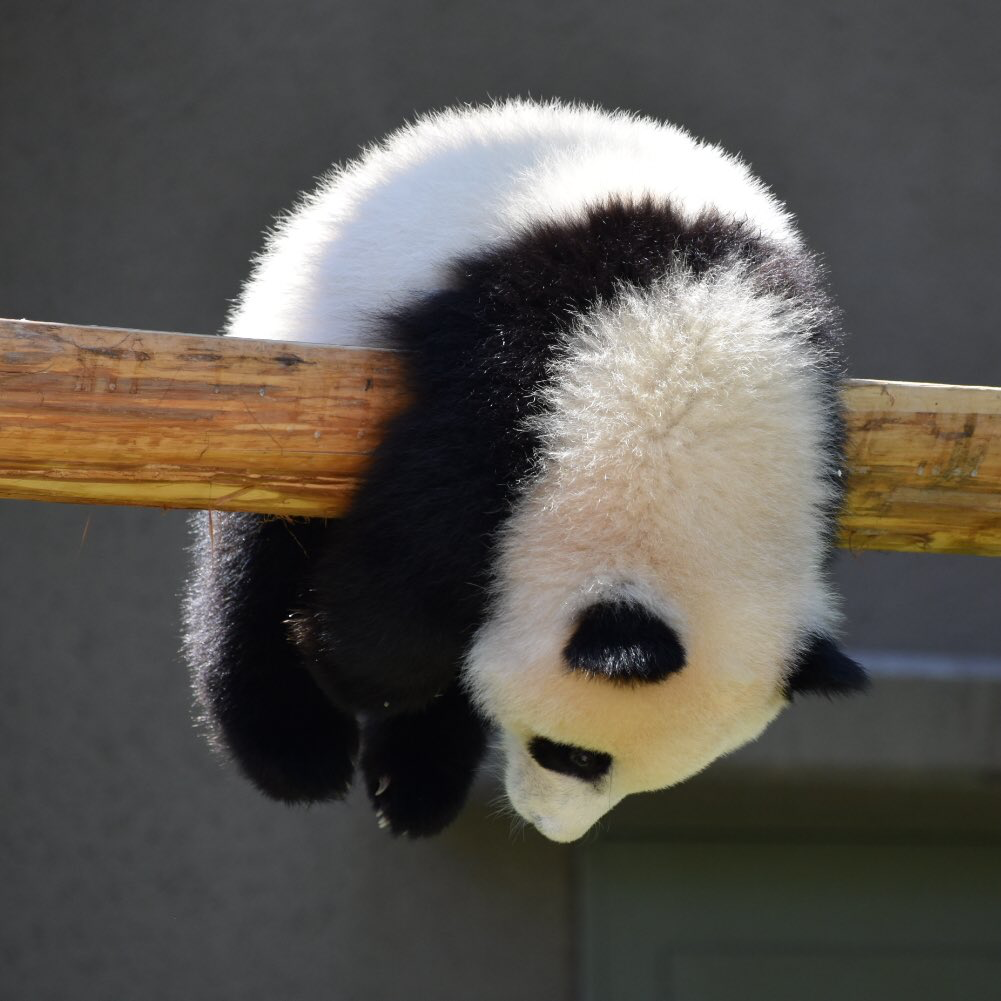
Giant panda cubs are among the most biologically improbable animals on Earth. It is pink. It is blind. It weighs roughly the same as a stick of butter. Its mother, cradling it in a single paw, is nearly nine hundred times its size. Nothing else in the placental mammal world cuts it quite this close.
This is the story of how a creature that fits in a human palm on day one becomes a hundred-kilogram adult less than two years later, and why the panda's reproductive playbook is as strange as everything else about the species.
For the full adult biology of the animal these cubs grow into, see our species profile on the giant panda. For the broader question of why pandas breed so rarely and so unreliably, see why panda reproduction is so hard.
The smallest baby any large mammal makes
Across the kingdom of placental mammals there is a rough rule. Big mothers make big babies. A blue whale calf arrives at 2.5 tonnes. A giraffe drops a calf of 60 kilograms standing a full six feet tall. A human newborn is about one-twentieth the mass of its mother. Even hibernating bears, which go through a period of very limited fetal growth, produce cubs at roughly one part in two to four hundred of maternal mass.
The giant panda breaks this rule harder than any other placental mammal on record.
A typical panda cub weighs between 85 and 130 grams at birth, with the population mean sitting almost exactly at 100 grams. The mother, in good condition, weighs between 80 and 125 kilograms. The ratio runs roughly one to nine hundred. Set next to a newborn human or a newborn horse, this is such a statistical outlier that researchers still argue about why natural selection produced it.
"No other eutherian mammal gives birth to a neonate this altricial at this maternal size. The giant panda is essentially producing a marsupial-grade infant from a placental womb, and then finishing the work with milk and body heat on the outside." , David Wildt, former head of the Center for Species Survival, Smithsonian Conservation Biology Institute, commenting in Zoo Biology.
Birth weight ratio compared across mammals
The table below puts the panda birth ratio into context with other species. The ratio is mother mass divided by newborn mass, so higher numbers mean a proportionally smaller baby.
| Species | Typical mother mass | Newborn mass | Ratio (mother to cub) |
|---|---|---|---|
| Giant panda | 90 kg | 100 g | ~900 : 1 |
| Polar bear | 350 kg | 600 g | ~580 : 1 |
| Grizzly bear | 200 kg | 450 g | ~440 : 1 |
| Brown bear (Eurasian) | 150 kg | 400 g | ~370 : 1 |
| American black bear | 80 kg | 300 g | ~265 : 1 |
| Human | 65 kg | 3.3 kg | ~20 : 1 |
| Horse | 500 kg | 50 kg | ~10 : 1 |
| African elephant | 3000 kg | 100 kg | ~30 : 1 |
| Blue whale | 140000 kg | 2700 kg | ~50 : 1 |
Even among bears, a clade already famous for producing tiny cubs because of winter-denning constraints, the panda is in a league of its own. A polar bear cub is small but still roughly six times heavier than a panda cub, and a polar sow is nearly four times heavier than a panda mother.
You can read more about the polar bear's own extreme reproductive strategy in polar bear cubs: denning and survival, and compare the denning-and-family pattern of grizzlies in grizzly bear cubs and family life and of the more temperate-forest brown bear in brown bear cubs and mothers.
Why are panda cubs so tiny?
The mechanical answer lies in gestation. A panda pregnancy is recorded as anywhere between 95 and 160 days, a wild variability that is virtually unique among large mammals. The variation is not noise. It reflects delayed implantation, a mechanism shared with other bears but pushed by the panda to an extreme.
After mating, the fertilised egg divides into a blastocyst and then pauses, floating free in the uterus for weeks or months while the mother samples the environment, bamboo quality, and her own fat stores.
Only when conditions look tolerable does implantation happen, and from that point the true active gestation runs a mere 45 to 60 days. The cub therefore spends only about two months being actively built inside the womb, far less than the five to seven months most carnivores of similar adult size invest in pregnancy. That short active window is the proximate reason the cub arrives so small and so undeveloped.
The deeper evolutionary explanation is still debated. The leading hypothesis is the bamboo-energetics trap. Bamboo is an absurdly poor food. It is low in protein, low in fat, and most of its carbohydrate is locked inside indigestible cellulose. A panda extracts only about 17 percent of the energy it chews.
For a bear-bodied animal, that means eating 12 to 38 kilograms of bamboo every single day just to meet baseline maintenance, with almost no surplus to pour into fetal growth. Selection appears to have pushed the panda toward externalising most of its offspring development into lactation, where energy can be converted more efficiently in the weeks after birth, rather than through a long and costly pregnancy.
"Bamboo is such a marginal food that the panda cannot afford to gestate like a normal bear. The reproductive system has effectively been redesigned to move most of the work from placenta to milk." , Ronald Swaisgood, conservation ecologist, San Diego Zoo Wildlife Alliance.
For the full picture of why a bear decided to eat grass, see why do pandas eat bamboo and what do pandas do all day.
The first two weeks: pink, blind, and carried in the mouth
When the cub is born, it is almost nothing but a squalling mouth. Its eyes are closed and will not open for about two months. It cannot regulate its own body temperature and would chill and die inside an hour without direct contact with the mother. It has no teeth. Its stomach is the size of a grape. It can make one sound, a remarkably loud and piercing squawk that carries through bamboo thickets, which is the only tool it has to stay alive.
The mother responds by becoming, in effect, a living incubator. For the first 10 to 14 days she barely moves. She does not feed. She does not drink. She does not leave the den. She holds the cub against her chest or belly in one paw, or lifts it gently in her teeth to reposition it, and nurses it up to 14 times a day in bouts of several minutes. Nursing sessions can last so long that early keepers at Chinese breeding stations thought the cubs had drowned in milk.
Transport is done by mouth. A panda mother will pick up her cub in the same grip a cat uses on a kitten, the canines pressed just behind the shoulder blades without puncturing the skin. The cub is so small and so limp that in footage from the field it is easy to mistake for a pink sock.
"During those first fifteen days, the sow's attention is absolute. She does not eat. She does not drink. She will refuse bamboo offered at arm's length if it means setting the cub down. That intensity is exactly what keeps the cub alive, and it is also exactly what makes raising twins impossible without human help." , Zhang Hemin, former director, China Conservation and Research Center for the Giant Panda at Wolong.
Developmental milestones in the first two years
| Age | Weight (typical) | Development |
|---|---|---|
| Birth | 85–130 g | Pink, blind, nearly hairless, 15–17 cm long, toothless |
| 7–10 days | 120–200 g | Grey shadows appear around eyes, ears, shoulders |
| 3–4 weeks | 400–800 g | Full black-and-white pattern emerges; still blind |
| 6–8 weeks | 1.2–1.8 kg | Eyes open; cub begins to vocalise in adult repertoire |
| 3 months | 4–6 kg | First teeth erupt; cub begins to crawl and wobble-walk |
| 4–5 months | 6–10 kg | Walks reliably; starts mouthing bamboo |
| 6–8 months | 10–20 kg | First real bamboo chewing; still nursing |
| 12 months | 25–45 kg | Climbs trees confidently; forages with mother |
| 18 months | 40–65 kg | Weaning usually complete; strong bamboo diet |
| 2 years | 60–90 kg | Begins dispersal behaviour |
| 2.5 years | 70–100 kg | Fully independent; leaves natal range |
| 4–7 years | 80–125 kg | Sexual maturity (females 4–5, males 6–7) |
One mouth, two cubs: the twin problem
Roughly 40 to 50 percent of panda births in captivity are twins, and fieldwork suggests the rate in wild pandas is similar, though observations are rare. Twin births were long considered fortunate, until keepers began to notice a grim pattern. A panda mother with two cubs almost always picks one and abandons the other, typically within the first 48 hours. In a wild den, the abandoned cub chills and dies.
The behaviour is not cruelty. It is an energy calculation that selection has burned into the species. A sow on a bamboo diet has just enough milk supply and just enough free time to keep one tiny neonate warm and fed. Splitting her attention between two means both starve or both chill. In a cold maternal den in Sichuan, a two-second delay in picking up a cub can drop its body temperature below the recoverable threshold.
Captive programs solved the twin problem with a now-classic protocol: the cub swap.
- One cub remains with the mother.
- The second cub is placed in an incubator and hand-fed formula or pooled donor milk.
- Every two to four hours, keepers swap the two cubs quietly while the mother is distracted with honey-water or bamboo shoots.
- The mother therefore always has a single cub to groom, warm, and nurse, and never realises she is raising two.
"Before the cub swap was perfected, we lost virtually every second twin. After the swap was standardised across Chinese breeding centres in the late 1990s, survival of twin litters rose above 90 percent. It is the single biggest reason the captive population passed 600 animals." , Chengdu Research Base of Giant Panda Breeding, annual report.
This is why the captive population rebounded so dramatically, a story covered in full in the panda conservation success story and put into numbers in how many pandas are left.
Growth curves: from 100 g to 100 kg
After the first two critical weeks, the cub's growth becomes one of the fastest in the bear family, though it starts from an unusually low base.
- By week 4 the cub has quadrupled its birth mass.
- By week 8 it has quadrupled again.
- By the time its eyes open at 6 to 8 weeks, it is already around 1.5 kilograms, fifteen times its birth weight.
- By 6 months it is ten kilograms, about a hundred times its birth weight.
- By 12 months, with a mix of milk and increasing amounts of bamboo, the cub typically clears 25 to 45 kilograms.
- By 18 to 24 months the cub passes the psychological milestone of 50 kilograms, at which point it looks like a small version of its mother and can forage independently for hours at a stretch.
Locomotion milestones
- Weeks 1 to 8: no locomotion. The cub squirms but cannot lift its head.
- Weeks 8 to 12: head control, first attempts to pull forward with the forelimbs.
- Month 3: crawling on all fours with the belly off the ground.
- Month 4: wobbly walking, frequent falls, first climbing attempts.
- Month 6: confident walking, climbing into low branches.
- Month 8 to 10: climbing to 5 metres or more; descending tail-first like a true bear.
- Month 12: capable of running short distances, wrestling with its mother and siblings, and handling bamboo stems.
Nursing, weaning, and the long tail of milk dependence
Unlike most carnivores, which wean within a few months, panda cubs nurse for an extraordinarily long time. Milk bouts persist well past the point at which the cub's teeth and gut could handle a mostly bamboo diet. Observed nursing beyond the first year is the norm, and occasional milk demands persist up to 18 months of age.
The reason again comes back to bamboo. The plant is so marginal a food that the cub cannot gain the energy it needs to build a large body from bamboo alone during the first year. Milk bridges the gap. Panda milk is unusual in its own right: relatively low in fat compared to bear milk, high in oligosaccharides that support a developing gut microbiome, and rich in antibodies that compensate for the cub's late-developing immune system.
Weaning itself is gradual. Around month 6 the cub begins sampling bamboo leaves and stem tips, often those the mother has discarded. By month 9 it is chewing independently for meaningful stretches of the day. By month 12 most cubs can survive, nutritionally, on bamboo alone, but the behavioural bond and occasional milk continue for many more months.
Independence, dispersal, and sexual maturity
Separation from the mother is less violent than in grizzly bears but clearer than in species like orangutans. A wild panda mother, back in estrus at around 18 to 24 months post-birth, begins actively shortening her interactions with her cub. She nurses less. She tolerates less play. By 2 to 2.5 years the cub is travelling on its own loop within the mother's broader home range, overlapping less and less, and eventually drifting out to establish its own territory.
Sexual maturity arrives slowly.
- Female pandas first ovulate and can conceive between 4 and 5 years of age.
- Males reach full reproductive capacity somewhat later, between 6 and 7 years.
- In the wild, effective reproductive career runs from about age 5 to age 20 for most females.
First-year survival in the wild
Wild cub mortality is harsh. Approximately 50 percent of panda cubs die within the first year of life. Causes include:
- Cold exposure in maternal dens during the brief periods when the mother must leave to feed.
- Predation, primarily by yellow-throated martens (Martes flavigula) and occasional leopards.
- Abandonment of the second twin.
- Maternal accidents where a cub is dropped or crushed during the first clumsy weeks.
- Starvation in years of mass bamboo flowering and die-back.
Captive survival, by contrast, is now above 90 percent in accredited Chinese breeding centres, which is why captive numbers have grown so rapidly even as the wild population has recovered more modestly.
The evolutionary logic of tiny pandas
Put all of this together and the panda's reproductive strategy stops looking strange and starts looking coherent. Every piece fits a single constraint: the cost of bamboo.
- Bamboo is low energy, so the mother cannot afford a long, costly pregnancy.
- Short active gestation means tiny, underdeveloped cubs.
- Tiny cubs cannot thermoregulate, so the mother must invest fully in the first two weeks.
- Full investment in one cub means twins cannot both be raised.
- Slow growth on a bad diet means long nursing and long dependence.
- Long dependence and slow maturity mean low lifetime reproductive output.
- Low output means the species is demographically fragile and easy to tip into decline.
This fragility is exactly why conservation biologists obsess over panda cubs. One cub successfully raised in the wild is a rare, expensive event. One cub lost to a human-caused pressure, be it habitat fragmentation, tourist disturbance, or climate-driven bamboo die-back, is disproportionately costly to the population.
Conservation work therefore targets reproductive outcomes almost as intensely as habitat protection, and the fact that the captive population crossed 700 animals owes as much to incubator rotations and hormone monitoring as to anything done in the forest itself.
Cross-references and further reading
Within Strange Animals:
- Giant panda, full species profile.
- Panda reproduction: why it is so hard.
- The panda conservation success story.
- How many pandas are left.
- Why do pandas eat bamboo.
- What do pandas do all day.
- Polar bear cubs: denning and survival.
- Grizzly bear cubs and family life.
- Brown bear cubs and mothers.
Outside reading from our partner sites:
- Science and cognition puzzles at whats-your-iq.com.
- Professional writing and communication craft at evolang.info.
- Career and certification preparation at pass4-sure.us.
References
- Schaller, G. B., Hu Jinchu, Pan Wenshi, and Zhu Jing. The Giant Pandas of Wolong. University of Chicago Press. doi:10.7208/chicago/9780226736488.001.0001
- Wei, F., Swaisgood, R., Hu, Y. et al. "Progress in the ecology and conservation of giant pandas." Conservation Biology, 29(6), 2015. doi:10.1111/cobi.12582
- Zhang, Z., Sheppard, J. K., Swaisgood, R. R. et al. "Ecological scale and seasonal heterogeneity in the spatial behaviors of giant pandas." Integrative Zoology, 9(1), 2014. doi:10.1111/1749-4877.12030
- Nie, Y., Speakman, J. R., Wu, Q. et al. "Exceptionally low daily energy expenditure in the bamboo-eating giant panda." Science, 349(6244), 2015. doi:10.1126/science.aab2413
- Hu, Y., Thapa, A., Fan, H. et al. "Genomic evidence for two phylogenetic species and long-term population bottlenecks in the giant panda." Science Advances, 6(18), 2020. doi:10.1126/sciadv.aax5751
- Zhu, L., Hu, Y., Qi, D., Wu, H., Zhan, X., and Wei, F. "Genetic analyses reveal reproductive patterns in captive giant panda populations." Zoo Biology, 32(3), 2013. doi:10.1002/zoo.21069
- Wildt, D. E., Zhang, A., Zhang, H., Janssen, D. L., and Ellis, S. (eds). Giant Pandas: Biology, Veterinary Medicine and Management. Cambridge University Press. doi:10.1017/CBO9780511542244
- Swaisgood, R. R., Zhang, G., Zhou, X., and Zhang, H. "The science of giant panda reproduction: implications for conservation and ex situ management." Reproduction, Fertility and Development, 18(4), 2006. doi:10.1071/RD05126
Frequently Asked Questions
How small are baby pandas when they are born?
A newborn giant panda cub (Ailuropoda melanoleuca) weighs between 85 and 130 grams, with an average very close to 100 grams, and measures only 15 to 17 centimetres from nose to tail tip. That is roughly the mass of a standard stick of American butter or a small lemon.
Cubs are born bright pink, blind, toothless, and almost entirely hairless apart from a sparse coat of fine white down, and the only dark pigmentation visible in the first days is a faint grey wash around the eye patches and shoulders. The ratio of mother weight to newborn weight is close to one to nine hundred in a typical 90 kilogram sow, which is the most extreme recorded in any placental mammal.
For context, that ratio is larger than in any other bear species, larger than in ungulates and primates, and comparable only to some marsupials, which give birth at an even earlier developmental stage.
The biological reason is that the panda embryo experiences delayed implantation and only two months of true active fetal growth, so the cub is effectively delivered half-formed and must finish its development on the mother’s belly, clinging to warmth and milk.
When do panda cubs turn black and white?
The iconic black-and-white pattern begins to emerge between 3 and 4 weeks after birth. First, faint grey shadows appear around the eyes, ears, and shoulders at about day 7 to day 10, and over the following two to three weeks these shadows darken progressively into the true black of the adult mask, ears, fore and hind limbs, and shoulder band.
By four weeks the cub is recognisably a panda in miniature, though still no larger than a loaf of bread and still effectively blind. The eyes open between six and eight weeks, first teeth appear at three to four months, and the cub begins to crawl and then wobble on its legs somewhere between three and four months of age.
First attempts to chew bamboo begin around six to eight months, but milk remains the main energy source for far longer than in most mammals, and cubs continue to nurse in some cases until 9 to 18 months, well after they have grown functional teeth and can process plant matter. Full weaning, independence, and dispersal usually come between one and a half and two and a half years, and reproductive maturity only at four to seven years.
Why do panda mothers often abandon one twin?
Twins are born in roughly 40 to 50 percent of captive panda pregnancies and at a similar rate in the wild, yet in almost every natural case the mother raises only one cub. The reason is a straightforward energy budget.
A panda cub at birth is so tiny and so underdeveloped that it must be held close to the mother’s chest or belly for nearly 24 hours a day during the first week, and feeding and grooming a single cub already consumes most of the sow’s time and lactation capacity on a bamboo-only diet.
Attempting to nurse two cubs simultaneously usually leads to both starving or chilling, so natural selection has shaped a cold triage behaviour in which the mother picks the stronger cub, almost always the firstborn or the heavier one, and walks away from the second within hours or days. Captive breeding programs exploit a specific workaround called cub-swap rotation.
Keepers at Wolong, Chengdu, and other facilities discreetly remove one twin at a time, place it in an incubator for feeding and warmth, and swap the pair every two to four hours so the mother always has a cub to groom and nurse but never more than one at a time.
This protocol, pioneered in the late 1990s, lifted captive twin survival from near zero to well above 90 percent and is one of the reasons the global captive panda population has grown from under 100 animals to more than 700.