
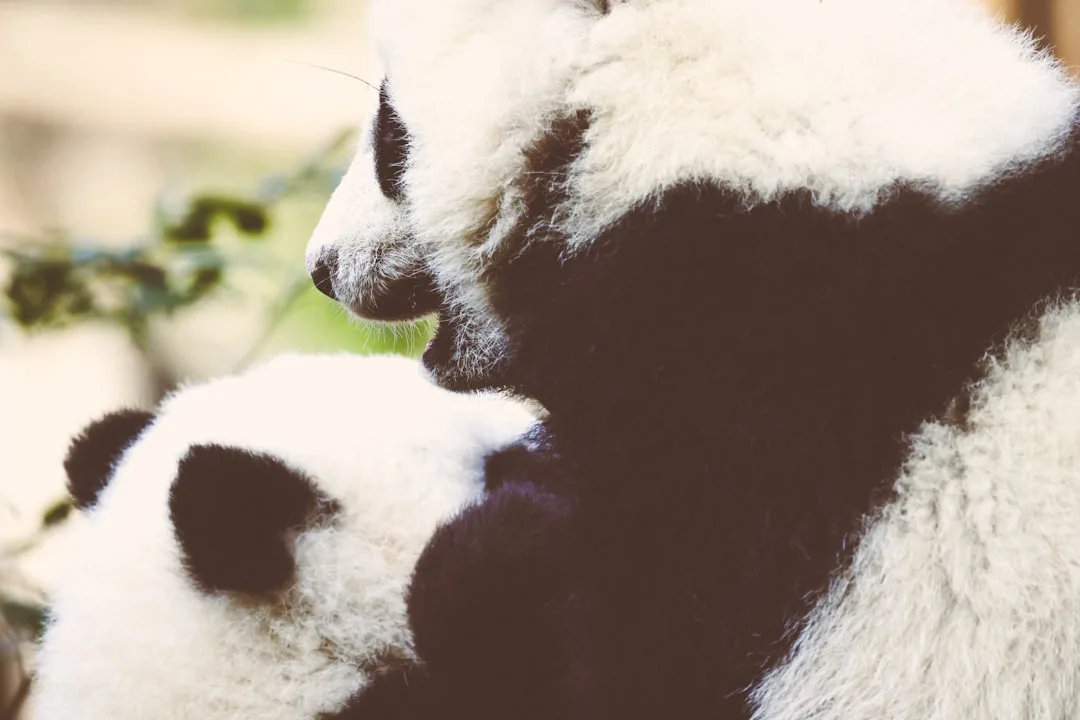
Are giant pandas actually bears?
Yes. Giant pandas (Ailuropoda melanoleuca) are true bears, members of the family Ursidae. The question was genuinely debated from 1869 until the mid-1980s because the giant panda's vegetarian diet, flat-faced skull, unusual vocalisations, and pseudo-thumb made it look like an outlier among ursids. The debate was settled by molecular biology.
A landmark 1985 study in Nature by Stephen O'Brien and colleagues, combining serum protein comparisons, mitochondrial DNA, and karyotype analysis, placed the giant panda firmly inside Ursidae. The red panda, despite the shared common name, is in an entirely different family (Ailuridae) and is not a bear.
A Question That Took 116 Years to Answer
Few animals have confused taxonomists as stubbornly as the giant panda. When the French missionary and naturalist Père Armand David first sent a giant panda pelt to Paris in 1869, nobody knew where to put it.
The animal had bear-shaped feet, a bear-sized body, and bear-like claws, yet its skull was short and deep, its diet was bamboo, and its wrist bone had been warped into a strange opposable pad. For more than a century biologists argued about whether the giant panda was a bear, a raccoon, or something of its own.
The debate produced thousands of journal pages, competing monographs, and no consensus. It was finally resolved in a handful of DNA-based studies published between 1985 and 1989. The answer, now accepted by every major taxonomic authority from the IUCN to the American Society of Mammalogists, is that the giant panda is a bear, sitting at the very base of the living bear family tree and diverging from all other bears roughly 19 to 22 million years ago in the late Oligocene or early Miocene.
For a full biological profile of the species itself, the entry on the giant panda covers size, diet, reproduction, and conservation. This article focuses on the narrower and historically contentious question of where the giant panda sits on the mammalian family tree, and how molecular genetics closed a century-long argument.
Why the Debate Started: 1869 and Père David
Before 1869, no western naturalist had ever seen a giant panda, alive or dead. The animal was known only in China and even there largely as folklore. Père Armand David, a French Lazarist missionary stationed in Sichuan, was the first outsider to document the species for western science. On 11 March 1869 he was shown a black-and-white pelt at the home of a local landowner in Muping (modern Baoxing County), and he bought specimens through local hunters over the following months.
David sent material back to the Muséum National d'Histoire Naturelle in Paris, where the director Alphonse Milne-Edwards received it. David himself initially described the animal under the provisional genus Ursus melanoleucus, treating it explicitly as a bear. Milne-Edwards disagreed.
After dissecting the skeletons and comparing dentition with known bears, raccoons, and the already-described red panda, Milne-Edwards concluded in 1870 that the new animal was not a bear. He erected a new genus, Ailuropoda ("cat-foot"), and wrote that the anatomy aligned more closely with the lesser pandas and the procyonids (raccoons and their kin) than with Ursidae.
That 1870 call by Milne-Edwards set the tone for the next 115 years. If the greatest mammalogist in France, working from actual specimens, could not decide whether the giant panda was a bear or a raccoon, nobody downstream of him had much hope of doing better without new evidence.
The Long Argument: 1870 to 1985
Between Milne-Edwards and molecular genetics sat more than a century of opinion-based taxonomy. The argument did not break cleanly into two camps. Different researchers proposed at least four distinct placements for the giant panda:
- Ursidae (the bears): the panda is a bear, full stop.
- Procyonidae (the raccoons and allies): the panda is an oversized relative of the red panda and raccoons.
- Ailuropodidae (its own family): the panda is neither bear nor raccoon, and deserves a family of its own.
- Ailuridae (the red panda family): the two pandas are closely related and share a family.
Almost every possible combination of these positions was defended in print at some point. Below is a sample of the major placements across the decades.
Historical classification attempts
| Year | Author | Proposed placement | Main line of evidence |
|---|---|---|---|
| 1869 | Armand David | Ursus melanoleucus (Ursidae) | External morphology, skeleton |
| 1870 | Alphonse Milne-Edwards | Ailuropoda, near Procyonidae | Comparative anatomy, dentition |
| 1885 | Henri Filhol | Procyonidae with red panda | Molar cusp pattern |
| 1901 | E. Ray Lankester | Ursidae | Skull and post-cranial morphology |
| 1915 | Richard Lydekker | Ailuropodidae, own family | Dentition divergence from bears |
| 1936 | Reginald Pocock | Ursidae | External and reproductive anatomy |
| 1964 | Dwight Davis | Ursidae | 500-page anatomical monograph |
| 1971 | Vincent Sarich | Ursidae | Immunological distance |
| 1985 | Stephen O'Brien et al. | Ursidae | Serum proteins, mtDNA, karyotype |
Two points stand out. First, the idea that the giant panda is a bear is not new. Lankester had argued it in 1901, Pocock in 1936, and the American anatomist Dwight Davis mounted a book-length defence of it in 1964 based on a granular dissection of muscle, viscera, and skeleton. Second, the Ursidae position kept losing traction every time a textbook writer decided that the panda's odd features (short face, bamboo diet, pseudo-thumb) were "too weird" for a bear.
By the 1970s the field was effectively split. Field guides routinely listed the giant panda either in Procyonidae alongside the red panda, or in its own family Ailuropodidae. A handful of authors stuck with Ursidae, but without a decisive line of evidence the argument was irresoluble. The problem was that all of this was morphology against morphology: teeth versus guts versus ear bones versus chromosomes, with no independent yardstick.
The Molecular Revolution: O'Brien, Goldman, Wozencraft
The yardstick arrived with molecular biology. In the early 1980s the geneticist Stephen J. O'Brien at the United States National Cancer Institute (and later Nova Southeastern University) was applying immunological distance, mitochondrial DNA restriction maps, and chromosome banding to several carnivoran puzzles. He turned to the panda problem and, with colleagues, published the decisive paper in Nature in 1985.
"The combined weight of the molecular and cytological data allow us to conclude that the giant panda belongs with the bears in the family Ursidae, and that the red panda is more closely allied with the procyonids. The two species called 'panda' are not, in fact, each other's closest relatives." - Stephen J. O'Brien, National Cancer Institute, 1985
The O'Brien et al. 1985 paper, with DOI 10.1038/317140a0, used three independent lines of molecular evidence:
- Serum albumin and transferrin immunological distance calibrated against a carnivoran clock
- Mitochondrial DNA restriction fragment length polymorphisms (RFLPs)
- G-banded karyotypes compared across bears, procyonids, and the two pandas
All three told the same story. The giant panda clustered with the bears, diverging early but clearly inside Ursidae. The red panda clustered with the procyonids and mustelids, far from Ursidae. The two "pandas" shared a common name and an ecology but not a recent ancestor.
The result was almost immediately confirmed. Goldman, Giri and O'Brien (1989) reanalysed the same questions with denser protein electrophoresis data and a wider carnivoran sample, and again recovered the giant panda inside Ursidae. In the same year W. Christopher Wozencraft, the mammalogist who would go on to edit the carnivore chapter of Mammal Species of the World, published an independent cladistic analysis that also placed the giant panda in Ursidae as the sister lineage to all other living bears.
Within five years of the 1985 paper, the major taxonomic authorities had converged. The IUCN, the American Society of Mammalogists, and the standard reference Mammal Species of the World all list the giant panda in Ursidae. No peer-reviewed paper since the mid-1990s has seriously argued otherwise.
The Ursidae Phylogeny: Where the Giant Panda Fits
Modern molecular phylogenies resolve the relationships among the eight living bear species with high confidence. The giant panda is the deepest branch: it diverged from the common ancestor of all other living bears in the late Oligocene or early Miocene, somewhere around 19 to 22 million years ago.
After that node comes the spectacled bear (Tremarctos ornatus) of South America, and after that a cluster of the six bears in the subfamily Ursinae (brown, polar, American black, Asiatic black, sloth, and sun).
Living Ursidae phylogeny and divergence
| Species | Common name | Subfamily | Divergence from sister | Range |
|---|---|---|---|---|
| Ailuropoda melanoleuca | Giant panda | Ailuropodinae | ~19-22 Mya from all other bears | Central China |
| Tremarctos ornatus | Spectacled bear | Tremarctinae | ~12-14 Mya from Ursinae | Andes |
| Ursus maritimus | Polar bear | Ursinae | ~0.5-1 Mya from brown bear | Arctic |
| Ursus arctos | Brown bear | Ursinae | ~0.5-1 Mya from polar bear | Holarctic |
| Ursus americanus | American black bear | Ursinae | ~4-5 Mya | North America |
| Ursus thibetanus | Asiatic black bear | Ursinae | ~4-5 Mya | Asia |
| Melursus ursinus | Sloth bear | Ursinae | ~5-6 Mya | South Asia |
| Helarctos malayanus | Sun bear | Ursinae | ~5-6 Mya | Southeast Asia |
The table makes the basic shape of bear evolution clear. The giant panda is not a recent, derived oddity. It is the earliest-diverging branch, a survivor of a lineage that split from the rest of Ursidae when the Miocene climate was still reshaping Asian forests. The spectacled bear of South America is the second-deepest branch. The six familiar Ursinae bears are a relatively recent radiation, with some lineages (polar versus brown) only parting ways within the last million years.
"Giant pandas are not halfway between bears and raccoons. They are bears. They just happen to be bears that branched off very early and then, over the next twenty million years, walked down a very peculiar ecological road." - Wolfgang Stephan, evolutionary geneticist
Why the Debate Dragged On: Features That Obscured the Call
If the giant panda is so clearly a bear, why did the question survive 116 years of argument? Because the panda carries a set of features that no other living bear has, and those features kept misleading morphologists.
1. A nearly pure vegetarian diet
Bears as a group are omnivores. Polar bears lean toward hypercarnivory, sun bears and sloth bears toward insectivory, but bamboo specialisation is an outlier. The giant panda eats roughly 99% bamboo, a fact covered in depth in our companion articles on why pandas eat bamboo and how pandas survive on bamboo. Nineteenth-century taxonomists reasonably wondered whether a "bear" that never ate meat really belonged with bears at all.
The modern answer is that the digestive tract tells the truer story: the panda's gut is still that of a carnivore, with a simple stomach, short intestine, and no caecum. Evolutionarily, a giant panda is a bear that turned to bamboo; it is not a herbivore that coincidentally looks ursine.
2. Vocalisations unlike other bears
Bears are famously quiet animals that mostly produce woofs, grunts, and roars. Giant pandas instead produce bleats, honks, chirps, and moans that sound more like a sheep or a small mammal than a bear. Early naturalists treated this as strong evidence against bear affinity.
In fact, the vocal repertoire is an autapomorphy (a unique derived trait). Giant pandas evolved a social signalling system adapted for short visual distances in dense bamboo. It has no bearing on family membership, in the same way that a vocally unusual primate is still a primate.
3. The pseudo-thumb
The giant panda's radial sesamoid bone has been enlarged and rotated into a functional sixth digit, used to grip bamboo stems. It is the most famous anatomical curiosity in the species, and for decades it was treated as a showcase example of how different the panda was from "ordinary" bears.
The embarrassing follow-up is that the red panda has an independently evolved pseudo-thumb of its own, built from the same bone. Two unrelated bamboo specialists converged on the same solution. Far from proving the two pandas are close relatives, the shared pseudo-thumb is now the textbook example of convergent evolution in Carnivora.
4. Skull shape
The giant panda's skull is short, deep, and heavily buttressed for crushing bamboo. It looks little like the long-snouted skull of a brown bear. In the nineteenth century this drove many authors toward a "not a bear" conclusion. Dwight Davis's 1964 monograph showed, point by point, that every skull feature could be derived from a generic ursine template by reshaping it for a high-fibre, high-bite-force diet. The shape is a feeding adaptation, not a signal of deep ancestry.
Red Pandas: The Other Panda, and Not a Bear
Part of the confusion comes from the common name itself. The word panda was originally applied to the red panda (Ailurus fulgens), a small cat-sized Himalayan mammal first described scientifically in 1825 by Frédéric Cuvier. When the giant panda was described in 1869, it inherited the name largely because of the two shared traits that struck early observers: a bamboo diet and an enlarged radial sesamoid.
Red pandas are not bears. They are not even in Ursoidea. Molecular phylogenies place them in Ailuridae, their own family, which is the sole surviving lineage of a once more diverse musteloid group. Ailuridae is the sister family to the clade containing skunks, weasels, and raccoons (Mephitidae + Mustelidae + Procyonidae). The red panda's closest living relatives are weasels, raccoons, and skunks, not bears or giant pandas.
"We have two very different animals here that look superficially alike because they both spent millions of years figuring out how to live on bamboo. The giant panda is a bear that stopped eating meat. The red panda is a small musteloid that moved up-slope into the Himalayas. They met each other on the bamboo." - Colin Groves, taxonomist, Australian National University
For the full comparison see the dedicated entry on giant panda vs red panda and the stand-alone profile of the red panda.
How to Tell the Difference at a Glance
The confusion persists in children's books, gift shops, and casual journalism. A short field comparison clears it up.
- Size: giant panda adults weigh 70-125 kg; red pandas weigh 3-6 kg.
- Colour: giant panda is black and white; red panda is rusty red and cream.
- Tail: short stub on giant panda; long, ringed, bushy tail on red panda.
- Habit: giant panda is almost entirely terrestrial; red panda is arboreal.
- Range: giant panda is confined to central China; red panda ranges from Nepal to Yunnan.
- Family: giant panda is Ursidae; red panda is Ailuridae.
They share a forest, a food, and a nickname. That is where the similarity ends.
What the WWF and Mainstream Science Say Today
Every major zoological and conservation authority agrees the giant panda is a bear.
"The giant panda (Ailuropoda melanoleuca) is a bear, native to south central China. It has been the symbol of WWF since the organisation's founding in 1961, and is the rarest species of bear in the world." - WWF, species profile
The IUCN Red List classifies Ailuropoda melanoleuca in family Ursidae and currently lists it as Vulnerable (downlisted from Endangered in 2016). Mammal Species of the World, edited by Wilson and Reeder, places the giant panda in Ursidae with the red panda in Ailuridae. The American Society of Mammalogists Mammal Diversity Database, the Catalogue of Life, and the ITIS all follow suit. The question is no longer controversial.
"Whether or not the giant panda belongs in Ursidae has not been a serious question in mammalogy since the late 1980s. The molecular evidence is unambiguous, the morphology has been reinterpreted in the light of it, and the species is at the base of the bear tree." - Editorial, Nature
Where the Giant Panda Sits Among the Eight Living Bears
There are eight living bear species in total. Naming them is a reasonable sanity check on whether you believe the giant panda is a bear.
- Brown bear (Ursus arctos), covered in depth at brown bear and by subspecies at brown bear subspecies explained.
- Polar bear (Ursus maritimus), covered at polar bear.
- American black bear (Ursus americanus).
- Asiatic black bear (Ursus thibetanus).
- Sloth bear (Melursus ursinus).
- Sun bear (Helarctos malayanus).
- Spectacled bear (Tremarctos ornatus).
- Giant panda (Ailuropoda melanoleuca).
The eighth slot on that list is not a rhetorical courtesy. It reflects a half-century of accumulated molecular, anatomical, and palaeontological evidence. Skip the panda and you have only seven bears. Include it, and the tree is complete. For a direct behavioural comparison between the species and its better-known relatives, see giant panda vs black bear and what pandas do all day. For the detailed biology of Ailuropoda melanoleuca itself, the main giant panda entry has the full infobox.
Pandas Are Bears, Just the Quietest Kind
The giant panda is a bear. The debate lasted from 1869 to the mid-1980s because the species is a bamboo specialist wrapped in the body of a carnivore, with a flat face, a strange vocal repertoire, and a famous extra thumb. Those traits genuinely misled morphologists working without a molecular clock. Once DNA, protein, and chromosome data became available, the question resolved cleanly in one direction: Ursidae, sister to all other living bears, diverging roughly 20 million years ago.
The red panda, despite the shared name and shared bamboo habit, is not a bear and never was. It is a small musteloid in its own family, whose resemblance to the giant panda is convergence rather than common descent.
The next time someone claims the giant panda is "not really a bear" or "actually a raccoon", they are quoting taxonomy that has been obsolete since Reagan's second term. Pandas are bears. The argument is over.
Further Reading on Strange Animals
- The full species entry at giant panda
- Side-by-side comparison at giant panda vs red panda
- Diet focus at why do pandas eat bamboo and how do pandas survive on bamboo
- Behavioural and size comparisons at giant panda vs black bear and what do pandas do all day
- Related ursid entries at brown bear, brown bear subspecies explained, and polar bear
- The not-a-bear counterpart at red panda
For readers interested in reasoning, language, and research skills that transfer well beyond biology, the editors also maintain whats-your-iq.com, the music and practice site whennotesfly.com, and the writing platform evolang.info.
References
- O'Brien, S. J., Nash, W. G., Wildt, D. E., Bush, M. E., & Benveniste, R. E. (1985). A molecular solution to the riddle of the giant panda's phylogeny. Nature, 317(6033), 140-144. https://doi.org/10.1038/317140a0
- Goldman, D., Giri, P. R., & O'Brien, S. J. (1989). Molecular genetic-distance estimates among the Ursidae as indicated by one- and two-dimensional protein electrophoresis. Evolution, 43(2), 282-295. https://doi.org/10.1111/j.1558-5646.1989.tb04227.x
- Wozencraft, W. C. (1989). The phylogeny of the Recent Carnivora. In J. L. Gittleman (Ed.), Carnivore Behavior, Ecology, and Evolution (pp. 495-535). Cornell University Press. https://doi.org/10.1007/978-1-4613-0855-3_19
- Krause, J., Unger, T., Noçon, A., Malaspinas, A. S., Kolokotronis, S. O., Stiller, M., et al. (2008). Mitochondrial genomes reveal an explosive radiation of extinct and extant bears near the Miocene-Pliocene boundary. BMC Evolutionary Biology, 8, 220. https://doi.org/10.1186/1471-2148-8-220
- Kumar, V., Lammers, F., Bidon, T., Pfenninger, M., Kolter, L., Nilsson, M. A., & Janke, A. (2017). The evolutionary history of bears is characterized by gene flow across species. Scientific Reports, 7, 46487. https://doi.org/10.1038/srep46487
- Li, R., Fan, W., Tian, G., Zhu, H., He, L., Cai, J., et al. (2010). The sequence and de novo assembly of the giant panda genome. Nature, 463(7279), 311-317. https://doi.org/10.1038/nature08696
- Hu, Y., Thapa, A., Fan, H., Ma, T., Wu, Q., Ma, S., et al. (2020). Genomic evidence for two phylogenetic species and long-term population bottlenecks in red pandas. Science Advances, 6(9), eaax5751. https://doi.org/10.1126/sciadv.aax5751
- Salesa, M. J., Antón, M., Peigné, S., & Morales, J. (2006). Evidence of a false thumb in a fossil carnivore clarifies the evolution of pandas. Proceedings of the National Academy of Sciences, 103(2), 379-382. https://doi.org/10.1073/pnas.0504899102
Frequently Asked Questions
Are giant pandas actually bears?
Yes. Giant pandas (Ailuropoda melanoleuca) are true bears, members of the family Ursidae. The question was genuinely debated in science from 1869 until the mid-1980s because the panda’s vegetarian diet, flat-faced skull, unusual vocalisations, and famous pseudo-thumb made it look like an outlier among bears.
The debate was settled by a landmark 1985 study in Nature by Stephen O’Brien and colleagues that combined serum protein, mitochondrial DNA, and karyotype evidence. Later work by Goldman, Giri and O’Brien (1989) and by Wozencraft (1989) confirmed the result. Giant pandas are the earliest branching lineage within the living bear family, but they are unambiguously inside Ursidae.
Are pandas related to raccoons?
Giant pandas are not closely related to raccoons. Some nineteenth-century naturalists did place the giant panda in Procyonidae, the raccoon family, largely because of superficial similarities to the red panda and to lesser pandas in jaw and tooth anatomy. Modern genetics rejected this placement. Raccoons belong to Procyonidae, a New World family in the Musteloidea branch of Carnivora.
Giant pandas belong to Ursidae, which split from the musteloid lineage more than 40 million years ago. The confusion is partly historical: the word panda was first applied to the red panda, and when the giant panda was discovered in 1869 it inherited the name and, for a while, the assumed family.
Is a red panda a bear?
No. The red panda (Ailurus fulgens) is not a bear. It is not even closely related to the giant panda despite sharing the panda common name, a bamboo-heavy diet, and an independently evolved pseudo-thumb. Red pandas sit in their own family, Ailuridae, which is the sole surviving branch of a once more diverse group.
On modern molecular trees Ailuridae is the sister family to the Mephitidae-Mustelidae-Procyonidae cluster, placing red pandas firmly within Musteloidea rather than Ursoidea. Giant pandas and red pandas are an example of convergent evolution, with two unrelated carnivores independently developing similar adaptations for eating bamboo.