
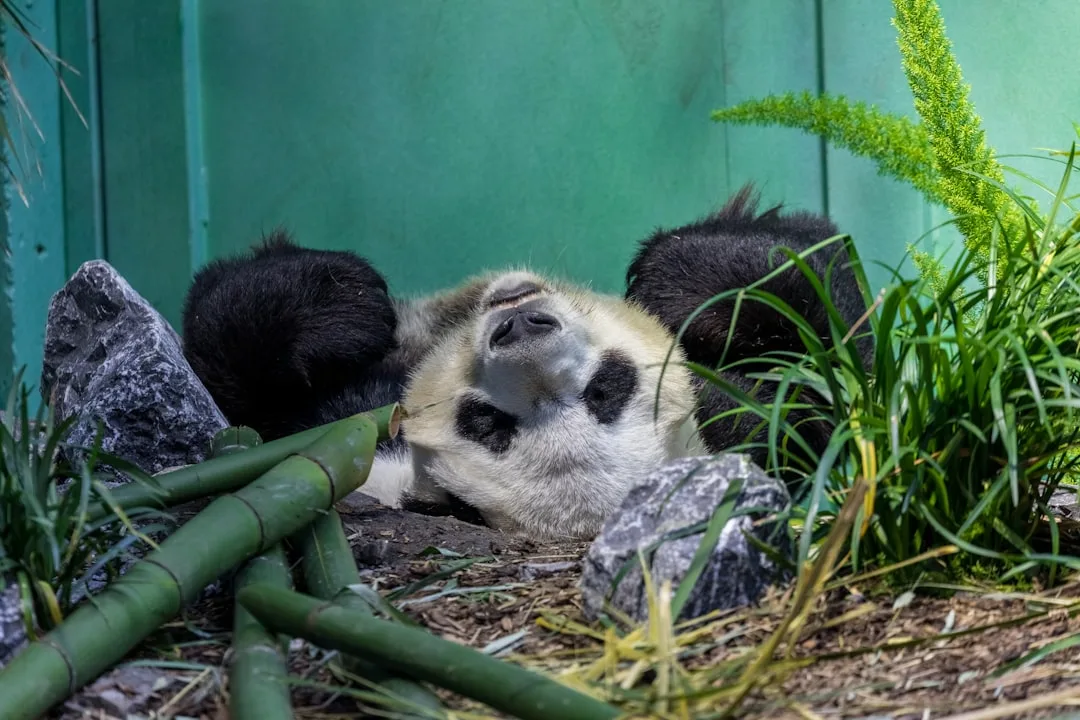
The giant panda is the most recognisable bear on the planet and arguably the most recognisable mammal of any kind. Black ears, black eye patches, black legs, and a cream-white body have been fixed in the public imagination since the species first reached western zoos in the 1930s.
Yet behind the soft toy image, Ailuropoda melanoleuca is a biological oddity: a member of the order Carnivora that has abandoned meat almost entirely, a bear that does not hibernate, a forest specialist confined to a handful of Chinese mountain ranges, and one of the few large mammals whose conservation status has genuinely improved in the 21st century.
This guide covers every aspect of giant panda biology and ecology: size, anatomy, the famous pseudo thumb, bamboo specialisation, reproduction, lifespan, conservation history, and the cultural and political role pandas play as the face of WWF and the subject of China's panda diplomacy programme. It is a reference entry, not a summary - so expect specifics: kilograms, kilometres, hours, and verified population figures.
Etymology and Classification
The scientific name Ailuropoda melanoleuca translates literally as 'cat-foot, black and white'. The genus name Ailuropoda was coined by French zoologist Henri Milne-Edwards in 1870, built on the earlier name Ailuropus ('cat-like') from 1869. The species name melanoleuca - from Greek melas (black) and leukos (white) - simply describes the pelage. In Chinese the animal is usually called da xiongmao, literally 'big bear-cat'.
For more than a century the panda's family affiliation was a genuine scientific controversy. Nineteenth-century naturalists variously placed the giant panda with bears (Ursidae), with raccoons (Procyonidae), or in its own family Ailuropodidae. The matter was finally settled in the 1980s and 1990s by molecular evidence: giant pandas are bears.
They sit at the base of the bear family tree, branching off before the common ancestor of all other living ursids roughly 18-25 million years ago. The similarly named red panda (Ailurus fulgens), despite the shared 'panda' common name and some shared adaptations to bamboo, is not closely related; it belongs to its own family, Ailuridae, in the weasel-raccoon branch of the carnivore tree.
Only one living species of giant panda is recognised, with two subspecies sometimes proposed: the nominate A. m. melanoleuca of Sichuan and the smaller, more reddish-brown A. m. qinlingensis of the Qinling Mountains, described in 2005.
Size and Physical Description
Giant pandas are medium-sized bears. They are substantially smaller than brown bears or polar bears but larger than sun bears or spectacled bears. Sexual dimorphism is modest by ursid standards.
Adult males:
- Length: 1.5-1.9 metres from nose to tail
- Shoulder height: 70-90 cm on all fours
- Weight: 85-125 kg, with captive individuals sometimes heavier
Adult females:
- Length: 1.2-1.7 metres
- Weight: 70-100 kg
- Generally 10-20% lighter than males of similar age
Cubs at birth:
- Length: roughly 15-17 cm
- Weight: 85-140 grams, averaging about 100 g
- Ratio of cub to mother: approximately 1/900, the most extreme of any placental mammal
The famous black-and-white coat serves two functions that biologists only partly understand. Recent camouflage studies suggest the pattern works well in broken forest light mixed with patches of snow: the white body blends with snow cover in winter, while the black limbs merge with shadow under bamboo canopies.
The bold face markings likely serve as a signal to other pandas, since individuals recognise one another partly by facial pattern variation. Subspecies A. m. qinlingensis shows brown-and-white colouration rather than black-and-white, a phenotype that appears to be fixed by an isolated gene pool in the Qinling range.
The head is round and disproportionately large, with powerful jaw muscles anchored to an enlarged sagittal crest. Molars are broad and flat, adapted for crushing rather than cutting. The skull is shorter and deeper than in any other bear, closer in proportion to that of a big cat - one reason nineteenth-century taxonomists debated the species' affinities.
The Pseudo Thumb
The most famous anatomical feature of the giant panda is its so-called pseudo thumb. Unlike a human thumb, this is not a true digit. It is a greatly enlarged wrist bone - the radial sesamoid - that has evolved into a mobile, opposable pad sitting opposite the five normal digits of the forepaw. The second hand bone, the ulnar sesamoid, is also enlarged on the opposite side, creating a functional gripping structure with a 'thumb' on either side of the palm.
The pseudo thumb allows pandas to hold bamboo stems securely while they strip leaves, shear shoots with their teeth, or manipulate fibrous sections into their mouths. Fossil evidence shows the structure has existed in some form for at least six million years - a panda ancestor called Ailurarctos from the late Miocene of China already had an enlarged radial sesamoid, suggesting bamboo feeding is an ancient specialisation.
Evolutionary biologist Stephen Jay Gould used the pseudo thumb as the subject of his 1980 essay 'The Panda's Thumb', arguing that its awkward, improvised design illustrates how natural selection works with whatever material is available rather than engineering optimal solutions from scratch. The essay remains a popular science classic and has helped make the panda's hand a minor cultural icon.
Bamboo Specialisation and Diet
The giant panda eats bamboo. Approximately 99% of its diet by mass is bamboo, drawn from more than 25 different species depending on region, altitude, and season. This is one of the most extreme cases of dietary specialisation in the order Carnivora. The remaining ~1% includes small mammals (pikas, bamboo rats), bird eggs, insects, fish, and carrion when available, but these foods make no meaningful contribution to daily nutrition.
The biological puzzle is that the panda's gut is still that of a carnivore. The stomach is simple rather than chambered, the intestine is relatively short, and there is no caecum or rumen to host the cellulose-digesting microbes that herbivores rely on. Gut microbiome studies show that pandas host some fibre-degrading bacteria, but at much lower diversity than true herbivores.
The net effect is that pandas extract only about 17% of the nutrients in the bamboo they eat, compared to 60-80% in a deer or cow eating grass.
Daily feeding budget:
| Metric | Value |
|---|---|
| Daily bamboo intake | 26-40 kg |
| Daily feeding time | 10-14 hours |
| Daily defecation events | 40+ |
| Assimilation efficiency | ~17% of dry matter |
| Preferred bamboo parts | Shoots (spring), leaves (summer-autumn), stems (winter) |
The compensatory strategy is simple: volume and time. A panda eats almost constantly during waking hours, passes food through the gut in under 12 hours, and excretes huge volumes of recognisable, fibrous droppings - often greenish-red in colour because the outer skin of bamboo shoots retains its pigment.
Pandas also move little and maintain a low basal metabolic rate, roughly half that expected for a placental mammal of their body size. Thyroid function is reduced compared to other bears, an adaptation documented by Chinese researchers in 2015.
Because different bamboo species flower and die en masse at long intervals - sometimes 40 to 120 years apart - historical bamboo die-offs have caused local panda starvation events. This vulnerability is one of the reasons habitat fragmentation is so serious for the species: when a patch of one bamboo species dies, pandas need to be able to reach another patch of a different species.
Habitat and Range
Wild giant pandas live exclusively in the mountain forests of central China. Their historical range extended across much of southern and eastern China and into northern Vietnam and Myanmar, but human expansion and deforestation progressively pushed them back. By the late 20th century the species was confined to six isolated mountain systems spread across three provinces.
Current wild range:
- Minshan Mountains (Sichuan and Gansu) - largest population
- Qinling Mountains (Shaanxi) - home of the brown-variant subspecies
- Qionglai Mountains (Sichuan)
- Liangshan Mountains (Sichuan)
- Daxiangling Mountains (Sichuan)
- Xiaoxiangling Mountains (Sichuan)
Pandas prefer elevations of 1,200 to 3,400 metres, where temperate bamboo forms a dense understorey beneath conifer or mixed broadleaf canopy. Winter temperatures in this zone routinely fall below freezing, and summers are cool and humid. Pandas do not hibernate; they move down-slope in winter and up-slope in summer to follow bamboo growth stages and avoid temperature extremes.
They are generally solitary and maintain loose home ranges of 4-10 square kilometres, with male ranges overlapping those of several females.
Scent marking is central to panda social life. Individuals rub glands near the base of the tail on tree trunks and rocks, leaving chemical signatures that carry information about identity, sex, and reproductive status. Vocalisations are rare but distinctive: adults use a honking bleat, a bark, a chirp, and a low moan, while cubs emit high-pitched squeals often picked up on captive breeding microphones.
Reproduction and the 24-Hour Window
Giant panda reproduction is a minefield of biological bottlenecks, which is a large part of why the species became a conservation emergency and why captive breeding was so slow to succeed.
Females reach sexual maturity at 4-6 years. They come into oestrus once a year, usually between March and May. The fertile window lasts just 24 to 72 hours. Outside that window pregnancy is biologically impossible. In the wild, males are drawn to females by scent and vocal cues, and several males may gather around a receptive female, competing through display and occasional fighting. The winning male mates briefly - copulations typically last 30 seconds to 5 minutes.
After mating, implantation of the fertilised egg is delayed for weeks or months. This is why reported gestation length in pandas ranges so widely: 95 to 160 days from mating to birth, depending largely on when implantation actually occurs. Active gestation, from implantation to birth, is closer to 45-60 days.
Births usually occur in late summer or autumn in a sheltered den, often inside a hollow tree or cave. Litter size is one or two cubs. When twins are born, wild mothers almost always raise only one; the other is typically abandoned within days, apparently because the mother cannot produce enough milk for two. Captive breeders exploit this pattern by rotating twins between the mother and a human-run incubator every few days, so the mother experiences a single cub at any given time.
Development timeline:
- Birth: 85-140 g, blind, nearly hairless, pink with sparse fur
- 1 week: skin begins to darken where adult black will appear
- 3 weeks: eyes begin to open
- 3-4 months: first solid food (softened bamboo)
- 6 months: weaned but still with mother
- 18-24 months: leaves mother, becomes independent
- 4-6 years: sexual maturity
Cub mortality is high. In the wild, only about 40% of cubs survive to independence. In captivity mortality was historically catastrophic - nearly all captive-born cubs died until Chinese researchers cracked the twin-rotation technique in the early 2000s. Today the Chengdu Research Base of Giant Panda Breeding and the Wolong National Nature Reserve routinely raise dozens of cubs per year, and the global captive population has climbed past 600 individuals.
The panda-cam phenomenon is a direct consequence of this fragile early life. Chinese breeding centres and some foreign zoos operate 24-hour livestreams of maternity dens and cub cribs, partly for public engagement, partly as a low-cost monitoring tool. When a famous cub is born - Bao Bao, Bei Bei, Tian Bao, Yuan Meng - the feeds can collectively draw millions of viewers in the first week.
Lifespan and Life History
Wild giant pandas typically live around 20 years. Captive individuals regularly exceed 30, thanks to consistent food supply, freedom from predation and injury, and modern veterinary care. The oldest documented captive panda, Basi, lived to 37 years; several others at Chinese breeding centres have passed 35. The oldest giant panda ever held in a non-Chinese zoo, Jia Jia of Hong Kong Ocean Park, died in 2016 at the age of 38.
Key life history markers:
- First reproduction: age 4-6 (females), 5-7 (males)
- Peak reproductive years: age 8-18
- Inter-birth interval in wild: 2-3 years
- Senescence in captivity: 25+
- Maximum documented lifespan: 38 years (captive)
Pandas are mostly solitary outside the brief mating season, but they are not hostile. Individual home ranges overlap extensively, and scent-marked trees function as neighbourhood bulletin boards where bears read and post information without direct contact.
Conservation History and Status
The giant panda is a conservation case study - both in how a species can be pulled back from the edge, and in how much sustained state investment is required to do it. Timeline highlights:
- 1869: first scientifically described (by Pere Armand David from Sichuan specimens)
- 1930s-1940s: live specimens reach western zoos; trophy hunting peaks
- 1963: first Chinese reserve for giant pandas established (Wolong)
- 1981: China signs CITES; international commercial trade banned
- 1988: China's Wild Animal Protection Law gives pandas top-tier protection
- 1990: IUCN Red List status listed as Endangered
- 1998: nationwide logging ban in the Yangtze watershed protects panda habitat
- 2004: national census estimates 1,596 wild pandas
- 2014: national census estimates 1,864 wild pandas (+17%)
- 2016: IUCN downlists giant panda from Endangered to Vulnerable
- 2021: China announces the Giant Panda National Park, merging 67+ reserves
Primary historical threats were habitat loss from logging and agriculture, along with incidental poaching (pandas were occasionally trapped in snares set for other species). Current threats have shifted: active poaching is now rare, and habitat conversion has slowed dramatically inside reserves.
The remaining pressures are habitat fragmentation, bamboo die-off cycles amplified by climate change, small-population genetic risks, and growing infrastructure - roads, tourism routes, and hydroelectric projects - inside or adjacent to panda range.
Conservation tools in use:
- The Giant Panda National Park: roughly 27,000 km^2, unified in 2021
- Corridor reforestation between isolated mountain sub-ranges
- Captive breeding and reintroduction (still experimental; several reintroduced individuals have died)
- Anti-poaching patrols and snare removal
- International loans that fund in-country conservation (see Panda Diplomacy below)
It is important not to overstate the recovery. Downlisting to Vulnerable does not mean the species is safe. The wild population is still small, still fragmented, and still dependent on active management. Chinese authorities officially retain a domestic classification of Endangered.
Panda Diplomacy
Since the 1950s the Chinese government has used giant pandas as diplomatic gifts and, later, as long-term loans to foreign zoos. The practice is widely known by the English nickname panda diplomacy.
The programme has moved through two phases. Between 1957 and 1982 China gave pandas outright as political gifts to allied governments - including the Soviet Union, North Korea, the United States (after Nixon's 1972 visit), Japan, and several European states. In 1984 China shifted from gifts to 10-year loans, keeping legal ownership of the animals and any cubs produced abroad.
Modern loan agreements typically carry an annual fee of around one million US dollars per panda, earmarked for conservation work inside China, along with strict husbandry conditions, cub-return clauses, and periodic diplomatic renewals.
Panda loans have tracked the state of China's international relationships. Loans have been granted to reward friendly trade partnerships, signal political thaws, or mark major state visits. Conversely, failed loan negotiations or early returns have sometimes accompanied diplomatic strain.
As of the mid-2020s, pandas on loan reside at zoos across Europe, North America, and Asia - including the Edinburgh, Berlin, Washington DC, Memphis, Atlanta, and Tokyo zoos, among others - though the specific roster shifts as contracts expire and are renegotiated.
Cultural Role and the WWF Logo
The giant panda is one of the most widely recognised animal symbols in human history. Its modern prominence owes much to a single decision in 1961, when conservationist and artist Sir Peter Scott adopted the giant panda as the logo of the new World Wildlife Fund. Scott had seen Chi-Chi, a giant panda kept at London Zoo at the time, and was struck by how graphically reproducible the animal's markings were - an essential consideration in an era when most printing was still black-and-white.
The WWF logo has been updated several times, most notably by designer Landor Associates, but the basic shape has not changed. The logo now appears on publications, merchandise, and campaigns in more than 100 countries and is estimated to be among the most recognised brand marks globally.
Within China, the giant panda functions as a quasi-official national animal and appears on coins, stamps, and state diplomatic imagery. The 2008 Beijing Olympics mascots included Jingjing, a stylised giant panda.
Popular culture references are too numerous to list exhaustively, but include the Kung Fu Panda film franchise, countless plush toys, the mascot of several major Chinese universities, and a long line of captive celebrity pandas whose births and deaths are covered as soft news in dozens of countries. This cultural prominence has been both a blessing and a distortion for conservation.
The panda's profile helps fund work that benefits thousands of less famous species sharing its habitat, but it can also concentrate conservation funding on a single charismatic animal at the expense of broader biodiversity priorities.
Related Reading
- Bears of the World: Power, Intelligence, and Survival
- How Bears Hibernate
- Polar Bear
- Spectacled Bear
- Sun Bear
References
Relevant peer-reviewed and governmental sources consulted for this entry include the IUCN Red List assessment for Ailuropoda melanoleuca (2016 reassessment), the Fourth National Giant Panda Survey (China State Forestry Administration, 2015), the Chengdu Research Base of Giant Panda Breeding annual reports, and published research in Science, Proceedings of the National Academy of Sciences, Conservation Biology, and Current Biology.
Population figures reflect the 2014 national census, the most recent complete wild survey at the time of writing. Historical material on panda diplomacy draws on archival coverage in Xinhua, the New York Times, and academic work on Sino-foreign wildlife diplomacy.
Frequently Asked Questions
How big is a giant panda?
Adult giant pandas (Ailuropoda melanoleuca) measure 1.2-1.9 metres from nose to tail and weigh 70-125 kg. Males average 10-20% heavier than females but the two sexes overlap in size, unlike the extreme sexual dimorphism seen in polar bears or brown bears. Shoulder height on all fours is 60-90 cm. Cubs weigh only about 100 grams at birth - smaller than a stick of butter - and take nearly a month to open their eyes.
By one year of age a cub reaches roughly 35 kg.
What do giant pandas eat?
Giant pandas are functionally herbivorous despite belonging to the order Carnivora. Approximately 99% of their diet is bamboo, drawn from more than 25 different species depending on region and season. An adult consumes 26-40 kg of bamboo per day and spends 10-14 hours eating. Because their carnivore-style digestive tract extracts only about 17% of the nutrients in bamboo, they compensate with volume.
The remaining 1% of the diet includes small mammals, bird eggs, insects, and occasional carrion when opportunity permits.
Where do giant pandas live?
Wild giant pandas live only in the mountain bamboo forests of central China, specifically in the Sichuan, Shaanxi, and Gansu provinces. Their range is fragmented across six mountain systems - the Minshan, Qinling, Qionglai, Liangshan, Daxiangling, and Xiaoxiangling. They prefer elevations between 1,200 and 3,400 metres, where temperate bamboo species dominate the understorey.
The total remaining wild habitat covers roughly 2.58 million hectares and is now largely protected within a network of over 67 nature reserves, unified in 2021 as the Giant Panda National Park.
Are giant pandas endangered?
The IUCN downlisted the giant panda from Endangered to Vulnerable in 2016, following decades of habitat protection, anti-poaching enforcement, and captive breeding in China. The 2014 national census counted 1,864 wild individuals, up from 1,596 in 2004. This represents one of the clearest conservation success stories for a large mammal in the 21st century.
However, the species remains vulnerable because its habitat is still fragmented, climate change threatens bamboo forests, and the total wild population is small. Chinese authorities officially still list the species as Endangered under domestic law.
How long do giant pandas live?
Wild giant pandas typically live around 20 years. Captive individuals regularly exceed 30 years thanks to consistent food, veterinary care, and freedom from habitat stress. The oldest documented captive panda, Basi, lived to 37. Females reach sexual maturity at 4-6 years and can reproduce until roughly age 20.
Cub mortality is high in both wild and captive settings, especially in the first week of life when the tiny newborn depends entirely on its mother for warmth and nursing.
Why is it so hard to breed giant pandas?
Panda reproduction is challenging for several reasons. Females come into oestrus only once a year and are fertile for a window of 24-72 hours. Males in captivity often show little mating interest, and behavioural pairing frequently fails. Fertilised eggs undergo delayed implantation, so actual gestation length varies between 95 and 160 days.
When twins are born - which happens in about half of captive births - the mother typically raises only one cub, forcing keepers to rotate twins between the mother and an incubator. Chinese breeding centres now use artificial insemination, hormone monitoring, and hand-rearing to maintain steady cub production.
What is panda diplomacy?
Panda diplomacy is the Chinese government practice of loaning giant pandas to foreign zoos as a gesture of political friendship. The modern system dates from 1984, when China shifted from outright gifts to 10-year loans with an annual fee - typically around one million US dollars per panda - that funds conservation programmes in China.
All giant pandas in overseas zoos remain property of the People’s Republic of China, and any cubs born abroad are also Chinese citizens in effect: most are returned to China by age 2-4. Panda loan agreements have historically tracked the state of China’s diplomatic relationships.
Why is the giant panda the WWF logo?
The giant panda has been the logo of the World Wildlife Fund since the organisation was founded in 1961. Co-founder Sir Peter Scott designed the mark after seeing Chi-Chi, a giant panda on display at London Zoo at the time. The panda was chosen for three practical reasons: it was recognisable, it reproduced clearly in black and white print (important in 1961), and it represented a species in obvious need of international protection.
The logo has been updated several times but the basic silhouette remains unchanged, making the giant panda one of the most recognised conservation symbols on Earth.