
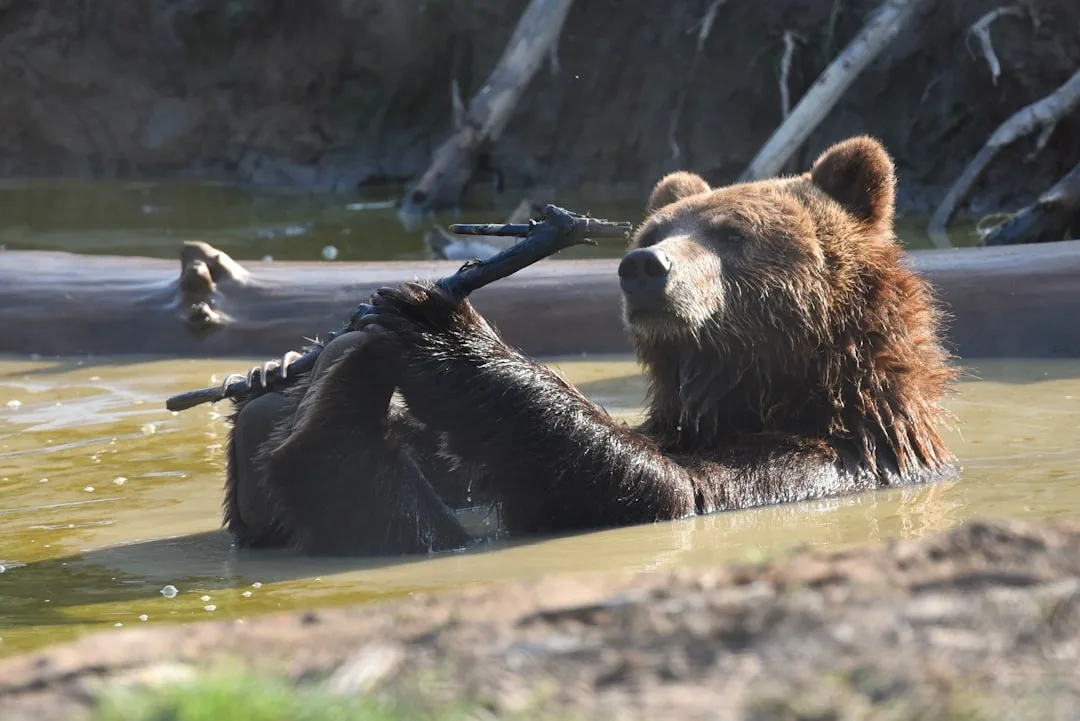
A grizzly bear cub is born in the dead of winter, underground, to a mother who has been asleep for two months and will not eat for two more. It weighs less than a pound of butter. Its eyes are sealed, its ears do not yet function, and its fur is so thin that pink skin shows through it. Outside the den, the Northern Rockies are buried in snow and the overnight air can drop below minus 30 Celsius.
Inside, wedged against the mother's belly in a chamber the size of a kitchen closet, the cub is already gaining weight on milk as rich as whipping cream.
This is the reproductive strategy of the grizzly bear, the North American brown bear and one of the most demographically constrained large carnivores on the continent. Unlike the polar bear, a grizzly mother does not fast on sea ice, and unlike the tropical bears, she is not racing seasonal fruit.
She is balancing hibernation, winter birth, milk production, and a three-year dependency period against the two most dangerous forces in her cubs' lives, starvation and adult male bears. Everything about grizzly family life is shaped by that balance.
From Mating to Implantation: The Hidden Five Months
Grizzly reproduction does not begin in the den. It begins in late spring, roughly eight months earlier, on alpine ridges and river flats where adults briefly tolerate each other for the purpose of mating. Mating season runs May through July, peaking in late May and June across most interior populations.
A receptive female will typically be courted and bred by more than one male across her estrus, which lasts up to three weeks, and multiple paternity within a single litter has been genetically confirmed in Yellowstone, Scandinavia, and the Canadian Rockies.
What follows is not what a mammalogist unfamiliar with bears would predict. The fertilized egg develops to the blastocyst stage, a cluster of roughly 100 cells, and then stops. It floats free in the uterus, suspended, neither implanting nor degrading, for four to five months. This is delayed implantation, also called embryonic diapause, and it is the pivot on which the entire grizzly reproductive cycle turns.
Implantation occurs in October or November, driven by declining day length and by maternal fat reserves. A female who did not reach adequate body condition during the late-summer hyperphagia will reabsorb the blastocyst. No implantation, no cubs, no catastrophic fast-through-lactation that would otherwise kill her.
"Delayed implantation is the grizzly's insurance policy. A female body does not commit to producing cubs until it knows it can survive doing so. In poor berry years we see reabsorption rates climb sharply, and those females den without giving birth, recover fat reserves, and try again the following cycle." - Chris Servheen, former U.S. Fish and Wildlife Service Grizzly Bear Recovery Coordinator
Once implantation occurs, effective gestation is short, roughly 55 to 60 days of active fetal development. Total elapsed time from fertilization to birth spans 180 to 260 days, one of the widest gestation windows documented in any mammal and a direct consequence of the diapause buffer. This flexibility allows birth to align with the coldest, most protected part of the denning season regardless of when the spring mating occurred.
The Winter Den as a Nursery
The grizzly den is not a hibernation bunker. It is a nursery. Pregnant females typically enter their dens earlier than any other age or sex class, often in October, weeks before the first serious snow. Males, in contrast, may not den until late November or December, and in mild coastal populations some males never fully den at all.
Most grizzly maternity dens are excavated into steep hillsides, typically at elevations of 1,800 to 3,000 meters in the interior Rockies and lower elsewhere. A female digs a tunnel several meters long that leads into a chamber just large enough for her to curl up in. The chamber is usually positioned slightly above the entry tunnel so warm air is trapped.
Snow accumulating above the den provides additional insulation, and the internal temperature typically holds near freezing even when ambient air sits at minus 30 Celsius or colder. For the full physiology of this seasonal state, the companion article on grizzly bear hibernation and how it works covers heart rate, metabolism, and urea recycling in detail.
"The maternity den is essentially a warm, dark, humid capsule built to absorb cubs into existence. The mother's body is the heater, the snow is the insulation, and the cubs arrive already knowing how to find her nipples in the dark. Everything about it is engineered by 30 million years of ursid evolution." - Andrew Derocher, University of Alberta, in conversation with Arctic science program coordinators
Inside the den, the mother's heart rate drops from roughly 40 beats per minute to 8 to 12. Her body temperature falls only about five degrees from normal, far less than a true hibernator like a ground squirrel. She does not eat, drink, urinate, or defecate for the entire denning period, typically five to six months. Her body recycles urea into protein, reabsorbs water from her own respiration, and catabolizes fat stores at a carefully regulated rate. Cubs are born into the middle of this state.
Birth: 400 Grams in the Dark
Cubs are born in January or early February, with the peak in late January across most populations. Birth itself is brief. The mother is already semi-recumbent. Labor is quiet. Cubs emerge one at a time, usually within a few hours of each other, and crawl immediately toward warmth along her belly.
At birth, a grizzly cub is:
- Weight: 400 to 500 grams, roughly the size of a chipmunk
- Length: 22 to 25 centimeters from nose to tail
- Eyes: sealed, opening around 3 weeks of age
- Ears: closed, opening around 4 to 5 weeks
- Fur: extremely thin, skin visible through it
- Teeth: absent at birth, erupting from roughly 6 to 8 weeks
- Movement: able to crawl toward heat and to nurse, but unable to thermoregulate or stand
The mother gathers cubs against her belly, in the deepest part of her fur where temperature is highest. For the first several weeks, the cubs do almost nothing except nurse and sleep. Newborn grizzlies vocalize almost constantly, a continuous low humming sound that biologists working den-cam projects have compared to a distant chainsaw or an idling motor.
The sound is generated without effort and is thought to signal contentment and warmth; hungry or cold cubs switch to sharp cries that trigger maternal repositioning.
What makes grizzly milk exceptional
Grizzly milk averages 30 to 35 percent fat during early lactation, nearly identical to polar bear milk and more than seven times richer than cow milk. The fat is the entire reproductive strategy. It must simultaneously:
- Keep the cub warm in a den chamber that sits just above freezing
- Fuel explosive growth, from 400 grams at birth to 4 to 5 kilograms at emergence, an order-of-magnitude gain in 90 days
- Be produced entirely from the mother's fat reserves, since she is not eating, drinking, or hunting
A grizzly mother produces roughly one and a half liters of milk per day inside the den. Drawing that much energy from stored fat is what drives her weight loss: a female entering the den at 200 kilograms typically emerges in the 130 to 150 range, a loss of 25 to 35 percent of body mass. Few mammals can survive that kind of catabolic deficit, and almost none can do it while gestating, giving birth, and nursing at the same time.
Growth Inside the Den: The Invisible Three Months
For roughly 90 days after birth, the family is effectively invisible to researchers. No biologist has directly observed a wild grizzly birth. Everything known about early cub development comes from captive births in zoos, acoustic monitoring of wild dens, infrared den-cam projects in Scandinavia and Alaska, and forensic evidence from dens abandoned in spring.
The growth curve inside the den is rapid and highly predictable.
| Age | Weight | Developmental milestone | Location |
|---|---|---|---|
| Birth (Jan-Feb) | 400 - 500 g | Blind, deaf, near-hairless | Inside den |
| 2 weeks | 0.7 - 1.0 kg | Fur thickening, constant humming | Inside den |
| 3 weeks | 1.1 - 1.5 kg | Eyes beginning to open | Inside den |
| 4 - 5 weeks | 1.6 - 2.2 kg | Ears functional, first soft cries | Inside den |
| 6 - 8 weeks | 2.5 - 3.5 kg | Teeth emerging, first attempts to stand | Inside den |
| 8 - 10 weeks | 3.5 - 4.5 kg | Walking, brief exploration of chamber | Inside den |
| 12 - 16 weeks | 4 - 5 kg | Emergence into daylight | Exiting den (Mar-Apr) |
| 6 months | 15 - 25 kg | Following mother, tasting solid food | Outside |
| 1 year | 40 - 70 kg | Still nursing, wintering with mother | Outside, denning again |
| 2 years | 70 - 120 kg | Nearly weaned, some families separate here | Outside |
| 3 years | 90 - 160 kg | Typical separation age in interior populations | Independent |
The growth between birth and emergence represents a roughly 10-fold weight gain in 90 days. Every gram of that growth came out of the mother's body. For context, a human newborn reaching the equivalent multiplier would weigh 35 kilograms by the start of preschool.
Emergence: Late March, April, and the First Sunlight
Sometime between late March and late April, depending on latitude and local snowpack, the mother excavates a new entrance or breaks through the old one. She does not lead the cubs directly into the world. For roughly one to three weeks she conducts short excursions, minutes at first, then hours, while the cubs acclimate to light, cold air, wind, and open space. Cubs play at the den entrance, tumble back inside to nurse, and gradually extend their tolerance for outside conditions.
The first emergence is the first time the cubs have ever experienced:
- Direct sunlight (their pupils take several days to adjust)
- Temperatures below zero Celsius at full exposure
- Wind and the sound of it
- Space larger than the den chamber
- Any non-mother animal, tree, rock, or plant
- The smell of conifer forest, wet earth, and distant rivers
During this staging period the mother does not travel far. Her fat reserves are nearly exhausted. She may scrape dead vegetation from under the snow, sometimes feed on emerging horsetail or early graminoids, and occasionally test-dig for roots. Once she judges the cubs ready for travel, the family moves downhill toward spring feeding areas.
These are the same foraging grounds described in detail in what do grizzly bears eat, which begin with overwinter-killed elk and deer carcasses, then early green forbs, then ground squirrels and cutworm moth aggregations, then finally summer berry mast.
Her first substantial meal after emergence is the most important meal of the family's year. Without calories within days, milk production fails and cubs begin to lose weight rapidly.
First-Year Mortality: Why 30 to 40 Percent Die
The first year of life is the primary demographic filter for the grizzly population. Across long-term studies in North America, first-year cub mortality runs 30 to 40 percent, with significant variation by region and year. Yellowstone data across four decades shows first-year losses averaging 33 percent; Scandinavian brown bear studies show comparable rates; coastal Alaskan populations with abundant salmon sometimes see first-year losses under 20 percent in strong years.
The main causes, ranked approximately by frequency:
- Maternal condition failure. The mother runs out of fat before lactation can be sustained, milk supply declines, and cubs either die in the den or fail within weeks of emergence. This is most common in interior populations after poor berry years.
- Male infanticide. Adult males kill and sometimes consume cubs, driven by the reproductive benefit of accelerating the female's return to estrus. Documented across every studied grizzly population.
- Intraspecific predation beyond infanticide. Subadult males and even unrelated females occasionally kill cubs, though less frequently than adult boars.
- Accidents. Falls on steep terrain, avalanches during the emergence window, drownings in spring rivers, and separations during storms.
- Disease and parasites. Rare as a direct cause but contributes in weakened cubs.
- Human-caused mortality of the mother. Orphaned cubs under one year almost always die; between one and two years they survive at low rates; only after two years do they reliably persist without the mother.
"In our Yellowstone data set the single biggest predictor of cub-of-the-year survival is not climate or disease or forage quality. It is whether the family group encountered an adult male between April and July. That single variable outweighs almost everything else." - Yellowstone Interagency Grizzly Bear Study Team, multi-decadal monitoring report
The Interagency Grizzly Bear Study Team in Yellowstone has tracked first-year mortality continuously since the 1970s, making it the longest-running grizzly cub survival dataset in existence. Their data underpins the federal recovery trajectory for the Greater Yellowstone Ecosystem population and informs related conservation decisions in the Northern Continental Divide Ecosystem and the Selkirks.
The Three-Year Apprenticeship
Cubs remain with the mother for two to three years in most populations, with a few outlier cases documented at four years. The dependency length is shorter than the polar bear's 2.5-year standard but longer than the black bear's 1.5-year norm, and it reflects the grizzly's need to teach complex seasonal foraging across highly variable landscapes.
During this apprenticeship the cubs learn:
- Foraging by season. Spring carrion, emerging forbs and horsetails, then early-summer roots, mid-summer ungulate calves and ground squirrels, late-summer berry mast, and fall army cutworm moth aggregations where present.
- Salmon fishing, where applicable. Coastal families teach specific river positions, surface versus underwater strikes, and the handling of large live fish. Cubs watch for entire seasons before attempting serious catches.
- Digging technique for ground squirrels, whitebark pine caches, and glacier lily bulbs. Mothers dig extensively in front of cubs; cubs imitate clumsily, then efficiently, across two summers.
- Hazard avoidance. Cubs learn by observation that adult males, human settlements, roads, and certain ridge corridors at certain times of day are to be avoided. Mothers actively retreat from these cues; cubs encode them.
- Den site selection. A first-den experience under the mother becomes the template for the cub's own eventual maternity den.
Mothers do not teach in an explicit, human-instructional sense. Cubs observe, attempt, fail, and eventually succeed, with the calorie deficit of their failed attempts subsidized by continued nursing through at least the first year and sometimes the second. The role of siblings is also substantial; triplet litters show more play-fighting, more cooperative foraging, and tighter post-weaning associations than twin or singleton groups.
"Grizzly families are small, intense, and lopsided in responsibility. The mother is teacher, provider, defender, and den architect all at once. Cubs are students, imitators, and liabilities. Every calorie she acquires for three years has to be enough for all of them." - Ursus, journal of the International Association for Bear Research and Management
At the end of the dependency period, usually in late May or June of the third year, the separation happens abruptly. The mother, often approached by a new male seeking mating opportunities, drives the cubs off, sometimes with aggressive bluff charges. Siblings frequently remain together for another one to two years, sharing home ranges and occasionally denning nearby.
Sibling bonding after maternal separation is especially well documented in the Yellowstone Interagency data, where radio-collared littermates have been tracked in close association for up to two years after separation from the mother.
Male Infanticide and How It Shapes Family Life
The threat from adult males is so pervasive that almost every visible feature of grizzly motherhood can be understood as a response to it. Female cub-rearing home ranges overlap less with male ranges than chance would predict. Mothers with cubs spend more time in steep, broken terrain that adult males use less frequently.
They alter their active hours, often feeding at dawn and dusk to avoid male peak activity windows. They travel in patterns that cross major corridors at angles, rather than along them, to reduce the chance of scent-matching a male's trail.
When encounters cannot be avoided, the mother fights. Sows attacking boars many times their size have been documented repeatedly across North America, and while the outcome is not always successful, the deterrent effect is real; males that have been bloodied by mothers often avoid family groups on subsequent encounters.
The National Park Service has published extensive guidance on this behavior for visitor safety, recognizing that sow-with-cubs aggression toward humans often derives from the same cognitive frame: a large-bodied potential threat approaching the family group.
"A sow grizzly with cubs of the year is operating at the sharpest end of her reproductive investment. She has spent six months in a den, lost a third of her body weight, and produced offspring that cannot yet survive without her. The cost of losing them is everything. This is why the National Park Service categorizes female grizzlies with cubs as the single most defensively aggressive demographic class in North American wildlife." - National Park Service, bear safety guidance, Yellowstone and Glacier National Parks
For the broader discussion of how this defensive aggression translates to human encounters, the companion article are grizzly bears dangerous to humans covers encounter statistics, deterrence, and the behavioral distinction between defensive and predatory bear interactions in detail.
Reproductive Pace: Why Grizzlies Recover Slowly
Grizzly bears are among the slowest-reproducing large mammals in North America. The combination of late female maturity, long interbirth interval, and extended dependency produces a population growth ceiling that is far below that of species like white-tailed deer or coyotes.
| Parameter | Greater Yellowstone | Northern Continental Divide | Coastal Alaska (Katmai) | Scandinavian brown bear |
|---|---|---|---|---|
| Age at first reproduction | 5 - 7 years | 5 - 7 years | 5 - 8 years | 4 - 6 years |
| Typical litter size | 2.0 - 2.3 | 2.1 - 2.4 | 2.1 - 2.6 | 2.3 - 2.5 |
| Interbirth interval | 3.0 - 3.5 years | 3.0 - 3.5 years | 2.5 - 3.0 years | 2.4 - 2.8 years |
| Dependency length | 2.5 - 3.0 years | 2.5 - 3.0 years | 2.0 - 2.5 years | 1.5 - 2.0 years |
| First-year cub mortality | 30 - 40 percent | 30 - 40 percent | 15 - 25 percent | 25 - 35 percent |
| Lifetime reproductive output | 6 - 10 cubs surviving | 6 - 10 cubs surviving | 8 - 14 cubs surviving | 8 - 14 cubs surviving |
Interior North American populations sit at the low end of this spectrum. A female who matures at six, produces her first litter at seven, and breeds every three and a half years until age 25 will contribute roughly four to six surviving adult daughters to the population across her lifetime, assuming average mortality. Remove her from the landscape early through a roadkill incident or a management action, and several potential lineages disappear with her.
This is why grizzly recovery has taken decades rather than years. It is also why human-caused mortality of adult females is managed so carefully in recovery zones. For a more detailed look at range, density, and recovery geography, the companion article on where do grizzly bears live maps the current and historic distribution across North America.
Comparing Strategies Across the Ursidae
The grizzly cub-rearing strategy is shared in broad outline with every other brown bear population on Earth, as covered in the overview of the brown bear. Delayed implantation, winter den birth, extremely small newborns, high-fat milk, and multi-year dependency appear in every subspecies from Kodiak to Kamchatka.
What varies is the specifics: coastal bears with salmon-rich diets produce larger litters, wean earlier, and achieve higher cub survival than interior bears relying on vegetation and ungulate scavenging.
The polar bear cubs, denning, and survival strategy is a specialized extension of the same ancestral template, pushed further in the same direction: longer fast, smaller newborn relative to mother, higher milk fat, and a longer dependency. The grizzly sits somewhere in the middle of the ursid spectrum, less extreme than the polar bear but much slower than the black bear.
Size at emergence also matters for long-term survival. Larger cubs at first emergence show better first-year survival, and first-emergence size is driven almost entirely by maternal condition at den entry, which is in turn driven by fall food availability. For the physical scale and adult size patterns that shape these energy budgets, the coverage of how big are grizzly bears, size and weight provides the body-mass reference points.
What the Family Phase Reveals
The grizzly reproductive cycle evolved for a specific environment: cold-temperate mountain landscapes with strong seasonal food pulses, predictable winter snow, and large home-range availability. Every element, from the 400-gram birth weight to the 30 percent milk fat to the three-year dependency, is a solution to that environment.
Climate shifts, habitat fragmentation, and elevated human-caused female mortality each press against the slowest-to-adjust parts of the strategy. Adult bears can ride out a bad year. Cubs cannot.
For readers interested in related patterns in animal cognition, behavior, and intelligence research, sites like whats-your-iq.com occasionally cover comparative mammalian cognition, while long-form nature and science writing at whennotesfly.com touches on field-biology fieldwork and reporting.
Tools for editing and refining scientific writing are collected at evolang.info, and for readers comparing this account with other bear species biology, the overviews of how fast can a grizzly bear run and the polar bear are the closest companion pieces in the series.
A grizzly mother emerging with spring cubs from a hillside den in Wyoming or Alberta is performing a reproductive routine tens of millions of years old. Whether that routine continues at today's pace depends on whether she can feed, move, and avoid adult males for another three years, and whether the human landscape around her allows those three years to pass.
References
- Schwartz, C. C., Haroldson, M. A., White, G. C., Harris, R. B., Cherry, S., Keating, K. A., Moody, D., & Servheen, C. (2006). Temporal, spatial, and environmental influences on the demographics of grizzly bears in the Greater Yellowstone Ecosystem. Wildlife Monographs, 161(1), 1-68. DOI: 10.2193/0084-0173(2006)161[1:TSAEIO]2.0.CO;2
- Hilderbrand, G. V., Schwartz, C. C., Robbins, C. T., Jacoby, M. E., Hanley, T. A., Arthur, S. M., & Servheen, C. (1999). The importance of meat, particularly salmon, to body size, population productivity, and conservation of North American brown bears. Canadian Journal of Zoology, 77(1), 132-138. DOI: 10.1139/z98-195
- Bellemain, E., Swenson, J. E., & Taberlet, P. (2006). Mating strategies in relation to sexually selected infanticide in a non-social carnivore: the brown bear. Ethology, 112(3), 238-246. DOI: 10.1111/j.1439-0310.2006.01152.x
- Swenson, J. E., Sandegren, F., Soderberg, A., Bjarvall, A., Franzen, R., & Wabakken, P. (1997). Infanticide caused by hunting of male bears. Nature, 386(6624), 450-451. DOI: 10.1038/386450a0
- Oftedal, O. T., Alt, G. L., Widdowson, E. M., & Jakubasz, M. R. (1993). Nutrition and growth of suckling black bears (Ursus americanus) during their mothers' period of hibernation. Journal of Zoology, 229(2), 281-296. DOI: 10.1111/j.1469-7998.1993.tb02637.x
- Haroldson, M. A., Schwartz, C. C., & White, G. C. (2006). Survival of independent grizzly bears in the Greater Yellowstone Ecosystem, 1983-2001. Wildlife Monographs, 161, 33-43. DOI: 10.2193/0084-0173(2006)161[33:SOIGBI]2.0.CO;2
- Steyaert, S. M. J. G., Endrestol, A., Hacklander, K., Swenson, J. E., & Zedrosser, A. (2012). The mating system of the brown bear Ursus arctos. Mammal Review, 42(1), 12-34. DOI: 10.1111/j.1365-2907.2011.00184.x
- van Manen, F. T., Haroldson, M. A., Bjornlie, D. D., Ebinger, M. R., Pilgrim, K. L., Schwartz, C. C., & Costello, C. M. (2016). Density dependence, whitebark pine, and vital rates of grizzly bears. Journal of Wildlife Management, 80(2), 300-313. DOI: 10.1002/jwmg.1005
Frequently Asked Questions
How many cubs do grizzly bears have at one time?
A grizzly bear mother (Ursus arctos horribilis) typically gives birth to two or three cubs per litter, with the full range spanning one to four. In Yellowstone and the Greater Yellowstone Ecosystem, twins account for roughly 50 to 60 percent of recorded litters, triplets 20 to 30 percent, singletons 10 to 15 percent, and quadruplets under 2 percent.
Litter size tracks maternal body condition closely: females who entered the den at higher weights, often above 180 kilograms, produce larger litters more reliably, while underweight females usually produce singletons or lose the pregnancy entirely through reabsorption during delayed implantation. The cubs are born blind, nearly hairless, and weighing only 400 to 500 grams, which is astonishingly small compared to a 150 to 250 kilogram mother.
This mother-to-cub weight ratio, over 400 to 1 in some cases, is among the most extreme in placental mammals and reflects the same winter-fast reproductive strategy used by the polar bear. A grizzly mother simply cannot carry large fetuses through hibernation, so the growth happens afterward, fueled by milk that is 30 to 35 percent fat.
How long do grizzly bear cubs stay with their mother?
Most grizzly cubs remain with their mother for between two and three years, with regional variation driven largely by food availability. In coastal populations such as Katmai and the British Columbia salmon streams, where high-calorie food is dependable, family groups often separate at age two and a half.
In interior populations like Yellowstone and the Northern Continental Divide, where vegetation and carrion replace salmon as summer staples, dependency more often extends to age three or slightly beyond. During this apprenticeship the cubs learn what to eat, where and when to find it, how to fish salmon runs, how to strip roots and cache carrion, how to read hazard scent trails from adult males, and how to locate a winter den. The bond ends suddenly.
The mother, typically pushed by returning estrus and by the arrival of a new adult male seeking mating opportunities, drives the cubs away, sometimes violently. Siblings frequently remain together for another one to two years, a behavior especially well documented in Yellowstone, before they too split and claim separate home ranges.
Why do grizzly mothers avoid adult male bears?
Adult male grizzlies are the single largest direct threat to cubs after starvation. Male infanticide is well documented across the species range, with cases recorded in Yellowstone, the Rocky Mountain Front, British Columbia, and across Eurasian brown bear populations.
The evolutionary driver is reproductive: a female with dependent cubs will not come into estrus for two to three years, so by killing unrelated cubs a male can accelerate her return to breeding readiness.
The behavior is not universal in every male, and coastal populations with abundant salmon show lower rates than interior populations with tighter food budgets, but the risk is high enough that females with cubs of the year shape much of their movement around it.
Sows systematically avoid river corridors, ridge trails, and salmon runs during the hours adult boars use them, favor steeper and more broken terrain that adult males use less, and will confront males many times their size when cornered.
Cub-rearing females in Yellowstone have been tracked using habitat that reduces overall food intake in exchange for lower male encounter rates, a direct trade-off between nutrition and cub survival that shapes the species’ social ecology.