
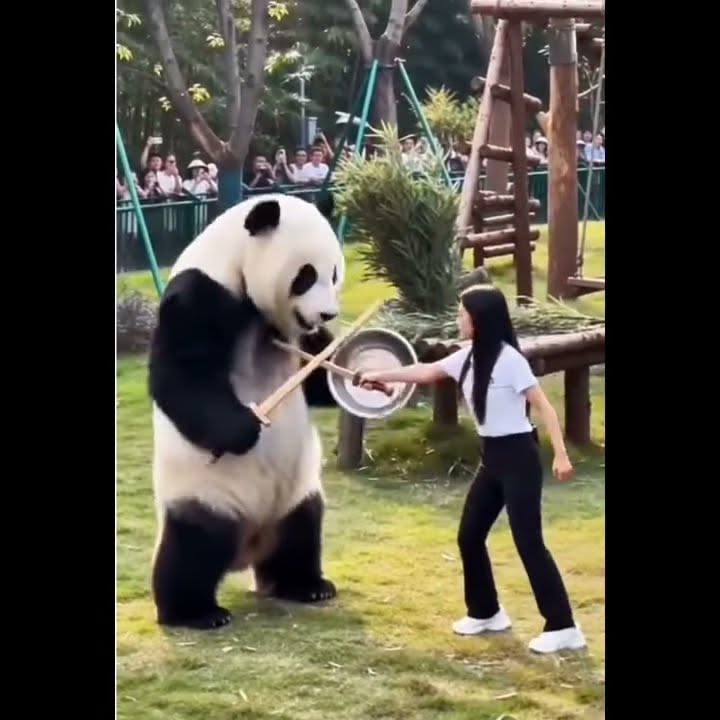
A wild giant panda opens its eyes in the grey half-light of a Sichuan bamboo forest and, within minutes, begins chewing. It will chew, walk a few paces, chew again, doze for three hours against a Fargesia stem, wake, chew, urinate against a fir trunk with its back legs in the air, climb a spruce to nap, descend, chew, and repeat the whole cycle until the sky is grey again.
This is the typical day of a panda, and almost every minute of it is organised around a single problem: extracting enough calories from a low-nutrient food to stay alive.
The image of pandas as lazy, sleeping all day in a cloud of bamboo leaves is only half true. Pandas are not especially sleepy by mammalian standards. What they are is slow, methodical, and almost permanently feeding.
This guide walks through a full 24 hours in the life of Ailuropoda melanoleuca: the activity budget, the dawn and dusk peaks, how winters differ from summers, how scent marking and vocal communication work between solitary individuals, and how captive behaviour compares with wild behaviour. For the broader biology of the animal, see the full profile of the giant panda.
The Core Numbers: A Panda's Daily Activity Budget
Detailed telemetry of wild pandas began with George Schaller's Wolong fieldwork in the early 1980s and has continued with GPS collars and accelerometers through to the 2020s. Across studies the numbers converge on a remarkably consistent picture.
"The panda's life is regulated by bamboo. The animal is awake, walking, and above all eating for most of the daylight hours, and its rest periods are short, fitted into the gaps between feeding bouts rather than taking the place of them." - George B. Schaller, The Giant Pandas of Wolong (1985)
A reasonable average day in the wild looks like this:
| Activity | Hours per day | Share of 24 h |
|---|---|---|
| Feeding (chewing and cropping bamboo) | 10-14 | 42-58% |
| Resting / sleeping between meals | 6-10 | 25-42% |
| Short-distance travel and foraging | 2-4 | 8-17% |
| Scent marking and territorial checking | 0.3-1 | 1-4% |
| Grooming, drinking, thermoregulation | 0.5-1 | 2-4% |
| Social / mating behaviour (seasonal) | <0.2 annual | <1% |
The striking feature is that feeding plus rest already accounts for more than 85% of the day. Everything else, including travel and social life, is slotted into the gaps. A panda behaves like an animal running on a tight energy budget because that is exactly what it is.
Why the Budget Looks This Way
Pandas belong to the order Carnivora but live on bamboo. Their gut extracts only about 17% of the nutrients they swallow, and their basal metabolic rate sits roughly 40% below what you would predict from body mass. These numbers are treated in detail in how do pandas survive on bamboo and why do pandas eat bamboo.
The short version is that a panda must process large volumes of a poor food using a slow digestive system, which forces long feeding bouts and rules out the burst-activity lifestyles of more typical bears. This is also part of why the question are pandas actually bears has a subtler answer than it looks.
The Crepuscular-Diurnal Cycle
Pandas are not strictly nocturnal or strictly diurnal. Radio-tracking data from the Qinling and Minshan mountains show two activity peaks per day, one around dawn and one around dusk, separated by a midday slump and a deeper midnight slump. The exact timing shifts with season and latitude, but the twin-peak pattern is consistent.
Dawn peak (roughly 04:30 to 09:00):
- Long feeding bout, often the longest of the day
- Fresh scent marks laid on trees in the core range
- Short uphill or downhill movements to reach preferred bamboo patches
- Drinking from a stream or seep, typically once
Midday lull (roughly 10:00 to 14:00):
- Rest in tree fork or on mossy ground
- Short, light feeding while reclining, often one-handed
- Grooming, especially paw-licking and face-wiping
- In summer, movement to shaded north-facing slopes
Dusk peak (roughly 15:00 to 20:00):
- Second main feeding bout, usually slightly shorter than the dawn one
- Higher rate of scent marking, especially in spring
- Tree climbing, particularly by cubs and young sub-adults
- Calls and responses between neighbouring adults during breeding season
Night lull (roughly 22:00 to 04:00):
- Two or three short feeding bursts, often less than 30 minutes each
- Main rest bouts of two to four hours at a time
- Very little travel; pandas tend to rest within a few metres of where they last ate
"Giant pandas in the Foping reserve showed clear bimodal activity with dawn and dusk peaks. Nocturnal feeding occurred but was substantially less intense than the two twilight peaks, and rest bouts rarely exceeded four hours." - Fuwen Wei et al., Journal of Mammalogy (2000)
The practical consequence for anyone watching pandas, whether in a reserve or a zoo, is that the two best viewing windows are early morning and late afternoon. Between those windows you will often see a panda doing exactly what the reputation suggests: slouched on its back, bamboo stem in one paw, chewing at half speed.
Do Pandas Sleep a Lot?
Pandas do not sleep an unusual amount for a large mammal. The daily sleep budget of six to ten hours is about the same as a brown bear in summer and slightly less than an average domestic dog. What makes pandas look sleepy is the way the sleep is distributed.
Instead of one long overnight rest, pandas take three to five short naps across the 24-hour cycle. A typical pattern in the wild is:
- Dawn feed (two to three hours), then nap (two hours)
- Morning feed (one to two hours), then nap (one to two hours)
- Afternoon feed (two to three hours), then nap (two hours)
- Evening feed (two to three hours), then nap (two to three hours)
- Night feed (30-60 minutes), then longer rest (two to three hours)
Because the animal is never asleep for long and never awake for long, observers dropping in at any given moment are statistically likely to catch the panda mid-doze. This is the origin of the internet myth that pandas sleep all day. The underlying reality is that they are almost always in one of two states - eating or resting - and the ratio is roughly three hours of eating to two hours of rest in the active season.
Rest Postures
Pandas are not picky about where they sleep. Favoured rest postures include:
- Back-slouch: lying on the back against a slope with forepaws holding a bamboo stem, still feeding intermittently
- Tree fork: wedged into the crotch of a conifer three to ten metres up, limbs dangling
- Side-curl: on the ground beside a feeding patch, often on a nest of crushed bamboo
- Sit-sleep: upright against a trunk with chin on chest, common after very large meals
Cubs spend even more time in trees than adults, partly for warmth and partly for safety from the main non-human threat to young pandas, the Asiatic leopard (Panthera pardus).
Home Range and Movement
A wild giant panda holds a home range of roughly 4 to 8 square kilometres, occasionally more in sparser bamboo and less in dense high-quality patches. Range sizes in the Qinling tend to be a little smaller than in the Minshan because the Qinling bamboo stands are denser and flatter. Males usually hold larger ranges than females, and male ranges overlap with those of several females.
| Population / region | Mean home range (km^2) | Notes |
|---|---|---|
| Wolong (Sichuan, Minshan) | 4.0-6.5 | Schaller et al. 1985 telemetry baseline |
| Foping (Shaanxi, Qinling) | 3.9-5.4 | Flatter terrain, dense Bashania bamboo |
| Wanglang (Sichuan) | 5.0-8.1 | Steeper slopes, mixed bamboo species |
| Males, averaged across sites | 6-10 | Overlapping several female ranges |
| Females, averaged across sites | 3-5 | Non-overlapping core areas |
Despite holding a range of several square kilometres, a panda does not march across it. Typical daily travel is only 400 to 1,500 metres in a straight-line sense, with a lot of short back-and-forth between feeding patches. Seasonal elevational movement is larger and more directed: animals shift 400 to 1,000 metres up or down the mountain over weeks, tracking the growth stages of different bamboo species.
"Giant panda movement is conservative. Our collared adults rarely travelled more than two kilometres per day, and core use areas of around 30 hectares accounted for more than 50% of all recorded locations." - Ronald R. Swaisgood, Animal Behaviour (2012)
This is another side of the same energy-budget story. Moving costs calories, and a panda cannot afford to waste any. Running, fighting, and long-distance travel are reserved for very specific contexts: mating season, cub defence, and escape from humans or leopards.
The Cold-Season Slow-Down (But No Hibernation)
The most persistent misconception about panda daily life is that pandas behave like other bears in winter. They do not. Brown bears and black bears enter a multi-month hibernation or winter lethargy supported by autumn hyperphagia and a deep insulated den. Pandas do neither. They feed every day of the year, they do not den, and their body temperature does not drop significantly.
What pandas do in winter is slow down in a graded way:
- Daily feeding time shifts toward the middle of the day, when temperatures are highest
- Rest bouts lengthen slightly and happen in sheltered spots behind fallen logs or at tree bases
- Elevational range shifts down-slope, often by 400 to 800 metres
- Preferred bamboo parts change from shoots and leaves to stems and rhizomes
- Social and mating activity drops to near zero until the first oestrus period in early spring
A panda's daily calorie need does not vanish because the calendar flips, and the 17% assimilation efficiency means winter bamboo has to be processed in the same huge volumes as summer bamboo. The result is a year-round eating schedule that differentiates pandas cleanly from brown bears, which spend winter sealed in a den, and from polar bears, which shift to fasting and den-based cub-rearing in the Arctic winter.
For contrast, the foraging style of non-hibernating ursids during the active season is covered in what do brown bears eat.
Solitary Life, Shared Forest
A panda's day is almost entirely a solo day. Adults are solitary outside the mating season, the main exception being a female with a dependent cub. Home ranges overlap, particularly between males and females, but actual face-to-face encounters are rare and usually brief. Two wild pandas that cross paths will normally separate within minutes unless one is a female in oestrus.
The signature pattern in the daily budget is therefore:
- 95% of minutes spent alone, out of sight of any other panda
- Communication handled almost entirely by smell and occasional distant calls
- Physical encounters concentrated into a few days each spring during mating
- Mother-cub pairs as the only sustained social unit, lasting roughly 18 months
This is radically different from primates, canids, or even the more social black bears. A full treatment of the mother-cub social unit sits in the section on reproduction in the giant panda profile, and the comparison with red pandas, which share the bamboo niche but have a different social structure, is covered in giant panda vs red panda.
Scent Marking and the Handstand
Because pandas rarely meet in person, scent marking is the main communication channel. Pandas carry a pair of anogenital glands at the base of the tail that produce a waxy, pungent secretion, mixed with urine and sometimes rubbed onto tree trunks, rocks, and low logs. A single mark can carry information about:
- Individual identity
- Sex
- Reproductive status (oestrous females in particular)
- Relative body size (through mark height)
- Approximate age
Pandas adopt three main marking postures, each leaving a mark at a different height:
- Squat: tail lifted, glands rubbed against a short tree stem or stone. Common in females.
- Leg-cock: one hind leg raised sideways against a tree, as in a domestic dog. Common in both sexes.
- Handstand: the animal walks its forepaws down, lifts its hind end into the air, and urinates as high up the trunk as it can reach. Documented almost exclusively in adult males, especially during the mating season.
The handstand is the most striking behaviour in the panda daily routine and the reason the question turns up in search results almost as often as the feeding question. Ronald Swaisgood's team at San Diego Zoo was the first to quantify it, followed by field confirmation in Sichuan and Shaanxi. The working hypothesis, well supported by the data, is that mark height is a proxy for body size. A competitor smelling a mark at 1.8 metres assumes a very large animal and adjusts accordingly.
Marks are refreshed roughly every few days on key trees. A wild adult will update between 10 and 40 marks in a typical spring day and far fewer in midwinter. For readers interested in scent-based communication in other ursids, the daily territorial patrolling behaviour of boars is set out in brown bear.
Vocal Communication
Pandas are famously quiet, but they are not silent. Wild and captive recordings describe at least eleven distinct vocal categories, most of them produced only in specific social contexts. Six of those are heard most often.
| Call | Context | Acoustic quality | Function |
|---|---|---|---|
| Bleat | Friendly contact, pre-mating approach | Soft, tonal, sheep-like | Reduce tension, signal non-aggression |
| Honk | Mild alarm, uncertainty | Abrupt, nasal | Warn of disturbance |
| Chirp | Oestrous female, sexual interest | High, bird-like, repeated | Advertise receptivity |
| Growl | Close-range threat | Low, rumbling, sustained | Warn off a rival or predator |
| Bark | Sudden threat or alarm | Sharp, dog-like | Startle an intruder |
| Moan | Submission, distance contact | Long, mournful | De-escalate or locate a mate |
Cubs have their own high-pitched squeal, which adults of all ages respond to instantly. The bleat and the chirp are the backbone of mating-season communication; the growl and bark are the backbone of conflict; and the moan covers longer-distance, low-stakes contact. Captive audio archives at Chengdu, San Diego, Edinburgh, and the Smithsonian have allowed acoustic researchers to link specific call structures to specific behavioural outcomes with a good level of reliability.
"Giant panda vocalisations are context-specific and show limited variation across populations. Bleats dominate affiliative interactions, chirps dominate sexual interactions, and growls and barks dominate agonistic interactions." - Benjamin Charlton et al., Animal Behaviour (2009)
Captive Days vs Wild Days
Captive pandas are the most closely watched members of their species, and their daily behaviour has been logged in 24-hour cycles for decades. The broad picture is that a well-managed captive panda behaves much like a wild one, with some measurable differences.
Similarities:
- Total active time of roughly 12-14 hours per day
- Twin dawn and dusk activity peaks
- Short sleep bouts of two to four hours rather than one long rest
- Year-round feeding with no hibernation
- Scent marking of enclosure walls and enrichment trees, including handstands
Differences:
- Slightly longer average rest bouts (food does not need searching out)
- Smaller movement ranges, often below 0.1 km^2 of enclosure vs several km^2 in the wild
- Higher frequency of social contact in enclosures that house multiple pandas
- Addition of human-scheduled activities: training, health checks, enrichment feeding
- More tree-platform use and less ground-nesting in most modern enclosures
Modern panda enclosures at facilities like Chengdu, Bifengxia, San Diego, and the Smithsonian are designed around the wild activity budget. Keepers hide bamboo in enrichment puzzles, spread multiple small meals across the day, and rotate scent-marked objects so that pandas retain their natural marking behaviour.
These design principles are part of why captive pandas live measurably longer than wild ones and why modern captive reproduction has become reliable, a story told at length in panda conservation success story.
A Sample 24 Hours
To pull the activity budget, circadian rhythm, and social life together, here is a realistic reconstruction of a single day for an adult female panda in the Qinling mountains in late April.
- 04:45 Wakes in a bed of crushed bamboo at 2,100 m elevation. Begins feeding within two minutes.
- 05:10 - 08:20 Main dawn feeding bout. Consumes roughly 8 kg of spring bamboo shoots, stripping outer skins with the pseudo thumb.
- 08:20 - 08:40 Walks 200 m downslope to a small stream, drinks briefly, grooms face and forepaws.
- 08:40 - 09:00 Stops at a marked fir tree, sniffs the bark, refreshes a squat mark at the base.
- 09:00 - 11:30 First rest bout, tucked into a mossy hollow at the base of a spruce. Brief light feeding at 10:15.
- 11:30 - 13:00 Secondary feeding bout on leafy stems of a second bamboo species.
- 13:00 - 15:00 Midday rest on open ground in dappled sun. Light wind, temperature around 11 C.
- 15:00 - 18:30 Dusk feeding bout, the second large meal of the day. Roughly 7 kg of bamboo.
- 18:30 - 19:00 Movement of 350 m to a ridge of preferred marking trees. Squats and leg-cocks at four trees. Passes a recent male mark at 1.7 m and spends several minutes investigating it.
- 19:00 - 21:00 Rest bout in tree fork four metres above the ground.
- 21:00 - 22:00 Short feeding bout on nearby bamboo stems.
- 22:00 - 01:30 Longest rest bout of the day, on ground beside the last feeding site.
- 01:30 - 02:15 Night feed on cold bamboo stems.
- 02:15 - 04:40 Final rest bout before dawn.
Total across the 24 hours: roughly 13 hours of feeding, 8.5 hours of rest, 1.5 hours of short travel and drinking, and the remainder split between marking, grooming, and transitional behaviour. Food intake lands at about 18 kg, at the lower end of the range because spring shoots are unusually rich.
Why the Daily Pattern Matters for Conservation
The activity budget is not a trivia question. It drives several conservation decisions.
- Reserve design must include enough connected bamboo habitat to cover a 4 to 8 km^2 home range per animal, plus seasonal elevational movement.
- Corridors between reserves must be walkable in short daily stages, not long forced marches, because pandas do not cover large distances quickly.
- Disturbance from roads, tourism, and cattle grazing disrupts the dawn and dusk feeding peaks, which are the most calorie-productive parts of the day.
- Captive enclosure design must mimic the twin-peak pattern and provide enough enrichment to fill the long feeding hours.
- Cub-training programmes in semi-wild enclosures deliberately reproduce the wild activity budget before any release attempt.
The net result is that something as modest as the time budget of a bamboo-eating bear shapes a national park system that now covers more than 27,000 square kilometres across three Chinese provinces.
Further Reading on This Site
For the full biology of the species, read the giant panda profile. For the digestive and metabolic machinery behind the 14-hour eating day, read how do pandas survive on bamboo and why do pandas eat bamboo. For the taxonomic and evolutionary backstory, read are pandas actually bears. For the comparison with the unrelated red panda, read giant panda vs red panda. For the conservation arc of the species, read panda conservation success story.
Elsewhere on Strange Animals, the activity budgets of other bear species make a useful contrast: what do brown bears eat, the brown bear profile, and the polar bear profile all describe very different daily rhythms driven by very different diets.
Readers who like this kind of structured, expert-written long read may also enjoy the learning material at Whats Your IQ, the music-puzzle writing at When Notes Fly, and the professional writing guides at Evolang.
References
- Schaller, G. B., Hu, J., Pan, W., and Zhu, J. (1985). The Giant Pandas of Wolong. University of Chicago Press. https://doi.org/10.7208/chicago/9780226736488.001.0001
- Nie, Y., Speakman, J. R., Wu, Q., Zhang, C., Hu, Y., Xia, M., Yan, L., Hambly, C., Wang, L., Wei, W., Zhang, J., and Wei, F. (2015). Exceptionally low daily energy expenditure in the bamboo-eating giant panda. Science, 349(6244), 171-174. https://doi.org/10.1126/science.aab2413
- Wei, F., Feng, Z., Wang, Z., and Hu, J. (2000). Habitat use and separation between the giant panda and the red panda. Journal of Mammalogy, 81(2), 448-455. https://doi.org/10.1644/1545-1542(2000)081<0448:HUASBT>2.0.CO;2
- Swaisgood, R. R., Lindburg, D. G., and Zhou, X. (1999). Giant pandas discriminate individual differences in conspecific scent. Animal Behaviour, 57(5), 1045-1053. https://doi.org/10.1006/anbe.1998.1070
- Charlton, B. D., Zhihe, Z., and Snyder, R. J. (2009). The information content of giant panda, Ailuropoda melanoleuca, bleats: acoustic cues to sex, age and size. Animal Behaviour, 78(4), 893-898. https://doi.org/10.1016/j.anbehav.2009.06.029
- Zhang, Z., Sheppard, J. K., Swaisgood, R. R., Wang, G., Nie, Y., Wei, W., Zhao, N., and Wei, F. (2014). Ecological scale and seasonal heterogeneity in the spatial behaviors of giant pandas. Integrative Zoology, 9(1), 46-60. https://doi.org/10.1111/1749-4877.12030
- Hull, V., Zhang, J., Zhou, S., Huang, J., Viña, A., Liu, W., Tuanmu, M.-N., Li, R., Liu, D., Xu, W., Huang, Y., Ouyang, Z., Zhang, H., and Liu, J. (2015). Space use by endangered giant pandas. Journal of Mammalogy, 96(1), 230-236. https://doi.org/10.1093/jmammal/gyu031
- Zhou, W., Nie, Y., Hu, Y., Swaisgood, R. R., Zhang, Y., Liu, D., and Wei, F. (2019). Seasonal and reproductive variation in chemical constituents of scent signals in wild giant pandas. Science China Life Sciences, 62(5), 648-660. https://doi.org/10.1007/s11427-018-9388-9
Frequently Asked Questions
Do pandas sleep a lot?
Giant pandas do not sleep as much as the internet suggests. Radio-collar studies from the Qinling and Wolong reserves show wild adults are active between 10 and 16 hours in every 24-hour cycle, almost all of it spent eating bamboo. Sleep is broken into short bouts of two to four hours that slot between feeding sessions, so a panda typically cycles through eat-sleep-eat-sleep four or five times a day rather than taking one long overnight rest.
The total daily sleep budget works out at roughly six to ten hours, which is normal for a large mammal and far below the 15-to-20-hour figures cited for koalas or sloths. Captive pandas in well-designed enclosures keep almost the same schedule, although their resting bouts tend to be a little longer because food is delivered rather than searched for.
What do pandas do at night?
Wild pandas are best described as crepuscular-diurnal, with two peaks of feeding activity clustered around dawn and dusk. Between midnight and 4 a.m. most individuals are at their quietest, dozing on bare ground, on a bed of crushed bamboo, or wedged into the fork of a large tree. They do feed overnight in short bursts, especially in cooler months when daytime sun is welcome and midday temperatures push them into shade.
Unlike brown bears they do not den or hibernate, so winter nights are spent in the same open rest sites, relying on a dense pelage and a reduced metabolic rate rather than an insulated burrow. Captive footage from night-vision cameras at Chengdu and the Smithsonian National Zoo confirms this same pattern of short nocturnal feeds between longer rests.
Why do pandas do handstands?
Male giant pandas occasionally perform a handstand against a tree trunk so that they can urinate as high as possible, a behaviour documented in detail by Ronald Swaisgood and colleagues at the San Diego Zoo and later confirmed in the wild in Sichuan.
The urine carries pheromones from the anogenital glands, and placing a scent mark high on the bark signals body size: a larger animal can reach higher, so a competitor assessing the mark assumes a formidable neighbour. Females mark too but generally do so in a normal standing or squatting position. Scent marking peaks in spring during the brief mating window, when males advertise territory and receptive females leave chemical trails.
Outside that window marks are updated throughout the year as a way for otherwise solitary pandas to keep tabs on one another without ever having to meet.