
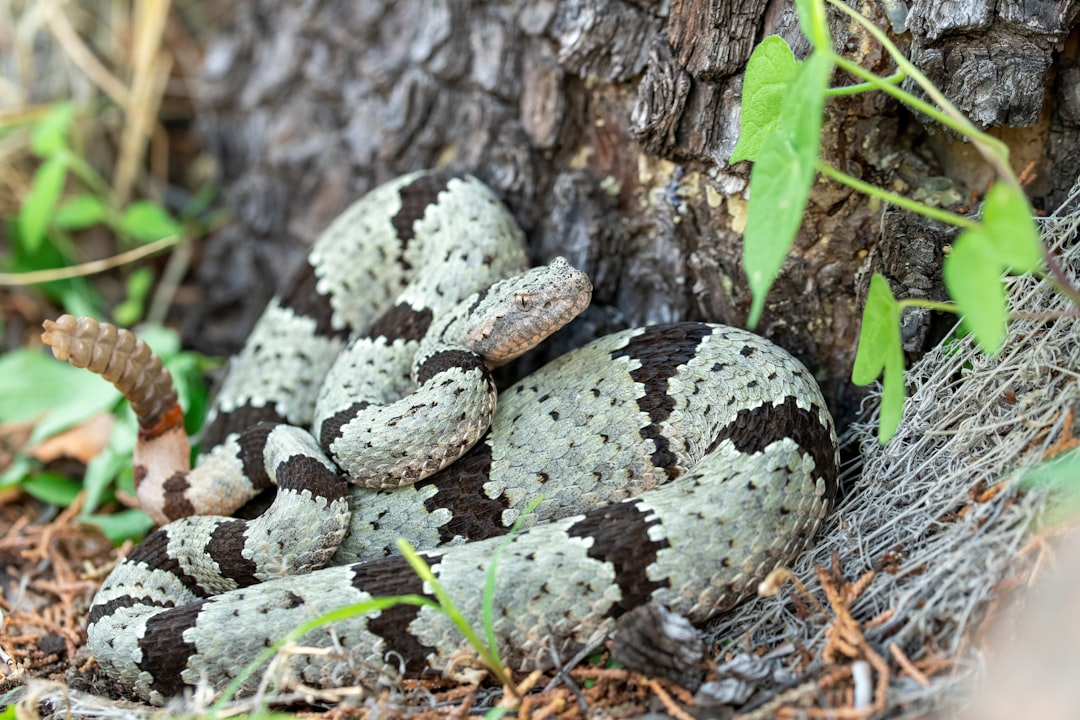
The rattlesnake is not a single species but a group -- more than thirty-six recognised species in the genus Crotalus plus several close relatives in the genus Sistrurus. What unites them is a feature no other snakes on Earth possess: a rattle at the tip of the tail, built from loose keratin segments that clack together when the snake vibrates its muscles. This guide focuses on the Eastern diamondback rattlesnake (Crotalus adamanteus), the largest and heaviest member of the genus, while drawing on the wider family for context. Rattlesnakes are among the most studied, most feared, and most ecologically misunderstood reptiles in the Americas.
This reference entry covers every major aspect of rattlesnake biology: anatomy and the rattle, the pit organ, hunting and venom, reproduction, subspecies and range, conservation, and the odd evolutionary stories that the rattlesnake lineage has produced -- including populations that may be evolving away from the rattle entirely.
Etymology and Classification
The genus name Crotalus comes from the Greek krotalon, meaning 'a rattle' or 'castanet'. Eighteenth-century naturalists needed no other defining feature. The species epithet adamanteus means 'of adamant' or 'diamond-like', a reference to the bold diamond pattern running down the animal's back. The common name 'rattlesnake' is a direct translation used across English-speaking regions of the New World since the seventeenth century.
Rattlesnakes are pit vipers, members of the subfamily Crotalinae inside the viper family Viperidae. Their closest relatives include copperheads, cottonmouths, bushmasters, and lanceheads -- all Americas-native pit vipers that share the heat-sensing pit organ between nostril and eye. Molecular phylogenies place the origin of the rattle somewhere in the late Miocene, roughly six to twelve million years ago, with rapid diversification in the uplands of what is now Mexico.
The two rattlesnake genera are Crotalus, which includes the vast majority of species, and Sistrurus, which contains three smaller-bodied species such as the pygmy rattlesnake. Together they occupy an ecological niche found nowhere else on Earth -- a heavy-bodied ambush predator that advertises its presence before it strikes.
Size and Physical Description
The Eastern diamondback is the largest rattlesnake, and among the heaviest venomous snakes anywhere. Most rattlesnakes are far smaller. Sexual dimorphism is modest; males tend to be slightly longer than females in most species.
Eastern diamondback (C. adamanteus):
- Length: typical adults 1.2-1.8 m; record verified 2.4 m
- Weight: typical adults 2-5 kg; record specimens near 7 kg
- Girth at midbody: up to 15 cm in heavy individuals
Western diamondback (C. atrox):
- Length: 1.2-1.8 m
- Weight: 2-3 kg
Timber rattlesnake (C. horridus):
- Length: 0.9-1.5 m
- Weight: 1-2 kg
Pygmy rattlesnake (Sistrurus miliarius):
- Length: 0.4-0.6 m
- Weight: 100-300 g
The body is thick and muscular compared with non-viper snakes, reflecting an ambush rather than pursuit lifestyle. The head is broad and triangular, sharply distinct from the narrow neck -- a useful field mark for telling rattlers apart from non-venomous species like bullsnakes that mimic their behaviour. The eyes have vertical-slit pupils, another pit viper trait. The scales are strongly keeled, giving the body a matte, textured appearance rather than the glossy finish of many colubrid snakes. Colouration is highly cryptic: diamonds, chevrons, bands, and speckling in browns, greys, olive, yellow, or pink, depending on species and substrate.
The single most recognisable feature is the rattle itself, sitting at the end of the tail. The rattle is not alive and contains no nerves or blood vessels. It is a chain of hollow keratin segments, each one a remnant of the scale that covered the rattle base at the last shed. A new segment is added each time the snake sheds its skin, but older segments break off with age and wear. Counting segments to age a rattlesnake is a widespread misconception.
The Rattle and Warning Behaviour
A rattlesnake builds its rattle by refusing to let go of skin fragments. Every other snake drops the entire shed as a single inside-out tube. Rattlesnakes keep the terminal end of the tail skin attached, and each shed leaves a new hollow segment locked loosely around the previous one. The segments are shaped like interlocking bells, free to move a few millimetres but unable to slide off.
When the snake vibrates its tail -- powered by dedicated shaker muscles that fire 50 to 100 times per second -- the segments clack against each other and produce the familiar dry buzz. The muscles are among the fastest-contracting in the vertebrate world, capable of sustained vibration for hours without fatigue, and draw an impressive fraction of the animal's total metabolic output while operating.
The rattle is a warning device, not a weapon. It functions to tell large animals -- bison, elk, deer, cattle, and humans -- to change course before either party gets hurt. A rattlesnake would rather not spend venom on something too big to eat, and the energetic cost of venom production is substantial. The rattle evolved in concert with the rise of large herd animals on the North American grasslands, and some biologists believe the rattle is specifically an anti-trampling signal.
Defensive posture follows a recognisable sequence. First, a startled rattlesnake coils its body into a flattened S-shape, raising the head and forebody off the ground. Second, it rattles continuously. Third, if threatened further, it may strike. Most defensive strikes are 'dry bites' delivering little or no venom, because venom is metabolically expensive and reserved for prey.
Several California populations of rattlesnakes on isolated islands and in heavily hunted areas appear to be evolving away from rattling entirely. Selection pressure against rattling comes from humans: snakes that buzz get shovelled to death, snakes that stay quiet survive to reproduce. Whether this will produce a true 'silent rattlesnake' subspecies is an open research question.
Pit Organs and Infrared Vision
Rattlesnakes share with all pit vipers a pair of highly specialised heat-sensing organs positioned between each nostril and eye. Each pit contains a thin membrane suspended inside a small chamber with two apertures, creating a primitive 'pinhole camera' that projects thermal images onto the membrane. The membrane is packed with temperature-sensitive TRPA1 ion channels that respond to shifts as small as 0.003 degrees Celsius.
The nervous signals from the pit organs travel to the optic tectum, the same brain region that processes visual input, where they are integrated with normal visual images. Behavioural and neural evidence suggests rattlesnakes perceive a combined thermal-and-visual view of the world, rather than switching between two separate senses.
Laboratory experiments confirm the sensitivity. Blindfolded rattlesnakes still strike live mice accurately in total darkness. They will ignore dead prey at room temperature but attack heated decoys shaped like mice even when the decoy is motionless. The system is most useful in low light -- dusk, dawn, or inside burrows -- where ambient thermal contrast between prey and background is highest.
| Sensing system | Detection capability |
|---|---|
| Eyes | Movement and shape, vertical-slit pupils, modest acuity |
| Pit organs | Temperature differences as small as 0.003 degrees C |
| Tongue | Chemical scent trails via Jacobson's organ |
| Body contact | Ground vibration through jaw and ventral scales |
No rattlesnake relies on a single sense. Infrared guides strike targeting, vision handles movement detection, tongue flicks track prey trails after a strike, and vibration warns of approaching threats. The integration is why a rattlesnake is so effective at ambush hunting despite its slow metabolism.
Hunting and Strike
Rattlesnakes are sit-and-wait predators. An adult may spend 80 to 95 per cent of its time motionless, choosing an ambush site near a rodent runway or at the base of a shrub and waiting hours or days for prey to pass. When a suitable target comes within range, the snake launches a strike that covers roughly half its body length in well under one tenth of a second. A two-metre Eastern diamondback can hit a mouse nearly a metre away before the rodent has time to react.
The strike mechanics are worth a closer look. The fangs are hinged, folding back against the roof of the mouth when not in use. When the mouth opens beyond about 170 degrees, the fangs swing forward into a perpendicular stabbing position. Venom is forced from glands behind the eyes through ducts into the hollow fangs and injected into the prey. The bite lasts well under a second. The snake then releases the prey and recoils to a safe distance.
Typical hunting sequence:
- Locate a site with good cover, scent traces of prey, and unobstructed strike lanes.
- Settle into ambush posture, often aligned with the prey's expected direction of travel.
- Wait. Sometimes days.
- Detect approaching prey by a combination of ground vibration and pit organ input.
- Strike at close range, inject venom, release immediately.
- Track the envenomated prey by scent trail once it has died or is dying.
- Swallow head-first, realigning the jaws around the carcass through unhinged quadrate bones.
After a major meal a rattlesnake may fast for weeks or even months. Large diamondbacks have been recorded going more than a year between meals in captivity. Their metabolism is slow enough, and their venom efficient enough, that this is a viable lifestyle.
Primary prey varies by species and location, but the core list is consistent. Rodents dominate: deer mice, wood rats, cotton rats, ground squirrels, and young rabbits. Ground-nesting birds are a secondary target. Some rattlesnakes eat lizards, and a few species take other snakes. Hatchling rattlesnakes often start on lizards and shift to small mammals as they grow.
Venom
Rattlesnake venom is a complex mix of enzymes, peptides, and small molecules produced in a pair of modified salivary glands behind the eyes. The composition varies dramatically between species, within species across the range, and even between adults and juveniles of the same population.
Primary venom components (typical species):
- Metalloproteinases -- destroy tissue at the bite site, rupture blood vessels
- Phospholipases A2 -- break down cell membranes, cause local and systemic damage
- Serine proteases -- interfere with blood clotting in complex ways
- L-amino acid oxidases -- generate reactive oxygen species, damage tissue
- C-type lectins -- aggregate or inhibit platelets depending on specific variant
The overall effect in most rattlesnakes is classic hemotoxic envenomation: local swelling, tissue death, bleeding disorders, bruising, and cardiovascular stress. Severe untreated bites can cause kidney failure, shock, and death. Modern treatment in North America relies on the antivenoms CroFab (ovine-derived Fab fragments) and Anavip (equine-derived F(ab')2 fragments), both of which neutralise the enzymatic fraction and reverse clotting derangements when given promptly.
The Mojave rattlesnake (Crotalus scutulatus) is a striking exception. Its venom contains a potent presynaptic neurotoxin known as Mojave toxin, which attacks the nervous system rather than blood vessels. Envenomation can cause muscle weakness, difficulty breathing, and respiratory failure, sometimes hours after the bite when local symptoms are minimal. Complicating matters, some Mojave populations produce only neurotoxic venom, others produce only hemotoxic venom, and some produce both -- a geographic mosaic that makes bite management regionally specific.
A common folk belief holds that baby rattlesnakes are more dangerous than adults because they 'cannot control their venom' and always deliver a full dose. The underlying biology is the reverse. Adults deliver far more venom per bite than juveniles, have more potent venom overall, and can cause far greater injury. Juveniles are dangerous, certainly -- they are fully venomous from birth -- but the 'baby rattler is worse' claim is a myth.
Roughly 7,000 to 8,000 venomous snakebites occur in the United States each year, the majority by rattlesnakes. Fatalities number fewer than ten, reflecting the availability of rapid medical care and antivenom. Where medical care is limited, envenomation is far more serious.
Reproduction and Life Cycle
Rattlesnakes are ovoviviparous. Fertilised eggs are retained inside the female's body, where the embryos develop using the nutrients in the egg yolk. The female gives birth to fully formed live young wrapped in a thin membrane, which the snakelets rupture within minutes.
Mating systems vary. Many species mate in spring shortly after emerging from hibernation; others mate in autumn and store sperm through winter. Males locate females by following pheromone trails and sometimes engage in ritualised combat with rival males, rearing up and wrestling until one is pinned. These combat 'dances' never involve venom.
Typical reproductive sequence:
- Mating in spring or autumn depending on species
- Delayed fertilisation if mating occurred in autumn
- Gestation of three to five months
- Birth of 5-20 snakelets, often in a secluded gestation site
- Short maternal attendance, typically until the young's first shed
- Dispersal of young, with no further parental care
Litter size scales roughly with maternal body size. Small species like pygmy rattlesnakes produce 4-8 young per litter, while large Eastern diamondbacks average 12-15 and occasionally exceed 20. Newborns are 20-35 centimetres long, fully venomous, and carry a single keratin 'pre-button' at the tail tip, which will become the first true rattle segment at the second shed.
Females do not reproduce every year. In northern populations they typically reproduce every two to three years because gestation is energetically expensive and females must rebuild fat reserves between litters. Environmental stress, poor prey years, and severe winters all reduce reproductive rates.
Growth is rapid in the first two years and slows thereafter. Sexual maturity is typically reached at three to six years depending on species and latitude. Wild lifespans cluster in the 10-20 year range, with some records reaching 25 years. Captive rattlesnakes on reliable diets have exceeded 30 years.
Hibernation and Communal Dens
Rattlesnakes in the northern and higher-elevation parts of their range cannot remain active through winter. They enter a period of dormancy called brumation, during which body temperature drops to near-freezing, heart rate slows dramatically, and metabolism runs on stored fat. Unlike true mammalian hibernation, rattlesnakes do not lose consciousness and will move if disturbed.
The striking feature of rattlesnake brumation is that it is often communal. Dozens, sometimes hundreds of snakes gather in hibernacula -- shared dens, typically deep rock crevices or burrows below the frost line. The same dens are used across many generations, with adult snakes often returning to the den where they were born. Timber rattlesnake hibernacula in the northeastern United States have been continuously occupied for centuries.
Den use is strikingly specific. Rattlesnakes sometimes share hibernacula with other snake species, including racers, gartersnakes, and copperheads, despite these species preying on or competing with rattlesnakes during the active season. Inside the den, aggression is suppressed and body contact is near continuous. The thermal mass of a packed den buffers temperature swings and keeps the group alive through sub-zero external air.
Loss of hibernacula is one of the quieter drivers of rattlesnake decline. When a hibernaculum is destroyed -- through quarrying, road building, or deliberate persecution -- the entire local population may be extirpated, because founding a new den requires decades of accumulated behaviour.
Range, Populations, and Subspecies
Rattlesnakes are restricted to the Americas. No rattlesnake species occurs naturally in Europe, Africa, Asia, or Australia. Their distribution spans from southern Canada to northern Argentina, with the genus reaching its highest diversity in the uplands of Mexico and the American Southwest.
Approximate geographic distribution:
| Region | Notable species |
|---|---|
| Southern Canada | Prairie rattlesnake (C. viridis), massasauga |
| Western and southwestern US | Western diamondback, Mojave, speckled, sidewinder |
| Southeastern US | Eastern diamondback, timber, canebrake, pygmy |
| Mexican uplands | Black-tailed, rock rattlesnake, Mexican dusky, ridge-nosed |
| Central America | Central American rattlesnake (C. simus) |
| South America | Neotropical rattlesnake (C. durissus) to N. Argentina |
Within many species, recognised subspecies reflect geographic variation in scale counts, colouration, and venom composition. The Western diamondback alone has been described with multiple forms across its range. Genetic work continues to revise the boundaries between species and subspecies, and several historical 'subspecies' have been elevated to full species in recent decades.
Conservation Status and Threats
Most rattlesnake species are listed as Least Concern on the IUCN Red List because their ranges remain large and their total populations substantial. This broad label conceals severe regional declines and, in some cases, near-extirpation from historic strongholds.
Principal threats:
- Habitat loss. The Eastern diamondback has lost roughly 97 per cent of its original longleaf pine habitat in the southeastern US. Timber rattlesnakes have vanished from most of New England. Urban sprawl, agriculture, and forest conversion fragment the remaining populations.
- Road mortality. Rattlesnakes move along predictable routes between hibernacula, gestation sites, and hunting areas. Roads cut these routes, and thousands of snakes are killed by vehicles each year.
- Persecution. Rattlesnakes are shot, clubbed, and run over deliberately by people who either fear them or believe that killing them protects livestock and children. Modern studies show that most bites occur when people attempt to handle or kill a snake they could have simply walked around.
- Rattlesnake roundups. Organised hunts in several US states collect thousands of snakes annually for slaughter, meat, and skins. These events have caused measurable long-term population declines in affected regions. Some states, including Georgia and Alabama, have banned roundups; others still permit them.
- Illegal collection. Live rattlesnakes command high prices in the exotic pet trade, and skin and rattle markets remove animals from the wild in volumes that fragile populations cannot sustain.
- Climate shifts. Changing precipitation and temperature regimes affect prey abundance, gestation success, and the viability of traditional hibernacula.
- Disease. Snake fungal disease (SFD), caused by Ophidiomyces ophidiicola, has emerged as a serious threat to several rattlesnake species, especially timber rattlesnakes in the northeastern US.
Species with the most serious conservation concerns:
- Timber rattlesnake (C. horridus) -- listed Endangered or Threatened in many northeastern US states
- Eastern diamondback (C. adamanteus) -- under federal review for listing
- Aruba Island rattlesnake (C. unicolor) -- Critically Endangered
- Santa Catalina rattleless rattlesnake (C. catalinensis) -- Critically Endangered, known from a single small island
- New Mexico ridge-nosed rattlesnake (C. willardi obscurus) -- Threatened
Protection efforts include state-level habitat conservation, hibernaculum protection, roundup bans, anti-persecution education, and radio-tracking projects that map movement for land use planning. The species are often easier to save than people expect -- a protected hibernaculum and a connected network of hunting habitat can sustain a rattlesnake population indefinitely.
Rattlesnakes and Humans
Human attitudes toward rattlesnakes remain polarised. Indigenous peoples across the Americas have long incorporated rattlesnakes into mythology, medicine, and ceremony, often with cultural rules that amount to early conservation. The Hopi snake dance, the Mayan vision serpent, and the Aztec Coatl are all culturally significant rattlesnake imagery. Early European settlers regarded the animal as dangerous vermin; the coiled rattlesnake on the Gadsden flag ('Don't Tread on Me') captures the colonial American attitude that the snake was respected precisely because it was willing to defend itself.
Rattlesnakes remain one of the most persecuted large reptiles in North America. Millions have been killed in roundups since the mid-twentieth century. At the same time, rattlesnake ecotourism, snake education programmes, and citizen science projects -- especially in the American Southwest -- have produced a generation of herpetologists working actively against the culture of persecution.
Bite prevention is straightforward. Nearly all rattlesnake bites in medically reported cases involve one of three scenarios: stepping on an unseen snake, handling a snake deliberately, or reaching into an unseen space. Wearing appropriate boots, watching where you step and sit, using a flashlight at night, and never attempting to catch or kill a rattlesnake reduces the risk to near zero. If bitten, the correct response is to move away from the snake, keep the limb immobile and below heart level, remove constrictive items, and reach a hospital quickly. Cutting the wound, sucking out venom, applying a tourniquet, and icing the bite are all outdated practices that cause harm without benefit.
Related Reading
References
Relevant peer-reviewed and governmental sources consulted for this entry include the IUCN Red List species assessments for Crotalus adamanteus, C. horridus, C. scutulatus, and congeners; the US Fish and Wildlife Service species status assessments; published research in Toxicon, Journal of Herpetology, Copeia, and Molecular Phylogenetics and Evolution; and the Center for North American Herpetology's rattlesnake taxonomy references. Venom composition and antivenom efficacy data reflect clinical literature indexed through PubMed and the most recent product inserts for CroFab and Anavip.