
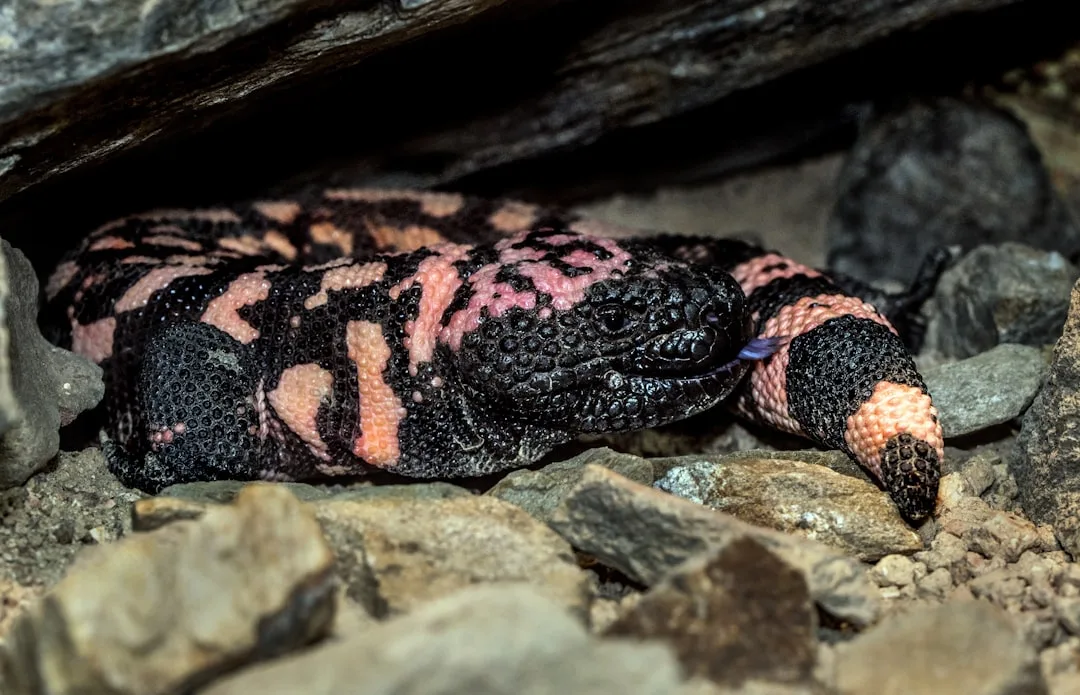
The Gila monster is one of only two lizards traditionally classified as venomous, alongside its close relative the Mexican beaded lizard. Heloderma suspectum is a stocky, slow-moving, boldly patterned reptile of the American southwest - black scales banded with pink, orange, or yellow, and embedded with tiny bony plates that give the species its distinctive beaded appearance.
It spends roughly ninety-five per cent of its life hidden underground, eats only five to ten times a year, and carries a cocktail of peptide toxins in its lower jaw that has already reshaped global diabetes medicine.
This guide covers every significant aspect of Gila monster biology: classification, size and physical structure, habitat and range, venom chemistry and delivery, diet, behaviour, reproduction, lifespan, conservation status, and the relationship between Gila monsters and humans.
It is a reference entry rather than a summary - so expect specifics: grams, centimetres, percentages, dollar figures, and the weird ecological details that make this animal one of the strangest vertebrates in North America.
Etymology and Classification
The common name "Gila monster" comes from the Gila River basin of Arizona and New Mexico, where the species was first described by European-American naturalists. The specific epithet suspectum was coined by zoologist Edward Drinker Cope in 1869 because he suspected - but could not yet prove - that the grooved teeth he observed delivered venom. It took another generation of comparative anatomy to confirm that Cope's suspicion was correct.
The genus name Heloderma means "studded skin" in Greek, a reference to the osteoderms - tiny bony plates - embedded within each dorsal scale. The lizard is, in effect, wearing a miniature skeleton on its back. These osteoderms give the Gila monster its beaded texture and provide a measure of protection against bites from predators and rival males.
Taxonomically, the Gila monster sits in its own small family, Helodermatidae, which contains only the genus Heloderma. Modern taxonomy recognises five species in the genus: H. suspectum (Gila monster) and four beaded lizards formerly lumped into H. horridum. The family is ancient. Fossil helodermatids are known from the Late Cretaceous, roughly 65-99 million years ago, making living Gila monsters members of one of the oldest surviving lizard lineages on Earth.
For most of the twentieth century, Gila monsters and beaded lizards were considered the only venomous lizards in the world. Research published in the 2000s and 2010s suggested that some monitor lizards - notably the Komodo dragon and the lace monitor - produce venom-like oral secretions, and a broader concept called "Toxicofera" argues that venom systems evolved once at the base of advanced lizards and snakes.
The scientific picture is still being worked out, but helodermatids remain the textbook, unambiguous case of a venomous lizard.
Size and Physical Description
Gila monsters are chunky, short-legged, and built low to the ground. Total adult length - nose to tail tip - ranges from 35 to 55 centimetres, with large males occasionally approaching 60 cm. Body mass is 350 to 700 grams in healthy adults, though very well-fed captive specimens have reached 800 g or more.
Adults:
- Total length: 35-55 cm (occasionally up to 60 cm)
- Body mass: 350-700 g
- Tail length: about 20% of total length
- Sexual dimorphism: males slightly larger with broader heads
Hatchlings:
- Length: about 16 cm at hatching
- Mass: 30-35 g
Colouration:
- Dorsal base colour: glossy black
- Banding: pink, salmon, orange, or yellow patches, blotches, or reticulations
- Belly: lighter, often pale pink or cream
- Pattern function: likely aposematic - warning to predators
The beaded skin is the feature that gives the family its name. Each dorsal scale contains a small osteoderm - a hard, bone-like nodule embedded in the dermis. Together these osteoderms form a studded armour that covers the back, sides, head, and tail. Under the armour, the body is heavy-boned and muscular, suited to digging, gripping prey, and wrestling with rivals.
The tail is short, thick, and sausage-shaped. In a well-fed adult it stores a large fat reserve - up to a quarter of the lizard's total mass is tail fat in prime condition. A visibly plump tail means a healthy animal; a shrunken, wrinkled tail means a lizard in trouble. Tail fat is the key to surviving the long fasting periods between meals and between active seasons.
The head is broad, blunt, and flattened with small, bead-like eyes. The tongue is forked like a snake's and is used to collect scent particles for delivery to the Jacobson's organ, an accessory olfactory system on the roof of the mouth. This gives the Gila monster an excellent chemosensory ability to track nests of buried eggs and hidden rodent young.
Habitat and Range
Gila monsters are native to arid and semi-arid landscapes of the American southwest and northwestern Mexico. The northernmost populations live in the southwestern corner of Utah; the southernmost populations reach central Sinaloa in Mexico.
US range:
- Arizona - the core of the range, every county south and west of the Mogollon Rim
- Nevada - southern tip only, Clark and parts of Lincoln and Nye counties
- California - extreme southeastern desert, very small population
- Utah - extreme southwestern corner, Washington County
- New Mexico - southwestern counties including Hidalgo and Grant
Mexican range:
- Sonora - widespread
- Sinaloa - northern portion
- Small populations into Chihuahua
Preferred habitat is rocky desert foothill - bajadas, arroyos, boulder piles, and packrat midden complexes - within the Sonoran, Mojave, and Chihuahuan deserts. Gila monsters tolerate a range of elevations, from just above sea level along the Colorado River to roughly 1,500 metres in oak-juniper woodland in the Arizona sky islands. They avoid open, flat creosote plains unless broken by washes or rodent burrow systems.
Shelter is the critical habitat requirement. Most Gila monsters rely on existing burrows - dug by woodrats, ground squirrels, kangaroo rats, or tortoises - rather than excavating their own. Individual lizards use multiple shelters across their home range and return to the same burrows year after year. Home ranges are typically 1 to 20 hectares, larger for males during the spring breeding season.
The Underground Life
Gila monsters are one of the most secretive reptiles in North America. Field studies using radio telemetry consistently find that individual lizards spend 90-95 per cent of their time underground - in burrows, under rocks, or in packrat middens.
Seasonal activity pattern (Arizona):
- March-April: emergence from winter brumation, feeding, mating
- May-early July: peak above-ground activity, hunts during monsoon build-up
- July-August: activity tracks monsoon rains, often crepuscular
- September-October: pre-brumation foraging, tail fat peak
- November-February: brumation in deep shelters, little or no activity
Across an entire year, the average Gila monster may be visible above ground for fewer than one hundred hours in total. Most surface activity happens in the cool mornings, on overcast days, after monsoon rains, or on warm spring nights. Mid-day summer surface activity is rare because substrate temperatures exceed the lizard's thermal tolerance within minutes.
This hidden lifestyle is why reliable population estimates are so difficult, and why the Gila monster was considered mythical or semi-mythical by some early naturalists. Surveys require targeted effort at the right season, time of day, and weather condition. A desert hiker may live in Gila monster habitat for decades without seeing one.
Venom: Chemistry and Delivery
The Gila monster's venom is produced in a set of modified salivary glands in the lower jaw - a striking reversal of the arrangement in venomous snakes, whose venom glands sit in the upper jaw. When the lizard bites, venom flows into the mouth, travels along grooves in the enlarged teeth of the lower jaw, and enters the wound as the animal chews. This means:
- The lizard cannot inject venom through a single quick strike; it must hold on and chew.
- Venom dose increases with bite duration, which can last minutes.
- Teeth break off occasionally and may remain embedded in the wound.
The chemistry of the venom is complex. Main active components include:
| Component | Class / function |
|---|---|
| Helodermin | Vasoactive peptide - blood pressure drop |
| Gilatoxin | Kallikrein-like serine protease - pain, swelling |
| Helothermine | Blocks calcium channels, lowers body temperature |
| Exendin-3 and exendin-4 | GLP-1 receptor agonists - digestive / metabolic action |
| Hyaluronidase | Spreading factor, helps other toxins diffuse |
| Phospholipase A2 | Tissue damage, inflammation |
The venom is a defensive weapon, not an offensive one. Gila monsters feed mostly on helpless prey - eggs and newborn mammals - so there is no selective pressure to kill active prey quickly. The venom's main function appears to be deterrence: biting back against foxes, coyotes, hawks, badgers, and rival Gila monsters that might otherwise eat or harass the lizard.
Human bites produce severe local pain - often described as the worst pain the victim has ever experienced - along with swelling, sweating, nausea, weakness, and a sudden drop in blood pressure. Serious systemic complications are rare in healthy adults. Medical treatment is supportive: wash the wound, remove embedded teeth, manage pain, monitor blood pressure, and provide fluids. There is no commercial Gila monster antivenom.
Reliable, verified human fatalities from wild Gila monster bites are essentially absent from the modern medical record. A small number of historical deaths reported in nineteenth- and early twentieth-century newspapers involved intoxicated victims, severe pre-existing disease, or questionable documentation. The reptile's reputation as a killer is almost entirely folklore.
From Venom to Medicine: Exendin-4 and the GLP-1 Revolution
In the early 1990s, endocrinologist John Eng was studying animal venoms at the Bronx VA Medical Center when he isolated a peptide from Gila monster venom that he called exendin-4. The molecule turned out to be structurally similar to glucagon-like peptide-1 (GLP-1), a human hormone that signals the pancreas to release insulin after a meal. Unlike human GLP-1, which is broken down in minutes, exendin-4 remained active in the bloodstream for hours.
A synthetic version, exenatide, was licensed by Eli Lilly and Amylin and approved by the FDA in 2005 under the trade name Byetta. A long-acting formulation, Bydureon, followed in 2012. These were the first GLP-1 receptor agonists on the market, founding a drug class that now includes:
- Liraglutide (Victoza, Saxenda)
- Dulaglutide (Trulicity)
- Semaglutide (Ozempic, Wegovy, Rybelsus)
- Tirzepatide (Mounjaro, Zepbound) - a dual GLP-1/GIP agonist
GLP-1 agonists have become one of the most commercially significant drug classes in modern medicine, with combined annual sales well into the tens of billions of US dollars, and uses now extending from Type 2 diabetes into weight loss, cardiovascular protection, and potentially neurodegenerative disease.
All of this began with a desert lizard that eats five meals a year.
Diet and Feeding
Gila monsters are specialised nest raiders. Their diet consists almost entirely of eggs and helpless newborn animals, with very little active prey. Dietary breakdown from stomach contents and field observations:
- Reptile eggs (tortoise, snake, lizard)
- Ground-nesting bird eggs (quail, dove, roadrunner)
- Newborn rodents (kangaroo rat, woodrat, cottontail)
- Nestling birds
- Small adult lizards, snakes, and invertebrates - minor
A single successful raid on a quail nest or a woodrat midden can provide enough calories for a month or longer. Observations have recorded individual lizards consuming a third of their own body weight in a single sitting. After such a meal, the lizard may retreat to a burrow and digest for days.
Annual feeding totals are strikingly low. Telemetry and body-condition studies suggest most wild adults consume only five to ten large meals per year. The balance of the year is covered by tail fat reserves accumulated during previous feeding bouts. Juvenile feeding rates are higher, since growth requires a steadier energy supply, but adult Gila monsters are among the most extreme fasting specialists of any large lizard.
The species relies heavily on chemosensory tracking. The forked tongue flicks across the ground and into crevices, transferring scent particles to the Jacobson's organ. Egg odours and infant-mammal odours are detectable across tens of metres in still air. Once a nest is located, the lizard digs it out with its stout forelimbs and eats the contents whole.
Reproduction and Life Cycle
Gila monster reproduction is slow and highly seasonal. Mating takes place in April and May following spring emergence. Males engage in prolonged wrestling matches that can last more than an hour, each animal trying to arch over the other and press its rival flat against the ground. The winner gains access to nearby females.
Copulation may last fifteen minutes to over two hours. Females lay clutches of 2-12 eggs (typically 5-8) in mid-summer, burying them in a burrow 10-30 cm below the surface, often in sandy soil warmed by the sun.
Incubation cycle:
- July-August: eggs laid
- Overwintering: eggs remain in burrow through autumn and winter
- April-June (next year): hatching
Incubation takes roughly 9-10 months - one of the longest incubation periods of any North American reptile. The long incubation allows embryos to develop slowly through winter cool-down and synchronise hatching with the first monsoon-driven prey pulses of the following summer. Some research suggests hatchlings may even emerge from the egg in autumn and remain underground until the next spring.
Hatchlings emerge at around 16 cm long, weighing 30-35 g, already patterned and fully venomous. They receive no parental care. First-year mortality is high and driven by predation from roadrunners, coachwhips, badgers, and other raptors and carnivores. Survivors grow slowly, reaching sexual maturity at 4-5 years of age. Mature females typically lay eggs every other year, and some skip multiple seasons if body condition is poor.
Lifespan and Longevity
Gila monsters are remarkably long-lived for a lizard of their size. Wild individuals typically live 20-30 years, and mark-recapture studies in Arizona have confirmed individual lizards more than 35 years old. Captive animals routinely exceed 30 years, and the oldest reliably documented captive Gila monster lived close to 40 years.
Several features of the species' biology support this long life span:
- Low metabolic rate
- Very low annual feeding frequency
- Minimal surface exposure to predators and heat stress
- Effective venom defence against would-be predators
- Slow, continuous growth with no senescent decline until old age
- Large tail fat reserves buffering lean years
The combination of long life and low reproductive output means that adult survival drives population stability. Killing one breeding adult can have consequences that last for a decade or more in the local population - a key reason for the strong legal protections now in place across the species' range.
Conservation Status and Threats
The IUCN Red List classifies the Gila monster as Near Threatened with a decreasing population trend. The species is not federally listed under the US Endangered Species Act, but every US state where it occurs provides legal protection:
- Arizona (1952): first lizard legally protected in any US state
- Nevada: protected wildlife, collection prohibited without permit
- Utah: protected, collection prohibited
- New Mexico: protected game species, collection prohibited
- California: fully protected
Mexico lists the species under its wildlife protection regulations, and international trade is restricted under CITES Appendix II.
Primary threats:
- Habitat loss. Urban sprawl around Phoenix, Tucson, Las Vegas, and St. George is steadily eating into prime Gila monster habitat. Housing, roads, solar farms, and pipelines fragment populations and destroy burrow complexes.
- Road mortality. Slow-moving lizards are killed in large numbers on paved roads, especially during monsoon nights when they are most active above ground.
- Illegal collection. Despite full legal protection, Gila monsters still appear in the illegal reptile trade. A single wild-caught adult can fetch hundreds to thousands of dollars on black markets.
- Climate change. Higher temperatures, longer droughts, and shifted monsoon timing reduce the egg and hatchling-rodent prey pulses that Gila monsters depend on. Surface activity windows are also shrinking.
- Direct killing. A small but persistent fraction of rural residents still kill Gila monsters on sight, driven by folkloric fears. This remains illegal everywhere in the US range.
Population trends are hard to quantify because the species is so cryptic, but long-term monitoring in parts of Arizona shows measurable declines around urbanising areas and apparent stability in large protected landscapes such as Saguaro National Park and the Sonoran Desert National Monument.
Gila Monsters and Humans
Gila monsters have occupied a prominent place in southwestern folklore for centuries. Nineteenth-century newspapers portrayed the animal as nearly supernatural, with fantastical claims about venomous breath, sting-tipped tails, and instantly lethal bites. Most of this was invention. The real Gila monster is shy, slow, and almost never encountered without being sought out.
Indigenous traditions across the Sonoran Desert treat the lizard with more nuance, often as a spiritually powerful but respected animal rather than a monster. Tohono O'odham and Apache stories include the Gila monster as a figure associated with medicine, rain, and transformation - a cultural framing that aligns surprisingly well with the animal's modern role as a source of groundbreaking medicine.
Today, the primary human interactions with Gila monsters fall into three categories. First, chance encounters by hikers, homeowners, and contractors working in rural desert areas; these almost always end safely for both parties if the lizard is left alone.
Second, research: ongoing radio telemetry projects at the University of Arizona, the US Geological Survey, and Mexican institutions continue to refine understanding of the species. Third, herpetoculture: captive-bred Gila monsters are legally kept by specialist reptile keepers in some jurisdictions, and medical research continues to mine the venom for new peptide drugs.
Public attitudes have shifted dramatically over the last fifty years, from fear and persecution to cautious admiration. That shift - driven partly by conservation education and partly by the pharmaceutical fame of exendin-4 - is one of the Gila monster's most important victories.
Related Reading
- Venomous Lizards: Heloderma and the New Toxicofera Debate
- Reptile Venom vs Snake Venom: How Delivery Systems Differ
- Mexican Beaded Lizard: Heloderma horridum
- Reptiles of the American Southwest
References
Relevant peer-reviewed and governmental sources consulted for this entry include IUCN Red List assessments for Heloderma suspectum, Arizona Game and Fish Department species accounts, US Geological Survey field studies, and published research in Toxicon, Journal of Herpetology, Copeia, and The Journal of Biological Chemistry.
Venom chemistry and exendin-4 discovery details draw on work by John Eng and subsequent pharmacology literature on GLP-1 receptor agonists. Population and distribution figures reflect the most recent available assessments as of 2024.
Frequently Asked Questions
How big is a Gila monster?
Adult Gila monsters (Heloderma suspectum) measure 35-55 cm in total length, including the thick tail that accounts for about 20% of body length. Body mass ranges from roughly 350 g in small females to 700 g or more in large males. Hatchlings emerge at about 16 cm long and weigh 30-35 g. Unlike many lizards, Gila monsters grow slowly and keep gaining mass for a decade or more, which is why very old wild individuals can reach the upper end of the size range.
The species is stocky and short-legged, so it looks heavier than it actually is.
Are Gila monsters venomous?
Yes. The Gila monster is one of only two lizards traditionally recognised as venomous, the other being its close cousin the Mexican beaded lizard (Heloderma horridum). The venom is produced in modified salivary glands in the lower jaw and travels up grooved teeth as the lizard chews, rather than being injected through hollow fangs like a snake.
The main toxins are kallikrein-family peptides that cause intense local pain, swelling, and a drop in blood pressure. Human bites are excruciating but almost never fatal to healthy adults. Recent research has shown that some monitor lizards produce venom-like saliva, but helodermatids remain the classic venomous lizards.
Where do Gila monsters live?
Gila monsters are native to the arid southwestern United States and northwestern Mexico. Their range covers Arizona (the stronghold), the southern tip of Nevada, extreme southeastern California, the southwestern corner of Utah, southwestern New Mexico, and the Mexican states of Sonora and Sinaloa. Preferred habitat is Sonoran, Mojave, and Chihuahuan desert scrub - rocky foothills, bajadas, arroyos, and oak-juniper woodland up to about 1,500 m elevation.
They avoid open flats and prefer broken terrain with abundant rodent burrows, packrat middens, and rock crevices where they can shelter from heat. Despite the name, they are not confined to the Gila River basin that gave them their common name.
What do Gila monsters eat?
Gila monsters are specialised nest raiders. They prefer high-fat, slow-moving prey: reptile eggs (tortoise, lizard, snake), ground-nesting bird eggs (quail, dove, roadrunner), newborn rodents, young rabbits, and nestling birds. A single raid on a quail nest or a packrat midden can provide a third of the lizard’s annual calories. Adults eat only 5-10 large meals per year and store excess fat in the tail.
Their forked tongue is used to track scent trails across the desert, and they can climb cactus and low trees to reach bird nests. Unlike monitor lizards, they rarely eat adult prey or carrion.
How long do Gila monsters live?
Wild Gila monsters typically live 20-30 years, and some individuals appear to reach their late thirties. Captive animals with consistent food and veterinary care regularly exceed 30 years, and the record is close to 40 years. This is exceptionally long for a lizard of this size and reflects their slow metabolism, long fasting tolerance, and low-activity lifestyle. Growth continues slowly throughout life.
Females typically begin reproducing at 4-5 years old and may only lay eggs every other year or less often. High juvenile mortality is offset by long adult life spans.
Are Gila monsters endangered?
The IUCN lists the Gila monster as Near Threatened with a decreasing population trend. The species is not currently listed under the US Endangered Species Act, but it is legally protected in every US state where it occurs - Arizona was the first, in 1952, making it the first lizard ever granted legal protection in the United States. Mexico also lists the species as protected.
Main threats include habitat loss from urban sprawl around Phoenix, Tucson, and Las Vegas; road mortality; illegal collection for the pet trade; and climate change, which is drying out the Sonoran Desert and shifting the timing of prey nesting. Deliberate killing by humans remains a localised issue despite legal protection.
Has a Gila monster helped cure any human diseases?
Yes, famously. Gila monster venom contains a peptide called exendin-4, first identified in the 1990s by endocrinologist John Eng. Exendin-4 mimics a human hormone called GLP-1 that triggers insulin release after meals, but it is far more stable in the bloodstream. A synthetic version called exenatide was approved in 2005 and marketed as Byetta and later Bydureon for Type 2 diabetes.
It became the founding drug in the GLP-1 agonist class that now includes semaglutide and tirzepatide - a pharmaceutical category generating tens of billions of dollars a year in sales. A desert lizard that eats five meals a year helped create one of the most valuable drug families in modern medicine.
Are Gila monsters dangerous to humans?
Gila monsters are dangerous only when picked up, cornered, or handled. They are slow, secretive, and entirely non-aggressive toward people who leave them alone. Bites occur almost exclusively among pet keepers, researchers, or people trying to kill or move the animal. The bite itself is extremely painful - victims describe burning pain that lasts for hours - and can cause swelling, nausea, weakness, and a sudden drop in blood pressure.
However, there is no reliably documented human fatality from a wild Gila monster bite in more than a century. Several historical deaths attributed to Gila monsters involved intoxicated victims or pre-existing health conditions. Standard medical treatment is supportive: pain management, fluids, and monitoring blood pressure.