
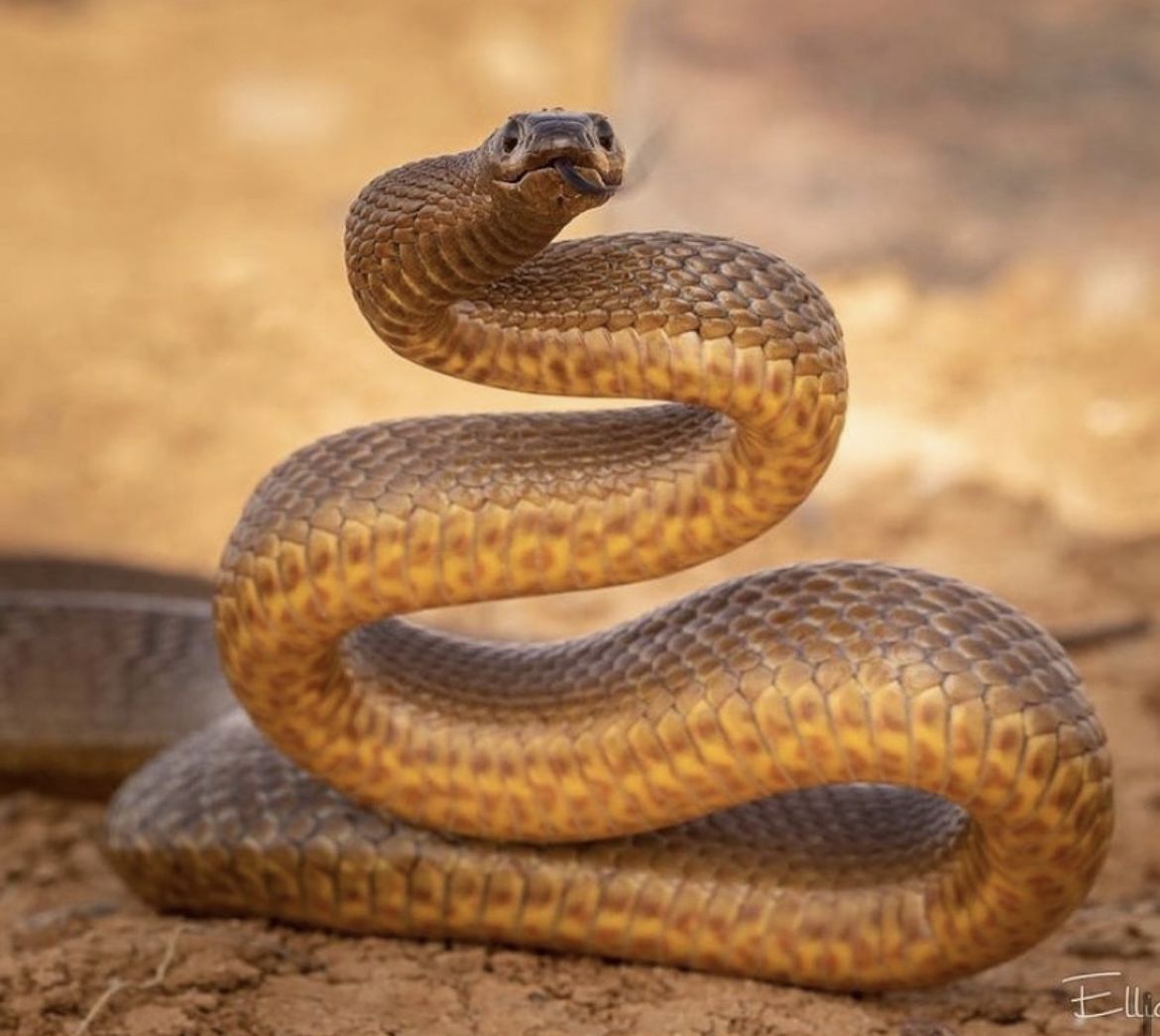
The inland taipan is the most venomous land snake on Earth. No other terrestrial serpent comes close. Its venom is roughly fifty times more toxic than that of a king cobra and ten times more toxic than a black mamba, and a single average bite carries enough neurotoxin to kill an estimated one hundred adult humans.
Yet despite these staggering statistics, there is not a single confirmed human fatality from an inland taipan bite since antivenom became available in 1955. The snake lives far from people, shuns confrontation, and spends most of its life concealed in soil cracks on the empty floodplains of central Australia.
This entry covers every aspect of inland taipan biology: taxonomy and discovery, the anatomy and chemistry of the world's most potent land venom, the species' mammal-specialist diet, the boom-and-bust ecology of the channel country, thermoregulation and seasonal colour change, reproduction, conservation, and the relationship between Oxyuranus microlepidotus and the humans who occasionally cross its path.
Etymology and Classification
The scientific name Oxyuranus microlepidotus combines Greek and Latin roots. Oxyuranus translates roughly as 'sharp arch of the palate', referring to the needle-like projection on the roof of the mouth that all three taipan species share. Microlepidotus means 'small-scaled', a diagnostic feature that distinguishes the species from its coastal relative.
In Australian English the species carries two common names: 'inland taipan' and 'fierce snake'. The latter predates any scientific knowledge of its venom potency and refers to the explosive multi-bite defensive strike, not to general temperament.
The inland taipan sits in the family Elapidae, the front-fanged proteroglyphous snakes, alongside cobras, mambas, sea snakes, and coral snakes. Within Elapidae it shares the genus Oxyuranus with two other species: the coastal taipan (Oxyuranus scutellatus) and the central ranges taipan (Oxyuranus temporalis), the latter described only in 2007.
Molecular studies suggest the inland taipan and coastal taipan diverged between five and ten million years ago as arid interior habitats expanded and separated populations.
Discovery and the 88-Year Gap
The discovery history of O. microlepidotus is unusually strange for a large, brightly distinctive snake. The first known specimen was collected in 1879 near Cooper Creek in the far west of the Darling basin. The collector was Ram Singh, an Indian cameleer attached to Australian exploration expeditions.
Singh's specimen reached the hands of Victorian paleontologist and zoologist Frederick McCoy, who formally described the species that same year under the name Diemenia microlepidota. The type specimen was catalogued, stored, and then effectively forgotten. For 88 years no further inland taipans appeared in Australian museum collections.
Local station workers and Aboriginal communities along the channel country continued to encounter the snake and knew it as the fierce snake, but the zoological establishment had no confirmed sightings to connect with McCoy's description.
The rediscovery came in 1967, when Queensland Museum herpetologist Jeanette Covacevich, acting on a tip from a grazier near Morney Station, collected fresh specimens and confirmed they matched McCoy's 1879 description. Follow-up work by Covacevich and colleague Charles Tanner in the 1970s re-established the species in the scientific record and mapped the core channel country range.
A second wave of attention followed when Melbourne toxinologist Struan Sutherland and colleagues assayed the venom in the mid-1970s and demonstrated that it was, by subcutaneous LD50 in mice, the most potent land snake venom ever measured. The inland taipan shifted overnight from obscure Australian curiosity to headline-grabbing holder of a global toxicological record.
Size and Physical Description
Inland taipans are medium-large elapids, slender for their length and built for rapid movement through narrow soil cracks rather than for constriction or power.
Adult dimensions:
- Length: 1.8-2.5 metres, with 1.8 m typical
- Weight: 1-3 kg depending on condition and prey availability
- Scale rows at mid-body: 23
- Ventral scales: 211-250
- Head: rectangular, only slightly distinct from the neck
Hatchlings:
- Length at emergence: approximately 47 cm
- Weight at emergence: 9-13 grams
- Growth rate: rapid during rodent boom years, slow during busts
The snake's head is smaller in proportion than the coastal taipan's and lacks the pronounced 'coffin-shaped' outline of its relative. Eyes are large and dark with round pupils, a feature typical of diurnal elapids. The fangs sit at the front of the upper jaw, are fixed in position, and measure 3.5-6.2 mm - short compared with viperid fangs but more than sufficient to penetrate the skin of rodent prey or a human hand.
The most distinctive visual feature of the inland taipan is seasonal colour change. Unlike many snakes, O. microlepidotus undergoes a marked shift in skin colouration between summer and winter.
- Summer coat: pale straw, olive, or light brown, sometimes faintly greenish. The head is lighter and less sharply demarcated from the body.
- Winter coat: dark olive to glossy black, especially on the head and forebody. The darker skin absorbs more solar radiation during the brief morning basking window when air temperatures are cool.
This thermoregulatory colour shift is rare among large snakes and is one of several features that mark the species as specialised for extreme arid-zone life.
Built for the Channel Country
The inland taipan's core range is the channel country, a system of braided floodplains and ephemeral watercourses that drain interior Queensland and adjacent parts of South Australia and the Northern Territory. The Diamantina River, Cooper Creek, and Georgina River are the defining watercourses. After heavy rains, water spreads across the plains in shallow channels that eventually evaporate, leaving behind cracked clay flats that can extend for kilometres.
These cracking clay soils are central to inland taipan ecology. When wet, the clay swells and seals. When dry, it contracts and splits into deep fissures - sometimes more than a metre deep. The fissures provide:
- Thermal refuge against daytime heat and nighttime cold
- Ambush cover for hunting rodents
- Egg-laying sites with stable humidity
- Protection from aerial predators such as birds of prey
Air temperatures in the channel country routinely exceed 45 degrees Celsius in summer. The inland taipan manages this extreme thermal environment through a combination of behaviour (seasonal colour change, retreat into fissures during midday heat, basking at burrow entrances in early morning) and physiology (tolerant of high body temperatures by snake standards but still dependent on shade for survival above 40 degrees).
Venom and Toxicology
The inland taipan's venom is the most potent land snake venom ever measured by the standard laboratory test: murine subcutaneous LD50. At 0.025 mg/kg, the venom is approximately fifty times more toxic than that of a king cobra and ten times more toxic than a black mamba. A single average bite delivers 44 mg of venom, with maximum recorded yields around 110 mg - enough to theoretically kill 100 adult humans or 250,000 mice.
Venom composition:
| Component | Role |
|---|---|
| Taipoxin | Presynaptic neurotoxin, blocks nerve-muscle signalling |
| Paradoxin | Closely related neurotoxin, contributes to paralysis |
| Procoagulants | Trigger runaway clotting, exhaust fibrinogen (consumptive coagulopathy) |
| Myotoxins | Break down skeletal muscle, release myoglobin |
| Haemotoxins | Damage vascular endothelium, cause internal bleeding |
| Nephrotoxic components | Drive acute kidney injury in untreated bites |
The venom is optimised for rapid kill of small warm-blooded prey. When the snake strikes a long-haired rat, the victim is typically paralysed and dead within minutes. This is an adaptation to the channel country's cracking-clay environment: a prey animal that runs fifty metres into a soil fissure before dying is a prey animal that the snake may never recover. Rapid, overwhelming venom toxicity is the solution.
In a human bite, untreated envenomation progresses in a predictable clinical sequence:
- Minutes 0-30: pain at bite site (often surprisingly mild), tingling around mouth, headache
- Minutes 30-90: vomiting, sweating, abdominal pain, early neurotoxic signs including ptosis (drooping eyelids)
- Hours 1-3: progressive flaccid paralysis, inability to swallow, respiratory compromise
- Hours 2-6: consumptive coagulopathy, spontaneous bleeding, haematuria
- Hours 6-24: acute kidney injury, cardiac arrhythmias
- Beyond 24 hours untreated: death from respiratory failure or intracranial bleeding
Fortunately, all of this is reversible with prompt antivenom and supportive care. Taipan antivenom, developed by Commonwealth Serum Laboratories in 1955, neutralises both inland and coastal taipan venoms. Every documented human bite since that date has survived, given that Australian medical services can deliver antivenom within a few hours.
Hunting and Diet
Unlike most Australian elapids, which take a varied diet including lizards, frogs, birds, and other snakes, the inland taipan is a mammal specialist. Its diet is dominated by a handful of rodent species, and its population dynamics follow those prey species with remarkable precision.
Primary prey:
- Long-haired rat (Rattus villosissimus) - by far the most important
- Native plains mouse (Pseudomys australis)
- Spinifex hopping mouse (Notomys alexis)
- House mouse (Mus musculus) during plague years
- Occasional dasyurids (small carnivorous marsupials)
The long-haired rat is the engine of inland taipan ecology. Populations of this species undergo massive boom-and-bust cycles driven by rainfall in the channel country. After good wet seasons, the rats erupt into plague proportions - millions of individuals per square kilometre in some reports.
Inland taipan populations respond within a single breeding season, with females producing larger clutches and juvenile survival spiking. When the rodent plague collapses, as it always does, taipan populations crash in turn.
Hunting technique:
- The snake locates a rodent by scent and heat inside a soil crack or burrow.
- It pushes into the crack, often disappearing entirely below ground.
- A rapid strike delivers multiple bites - up to eight in a sequence - ensuring a lethal dose.
- The snake withdraws a short distance and waits for the venom to immobilise the prey.
- Consumption follows head-first, often without leaving the soil crack.
This underground hunting style keeps the inland taipan almost invisible to surface observers, which is one reason it remained missing from science for nearly ninety years.
Reproduction
Inland taipan reproduction is tightly keyed to food availability. During rodent boom years, females can produce two clutches in a single breeding season; during bust years, many females skip breeding entirely.
Breeding cycle:
- Spring mating (September-November)
- Gestation: 9-11 weeks inside the female
- Oviparous - eggs are laid, not live-born
- Clutch size: typically 11-20 eggs, with records up to 24
- Incubation: 9-11 weeks in abandoned burrows or deep soil cracks
- Hatchlings emerge in late summer, approximately 47 cm long
Unlike viperids, which often give live birth, all Oxyuranus species are egg-layers. The female selects a humid, thermally stable site - typically a deep soil fissure or an abandoned mammal burrow - and leaves the eggs to incubate without parental care. Hatchlings are self-sufficient from emergence and begin hunting small rodents within days. Sexual maturity is reached at 24-36 months in well-fed individuals.
Lifespan and Growth
In the wild, inland taipans typically live 10-15 years. The harsh channel country environment, drought-driven food collapses, and predation on juveniles by raptors and larger snakes keep average lifespan well below the species' physiological maximum. In captivity, where food and temperature are controlled, inland taipans have lived more than 20 years. Growth is rapid during boom years and nearly arrested during busts.
Distribution and Habitat
The inland taipan occupies one of the smallest core ranges of any large Australian elapid. Its distribution clusters around the cracking-clay floodplains of central Australia where three state boundaries meet.
| Region | Status |
|---|---|
| South-west Queensland | Core range |
| North-east South Australia | Core range |
| South-east Northern Territory | Peripheral |
| New South Wales (historical) | Rare, mostly boom-year drift |
| Coastal Australia | Absent |
The species has never been recorded from the Australian coast. Habitat specialisation is extreme: inland taipans require cracking clay soils, access to small-mammal prey populations, and the absence of sustained human disturbance. These conditions are common across the channel country and nearly absent elsewhere.
Conservation Status and Threats
The IUCN lists the inland taipan as Least Concern. The core range is one of the most sparsely populated regions on the Australian continent and has seen relatively little modification from agriculture, mining, or development. Population estimates are unreliable because the species' boom-bust ecology produces order-of-magnitude swings in abundance, but long-term population trends appear stable.
Recognised and potential threats:
- Climate change. Long-term drying trends in the channel country could reduce the frequency of rodent booms and shrink the soil-cracking regime the species depends on.
- Invasive species. Cane toads (Rhinella marina) have devastated elapid populations across northern Australia. The channel country is at the southern edge of the toad's potential range; arrival is a real long-term risk.
- Livestock grazing. Heavy cattle grazing degrades cracking-clay habitat and reduces native rodent populations, indirectly threatening taipan food supplies.
- Direct human persecution. Limited because encounters are rare, but occasional bites to snake handlers and station workers still generate retaliatory killings.
The species is legally protected under Australian state wildlife legislation in Queensland, South Australia, and the Northern Territory. Export is regulated under Commonwealth law. No dedicated recovery programme exists because the population is considered stable, but ongoing rodent monitoring in the channel country provides indirect population data.
Inland Taipans and Humans
For a snake with the world's most toxic land venom, the inland taipan has a remarkably gentle record with humans. There are no confirmed fatalities since taipan antivenom was developed in 1955. Every documented bite has occurred to professional snake handlers, venom collectors, or researchers - never to a member of the general public in routine circumstances. All victims have survived after prompt medical treatment.
Two factors explain the contrast between lethal potential and actual harm:
- Habitat remoteness. The inland taipan lives far from towns, farms, and roads. The channel country has a human population density of less than 0.1 people per square kilometre in most areas.
- Behaviour. The species is shy and reclusive. When encountered it retreats into soil cracks. Defensive strikes occur only when the snake is cornered or physically handled.
The inland taipan has entered Australian popular culture as a kind of quiet superlative - the world's deadliest snake that nobody ever sees. Captive specimens at Australian zoos and venom research laboratories support antivenom production, toxicology research, and public education. Wild encounters remain so rare that many Australians go their entire lives without seeing one, even in the core range.
Related Reading
- Rattlesnake: Pit Viper of the Americas
- Gila Monster: Venomous Lizard of the Sonoran Desert
- Venomous Reptiles: How Venom Works and Why It Evolved
References
Relevant peer-reviewed and governmental sources consulted for this entry include the Australian Venom Research Unit taipan toxicology assessments, Commonwealth Serum Laboratories antivenom production data, IUCN Red List 2018 assessment of Oxyuranus microlepidotus, Queensland Museum historical records of the 1879 type specimen and 1967 rediscovery, and research published in Toxicon, Journal of Herpetology, and the Australian Journal of Zoology.
Specific venom LD50 figures reflect the most widely cited subcutaneous murine assays compiled in international toxinology reviews.
Frequently Asked Questions
How venomous is the inland taipan?
The inland taipan (Oxyuranus microlepidotus) is the most venomous land snake on Earth. Its venom has a murine subcutaneous LD50 of roughly 0.025 mg/kg, meaning a dose of twenty-five micrograms per kilogram of body weight is enough to kill half of all mice exposed. This is approximately fifty times more toxic than a king cobra and ten times more toxic than a black mamba.
A single average bite delivers 44-110 mg of venom, enough to kill an estimated 100 adult humans or about 250,000 mice. The venom is a cocktail of neurotoxins (including taipoxin), procoagulants, myotoxins, and haemotoxins that cause paralysis, internal bleeding, and muscle breakdown within 30-45 minutes if untreated.
Has anyone ever died from an inland taipan bite?
There are no confirmed human fatalities from an inland taipan bite since antivenom became available in 1955. This is a striking contrast with the snake’s venom potency and reflects two factors: the inland taipan lives in extremely remote arid country where human contact is rare, and it is a shy, reclusive species that prefers retreat over confrontation.
Every documented bite on record has involved snake handlers, herpetologists, or researchers - not members of the general public. All bite victims have survived thanks to rapid administration of taipan antivenom, which is effective against both inland and coastal taipan species.
Where does the inland taipan live?
The inland taipan inhabits a small, arid region of central Australia known as the channel country, where the borders of Queensland, South Australia, and the Northern Territory meet. It specialises in the cracking-clay floodplains around the Diamantina River, Cooper Creek, and their tributaries. These soils dry out in summer and split into deep fissures that provide shelter, hunting cover, and thermal refuge.
The range is one of the most sparsely populated regions on the continent. The species does not occur along the Australian coast - that territory belongs to its larger relative, the coastal taipan (Oxyuranus scutellatus).
What do inland taipans eat?
Inland taipans are mammal specialists, an unusual dietary niche for an Australian elapid. Their primary prey is the long-haired rat (Rattus villosissimus), along with native hopping mice, plains mice, and other small rodents. Boom-and-bust cycles drive the population: after good rains, long-haired rat populations erupt into plague proportions across the channel country, and taipan numbers rise rapidly.
During dry years when rodents crash, taipan populations collapse correspondingly. A single taipan will kill and eat a rodent every few days during boom years, typically ambushing prey inside burrows or soil cracks and delivering multiple rapid bites to ensure a quick kill before retreating to wait for the venom to act.
How big is an inland taipan?
Adult inland taipans typically reach 1.8 metres in length, with large individuals growing to 2.5 metres. They are slender for their length - typical weight is 1-3 kg. The head is rectangular and slightly distinct from the neck. Scale counts are diagnostic: 23 rows of mid-body scales arranged in a smooth, polished pattern (the species name microlepidotus means ‘small-scaled’). Juveniles hatch at around 47 cm long and grow rapidly during rodent boom years.
Sexual size dimorphism is modest, with males sometimes slightly longer than females, but overall the species is considerably smaller than its coastal cousin.
Why is it called the fierce snake?
The nickname ‘fierce snake’ refers to the species’ strike behaviour, not its overall temperament. When cornered or provoked, an inland taipan can deliver up to eight rapid, accurate bites in a single defensive sequence lasting only a few seconds. Each bite injects a lethal dose of venom. The strike is S-shaped, lightning-fast, and often difficult to see. Outside of active defence, however, the inland taipan is famously shy and reclusive.
It prefers to retreat into burrows or soil cracks rather than engage. Herpetologists who work with the species describe it as calm compared with more excitable elapids like mulga snakes or brown snakes.
When was the inland taipan discovered?
The first scientific specimen was collected in 1879 near Cooper Creek by Ram Singh, an Indian cameleer working with Australian explorer expeditions. Frederick McCoy formally described the species that year. The specimen was subsequently lost in museum collections, and no further inland taipans were recorded for 88 years.
The species was effectively forgotten until 1967, when herpetologist Jeanette Covacevich rediscovered specimens near Morney Station in Queensland and confirmed that the ‘fierce snake’ of local lore was in fact the same species described by McCoy. Follow-up research by Struan Sutherland in the 1970s established its venom potency as the highest of any land snake.
Is the inland taipan endangered?
The IUCN lists the inland taipan as Least Concern. Its channel country habitat is sparsely populated by humans and has seen relatively little modification from agriculture or development. The main ecological threat is drought-driven collapse of its rodent prey base, but populations rebound rapidly during the next boom cycle.
Climate change is a longer-term concern because the species relies on cracking-clay soils that form under specific rainfall-evaporation regimes. Cane toads, which have devastated other Australian snake populations, have not yet reached the core range. The species is legally protected in all three Australian states it inhabits.