
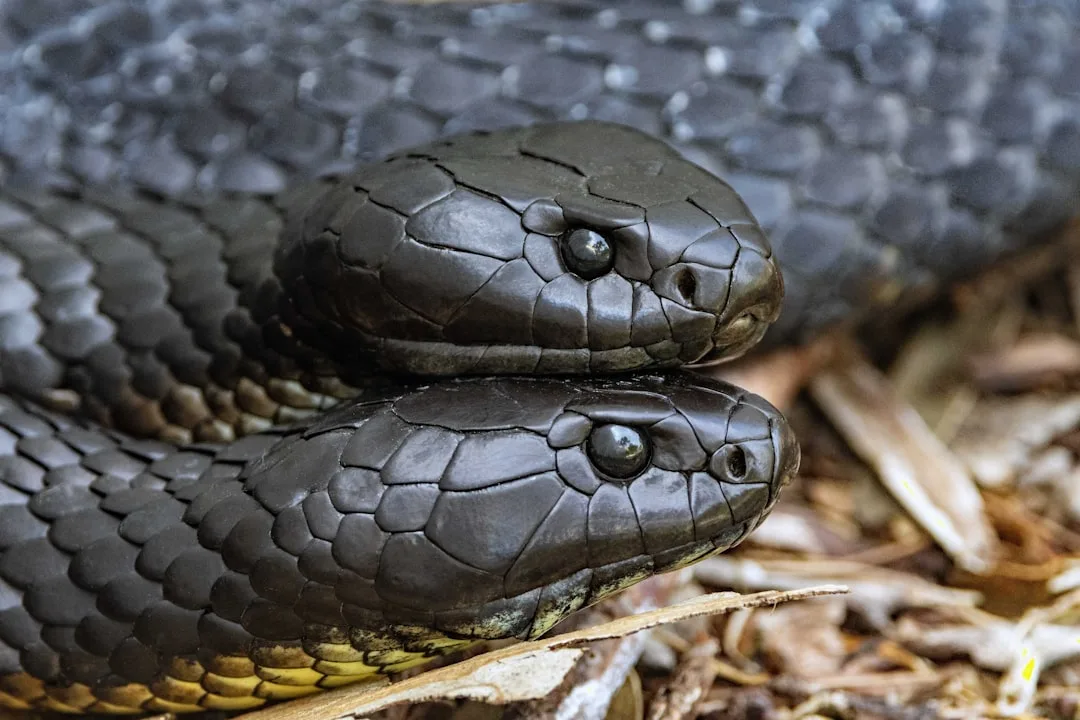
The eastern brown snake is the single most lethal snake in Australia by confirmed human fatality count. It is not the most venomous snake in the world - that distinction belongs to its fellow Australian, the inland taipan - but its venom is the second most toxic of any land snake, and unlike the reclusive, desert-dwelling taipan, Pseudonaja textilis lives in direct daily contact with humans.
It patrols wheat paddocks, sheep country, suburban backyards, schoolyards, and outer-city industrial estates. It hunts during the day. It moves fast. It stands its ground when cornered. And its venom can kill an unprotected adult in under thirty minutes.
This guide is a reference entry on the species rather than a quick summary. Expect specifics: milligrams of venom, millimetres of fang, minutes of clinical onset, the rodent ecology that fuels the snake's population, the coagulation cascade that its venom targets, and the anti-venom protocols that have cut the case fatality rate from roughly forty per cent down to less than one.
By the end of this article you should understand why the eastern brown is the only Australian snake most state ambulance services train their officers to identify on sight.
Etymology and Classification
The genus name Pseudonaja means 'false cobra', coined because these snakes share a superficial resemblance to true cobras (Naja) when they rear up and flatten the neck in threat. The species epithet textilis, meaning 'woven' or 'textile-like', was chosen by Andre-Marie Constant Dumeril and colleagues in 1854 in reference to the fine cross-banding visible on some specimens' scales.
"Brown snake" in Australian usage refers to a colour, not a taxonomic group. Several distantly related species are called brown snakes by the public, and a single eastern brown can range from pale tan through orange-brown, grey-brown, olive, and almost black across its range and life stages. Juveniles often carry a distinctive black head cap and neck band that fades with maturity.
Adults can be unicoloured, cross-banded, or speckled. Colour is therefore useless as an identification tool - only scale counts, head shape, and behaviour reliably diagnose the species.
The eastern brown sits within the family Elapidae, the front-fanged proteroglyph venomous snakes that include cobras, mambas, coral snakes, and the Australian radiation that produced taipans, tigers, death adders, and mulga snakes.
Within Pseudonaja, there are at least nine recognised species, including the western brown (P. mengdeni), the dugite (P. affinis), the speckled brown (P. guttata), and the Ingram's brown (P. ingrami). P. textilis itself has recently been shown by molecular studies to contain substantial regional genetic diversity, and further taxonomic splits are possible.
Size and Physical Description
The eastern brown is a medium-to-large elapid with a slender build and extraordinary speed for its length.
Typical adult dimensions:
- Length: 1.1-1.8 metres total
- Maximum verified: approximately 2.4 metres
- Weight: 0.5-2.5 kg depending on size and feeding condition
- Head: small, only faintly distinct from the neck, with large round-pupiled eyes
- Body: smooth, slender, with a long whip-like tail comprising around 20% of total length
Scale counts are the definitive diagnostic feature. The eastern brown typically has 17 rows of smooth mid-body scales, a divided anal plate, and a complete series of paired subcaudal scales. These counts distinguish it from superficially similar Australian species such as the king brown (which is not actually a brown snake but a member of Pseudechis) or the yellow-faced whip snake.
Coloration, as noted above, varies enormously:
- Ground colour: pale tan, orange-brown, chestnut, grey-brown, olive, to near black
- Ventral surface: cream to pale yellow, often with irregular orange spots or blotches
- Juveniles: frequently banded, with a dark head cap and neck band that may persist or fade
- Geographic variation: populations in the north tend toward paler, more banded forms; southern animals are frequently darker and more uniform
Where It Lives
The eastern brown snake is one of the most widely distributed venomous snakes in mainland Australia, occupying a huge arc from Cape York Peninsula in northern Queensland, southward through the eastern half of the continent across New South Wales, Victoria, and into eastern South Australia. A disjunct population occupies the savannas of southern Papua New Guinea, probably representing a connection dating to the last glacial sea-level lowstand when Australia and New Guinea were joined.
Preferred habitats:
- Native grasslands and open woodlands
- Floodplains and riverine grassland
- Cleared agricultural land - paddocks, wheat and barley fields, stock routes
- Rocky outcrops and scree slopes
- Urban fringe environments - outer suburbs, industrial estates, backyards bordering grassland
- Sheds, woodpiles, haystacks, and compost heaps used as shelter
Habitats it avoids:
- Closed-canopy rainforest
- High alpine country above approximately 1,500 metres
- Permanently waterlogged swamp
- True desert interior (outcompeted there by other species)
Crucially, the eastern brown is one of the few Australian venomous snakes that has actively benefited from European settlement. Agricultural clearing created more of its preferred open-grassland habitat. Grain silos, chicken coops, haystacks, and the introduction of European and Asian rodents created prey densities far higher than those sustained by natural Australian ecosystems.
In Victoria, eastern browns are now the most frequently encountered deadly snake - in large part because Melbourne has expanded into country that was formerly sheep paddock and native grassland.
Hunting and Diet
Unlike many large elapids that ambush from cover, the eastern brown is an active diurnal hunter. It patrols open ground during daylight, moving with surprising speed - up to around 20 km/h over short distances - with the head raised a few centimetres above the ground to catch airborne scent trails. Prey is located by a combination of vision and vomeronasal scent sampling via the forked tongue.
Principal prey by life stage:
| Life stage | Dominant prey |
|---|---|
| Hatchling (<40 cm) | Small skinks, geckos, frogs |
| Juvenile (40-80 cm) | Lizards, frogs, occasional nestling birds |
| Subadult (0.8-1.2 m) | Lizards, small mammals, other small snakes |
| Adult (>1.2 m) | Rodents, small birds, snakes, lizards |
Adult diet is dominated by rodents, and the species has become functionally dependent on introduced house mice (Mus musculus) and black rats (Rattus rattus) across much of its range. Native rodents - hopping mice, bush rats, native field mice - remain important in less modified country. Other snakes, including smaller elapids and blind snakes, are taken opportunistically, making the eastern brown a genuine ophiophage (snake-eater).
Strike sequence:
- Approach: rapid low-profile movement toward located prey.
- Strike: single fast bite, delivered with the body in a tight S-coil.
- Release: the snake typically releases after envenomation rather than holding.
- Track: prey is pursued by scent for the few seconds or minutes it takes venom to act.
- Consume: head-first swallowing once the prey is fully immobilised.
Agricultural landscapes dramatically inflate local populations. In rat-plague years, driven by good rainfall and cereal production in eastern Australia, eastern brown densities can rise to the point where farmers report multiple sightings per day on a single property. These plagues also drive annual spikes in snakebite presentations at regional hospitals.
Venom and Clinical Toxicology
The eastern brown snake is a medical marvel - and a medical nightmare - because its venom combines extreme potency with a distinctive clinical signature unlike any other Australian elapid.
Quantitative profile:
| Parameter | Value |
|---|---|
| Murine subcutaneous LD50 | ~0.053 mg/kg (2nd most toxic land snake) |
| Venom yield per milking | 2-6 mg dry weight (exceptionally low) |
| Fang length | 2.8-4 mm (short for a large elapid) |
| Mean time to systemic symptoms | 10-30 minutes |
| Untreated case fatality rate | Estimated 10-40% historically |
| Treated case fatality rate | ~0.5% with prompt antivenom |
Major venom components:
- Prothrombin activators (pseutarin C and related complexes): the defining toxin group. These enzymes convert prothrombin to thrombin in the victim's bloodstream at extraordinary rates, triggering runaway clotting throughout the microcirculation.
- Presynaptic neurotoxins (textilotoxin and related proteins): once considered the most potent neurotoxins isolated from any snake; cause irreversible presynaptic paralysis of neuromuscular junctions.
- Postsynaptic neurotoxins: contribute to ptosis (drooping eyelids) and facial muscle weakness, usually the first visible clinical sign.
- Smaller amounts of phospholipase A2 and cardiotoxic components.
Clinical course of untreated envenomation:
- 0-15 minutes: Bite site often minimally painful. Early symptoms include headache, nausea, and transient collapse. Ptosis may begin within fifteen minutes.
- 15-60 minutes: Venom-induced consumption coagulopathy (VICC) develops rapidly. Clotting factors are consumed and the blood becomes unable to clot. Bleeding from gums, venipuncture sites, and old wounds may appear.
- 1-6 hours: Progressive flaccid paralysis, respiratory muscle weakness. Thrombotic microangiopathy may emerge, damaging the kidneys and causing haemolysis.
- 6-24 hours: Death from intracranial haemorrhage, cardiac arrest, or respiratory failure if untreated. Survivors face acute kidney injury requiring dialysis in a significant minority of cases.
Treatment:
Standard Australian first aid is pressure-immobilisation bandaging, which compresses lymphatic vessels to slow systemic venom spread without cutting off arterial blood supply. Immediate transport to a hospital with antivenom is essential. Monovalent brown snake antivenom is effective against all Pseudonaja species. Polyvalent snake antivenom is used where species identification is not possible.
Fresh frozen plasma is sometimes given to restore clotting factors after VICC, though antivenom remains the definitive therapy.
Despite the venom's extreme potency, approximately only 15 bites per year in Australia progress to clinically significant envenomation that would be fatal without treatment. Many encounters result in dry bites (no venom injected) or minor envenomations, because the eastern brown's venom yield is small and it does not always inject when striking defensively.
Defensive Behaviour - the S-Shape Threat Display
Eastern browns are not aggressive by the strict zoological definition - they do not seek out encounters with humans - but they are highly defensive and extremely fast. When cornered, the typical sequence runs:
- Flight attempt: the snake tries to retreat. Most encounters end here.
- S-coil stance: if blocked, the snake lifts the front third of its body off the ground in a tight S-curve, mouth open, eyes on the threat.
- Warning strikes: short lunges toward the threat, often with closed mouth or dry bites.
- Committed bite: if the threat continues to close, a full envenomating strike is delivered.
The S-shape threat display is one of the most recognisable postures in Australian herpetology and is worth memorising if you live within the species' range. A brown snake holding this pose has already decided to fight if you do not back away.
Eastern browns can strike with startling reach. A snake coiled in the classic S can deliver a bite at a distance equivalent to roughly half its body length, meaning a 1.5-metre snake can reach a target 70 centimetres away in a fraction of a second. Unlike most snakes, eastern browns are willing to chase a close threat briefly before returning to retreat mode, which has contributed to their reputation for aggression.
Reproduction and Life Cycle
The eastern brown snake is oviparous - one of the relatively few Australian elapids that lay eggs rather than bear live young.
Reproductive timeline:
- Spring (September-November): Mating season. Males engage in combat wrestling where two males intertwine and attempt to pin each other's heads to the ground. No biting is involved, and the loser leaves unharmed.
- Late spring to early summer (November-December): Females lay 10-35 eggs in deep burrows, rotting log cavities, rock fissures, or abandoned rabbit warrens. Communal nesting occurs occasionally, with several females depositing eggs in the same shelter.
- Incubation: 65-95 days depending on soil temperature. Eggs are soft-shelled and absorb moisture from the surrounding substrate.
- Hatching (January-March): Hatchlings emerge at approximately 27 cm and 5-7 grams. They are fully venomous from the moment of emergence.
Hatchlings disperse immediately. Parental care is absent, which is standard for elapids. Juvenile mortality is very high - predation by kookaburras, butcherbirds, goannas, and other snakes accounts for most losses. Survivors reach sexual maturity at roughly two to three years and continue to grow throughout life, though growth slows after maturity.
Wild eastern browns typically live around 15 years, with exceptional individuals reaching 20. Captive specimens in Australian zoos and reptile parks have occasionally exceeded 20 years under managed care.
Predators, Competitors, and Ecology
Despite their venom, eastern browns are far from apex. Australian ecosystems contain several predators that specialise in snakes or regularly take them opportunistically.
Known predators:
- Brown falcon (Falco berigora) and black-shouldered kite
- Kookaburras (Dacelo novaeguineae)
- Sand and lace monitors (Varanus gouldii, V. varius)
- Mulga snakes (Pseudechis australis) - ophiophagous
- Feral cats, foxes, and pigs (introduced)
- Cane toads (indirectly - brown snakes that try to eat them die from bufotoxin)
The arrival of the cane toad (Rhinella marina) across northern Australia has reduced eastern brown populations in parts of Queensland. Naive snakes attempt to eat the toads and die from ingestion of the toad's lipophilic bufotoxins. Some populations appear to be evolving increased toxin resistance, but the process is slow and incomplete.
Feral cats and red foxes kill hatchling and juvenile browns in large numbers across the southern range. Adult browns are generally too large and too dangerous for cats to tackle but remain vulnerable to fox predation at night during torpor.
Relationship with Humans
No Australian reptile has a more tangled relationship with humans than the eastern brown. It is simultaneously:
- The deadliest snake in Australia by fatality count (roughly two deaths per year; roughly 60% of all Australian snakebite deaths).
- A protected species under state wildlife legislation, with significant fines for killing one without cause.
- A beneficiary of European settlement, its populations boosted by introduced rodents.
- A provider of antivenom - Australian eastern browns supply the venom milked at places like the Australian Reptile Park for manufacture of life-saving antivenom.
- A rat-control agent welcomed by many farmers, whose sheep and grain are protected by a resident brown keeping rodent populations down.
Snake-catching services in most eastern Australian cities will relocate eastern browns from residential properties rather than killing them. Protocols for householders are consistent across state health departments: do not try to kill the snake, do not attempt capture, keep people and pets indoors, note the snake's rough direction if it moves away, and call a licensed snake catcher if it does not leave.
First aid education is widely delivered in rural schools. The pressure-immobilisation bandage technique, developed in Australia in the late 1970s, dramatically slows lymphatic spread of venom and has been credited with saving many lives in the interval between bite and hospital. Every rural ambulance in eastern Australia carries brown snake antivenom or polyvalent antivenom.
Conservation Status
The IUCN Red List classifies Pseudonaja textilis as Least Concern. The species is widespread, locally abundant, and generally stable or increasing in population. It is legally protected in all Australian states, where killing or harassing one without justification can attract fines of several thousand dollars.
Key threats - none currently population-level:
- Cane toad invasion in the northern range
- Road mortality near expanding urban centres
- Habitat fragmentation for specific local populations
- Climate-driven shifts in rainfall that could alter rodent prey cycles
The species' close association with agricultural land means its long-term future is closely tied to how Australian farming evolves. A shift away from grain storage and open grazing, or widespread rodent eradication campaigns, could reduce eastern brown populations more than any direct threat. For now, however, the eastern brown snake remains one of the most secure large venomous snake species in the world - and one of the most medically important.
Related Reading
- Inland Taipan: The World's Most Venomous Land Snake
- Venomous Reptiles: How Venom Works and Why It Evolved
- Rattlesnake: North America's Most Famous Pit Viper
- Gila Monster: North America's Venomous Lizard
References
Relevant peer-reviewed and governmental sources consulted for this entry include clinical toxicology reports from the Australian Venom Research Unit (University of Melbourne), the Australian Snakebite Project (ASP), IUCN Red List assessments for Pseudonaja textilis, field guides published by CSIRO Publishing, and research papers in Toxicon, Clinical Toxicology, Journal of Herpetology, and the Medical Journal of Australia.
Fatality statistics reflect consolidated Australian coronial data and published epidemiological summaries through the most recent available reporting period.
Frequently Asked Questions
Why is the eastern brown snake the deadliest snake in Australia?
The eastern brown snake (Pseudonaja textilis) causes more human fatalities in Australia than any other snake species - approximately two confirmed deaths per year and roughly 60% of all snakebite deaths on the continent. This is not because its venom is the most toxic (the inland taipan holds that title), but because the eastern brown lives in direct contact with humans. Its preferred habitat is grassland, farmland, and urban fringe.
It is diurnal and therefore active during human working hours. It is fast, alert, and holds its ground when cornered. The combination of extreme venom potency, high encounter rate, and rapid procoagulant action - which can kill an adult within 30 minutes if untreated - makes it the most statistically dangerous snake in Australia.
How venomous is the eastern brown snake?
The eastern brown snake has the second most toxic venom of any land snake in the world. Its murine subcutaneous LD50 is approximately 0.053 mg/kg, meaning fifty-three micrograms per kilogram of body weight is enough to kill half of exposed mice. Only the inland taipan (Oxyuranus microlepidotus), at around 0.025 mg/kg, is more potent.
Venom yields per bite are small - typically 2-6 mg, far less than larger elapids such as taipans or king cobras - but the extreme potency means that even tiny injected doses are clinically significant. The venom is dominated by procoagulants (prothrombin activators) and potent neurotoxins (textilotoxin and related proteins), producing a distinct clinical picture built around disseminated intravascular coagulation and flaccid paralysis.
Where does the eastern brown snake live?
The eastern brown snake occupies a broad swath of eastern and central Australia, from the Cape York Peninsula in northern Queensland down through New South Wales, Victoria, and into eastern South Australia. A disjunct population also occurs in the savannas of southern Papua New Guinea. Preferred habitats are open grasslands, woodland edges, floodplains, and agricultural land - paddocks, wheat fields, and cattle country are ideal.
The species has adapted unusually well to human-modified landscapes, including urban fringe developments where rodent populations flourish. It avoids dense rainforest and high alpine country but is otherwise one of the most widely distributed venomous snakes on the Australian mainland.
What does the eastern brown snake eat?
Eastern brown snakes are diurnal active hunters with a varied carnivorous diet. Juveniles feed primarily on lizards and frogs, gradually shifting toward warm-blooded prey as they grow. Adults prey heavily on rodents - especially introduced house mice (Mus musculus) and black rats (Rattus rattus) - along with small birds, lizards, frogs, and other snakes, including smaller elapids.
The species actively hunts during the warm parts of the day, quartering open ground with the head raised to scent for prey and using speed rather than ambush to secure a kill. Prey is bitten once, released, tracked by scent, and swallowed once the venom has acted. Agricultural landscapes dramatically inflate local populations because stored grain and livestock feed concentrate rodents.
How big do eastern brown snakes get?
Adult eastern brown snakes typically measure 1.1 to 1.8 metres in total length, with weight ranging from 0.5 to 2.5 kilograms. Exceptional individuals reach about 2.4 metres, though such specimens are rare. Males tend to be slightly longer and heavier than females on average.
The body is slender, the head small and only faintly distinct from the neck, and the eyes are proportionately large with round pupils - features consistent with a visually oriented diurnal hunter. Colour ranges from pale tan, orange-brown, grey-brown, to almost black, with the ventral surface typically cream to yellow with irregular orange blotches.
Hatchlings emerge at roughly 27 centimetres long and often display a distinctive black head and neck band that fades with age.
What happens if an eastern brown snake bites you?
A confirmed envenomation from an eastern brown snake is a medical emergency. The venom triggers venom-induced consumption coagulopathy, a condition in which procoagulant toxins activate the clotting cascade so aggressively that the body consumes its own clotting factors within minutes. The blood then becomes paradoxically incoagulable, and patients can suffer catastrophic internal or cerebral haemorrhage.
Neurotoxins concurrently cause flaccid paralysis - ptosis (drooping eyelids) is often the first sign, progressing to respiratory muscle failure. Cardiac arrest from thrombotic microangiopathy occurs in a minority of cases, sometimes within 30 minutes of the bite. Standard first aid is immediate pressure-immobilisation bandaging of the entire affected limb and urgent transport to a hospital capable of administering brown snake antivenom.
Australian antivenom reduces the case fatality rate from roughly 40% to around 0.5%.
Why is the eastern brown snake so common in cities and farmland?
Eastern brown snakes are among the few Australian elapids that have genuinely benefited from European settlement. Agricultural clearing created the open grassland habitat they prefer. Grain silos, haystacks, chicken coops, and suburban sheds concentrate introduced house mice and black rats at densities far higher than those supported by native ecosystems. The snake’s diurnal hunting behaviour allows it to exploit this prey base during daylight.
Outer suburbs of Melbourne, Sydney, Brisbane, and Adelaide routinely record eastern browns in backyards, schoolyards, and industrial estates bordering remnant grassland. The species will use compost heaps, corrugated iron sheets, woodpiles, and sub-floor cavities as shelter, which places it in close proximity to humans.
Rat plague years in rural Australia - driven by favourable rainfall - produce corresponding spikes in brown snake sightings and snakebite presentations.
Is the eastern brown snake endangered?
The eastern brown snake is listed as Least Concern on the IUCN Red List. Populations are large, widely distributed, and in most regions appear stable or increasing. The species has benefited from agricultural land clearing and the introduction of European rodents, which provide a reliable food base absent from purely native ecosystems.
Localised declines can occur after severe drought or intensive predation by introduced red foxes and feral cats, but populations rebound quickly during the next rodent boom. Cane toads pose a significant threat in parts of the northern range because brown snakes that attempt to eat them ingest lethal doses of bufotoxin; however, the core southern range remains toad-free. Road mortality is a major source of adult loss near urban areas.
Despite being routinely killed by humans on sight, the species is legally protected under Australian state wildlife legislation.