
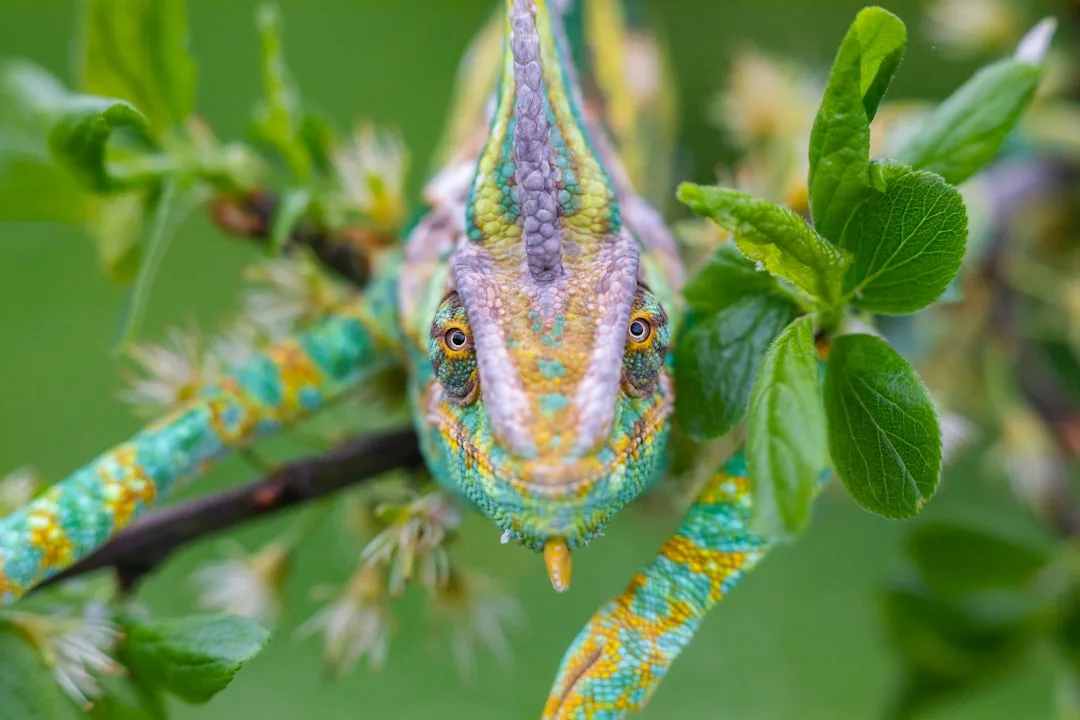
How do chameleons actually change color?
Chameleons do not change color by dispersing pigments, as was long believed. Research published in Nature Communications in 2015 by scientists at the University of Geneva revealed that chameleons possess a lattice of guanine nanocrystals embedded in specialized skin cells called iridophores.
Few creatures have captured the human imagination quite like the chameleon. For centuries, these peculiar reptiles have been symbols of deception, adaptability, and mystery - their ability to shift color seemingly at will earning them a permanent place in folklore, literature, and everyday metaphor. We call dishonest people "chameleons." We describe social adaptability as "chameleon-like." The very word has become shorthand for transformation itself.
Yet the real chameleon is far stranger than any metaphor suggests. The popular image - a small green lizard that turns the color of whatever it sits on - is almost entirely wrong. Chameleons do not match their backgrounds. They do not change color using pigments. And color change, while spectacular, is arguably the least remarkable thing about them.
These are animals with eyes that move independently of each other, tongues that fire like ballistic missiles, feet designed like molecular clamps, and a body plan so specialized that it has remained virtually unchanged for tens of millions of years. To study chameleons is to encounter an animal that seems to have been engineered by a mind unbound by conventional zoological logic.
A Family of Over 200 Species
The family Chamaeleonidae contains more than 210 recognized species distributed across two primary subfamilies. They range in size from the smallest known reptile on Earth to robust, helmet-headed giants over 60 centimeters long. Their diversity is staggering, yet their distribution tells a story of deep evolutionary history concentrated in one remarkable place.
Madagascar: The Chameleon Capital of the World
Roughly half of all known chameleon species are found on Madagascar, the island nation off the southeast coast of Africa. This extraordinary concentration is the product of millions of years of isolation and adaptive radiation.
When Madagascar separated from the Indian subcontinent approximately 88 million years ago, the ancestral chameleon lineages already present on the island were free to diversify without competition from the placental mammals and advanced predators evolving on the mainland continents.
The result is a chameleon fauna of breathtaking variety. Madagascar is home to both the largest chameleons (the Parson's chameleon, Calumma parsonii, which can exceed 68 centimeters in total length) and the smallest (the nano-chameleon, Brookesia nana, at just 13.5 millimeters from snout to vent).
Some Malagasy species inhabit high-altitude cloud forests, others the arid spiny desert of the southwest, and still others the leaf litter of lowland rainforests where they are virtually indistinguishable from dead leaves.
The remaining species are distributed across mainland sub-Saharan Africa, with smaller radiations in southern Europe (the European chameleon, Chamaeleo chamaeleon, found in Spain, Portugal, and Greece), the Middle East, South Asia, and Sri Lanka. No chameleons occur naturally in the Americas, Australia, or East Asia - though feral populations of veiled and Jackson's chameleons have established themselves in Hawaii and Florida through the pet trade.
The Color-Change Mechanism: Not What You Think
The single most persistent myth about chameleons is that they change color to match their surroundings - a form of camouflage. This belief, repeated in countless nature documentaries and children's books, is fundamentally incorrect. Chameleons change color primarily for social signaling, thermoregulation, and emotional expression, not background matching. And the mechanism by which they accomplish this feat is not what scientists believed for over a century.
The Old Model: Pigment Dispersal
For decades, the standard explanation for chameleon color change followed the model established for other color-changing animals like cuttlefish and octopuses. Specialized skin cells called chromatophores were thought to contain pigment granules that could be dispersed throughout the cell (making the color visible) or concentrated into a tight cluster (making the color invisible).
By selectively activating different chromatophore layers - yellow xanthophores, red erythrophores, dark melanophores - the chameleon could theoretically mix colors like a biological paint palette.
This model was not entirely wrong. Chameleons do possess chromatophores, and these cells do contribute to their coloration. But the pigment model could never adequately explain the speed, range, or brilliance of chameleon color shifts - particularly the vivid blues, greens, and ultraviolet reflections that no known biological pigment can produce.
The 2015 Discovery: Nanocrystal Lattices
The real mechanism was revealed in a landmark paper published in Nature Communications in March 2015 by a team led by Michel Milinkovitch at the University of Geneva. Using a combination of high-resolution videography, spectroscopy, electron microscopy, and numerical modeling, Milinkovitch and colleagues demonstrated that chameleons possess a layer of specialized skin cells called iridophores containing a lattice of guanine nanocrystals.
These nanocrystals are arranged in a highly organized, three-dimensional geometric pattern - essentially a photonic crystal. When the chameleon is calm and the iridophore cells are in a relaxed state, the nanocrystals are tightly packed, and the lattice selectively reflects short wavelengths of light (blue).
When the chameleon becomes excited - during a territorial display, courtship, or stress response - the iridophore cells actively expand, increasing the spacing between nanocrystals. This expanded lattice reflects progressively longer wavelengths: green, then yellow, then orange, then red.
"We discovered that chameleons have a superficial thick layer of iridophore cells with a triangular lattice of guanine nanocrystals that they can actively tune to change color. The shift from blue to red requires only a 30% increase in the distance between nanocrystals." - Michel Milinkovitch, Professor of Genetics and Evolution, University of Geneva, Nature Communications (2015)
The brilliance of this system is that it operates independently of the pigment-based chromatophores in the upper skin layers. The chameleon effectively has two superimposed color systems: a structural color layer (the nanocrystal iridophores) and a pigment layer (the chromatophores). By combining signals from both, the animal achieves a color palette of extraordinary range and intensity.
Milinkovitch's team also discovered a second, deeper layer of iridophores with larger, less organized nanocrystals. This layer does not change color but instead reflects a broad spectrum of infrared light, functioning as a thermal shield. Chameleons, in other words, have evolved a two-layer photonic system: the upper layer for active color signaling, the lower layer for passive heat management. No other vertebrate is known to possess anything comparable.
The Ballistic Tongue: Nature's Fastest Projectile
If the color-change mechanism is the chameleon's most famous feature, the tongue is arguably its most impressive. Chameleon tongue projection is one of the most extreme biomechanical events in the vertebrate world - a ballistic strike of such speed and precision that high-speed cameras were required to reveal its mechanics.
Anatomy of the Strike
The chameleon tongue is a complex hydraulic and elastic system built around a tapered cartilaginous bone called the hyoid. In its resting position, the tongue sits bunched up at the back of the mouth, with a specialized ring of accelerator muscle wrapped tightly around the tapered end of the hyoid, like a compressed spring on a cone.
When the chameleon fires its tongue, the accelerator muscle contracts with explosive force and slides forward off the tapered hyoid bone. The geometry of the taper converts the muscle's radial contraction into powerful forward acceleration - the same principle as squeezing a wet watermelon seed between your fingers. The tongue is launched ballistically, meaning it is no longer under muscular control once it leaves the hyoid. It is, in the truest sense, a projectile.
The Numbers
The performance statistics of the chameleon tongue are difficult to overstate:
- Extension length: Up to 2.5 times the chameleon's body length (some smaller species achieve even greater relative extensions)
- Acceleration: Exceeding 41 g-forces, or roughly 2,590 meters per second squared
- Speed: From zero to 60 miles per hour in approximately 1/100th of a second (10 milliseconds)
- Total strike time: The tongue reaches full extension and captures prey in roughly 20 milliseconds - faster than the blink of a human eye (300-400 milliseconds)
- Prey capture force: The bulbous tongue tip generates adhesive force equivalent to one-third of the chameleon's body weight
Research published by Christopher Anderson of Brown University in Scientific Reports (2016) demonstrated that smaller chameleon species actually produce proportionally more powerful tongue projections than larger species. The tiny Rhampholeon spinosus, at just 47 millimeters in body length, generated peak accelerations of 264 g-forces - the highest acceleration ever recorded in any reptile, bird, or mammal.
The Suction Cup
The tongue tip is not simply sticky. High-speed photography and biomechanical analysis have revealed that the bulbous tongue pad functions as a wet-adhesion suction cup. Upon contact, the pad deforms around the prey item, creating a vacuum seal amplified by viscous mucus secretions that are 400 times thicker than human saliva.
This combination of suction and viscous adhesion allows chameleons to capture prey items that would be impossible to hold with simple stickiness alone, including hard-bodied beetles and smooth-shelled snails.
"The chameleon tongue is not merely fast - it is a masterpiece of elastic energy storage and release. The accelerator muscle loads energy into collagen tissue like drawing back a bowstring, then releases it all in a fraction of a second. No muscle alone could produce these accelerations." - Christopher V. Anderson, University of South Dakota, Scientific Reports (2016)
Independent Eyes: 360-Degree Surveillance
The chameleon eye is unlike any other vertebrate eye. Set in prominent conical turrets that protrude from either side of the head, chameleon eyes can rotate with a degree of independence that borders on the surreal.
Range of Motion
Each eye can rotate approximately 180 degrees horizontally and 90 degrees vertically, independent of the other eye. This means a chameleon can simultaneously look forward and backward, up and down, tracking completely different objects with each eye. The combined visual field approaches 360 degrees - effectively eliminating blind spots without any head movement.
The neural processing required for this dual-attention system is extraordinary. The chameleon brain must simultaneously process two entirely different visual scenes, assess threats and opportunities in each, and coordinate whole-body responses.
Studies using eye-tracking technology have shown that chameleons allocate different cognitive priorities to each eye depending on context: one eye may be engaged in prey search mode (rapid scanning) while the other is in predator vigilance mode (slower, broader sweeps).
Binocular Convergence for the Strike
When a prey item is identified by one eye, the second eye swings forward to join the first, locking both eyes on the target. This binocular convergence provides stereoscopic depth perception - the precise distance calculation necessary for an accurate tongue strike. The transition from monocular scanning to binocular targeting takes less than a second and represents one of the most rapid attention shifts known in any vertebrate.
The chameleon eye also has a negative lens, unique among vertebrates. While most vertebrate eyes use a positive (convex) lens to focus light, the chameleon cornea focuses the image before it reaches the lens, which then magnifies it - functioning like a telephoto lens on a camera. This gives chameleons the ability to judge prey distance at ranges of 5 to 10 meters with remarkable accuracy, despite their relatively small eye size.
Built for the Branch: Zygodactylous Feet and Prehensile Tails
Chameleons are among the most specialized arboreal vertebrates on Earth. Every aspect of their limb and tail anatomy reflects tens of millions of years of adaptation to life on narrow branches.
The Zygodactylous Grip
Chameleon feet are zygodactylous - meaning the five toes on each foot are fused into two opposing groups that function like a pair of tongs. On the front feet, the inner group contains two toes and the outer group contains three. On the hind feet, this arrangement is reversed: three inner, two outer.
This configuration provides an extraordinarily powerful and stable grip on cylindrical branches, allowing chameleons to cling securely to perches in high winds and during the violent recoil of a tongue strike.
The grip strength is remarkable. Chameleons can hang from a single foot, supporting their entire body weight on a branch with a grip that resists forces several times greater than gravity alone. The toe pads are covered in microscopic ridges and tubercles that increase friction, though unlike geckos, chameleons do not use van der Waals forces - their grip is purely mechanical.
The Prehensile Tail
Most chameleon species possess a fully prehensile tail that functions as a fifth limb. The tail can coil tightly around branches, providing an anchor point during feeding, climbing, and sleeping. Unlike the prehensile tails of some monkeys, which have bare, tactile skin on the underside, the chameleon tail grips through muscular coiling alone.
The tail cannot be regenerated if lost - a critical difference from many other lizard species that can shed and regrow their tails as a predator escape mechanism.
Comparison of Notable Chameleon Species
| Species | Size (Total Length) | Range | Distinctive Feature | Conservation Status |
|---|---|---|---|---|
| Parson's chameleon (Calumma parsonii) | Up to 68 cm | Eastern Madagascar | Largest chameleon species; massive casque | Near Threatened |
| Panther chameleon (Furcifer pardalis) | 38-53 cm | Northern Madagascar | Most vivid coloration; locale-specific color morphs | Least Concern |
| Jackson's chameleon (Trioceros jacksonii) | 25-35 cm | East Africa (invasive Hawaii) | Three prominent horns in males | Least Concern |
| Veiled chameleon (Chamaeleo calyptratus) | 35-60 cm | Yemen, Saudi Arabia | Tall cranial casque; popular in pet trade | Least Concern |
| Brookesia nana (Brookesia nana) | 21.6 mm (total) | Northern Madagascar | Smallest known reptile; discovered 2012, described 2021 | Critically Endangered |
| Labord's chameleon (Furcifer labordi) | 7-9 cm | Western Madagascar | Shortest lifespan of any tetrapod (4-5 months) | Vulnerable |
| European chameleon (Chamaeleo chamaeleon) | 20-30 cm | Southern Europe, North Africa | Only chameleon species native to Europe | Least Concern |
The Smallest Reptile on Earth: Brookesia nana
In 2021, a team of German and Malagasy scientists led by Frank Glaw of the Bavarian State Collection of Zoology published the formal description of Brookesia nana - the nano-chameleon - in the journal Scientific Reports. The species immediately became an international sensation, and for good reason: the adult male measured just 13.5 millimeters from snout to vent (21.6 mm including the tail), making it the smallest known reptile and one of the smallest vertebrates ever recorded.
The Discovery
The specimens were collected during expeditions to the Sorata massif in northern Madagascar in 2012, a rugged mountainous region covered in montane rainforest. The team found just two individuals: one male and one female. The female was slightly larger at 19.2 mm snout-to-vent, a pattern common in tiny chameleons where females need larger body cavities for egg production.
The discovery raised immediate questions about the lower limits of vertebrate body size. At 13.5 mm, the male Brookesia nana approaches the theoretical minimum size at which a vertebrate skeleton, nervous system, and sensory apparatus can function. The animal's eyes occupy a proportionally enormous fraction of its head - a common feature of miniaturized vertebrates, since the optical physics of vision impose minimum lens sizes regardless of body size.
A Paradox of Proportions
Perhaps the most unexpected finding was the male's hemipenis size. Relative to body size, the male Brookesia nana possesses the largest hemipenes of any chameleon - nearly 18.5% of its body length when fully everted.
The researchers speculated that this extreme relative size is driven by the size difference between males and females: the male's genitalia must be large enough to physically interface with the considerably larger female during mating. This finding added the nano-chameleon to a growing list of miniaturized animals in which sexual organs do not scale down proportionally with body size.
The species is presumed to be Critically Endangered. Its entire known range encompasses a small patch of degraded forest that is under ongoing pressure from slash-and-burn agriculture. Whether populations exist elsewhere remains unknown.
Panther Chameleons: Living Prisms
The panther chameleon (Furcifer pardalis) of northern Madagascar is widely considered the most colorful reptile on Earth. Males display a kaleidoscopic palette of turquoise, emerald green, electric blue, fiery orange, vivid red, and bright yellow - often simultaneously. What makes the panther chameleon particularly remarkable among chameleon enthusiasts and scientists alike is the existence of distinct locale-specific color morphs.
Panther chameleons from the island of Nosy Be display predominantly blue and green coloration. Those from Ambilobe show a mix of blue, red, and orange bars. Specimens from Ambanja are predominantly blue with touches of green. The Tamatave locale produces primarily red and orange individuals.
These color differences are genetically fixed and correspond to geographically isolated populations, making the panther chameleon a living case study in incipient speciation - the early stages of one species diverging into several.
Jackson's Chameleon: The Three-Horned Dragon
The Jackson's chameleon (Trioceros jacksonii) of East Africa is the species most responsible for the popular association between chameleons and prehistoric-looking reptiles. Males possess three prominent annulated horns - one on the nose (the rostral horn) and one above each eye (the preocular horns) - that give them a striking resemblance to the ceratopsian dinosaurs. Females typically lack horns or have only small rudimentary bumps.
The horns serve a clear purpose in male-male combat. During territorial disputes, rival males lock horns and attempt to push each other off branches in slow-motion jousting matches that can last several minutes. These contests are rarely lethal but can result in broken horns, scratches, and significant stress. The loser typically turns dark brown or black - a submissive color signal - and retreats.
Jackson's chameleons are one of the few chameleon species that are ovoviviparous, giving birth to live young rather than laying eggs. Females typically produce 8 to 30 neonates after a gestation period of approximately five to six months. This reproductive strategy may be an adaptation to the cool, high-altitude environments of the East African highlands where the species originated, as buried eggs might fail to develop in cold soil.
Veiled Chameleons and the Pet Trade
The veiled chameleon (Chamaeleo calyptratus) of the Arabian Peninsula is the most commonly kept chameleon in captivity. Its tolerance for variable humidity, relatively robust health compared to other chameleon species, and impressive size (males can reach 60 centimeters) have made it the gateway species for chameleon keeping.
The species is named for its tall, blade-like cranial casque, which can reach 8 centimeters in height and is thought to channel morning dew toward the mouth in its arid native habitat.
The pet trade has been both a blessing and a curse for chameleon awareness. On one hand, the availability of captive-bred veiled and panther chameleons has exposed millions of people to these extraordinary animals and generated funding for breeding research. On the other hand, chameleons remain among the most difficult reptiles to keep in captivity.
They are highly sensitive to stress, require precise temperature and humidity gradients, need large screen enclosures with live plants, and are prone to metabolic bone disease, respiratory infections, and organ failure when husbandry is inadequate. Mortality rates among chameleons purchased by inexperienced keepers remain distressingly high.
Communication Through Color
The primary biological function of chameleon color change is not camouflage but communication. Chameleons are largely solitary, territorial animals, and color provides a rapid, high-bandwidth signaling system that conveys information about mood, intent, health, and reproductive status.
Aggression and Dominance
When two male chameleons encounter each other, both undergo rapid color intensification. Dominant individuals display brighter, more saturated colors - vivid greens, yellows, and reds - while inflating their bodies laterally to appear larger. Subordinate individuals display darker, duller colors - browns, grays, and blacks - signaling submission.
In most cases, the color contest resolves the dispute without physical contact. The male whose display is less impressive will darken and retreat. Only when both males display equally intense coloration does the encounter escalate to physical combat.
Courtship
Males courting females display species-specific color patterns that serve as both species recognition signals and fitness indicators. Brighter, more complex color patterns correlate with better health, nutritional status, and parasite resistance.
Females evaluate these displays and respond with their own color signals: receptive females typically lighten in color, while unreceptive females (often already gravid) display dark coloration with bright contrasting spots - an aggressive rejection signal that warns males to stay away. In some species, unreceptive females will rock back and forth, gape their mouths, and hiss while displaying these warning colors.
Stress and Thermoregulation
Darker colors absorb more solar radiation, so chameleons often darken in the early morning to warm up quickly and lighten during the hottest part of the day to reflect excess heat. Stressed chameleons - those subjected to handling, overcrowding, or perceived predator threats - display characteristically dark, muted coloration that experienced keepers and field researchers learn to recognize immediately.
Chameleon Myths Debunked
The cultural prominence of chameleons has generated a persistent collection of myths that bear little resemblance to biological reality.
Myth: Chameleons change color to match their background. Reality: Chameleons change color primarily for social signaling, thermoregulation, and emotional expression. While their resting coloration does provide effective camouflage in their natural habitat (greens and browns that blend with foliage), the active color-change mechanism is driven by internal physiological states, not external visual input. A chameleon placed on a red surface will not turn red.
Myth: Chameleons are slow-moving and defenseless. Reality: While chameleons move with a characteristic slow, rocking gait designed to mimic wind-blown leaves, their tongue strike is among the fastest movements in the animal kingdom. Their independent eyes provide near-total situational awareness. And many species are capable of surprising bursts of speed when fleeing predators, including leaping from branches and surviving falls from considerable heights.
Myth: Chameleons make good beginner pets. Reality: Chameleons are among the most demanding reptiles in captivity. They require specialized enclosures, precise environmental control, varied insect diets supplemented with calcium and vitamins, and minimal handling. They are easily stressed and display few obvious symptoms of illness until disease is advanced. Experienced reptile keepers with prior husbandry knowledge are the appropriate audience for chameleon keeping.
Myth: All chameleons are small. Reality: While the tiny Brookesia leaf chameleons get most of the attention, the Parson's chameleon of Madagascar reaches 68 centimeters and weighs over 700 grams - larger than many pet cats' heads. The Meller's chameleon of East Africa can reach 61 centimeters.
Myth: Chameleons change color instantaneously. Reality: Color change speed varies dramatically by species and context. Some shifts (darkening under stress) occur within seconds. Full display changes during territorial contests may take 15 to 30 seconds to complete. The photonic nanocrystal mechanism, while faster than pigment-based systems in other animals, is not instantaneous.
An Evolutionary Masterpiece Under Threat
Chameleons face a constellation of threats across their range. Habitat destruction, particularly the slash-and-burn agriculture (tavy) that continues to devastate Madagascar's forests, is the primary concern. Madagascar has lost an estimated 90% of its original forest cover, and with half of all chameleon species found nowhere else, every hectare of forest lost potentially drives species toward extinction.
The international pet trade, while increasingly regulated under CITES (the Convention on International Trade in Endangered Species), continues to exert pressure on wild populations of desirable species. Climate change poses an emerging threat to montane species adapted to narrow temperature ranges. And road mortality is a surprisingly significant factor for species that cross roads at the pace of a slow-motion replay.
Yet chameleons persist, as they have for an estimated 60 to 100 million years based on the fossil record and molecular phylogenetics. They survived the asteroid impact that ended the Cretaceous, the climatic upheavals of the Cenozoic, and the arrival of mammalian predators.
Whether they can survive the Anthropocene - the age of human dominance - remains an open question, and one that depends entirely on the choices made in the coming decades regarding forest conservation, trade regulation, and climate action.
What Animals Can Regenerate Their Eyes?
Chameleons cannot regenerate their famously independent-moving eyes, but several other animals can. Axolotls (Ambystoma mexicanum) regrow retina, lens, cornea, and in some cases the optic nerve. Newts regenerate lens tissue through a process called Wolffian lens regeneration, where pigmented iris cells transdifferentiate into new lens material.
Zebrafish regenerate damaged retinal tissue by reactivating Muller glial cells. Planaria flatworms rebuild entire eyespots from scratch, complete with photoreceptors. Chameleons themselves possess extraordinary eye hardware - independently rotating sockets, 342-degree arc of view, negative-lens focusing - but no regeneration ability.
Their 210+ species in family Chamaeleonidae, including the 13.5 mm Brookesia nana and 68 cm Calumma parsonii (Parson's chameleon), rely on color signaling via iridophore nanocrystal lattices rather than tissue regrowth for survival.
References
Teyssier, J., Saenko, S.V., van der Marel, D., & Milinkovitch, M.C. (2015). "Photonic crystals cause active colour change in chameleons." Nature Communications, 6, 6368.
Anderson, C.V. & Deban, S.M. (2010). "Ballistic tongue projection in chameleons maintains high performance at low temperature." Proceedings of the National Academy of Sciences, 107(12), 5495-5499.
Glaw, F., Kohler, J., Hawlitschek, O., Feldmeier, S., Lombolt, M., Mickoleit, M., Ruthensteiner, B., & Vences, M. (2021). "Extreme miniaturization of a new amniote with adaptive coupling to its host microhabitat." Scientific Reports, 11, 2522.
Anderson, C.V. (2016). "Off like a shot: scaling of ballistic tongue projection reveals extremely high performance in small chameleons." Scientific Reports, 6, 18625.
Tolley, K.A. & Herrel, A. (2013). The Biology of Chameleons. University of California Press.
Stuart-Fox, D. & Moussalli, A. (2009). "Camouflage, communication and thermoregulation: lessons from colour changing organisms." Philosophical Transactions of the Royal Society B, 364(1516), 463-470.
Frequently Asked Questions
How do chameleons actually change color?
Chameleons do not change color by dispersing pigments, as was long believed. Research published in Nature Communications in 2015 by scientists at the University of Geneva revealed that chameleons possess a lattice of guanine nanocrystals embedded in specialized skin cells called iridophores. By actively tuning the spacing between these nanocrystals - relaxing or exciting the lattice - chameleons shift the wavelengths of light the skin reflects.
A relaxed lattice reflects shorter blue wavelengths, while a stretched lattice reflects longer red and yellow wavelengths. This structural color mechanism operates independently of the pigment-containing chromatophores in upper skin layers, giving chameleons two superimposed systems for color manipulation.
How fast is a chameleon's tongue and how does it work?
A chameleon’s tongue accelerates from zero to 60 miles per hour in roughly 1/100th of a second, making it one of the fastest ballistic movements in the entire animal kingdom. The tongue can extend to approximately 2.5 times the chameleon’s body length and is powered by a specialized accelerator muscle wrapped around a tapered cartilaginous bone called the hyoid.
When fired, the muscle contracts and slides off the bone like a compressed spring releasing, launching the sticky tongue pad at accelerations exceeding 41 g-forces. The bulbous tip creates a suction-cup effect on contact, generating adhesive force strong enough to capture prey up to one-third the chameleon’s own body weight.
Can chameleons really move their eyes independently?
Yes, chameleons possess the most advanced independent eye movement of any vertebrate. Each eye sits in a conical turret and can rotate nearly 180 degrees horizontally and 90 degrees vertically, completely independent of the other eye. This gives chameleons an effective visual field approaching 360 degrees without moving their head. A chameleon can simultaneously track a flying insect with one eye while scanning for predators with the other.
When prey is identified, both eyes converge forward to provide binocular stereoscopic vision, which allows the chameleon to calculate the precise distance needed for an accurate tongue strike.