
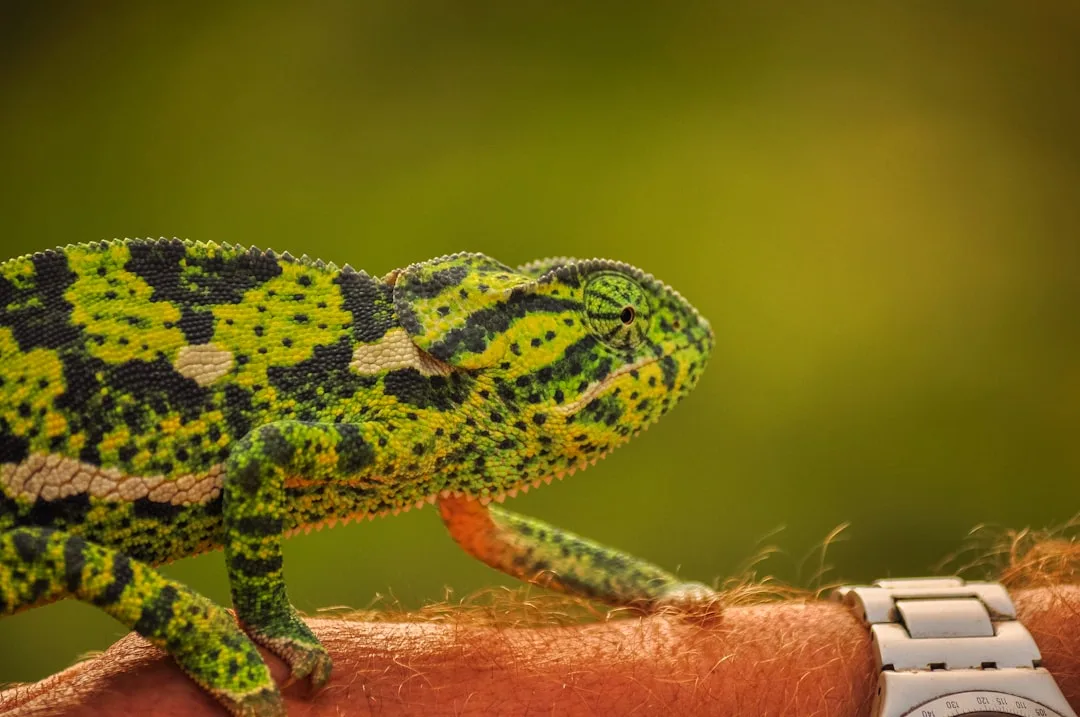
Do chameleons really change color to match their surroundings?
No, chameleons do not change color primarily to match their surroundings - this is one of the most persistent myths in popular biology. Chameleon color changes are mostly communication signals and thermoregulation responses. Male chameleons display bright colors during courtship and territorial disputes. Stressed or excited chameleons often become brighter and more conspicuous, not less.
The Nanocrystal Secret
In 2015, Swiss researchers at the University of Geneva made a discovery that rewrote decades of biology textbooks. Chameleons do not change color through pigments - they change color by rearranging microscopic crystals in their skin. Every chameleon is essentially walking around with a living nanotechnology system producing colors through physical structure rather than chemistry.
This revelation, combined with renewed attention on why chameleons actually change color (hint: it is not primarily for camouflage), has transformed how biologists understand one of the most familiar yet misunderstood animal behaviors on Earth.
The Camouflage Myth
Most people believe chameleons change color to blend into their surroundings. This is almost entirely wrong.
Chameleons have baseline colors matching their typical habitat - green for tree-dwelling species, brown for ground-dwelling species. This baseline camouflage is effective because chameleons generally live in environments that match their default colors.
But active color change is not primarily for camouflage. When a chameleon changes color dramatically, it is most often:
- Communicating with other chameleons (territorial displays, courtship signals, dominance hierarchies)
- Regulating body temperature (darkening to absorb heat, lightening to reflect it)
- Expressing emotional state (stress, excitement, aggression, receptivity)
The cartoon image of a chameleon walking across a plaid surface and becoming plaid is pure fiction. Real chameleons cannot replicate complex patterns. They change along a limited color spectrum (typically green to yellow to red, sometimes incorporating blue and black), and these changes communicate rather than conceal.
A stressed or excited chameleon actually becomes MORE visible, displaying vivid colors that effectively advertise "stay away from me" rather than "you can't see me."
The Nanocrystal Discovery
Before 2015, biologists assumed chameleons changed color through pigment dispersion, similar to octopuses. The assumption was that pigment cells (chromatophores) expanded to display color and contracted to hide it.
A research team led by Michel Milinkovitch at the University of Geneva used advanced electron microscopy and photonic analysis to study the skin of panther chameleons. What they found was entirely different from the pigment theory.
The structural color mechanism:
Chameleon skin contains specialized cells called iridophores that hold guanine crystals arranged in precise geometric patterns. The crystals themselves are not colored. They produce color through structural interference with light waves.
When light hits the crystal lattice, specific wavelengths are reflected while others pass through. The wavelength reflected depends on the distance between crystals.
Crystals packed tightly reflect short wavelengths (blue, green, violet).
Crystals spaced farther apart reflect longer wavelengths (yellow, orange, red).
Chameleons actively adjust this spacing by contracting or relaxing muscles in the iridophore cells. When the cell contracts, crystals pack together; when it relaxes, they spread apart. The color shifts across the visible spectrum accordingly.
Two layers:
Chameleons actually have two layers of iridophores:
- Upper layer: Controls visible color change
- Lower layer: Reflects near-infrared light (invisible to humans but crucial for thermoregulation)
The lower layer is always active, reflecting infrared to prevent the chameleon from overheating. The upper layer is the "color display" that does the communication work.
This is structural color, not pigment-based color. The underlying chemistry does not change during color shifts - only the physical arrangement of nanoscopic crystals.
Why Chameleons Change Color
With the mechanism understood, the more interesting question is: what is color change FOR? Research over the past two decades has clarified the three main purposes.
1. Communication (The Primary Function)
Most color changes serve to communicate with other chameleons or with potential threats.
Territorial disputes. Male chameleons display vivid bright colors - reds, yellows, and whites - to warn rival males to stay away. The brighter and more contrasting the display, the more aggressive the signal.
Courtship. Males use different color patterns to attract females. Successful courting males are often dramatically more colorful than their baseline state. A male panther chameleon in full courtship display is almost unrecognizable as the same species as his calm, green baseline self.
Female receptivity. Female chameleons signal their reproductive status through color. Receptive females show specific pattern colors. Non-receptive females turn dark colors with distinctive patterns that warn males to leave them alone.
Stress and threat response. A chameleon encountering a snake or bird predator becomes more colorful, not less. The vivid display says "I am toxic or aggressive and not worth the risk." This is similar to how poison dart frogs use aposematic coloration.
Dominance hierarchies. In captivity, when multiple males are kept together, the dominant male typically displays brighter colors consistently. Subordinate males become darker and less vivid.
2. Thermoregulation
As ectotherms (cold-blooded animals), chameleons regulate body temperature through behavior and color.
Cold chameleons become darker. Dark colors absorb more sunlight. A cold chameleon in morning sun darkens to increase solar absorption and warm up faster.
Hot chameleons become lighter. Light colors reflect sunlight. A hot chameleon lightens to reduce heat absorption.
This thermoregulation happens automatically based on body temperature. A chameleon does not "decide" to change color for temperature reasons; the change happens as part of physiological regulation.
3. Camouflage (The Secondary Function)
Baseline camouflage is real but not dramatic. A green chameleon is green because it lives in green leaves. A brown ground chameleon is brown. This baseline match provides camouflage without active color change.
Active color changes for camouflage do occur but are limited. A chameleon moving from green foliage to brown bark may gradually shift its base tone to better match. But the change is not precise, not instantaneous, and not patterned - nothing like the movie portrayal.
Color Change Speed
How fast can a chameleon change color? Faster than you might think, but slower than octopuses.
Typical timings:
- Small shifts (brightening, darkening): 2-5 seconds
- Moderate changes (green to yellow): 10-20 seconds
- Dramatic transformations (calm to agitated): 20-30 seconds
- Complete pattern changes: 30-60 seconds
For comparison:
- Octopuses: milliseconds to seconds
- Cuttlefish: 100 milliseconds
- Some squid species: under 1 second
- Chameleons: 5-60 seconds
- Arctic fox seasonal change: 6-8 weeks
Chameleons are fast relative to most color-changing vertebrates but slow compared to cephalopods. The difference is that chameleons use muscle-driven mechanical rearrangement, while octopuses use electrically-triggered pigment expansion.
The Different Species
Approximately 200 chameleon species exist, distributed across specific regions:
Madagascar: 75 species. Half of all chameleon species live on Madagascar, a testament to evolutionary isolation on this large island.
Africa: ~100 species. Most of sub-Saharan Africa has chameleon species, with particular diversity in east Africa and southern Africa.
Europe, Middle East, India: Small populations of a few species. The common chameleon (Chamaeleo chamaeleon) ranges from southern Europe through North Africa into the Middle East.
Size range:
The smallest chameleon is the pygmy leaf chameleon (Brookesia micra), at just 16 mm long. It is so small it can comfortably stand on the head of a matchstick.
The largest is the Malagasy giant chameleon (Furcifer oustaleti), at 70 cm long - comparable to a house cat in length (though much lighter).
The range of chameleon sizes spans over 40-fold in length, probably the largest size range within any reptile family.
The Tongue
Chameleons are famous for their rapid tongue strikes, which deserve their own discussion.
The mechanism:
A chameleon's tongue can extend to approximately twice its body length - so a 30 cm chameleon has a 60 cm tongue. The tongue launches at acceleration of up to 264 g (264 times the force of gravity), reaching full extension in under 0.07 seconds.
This is achieved through elastic energy storage. The tongue's skeletal structure (a bone called the hyoid) is surrounded by muscles that stretch an elastic collagen sheath. When the chameleon decides to strike, a separate muscle releases the tension - the collagen snaps back to its resting length, launching the tongue forward.
This is essentially a biological crossbow. The muscle that pulls back the "bowstring" is the same muscle that most vertebrates use for slow contraction. The elastic release amplifies the relatively slow muscle action into the extraordinarily rapid tongue strike.
Sticky pad at the tip:
The tongue tip contains a specialized pad covered in mucus that physically adheres to prey through suction and adhesion. Small insects stick to the pad and are pulled back into the chameleon's mouth.
Temperature independence:
Most reptile muscle-driven movements slow down significantly in cold weather. The chameleon tongue strike works almost as fast in cold temperatures as in warm, because the critical energy comes from elastic collagen (which is temperature-insensitive) rather than active muscle contraction (which slows in cold).
This means chameleons can hunt effectively at cooler temperatures than their body temperature would otherwise allow.
Eyes and Vision
Chameleons have remarkable vision that complements their color-change abilities.
Independent eye movement. Each chameleon eye can move independently of the other. A chameleon can simultaneously watch two different things - a predator behind it and prey in front of it. When both eyes focus on the same target (convergent binocular vision), the chameleon can judge distance precisely for tongue strikes.
Full 360-degree coverage. With independent eye movement, a chameleon can see in essentially all directions simultaneously. There is no blind spot behind the animal.
UV vision. Like many reptiles, chameleons see into the ultraviolet range. Their color displays often have UV components invisible to humans but visible to other chameleons, adding a dimension to communication.
Depth perception. When a chameleon decides to strike at prey, it first aims both eyes at the target. The resulting binocular vision provides precise depth information needed for the tongue strike, which requires accurate distance estimation to hit target.
Conservation Status
Approximately 40 percent of chameleon species are threatened with extinction. The primary threats are:
Deforestation. Most chameleons require specific habitats (forests, montane ecosystems, savannas with trees). Habitat loss has affected chameleons severely, particularly in Madagascar where 90+ percent of original forest has been cleared.
International pet trade. Chameleons are popular exotic pets. While some species are sustainably captive-bred, wild-caught specimens continue to enter the market illegally. The trade affects wild populations significantly.
Climate change. Many chameleon species have narrow temperature ranges. Rising temperatures force them into higher elevations, reducing available habitat.
Isolated island populations. Madagascar's chameleons are particularly vulnerable because they exist only in one country with high rates of ecological degradation.
The most endangered chameleons include:
- Tarzan chameleon (Calumma tarzan): Critically endangered
- Jewel chameleon (Furcifer lateralis): Endangered
- Pygmy leaf chameleon (Brookesia micra): Critically endangered (only discovered in 2012)
Some species are already extinct, including specific chameleon populations in small Madagascan forests that have been eliminated entirely.
What Chameleons Teach Us
The study of chameleons has produced insights extending far beyond the animals themselves.
Structural color research. Understanding how chameleons manipulate crystal lattices has informed research in:
- Adaptive camouflage materials for military applications
- Color-changing architectural materials
- Smart windows that adjust transparency
- Advanced display technologies
Biomimicry. The chameleon tongue's elastic launch mechanism has inspired mechanical actuators for robotics, particularly for rapid-response applications.
Vision research. The chameleon's independent eye movement has stimulated research into multi-tasking visual systems and parallel processing in nervous systems.
Evolutionary biology. The diversification of chameleons on Madagascar is a classic example of adaptive radiation - the process by which a single ancestor evolves into many species occupying different niches.
The Real Chameleon
Strip away the cartoon myth of background-matching chameleons, and what remains is more interesting than the fiction.
Real chameleons are:
- Visual communicators using some of the most sophisticated color-signaling systems in vertebrates
- Nanotechnology experts rearranging crystals in their skin to produce colors
- Independent-eyed hunters using parallel visual processing
- Elastic-launch predators striking prey with biomechanical crossbows
- Temperature regulators using structural color to manage their body heat
They are not invisible chameleons blending into kaleidoscopic backgrounds. They are expressive, communicative, biologically sophisticated animals whose color changes advertise their emotional states to the world.
In a sense, the chameleon is one of the most emotionally transparent animals on Earth. Its mood is literally written on its skin. A happy, healthy chameleon glows in calm colors. A stressed one blazes in warning patterns. An aroused courting male explodes in colorful display.
We have just misread what those colors meant for centuries. Now that we understand, chameleons are more fascinating than they were when they were supposedly invisible.
Chameleon Species Diversity
The family Chamaeleonidae contains approximately 203 recognized species across 12 genera, with roughly half of all chameleon species endemic to Madagascar. Our research team has compiled a selection of biologically notable species to illustrate the range of sizes and specializations within the family.
| Species | Common Name | Maximum Length | Range | Notable Trait |
|---|---|---|---|---|
| Furcifer oustaleti | Malagasy giant | 68.5 cm | Madagascar | Longest chameleon species |
| Calumma parsonii | Parson's chameleon | 68 cm | E. Madagascar | Heaviest chameleon |
| Chamaeleo calyptratus | Veiled chameleon | 61 cm | Yemen, Saudi Arabia | Pet trade staple |
| Chamaeleo jacksonii | Jackson's chameleon | 38 cm | East Africa | Male triple-horned |
| Furcifer pardalis | Panther chameleon | 51 cm | N. Madagascar | Most vivid color range |
| Brookesia micra | Micro leaf chameleon | 29 mm | Nosy Hara, Madagascar | One of smallest reptiles |
| Brookesia nana | Nano-chameleon | 28.9 mm | N. Madagascar | Possibly smallest reptile, 2021 |
| Trioceros hoehnelii | Helmeted chameleon | 18 cm | Kenya, Uganda | High-altitude specialist |
The nano-chameleon Brookesia nana, described in 2021 by Frank Glaw and colleagues, may be the smallest reptile species ever discovered. An adult male measured 21.6 millimeters from snout to vent with a total length of 29 millimeters including the tail. Despite its miniature size, the species possesses functional genitalia representing approximately 20 percent of its body length - one of the largest genital-to-body ratios recorded in any vertebrate.
The Nanocrystal Mechanism of Color Change
A 2015 study published in Nature Communications by Jeremie Teyssier and colleagues at the University of Geneva used high-resolution electron microscopy to document the dual-layer iridophore system that produces rapid color changes in panther chameleons (Furcifer pardalis). The research revealed that chameleons actively rearrange the spacing of guanine nanocrystals in their upper iridophore layer to shift reflected wavelengths across the visible spectrum [1].
"What looks like color change in the chameleon is actually a controlled deformation of photonic crystal lattices. By adjusting the spacing between crystals, the animal tunes which wavelengths of light its skin reflects. This is active structural coloration at the nanometer scale, and it represents one of the most precise examples of biological optics in the entire animal kingdom." - Dr. Michel Milinkovitch, University of Geneva [1]
The discovery overturned older hypotheses that attributed color change to pigment movement alone. Both pigment-based and structural color mechanisms operate simultaneously in chameleon skin, producing the rich color palette that has made the group famous.
Tongue Mechanics and the Fastest Strike
Chameleon tongue projection is one of the fastest movements in the vertebrate kingdom. A 2016 study published in Scientific Reports by Christopher Anderson and colleagues used high-speed cinematography to document tongue acceleration in the Rosette-nosed pygmy chameleon (Rhampholeon spinosus) at 2,590 m/s2 - 264 times the acceleration of gravity [2].
"Small chameleons produce the highest-acceleration movements of any amniote vertebrate. The tongue is launched from a pre-loaded elastic accelerator system stored in the hyoid, and the entire strike completes in under 20 milliseconds. The smaller the chameleon, the faster the tongue - a scaling relationship opposite to that of most biomechanical systems." - Dr. Christopher Anderson, Brown University [2]
The elastic launch mechanism permits chameleon strikes to exceed by orders of magnitude the performance limits of direct muscle contraction. The tongue contains specialized telescoping accelerator sheaths that compress during aim and then rapidly extend when released, powered by accumulated elastic energy rather than real-time muscle work.
References
- Teyssier, J., Saenko, S. V., van der Marel, D., & Milinkovitch, M. C. (2015). Photonic crystals cause active colour change in chameleons. Nature Communications, 6, 6368. DOI: 10.1038/ncomms7368
- Anderson, C. V. (2016). Off like a shot: scaling of ballistic tongue projection reveals extremely high performance in small chameleons. Scientific Reports, 6, 18625. DOI: 10.1038/srep18625
- Glaw, F., Kohler, J., Hawlitschek, O., et al. (2021). Extreme miniaturization of a new amniote vertebrate and insights into the evolution of genital size in chameleons. Scientific Reports, 11, 2522. DOI: 10.1038/s41598-020-80955-1
- Tolley, K. A., Townsend, T. M., & Vences, M. (2013). Large-scale phylogeny of chameleons suggests African origins and Eocene diversification. Proceedings of the Royal Society B, 280(1759), 20130184. DOI: 10.1098/rspb.2013.0184
Related Articles
- Chameleons: The Color-Changing Reptiles of Legend
- Lizards: Masters of Adaptation and Survival
- Geckos: Wall-Climbing Marvels of the Reptile World
Frequently Asked Questions
Do chameleons really change color to match their surroundings?
No, chameleons do not change color primarily to match their surroundings - this is one of the most persistent myths in popular biology. Chameleon color changes are mostly communication signals and thermoregulation responses. Male chameleons display bright colors during courtship and territorial disputes. Stressed or excited chameleons often become brighter and more conspicuous, not less.
Some chameleons become darker in cold weather to absorb more sunlight for warming, then lighten as they heat up. Camouflage is a minor role - chameleons already have baseline colors matching their typical habitat (green for arboreal species, brown for ground species), but they do not actively change color to blend into backgrounds like cartoons depict. The color changes we see are more like emotional expressions than invisibility cloaks.
How do chameleons change color?
Chameleons change color through a unique mechanism discovered in 2015: they rearrange microscopic guanine nanocrystals in specialized skin cells called iridophores. Unlike most color-changing animals that use pigment expansion (like octopuses), chameleons use structural color. They have two layers of iridophores in their skin.
The upper layer contains crystals that can be packed tightly (reflecting short wavelengths - blues and greens) or spaced apart (reflecting longer wavelengths - yellows, oranges, reds). By physically adjusting the spacing between crystals through skin muscle contraction, the chameleon changes which wavelengths of light reflect from its skin. A second, deeper iridophore layer reflects near-infrared light, helping with thermoregulation.
This nanocrystal system was revealed by Swiss researchers at the University of Geneva using specialized microscopy.
Why do chameleons change color?
Chameleons change color for three main reasons: communication, thermoregulation, and camouflage (in order of importance). Communication is the primary function. Males display bright territorial colors to warn rivals and vibrant courtship colors to attract females. Females signal receptivity or rejection through color changes.
Stressed chameleons turn bright colors that effectively say ‘back off.’ Thermoregulation uses darker colors to absorb heat and lighter colors to reflect it - chameleons darken when cold and lighten when hot. Camouflage is a tertiary function; their baseline colors match their habitat, but rapid color shifts are not typically for hiding.
The popular image of a chameleon walking across a plaid surface and matching the pattern is pure myth - chameleons cannot replicate complex patterns.
How fast can a chameleon change color?
Most chameleon color changes take 20-30 seconds for significant shifts, though subtle changes can happen within 2-5 seconds. This is slower than octopuses (which change color in milliseconds) but faster than most other color-changing animals. The speed depends on the type of change. Brightening from green to yellow might happen in under 10 seconds if the chameleon is already signaling.
Complete transformations from calm green to agitated red-orange-black patterns typically take 20-30 seconds. The process involves neural signals triggering muscle contractions in the iridophore cells, physically rearranging the nanocrystal spacing. Unlike Hollywood portrayals showing instantaneous matching to backgrounds, real chameleon color changes are visible, gradual, and rarely precisely match a specific backdrop.
How many chameleon species are there?
Approximately 200 chameleon species are recognized, though the exact count changes as new species are discovered. Chameleons are most diverse in Madagascar, where 75 species live (half the global total). Africa, particularly around the Horn of Africa and southern regions, has the next highest diversity.
A few species extend into parts of Europe, India, and the Middle East, but chameleons are essentially African reptiles with Madagascar as their center of diversification. Species range from the tiny pygmy leaf chameleon (Brookesia micra), at 16 mm long (small enough to stand on a matchstick head) to the massive Malagasy giant chameleon (Furcifer oustaleti), reaching 70 cm.
About 40 percent of chameleon species are threatened due to habitat loss from deforestation and the international pet trade. The Jackson’s chameleon, veiled chameleon, and panther chameleon are the most common pet species.