
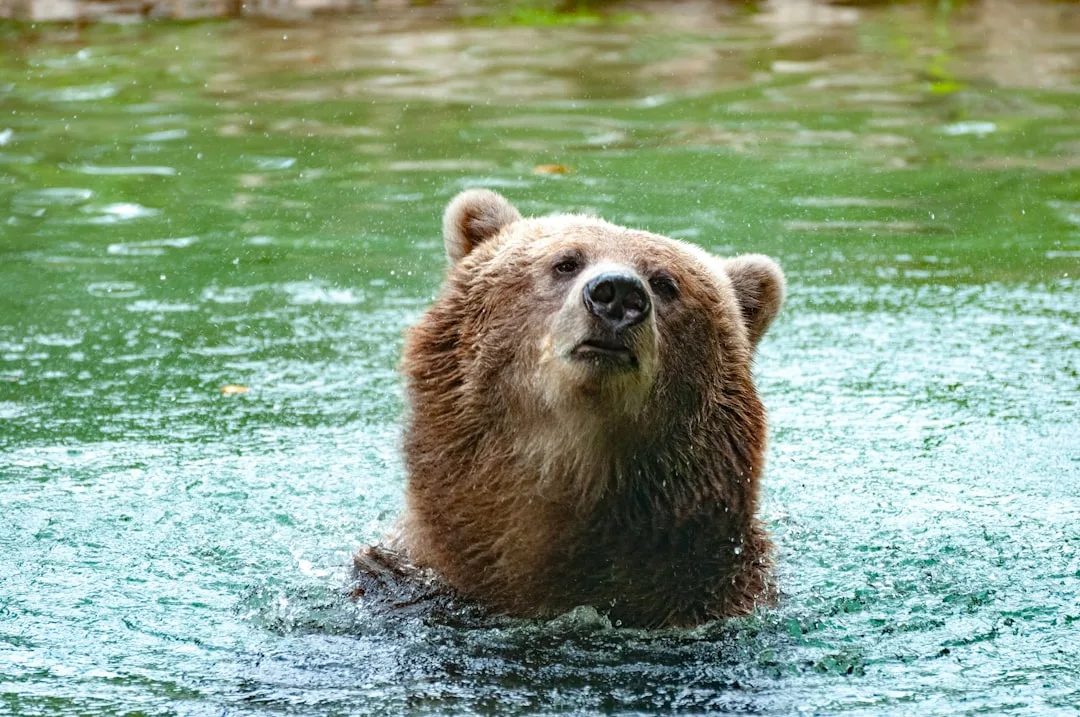
How dangerous are grizzly bears to humans?
Grizzly bears kill fewer than one person per year on average across North America, with roughly 11 fatal attacks recorded between 2000 and 2023. Most attacks are defensive, triggered by surprise encounters or sows protecting cubs, and end quickly once the bear no longer perceives a threat. Predatory attacks are rare but carry roughly double the fatality rate.
Bear spray stops aggressive grizzly behaviour in 98% of cases according to Smith et al. (2008), compared with 76% for firearms. A person who hikes in groups, stores food properly, makes noise on trail, and carries spray enters grizzly country with the odds heavily in their favour.
The Real Shape of the Risk
Grizzly bears are the apex land predator of western North America. A large male in Yellowstone or the Flathead Valley can weigh 400 to 600 pounds, run 35 miles an hour, and flip a 300-pound carcass with a single paw. The species has every tool required to kill a human in under a minute.
And yet across a continent holding roughly 55,000 grizzlies, two national parks receiving nearly eight million visitors a year, and a backcountry that sees tens of millions of overnight camping stays, the species kills fewer than one human annually. Lightning strikes, bee stings, and domestic dogs each outperform the grizzly as a cause of death by an order of magnitude.
The discrepancy is not an accident. It is the product of millions of years of coevolution between bears and bipedal primates, layered over a modern regime of bear spray, food storage regulations, hiker education, and wildlife managers who understand the animal better than any previous generation did. For the natural history of the animal itself, see our profile of the grizzly bear, North American predator.
This article unpacks the attack data, names the landmark cases that shaped current protocols, and explains what to actually do if a grizzly closes the distance.
The Numbers: What the Long Record Shows
Two bodies of peer-reviewed work form the anchor of any serious conversation about grizzly risk. The first is Stephen Herrero's long-running attack database, maintained at the University of Calgary and published in multiple forms since the 1970s. The second is Tom Smith and colleagues' Alaska-focused analysis of deterrent effectiveness, published in the Journal of Wildlife Management starting in 2008.
Herrero and Higgins (2003) and the later Herrero et al. (2011) update codify the most consistent findings in the field:
- Fatal brown bear attacks on humans in North America averaged fewer than one per year across the 20th century
- Frequency has risen since 1960, tracking growth in outdoor recreation and grizzly recovery
- Roughly 70% of fatal attacks involved either a sow with cubs or a sudden close encounter
- Predatory attacks are a minority of incidents but account for a disproportionately high share of deaths
- A single habituated or food-conditioned bear accounts for multiple incidents in a significant fraction of cases
Fatal Grizzly Attacks by Decade, North America
The decade-by-decade totals below compile fatal grizzly attacks outside captivity across the United States and Canada, drawing on Herrero's database, National Park Service incident reports, Parks Canada records, and peer-reviewed updates through 2023.
| Period | Fatal Attacks | Notable Context |
|---|---|---|
| 1900-1959 | ~11 | Heavy under-reporting; most cases involved hunters and trappers |
| 1960-1969 | 5 | Surge of national park visitation; Glacier "Night of the Grizzlies" 1967 |
| 1970-1979 | 6 | First generation of closed-dumpster programmes in Yellowstone |
| 1980-1989 | 5 | ESA recovery plan begins; bear spray enters public safety literature |
| 1990-1999 | 4 | Low decade; food-storage orders mature |
| 2000-2009 | 7 | Population recovery; Treadwell (2003); elk-hunter conflicts rise |
| 2010-2019 | 10 | Yellowstone recovery accelerates; multiple hunter predation cases |
| 2020-2023 | 4 | Ongoing range expansion into ranchland and exurban interface |
The approximately 11 fatal attacks recorded between 2000 and 2023 span Alaska, Montana, Wyoming, British Columbia, Alberta, and the Yukon. Of those, roughly two-thirds were classified as defensive in origin and one-third as predatory. No year in that window recorded more than two fatal attacks continent-wide.
Attacks by Region, 2000-2023
| Region | Fatal Attacks | Primary Context |
|---|---|---|
| Alaska (USA) | 5 | Backcountry hunters, anglers, and remote homesteaders |
| Greater Yellowstone (WY/MT/ID) | 3 | Hiker surprise encounters, elk-hunter carcass conflicts |
| Montana (Northern Continental Divide) | 2 | Glacier backcountry and ranchland interface |
| British Columbia and Alberta | 3 | Trail encounters and bear-with-cubs incidents |
| Yukon and NWT | 1 | Hunter and camp attacks |
Why Attacks Happen: The Four Contexts
Herrero's classification has become the standard framework for analysing grizzly attacks. Four contexts produce the overwhelming majority of incidents.
1. Sow With Cubs (Most Common)
A female grizzly defending one or two cubs of the year is the single most dangerous context in North American bear country. She has fixed investment, no fat reserves to gamble, and a hair-trigger calculus that says eliminate the threat quickly. The attack is short, ferocious, and ends when the perceived threat stops moving. Herrero and Higgins (2003) identified sow-with-cubs encounters as the leading context in fatal and serious injury attacks across their long record.
"The majority of serious injuries and fatalities from brown bears in North America have resulted from defensive responses by females protecting their young. Such attacks are typically brief and highly motivated, and the human's best response is to cease to present as a threat."
- Stephen Herrero, Bear Attacks: Their Causes and Avoidance
2. Sudden Close-Range Encounter
A bear walking a game trail rounds a blind curve and finds a human inside its flight distance. With no time to retreat, the bear processes the encounter as attack or be attacked. These incidents are almost always defensive, usually terminate once the person stops moving or the bear gains space, and are the reason every experienced guide insists on noise in thick timber.
3. Food-Conditioned and Habituated Bears
A bear that has learned humans mean coolers, garbage, or elk carcasses has lost the caution that keeps wild grizzlies alive. Habituated bears approach camps and are prepared to defend food once they have it. The 2018 Yellowstone fatality, in which outfitter Mark Uptain was killed while packing out an elk, sits near this category: the bear arrived at a kill site, had food, and was willing to escalate when humans were present.
4. Predatory Attack (Rare But Lethal)
A predatory grizzly is hunting. The bear approaches silently, often at night, shows no defensive posturing, and continues the attack past the point where a defensive bear would disengage. Herrero's data place predatory attacks at a minority of total incidents but roughly twice the fatality rate of defensive attacks. The Timothy Treadwell and Amie Huguenard killings at Katmai in October 2003 are the most widely known predatory case on record.
The Case Files That Shaped Current Policy
Timothy Treadwell and Amie Huguenard, Katmai, October 2003
Treadwell had camped among Katmai grizzlies for thirteen summers, filming them at close quarters and operating outside standard bear-safety protocols. On 5 October 2003, a large male bear killed him and his partner, Amie Huguenard, at their camp on the Katmai coast. Remains were recovered from the bear's stomach after park rangers shot it at the site.
The Treadwell case matters because it is the textbook predatory attack. The bear was of an unusually late-season age class, body condition suggested food stress, and the camp was in a location frequented by older boars displaced from prime fishing spots. Treadwell's famous tolerance for close proximity reduced no risk. It increased it.
The National Park Service, Jane Goodall Institute, and University of Alberta bear specialists have used the case as evidence that habituating yourself to bears does not habituate the bear to you.
Mark Uptain, Teton Wilderness, September 2018
Uptain, a professional hunting guide, was packing out an elk carcass with a client in the Teton Wilderness when a grizzly came in on the kill. The bear attacked both men. The client escaped and retrieved bear spray, but Uptain was killed. A second responder bear was euthanised after the attack.
The Uptain incident is the modern template for the elk-hunter predation risk. Greater Yellowstone grizzlies have learned that rifle shots in September and October signal a gut pile. The bear that arrives is hungry, motivated, and prepared to displace human competitors. USGS and USFWS have since elevated hunter-specific safety messaging, including carcass handling, spray placement, and the two-person rule.
Night of the Grizzlies, Glacier National Park, August 1967
In a single night, 13 August 1967, two women were killed by two different grizzlies in two different locations in Glacier National Park. The case prompted the closure of park dumps, the end of roadside bear feeding, and the first modern food-storage regulations. It is the reason any campground in grizzly country today has a bear box and any backcountry permit includes a food-hang or canister rule.
Bear Spray vs Firearms: The Evidence
The single most consequential finding in the last twenty years of bear-attack research comes from Tom Smith and colleagues at the United States Geological Survey. Their 2008 paper, Efficacy of Bear Deterrent Spray in Alaska, analysed 83 incidents in which bear spray was deployed on brown, black, or polar bears between 1985 and 2006.
"Red pepper spray stopped bears' undesirable behavior 92% of the time it was used on brown bears. Of all persons carrying sprays, 98% were uninjured by bears in close-range encounters."
- Tom Smith et al., Journal of Wildlife Management, 2008 (DOI 10.2193/2006-452)
A companion paper, Smith et al. (2012), examined firearm use in bear encounters. Across 269 documented cases, firearms failed to prevent injury in a substantial fraction of incidents. The headline numbers that now drive National Park Service and Parks Canada messaging:
Deterrent Effectiveness Comparison
| Metric | Bear Spray | Firearm |
|---|---|---|
| Aggressive behaviour stopped | 98% (72 of 72 close-range cases) | 76% |
| User uninjured in close-range encounter | 98% | 44% (151 of 269 injured) |
| Effective deployment distance | 3-10 metres | Any distance, but requires aim under stress |
| Training burden | Minimal, seconds to learn | High, years of live-fire practice |
| Kill the bear | No | Often |
| Legal in all national parks | Yes | Varies; restricted in Canadian parks |
"Bear spray represents an effective alternative to lethal force and should be considered as an option by anyone who spends time in bear country."
- Tom Smith, United States Geological Survey, 2008
The mechanism matters. A charging grizzly closes 10 metres in under one second. Firing a rifle accurately at that speed, under that adrenaline load, at a target moving low and fast, is not a skill most people hold. Spray produces a 3-to-8-metre cone of capsaicin that does not require precision. Even a poorly aimed discharge will hit the bear's face as the animal runs into it.
The National Park Service position is unambiguous.
"Bear spray has proven to be the most effective means of defense against an aggressive bear. Every visitor travelling in bear country is encouraged to carry bear spray and know how to use it."
- National Park Service, Yellowstone safety guidance
Why Encounters Are Rising
Two curves are converging. The first is grizzly recovery. When the species was listed under the Endangered Species Act in 1975, the Lower 48 population was estimated at 700 to 800 individuals across a handful of isolated subpopulations. Today, the figure is approximately 2,000, with the Greater Yellowstone Ecosystem alone holding more than 1,000 bears and the Northern Continental Divide Ecosystem another 1,000-plus.
Bears are reoccupying the Bitterroots, the Cabinet-Yaak, and the ranchland fringe of the Rocky Mountain Front for the first time in a century.
The second curve is human recreation. Backcountry visitation to Yellowstone, Glacier, Grand Teton, and Banff has roughly doubled since 1990. Elk hunting tags, mountain biking participation, and off-trail hiking have all grown in tandem. More people on more trails at the same time that the bear population is expanding produces, deterministically, more encounters.
"We should expect the long-term trend in human-bear conflict to continue upward as long as both populations grow. The management challenge is to ensure that this increase manifests as non-injurious encounters rather than as attacks, through a combination of education, sanitation, and deterrent carriage."
- Chris Servheen, former Grizzly Bear Recovery Coordinator, United States Fish and Wildlife Service
Herrero's own summary in the Wildlife Society Bulletin has been similarly plainspoken.
"Most brown bear attacks on people are preventable. The behavioural and situational patterns we identified in fatal incidents repeat themselves: alone, quiet, at close range, and in thick cover, with a bear that had no warning."
- Herrero et al., Wildlife Society Bulletin, 2011 (DOI 10.2192/URSUS-D-10-00005.1)
For a more complete breakdown of how grizzlies differ from the other black-coated bear most hikers encounter, see grizzly bear vs black bear. For speed and pursuit data, see how fast can a grizzly bear run.
How Not to Get Attacked
The protocols that follow are not improvisation. They come from fifty years of incident analysis and are enforced, in one form or another, by every land management agency with grizzlies in its jurisdiction.
Make Noise
Grizzlies attack when surprised. A human who announces themselves at 100 metres gives the bear time to slip away. Talk on the trail. Clap at blind corners. In dense willow along a salmon stream, shout every few seconds. Bear bells are weak. Human voice is strong.
Travel in Groups
Herrero's data could not be clearer. A lone hiker is the modal victim of a serious grizzly attack. Parties of four or more are almost unheard-of in the fatal-attack literature. Numbers deter. A group presents as large, noisy, and dangerous to engage.
Carry Bear Spray and Know How
Carried spray is useless. Accessible spray is life-saving. Clip the canister to your chest strap or hip belt, never inside your pack. Practice pulling the safety and deploying a canister of inert training spray at least once a year. You need to reach, aim, and fire in under three seconds.
Respect Food Storage
Every campsite in grizzly country requires either a bear box, a bear-resistant canister, or a proper hang 4 metres off the ground and 2 metres from the trunk. Cooking and food storage should sit at least 100 metres from the sleeping area. Never sleep in the clothes you cooked in.
Read the Habitat
Berry fields in August, salmon streams in September, and elk gut piles in October are concentrated food sources. A grizzly that has invested calories in a kill will defend it violently. If you smell carrion or see ravens circling, retreat and take a different line. See what do grizzly bears eat for the seasonal foraging map and where do grizzly bears live for range overlap.
What To Do During an Attack
The rule is simple and counterintuitive: the response depends on the motivation of the bear.
Defensive Attack (Most Common)
You have surprised a bear, intruded on cubs, or approached a food cache. The bear charges, closes, and contacts.
- Drop face down on the ground
- Interlace your fingers behind your neck, elbows out and forward to shield your face
- Spread your legs to make rolling you harder; keep your pack on to armour your back
- Do not scream, do not fight back, do not move
- Wait until the bear has left the area and you are certain it is gone, then slowly get up
A defensive grizzly wants the threat neutralised. Stillness convinces the bear you are no longer a threat. Herrero's records show that most defensive maulings end in seconds to a minute once the person goes limp. Movement or screaming can re-trigger the attack.
Predatory Attack (Rare)
A bear that has stalked you silently, approached at night into a camp, or continued an attack past the point at which a defensive bear would disengage is predatory. Playing dead invites consumption.
- Fight back with every tool available: rocks, sticks, pot, knife, ice axe
- Target the face, eyes, and muzzle
- Make maximum noise, scream, appear as large as possible
- Keep fighting until the bear breaks off or you do
A predatory grizzly is a rare animal. Most hikers will never face one. But the protocol must be distinct, because the behaviour that saves lives in the defensive case is catastrophic in the predatory one.
For the detailed field-ready walkthrough, see our companion piece how to survive a grizzly bear attack.
Comparative Context: The Two Dangerous Bears
A common question is how grizzly risk compares with polar bear risk, given that both are large brown-coated predators with a long record of human fatalities.
| Dimension | Grizzly Bear | Polar Bear |
|---|---|---|
| Range | Western North America, Russia, Europe | Circumpolar Arctic sea ice and coasts |
| Typical attack motivation | Defensive (sow with cubs, surprise) | Predatory (hunting for food) |
| Fatality rate per attack | ~5% | ~15% |
| Fatal attacks per year (range-wide) | Under 1 | Under 1 |
| Best deterrent | Bear spray (98% effective) | Large-calibre firearm, deterrent chain |
| Play dead? | Yes, for defensive attacks | No, always fight |
| Population trend | Recovering | Declining |
The key distinction is motivation. A grizzly that attacks almost always wants you to stop being a threat. A polar bear that attacks almost always wants to eat you. See our full treatment in are polar bears dangerous to humans and the species profile at polar bear.
Risk in Perspective
A hiker in Glacier National Park in August is more likely to drown, fall, suffer cardiac arrest, or be struck by lightning than to be attacked by a grizzly. The attack risk per person per visit is on the order of one in several million. Even inside the worst ecosystems for human-bear conflict, the combination of bear spray, group travel, noise, and food storage reduces the residual risk to a fraction of the baseline.
What grizzlies do possess is the capacity to cause catastrophic harm when things go wrong. The risk is low-frequency, high-consequence. That is why the protocols feel heavy relative to the statistical probability they address. An attack that happens once every 200,000 trail-days produces a fatality rate orders of magnitude higher than a fall on scree. The system has been calibrated to the worst case, not the average.
For the broader context, see again our anchor piece on the grizzly bear as a North American predator. Readers training for mountain guiding certifications, wildland medicine, or field research logistics can find relevant cognitive and exam prep material at Whats Your IQ, expedition and professional certification resources at Pass4-Sure, and writing tools for trip reports and grant proposals at Evolang.
For lighter reading away from the woods, When Notes Fly covers music and culture, while File Converter Free handles the document work that comes with permits.
Frequently Asked Questions
How many grizzly attacks happen per year on average? Across North America, serious grizzly maulings number roughly ten to fifteen per year, with fatalities averaging well below one per year. Herrero and Higgins (2003) documented a long-term rise in frequency tied to growing outdoor recreation and bear recovery. The overwhelming majority of victims survive because most attacks are defensive and end quickly once the bear no longer perceives a threat.
Are grizzlies more dangerous than black bears? Yes, per encounter. Black bears have a fatality rate in the 1-2% range and are typically displaced by shouting and assertive behaviour. Grizzlies have a fatality rate near 5% and do not back down from confrontation. The response protocol is also different. For black bears, stand tall and fight if attacked. For grizzlies in a defensive attack, play dead. See grizzly bear vs black bear.
Does bear spray actually work on a charging grizzly? Yes. Smith et al. (2008) documented a 98% success rate in stopping aggressive bear behaviour, and bear spray is the deterrent endorsed by the National Park Service, the United States Fish and Wildlife Service, and Parks Canada. The keys are carrying it accessibly, removing the safety clip in time, and firing when the bear is 5 to 10 metres out.
What is the most dangerous situation in grizzly country? A lone hiker, moving quietly in thick cover, rounding a blind curve on a game trail during August berry season or September carcass season. Herrero's attack database shows this pattern repeating across decades. Adding group numbers, noise, and spray cuts the risk dramatically.
Are grizzlies coming back to places they used to live? Yes. The Lower 48 population has grown from roughly 700-800 at Endangered Species Act listing in 1975 to approximately 2,000 today, with active range expansion in the Bitterroots, the Cabinet-Yaak, and the Rocky Mountain Front. Managers expect the geographic footprint of potential human-bear conflict to continue expanding. For range details, see where do grizzly bears live.
References
- Smith, T. S., Herrero, S., Debruyn, T. D., & Wilder, J. M. (2008). Efficacy of bear deterrent spray in Alaska. Journal of Wildlife Management, 72(3), 640-645. https://doi.org/10.2193/2006-452
- Smith, T. S., Herrero, S., Layton, C. S., Larsen, R. T., & Johnson, K. R. (2012). Efficacy of firearms for bear deterrence in Alaska. Journal of Wildlife Management, 76(5), 1021-1027. https://doi.org/10.1002/jwmg.342
- Herrero, S., & Higgins, A. (2003). Human injuries inflicted by bears in Alberta: 1960-98. Ursus, 14(1), 44-54. https://doi.org/10.2192/1537-6176(2003)014%3C0044%3AHIIBBI%3E2.0.CO%3B2
- Herrero, S., Higgins, A., Cardoza, J. E., Hajduk, L. I., & Smith, T. S. (2011). Fatal attacks by American black bear on people: 1900-2009. Journal of Wildlife Management, 75(3), 596-603. https://doi.org/10.1002/jwmg.72
- Herrero, S., Smith, T., DeBruyn, T. D., Gunther, K., & Matt, C. A. (2005). From the field: brown bear habituation to people, safety, risks, and benefits. Wildlife Society Bulletin, 33(1), 362-373. https://doi.org/10.2193/0091-7648(2005)33[362:FTFBBH]2.0.CO;2
- Gunther, K. A., Haroldson, M. A., Frey, K., Cain, S. L., Copeland, J., & Schwartz, C. C. (2004). Grizzly bear-human conflicts in the Greater Yellowstone Ecosystem, 1992-2000. Ursus, 15(1), 10-22. https://doi.org/10.2192/1537-6176(2004)015<0010:GBCITG>2.0.CO;2
- Servheen, C., Herrero, S., & Peyton, B. (1999). Bears: Status Survey and Conservation Action Plan. IUCN/SSC Bear and Polar Bear Specialist Groups, Gland, Switzerland.
- Herrero, S. (2018). Bear Attacks: Their Causes and Avoidance (Revised Edition). Lyons Press.
Frequently Asked Questions
How many people are killed by grizzly bears each year?
Across North America, fatal grizzly attacks average fewer than one per year. Between 2000 and 2023, approximately 11 people were killed by grizzly bears outside captivity across the United States and Canada combined. The underlying attack rate is higher, with dozens of non-fatal maulings recorded in the same period, but most injured parties survive because grizzly attacks are overwhelmingly defensive and terminate once the perceived threat is neutralised.
Herrero and Higgins (2003) and Herrero et al. (2011) remain the most rigorous longitudinal studies of the subject, and both confirm that in absolute terms a grizzly is a remote threat even inside occupied range.
Is bear spray really more effective than a gun against a grizzly?
Yes, and the evidence is not close. Smith et al. (2008) reviewed 83 bear spray incidents in Alaska between 1985 and 2006 and found that bear spray stopped aggressive bear behaviour in 98% of cases, with injuries in only 3 of 72 close-range encounters. A companion study of firearm use (Smith et al. 2012) found firearms prevented injury in 76% of encounters, with shooters injured in 151 of the 269 reviewed cases.
The spray is faster to deploy, does not require marksmanship under a charge, and creates a wall of capsaicin that disorients the bear at the distance where firearms are most likely to miss.
Should I play dead if a grizzly bear attacks me?
In a defensive attack, yes. Lie face down, interlace your fingers behind your neck, keep your elbows protecting the sides of your face, and spread your legs to make it harder for the bear to roll you. A grizzly that is defending cubs, a food cache, or its personal space wants you to stop being a threat, not to eat you. Most defensive maulings end within seconds once the bear is satisfied.
Only if the attack is predatory, meaning the bear is stalking you silently without a defensive trigger, or if the attack persists unusually long, should you switch to fighting back aggressively and targeting the bear’s face and muzzle.