
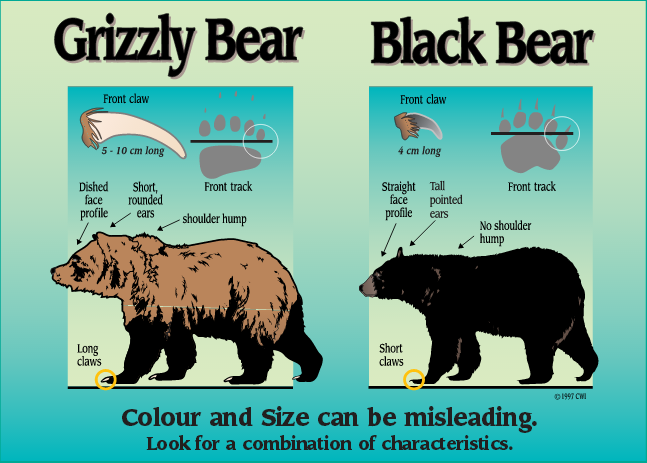
Grizzly bear vs black bear: the quick answer
The grizzly bear (Ursus arctos horribilis) is a subspecies of brown bear; the American black bear (Ursus americanus) is a separate species. Three identification features work at distance: the shoulder hump (grizzly yes, black bear no), the face profile (grizzly dished, black bear straight), and the ears (black bear tall and pointed, grizzly short and rounded).
Grizzlies are larger at 180-360 kg for males versus 60-300 kg for black bears, carry 5-10 cm digging claws rather than 2-5 cm climbing claws, and tend toward defensive attacks when surprised. Black bears inflict fewer total fatalities but a higher proportion of their fatal attacks are predatory.
Color is not a reliable cue because black bears come in black, cinnamon, blond, and even white Kermode or blue glacier variants.
Two bears, one continent, constant confusion
In the lower 48 United States, the grizzly bear and the American black bear are the only two bear species a person is likely to meet. They share most of their range in western Montana, Idaho, Wyoming, and Washington, and they share almost all of it across western Canada and Alaska. A hiker walking a single trail in the Bob Marshall Wilderness or the Canadian Rockies can cross fresh sign from both species within the same afternoon.
That sounds manageable. It is not. Every summer, state wildlife agencies field calls from people who shot a grizzly and thought it was a black bear, or who spotted a cinnamon-phase black bear and called in a grizzly sighting. Color is the worst possible cue and it is the one most people reach for first.
This article lays out the features that actually work, compares size and attack behavior with reference to peer-reviewed data, and explains why the old "play dead for grizzly, fight back for black bear" rule is still broadly right but needs a nuance or two. For the deeper profile of one species, start with the grizzly bear overview and for continental context see the brown bear entry.
Taxonomy: a subspecies and a species
This is the first thing most field guides get wrong.
The grizzly bear is not a separate species. It is a subspecies of the brown bear, Ursus arctos horribilis. Its closest relatives are the Kodiak bear of southwestern Alaska, the Eurasian brown bear of Scandinavia and Russia, and the coastal brown bears of the Alaska Peninsula. All of these are Ursus arctos, and they interbreed freely where ranges touch.
The American black bear is a full species, Ursus americanus, with sixteen recognized subspecies ranging from the cinnamon bear of the northern Rockies to the Louisiana black bear of the lower Mississippi, the Florida black bear of the Everglades, and the spirit bear or Kermode bear (Ursus americanus kermodei) of British Columbia's central coast. The two lineages split roughly 5 million years ago, long before brown and polar bears diverged.
Because they are deeply separated, grizzlies and black bears do not hybridize in the wild. No confirmed hybrid has ever been documented. Chromosome counts and mitochondrial DNA are cleanly distinct. When people argue about a grizzly vs black bear identification, they are arguing about two animals with 5 million years of separate evolution behind them, not two color morphs of the same thing.
How to tell a grizzly from a black bear: the three features that work
Forget color. Focus on shape.
1. The shoulder hump
The single most reliable field mark is the shoulder hump. A grizzly bear has a pronounced muscular hump that sits between and slightly behind the shoulder blades. It is not fat. It is the muscle mass that powers the forelimbs for digging, turning over logs, flipping stones, and excavating ground squirrel burrows and roots. In profile, a grizzly's highest point is this hump, and the rump sits distinctly lower.
A black bear has no hump. The highest point of a standing black bear is the rump, which sits level with or above the shoulders. The back slopes gently upward toward the tail. This reflects a lifestyle that involves more climbing than digging.
"The shoulder hump is diagnostic. If you see a hump at the shoulder and the rump looks lower than the shoulder, it is a grizzly. If the rump is the highest point of the back, it is a black bear. I have never had this rule fail me in forty years in the field."
- Stephen Herrero, Professor Emeritus, University of Calgary, and author of Bear Attacks: Their Causes and Avoidance
2. The face profile
View the head in profile. A grizzly's face is dished or concave: the forehead drops sharply, the snout is short and broad, and the line from the brow to the nose dips in the middle. A black bear's face is straight, almost Roman in profile. The forehead and the snout form a nearly continuous line with little concavity.
This is why old lithographs labeled grizzlies as having a "dished" face. It is not stylization. It is the real shape of the skull and the musculature over it.
3. The ears
Look at the ears relative to the head. Black bear ears are tall, oval, and prominent, often appearing to stick up above the crown of the head. Grizzly ears are short, rounded, and set low on a much broader skull, so they look smaller in proportion.
Identification at a glance
The following chart is the one I carry in my head on every trail in bear country.
| Feature | Grizzly bear | Black bear |
|---|---|---|
| Scientific name | Ursus arctos horribilis | Ursus americanus |
| Shoulder hump | Prominent muscular hump | Absent; rump is higher than shoulders |
| Face profile | Dished, concave between brow and snout | Straight, Roman |
| Ears | Short, rounded, set low on a broad head | Tall, oval, prominent |
| Front claws | 5-10 cm, slightly curved, pale cream or ivory | 2-5 cm, sharply curved, dark brown or black |
| Tracks (front pad) | Toes in a near-straight line; claw marks far ahead of toes | Toes in a curved arc; claw marks close to toes |
| Tail | Short, usually hidden | Short, usually hidden |
| Color (NOT diagnostic) | Brown, blond-tipped, silver-tipped | Black, cinnamon, blond, white (Kermode), blue (glacier) |
| Adult male weight | 180-360 kg (interior), up to 680 kg (coastal) | 60-300 kg |
| Adult female weight | 130-180 kg | 40-180 kg |
| Shoulder height | 1.0-1.1 m on all fours | 0.7-0.9 m on all fours |
| Standing height | 2.0-2.4 m | 1.5-2.1 m |
| Climbing ability | Poor as adults (claws too straight and long) | Excellent at any age |
| Tree scratch marks | Low, from digging, few claw lines | High on trunk, five parallel claw lines |
The claws deserve a closer look. A grizzly's front claws are 5-10 cm long, often pale, almost straight, and shaped like mason's trowels. They are built to shift dirt and lever roots. A black bear's front claws are 2-5 cm, dark, sharply hooked, and built to grip bark. This is why adult grizzlies are poor tree climbers while black bears of any age can be up a Douglas fir in seconds.
Why color is a trap
Most people asked to picture a black bear picture a black animal. Most people asked to picture a grizzly picture a brown animal. In western North America this intuition fails constantly.
American black bears across the western US and Canada are often cinnamon, blond, or chocolate, especially in the Rockies and the interior west. In some Colorado and Arizona populations, cinnamon and blond bears outnumber black-coated individuals. The Kermode bear of British Columbia's Great Bear Rainforest is a white-coated black bear caused by a recessive allele in the MC1R gene. On Admiralty Island and parts of the southeast Alaska coast, the glacier bear is a rare blue-gray black bear.
Grizzlies, meanwhile, can be almost blond, silver-tipped ("silvertip"), dark brown, or nearly black. The name grizzly refers to the grizzled or frosted appearance of the guard hairs, not to the overall coat tone.
The upshot is simple: a pale bear is not necessarily a grizzly, and a black bear is not necessarily black. Use the hump, the face, and the ears. Color is noise.
Size: why the weight ranges overlap
Head-to-head, a large black bear can outweigh a small grizzly. The ranges overlap in the middle.
| Metric | Grizzly bear (interior male) | Coastal grizzly (male) | Black bear (male) | Black bear (female) |
|---|---|---|---|---|
| Typical weight | 180-360 kg | 270-680 kg | 60-300 kg | 40-180 kg |
| Record weight | 499 kg | 751 kg (Kodiak) | 409 kg (North Carolina, 1998) | 226 kg |
| Body length | 1.8-2.5 m | 2.2-3.0 m | 1.2-1.9 m | 1.1-1.6 m |
| Shoulder height | 1.0-1.1 m | 1.2-1.4 m | 0.7-0.9 m | 0.6-0.8 m |
| Standing height | 2.0-2.4 m | 2.4-3.0 m | 1.5-2.1 m | 1.4-1.8 m |
An interior Yellowstone grizzly averaging 220 kg is smaller than a well-fed Pennsylvania male black bear at 250 kg. So mass alone will not identify the species. The shape of the mass will. A 250 kg grizzly looks stockier, humped, and dished. A 250 kg black bear looks longer-legged, taller at the rump, and more dog-like in profile.
For a deeper comparison of body mass by ecosystem, see how big are grizzly bears.
Range: where the two species overlap
The two species share ground only in a relatively narrow swath of the continent.
Black bears range across most of forested North America. They occupy Alaska, all of Canada except the high Arctic, every Canadian province, 40 of the 50 US states, and parts of northern Mexico. Total population is roughly 800,000 to 900,000 animals, making them the most numerous large carnivore on the continent.
Grizzly bears in the contiguous US are confined to about six recovery zones totaling less than 2% of their historic range: Greater Yellowstone, the Northern Continental Divide (Glacier and the Bob), the Cabinet-Yaak, the Selkirks, the North Cascades, and the Bitterroot. The contiguous US population is roughly 2,000 bears. Add Canada's 25,000 and Alaska's 30,000, and the North American total is near 55,000 to 60,000. See where do grizzly bears live for the full distribution.
The overlap zone is western Montana, northern Idaho, the Cascades of Washington, the Canadian Rockies from Banff to the Yukon, most of British Columbia and Alberta's mountain parks, and all of Alaska. Outside this zone, any bear you see is a black bear. Inside this zone, you need to use the identification features above.
Diet and ecology: the digger and the climber
Both species are opportunistic omnivores, but the proportions differ.
A grizzly's diet is roughly 80-90% plant matter by volume across most of its range: grasses, sedges, forbs, roots, bulbs, and berries. The remainder is insects (whitebark pine moths and army cutworm moths are important in Yellowstone), ungulate calves in spring, salmon where available, and carrion. Grizzlies dig. They dig ground squirrels, they dig roots, they dig bulbs, they dig denning sites.
The shoulder hump and the long claws are tools for this work. For detail on seasonal shifts, see what do grizzly bears eat.
A black bear's diet is even more plant-heavy, often 85-95% vegetation by volume: hard mast (acorns, beechnuts, hickory), soft mast (blackberry, blueberry, serviceberry), forbs, and grasses. Black bears climb. They climb for cherries, they climb for pine nuts, they climb for beehives in oak cavities, they climb to escape conflict. The shorter curved claws and the rump-high body shape are tools for this work.
Where the species overlap, grizzlies often displace black bears at concentrated food sources like salmon streams or carcasses. Black bears compensate by being more nocturnal in areas with grizzly presence and by staying closer to climbable trees.
Attack statistics: rare but different in character
This is the most misunderstood part of bear safety. Both species kill humans. They do it in very different circumstances, and the response that works for one is wrong for the other.
Stephen Herrero's landmark 2011 analysis in the Journal of Wildlife Management, covering fatal black bear attacks in North America from 1900 to 2009, identified 63 fatal attacks involving 88 deaths. The pattern was striking: 88% of fatal black bear attacks were predatory. Lone male black bears, typically in remote backcountry, were the aggressors in 92% of cases. These were not defensive reactions to surprise. They were hunts.
The counterpart data for grizzly attacks tells the opposite story. Tom Smith and Stephen Herrero's 2012 paper in the same journal examined grizzly and brown bear attacks in North America and found that the majority of fatal grizzly attacks are defensive: the bear was surprised at close range, was defending cubs, or was defending a carcass or food cache.
Predatory grizzly attacks do occur (the Night of the Grizzlies in Glacier in 1967, the Timothy Treadwell case in 2003), but they are a smaller fraction of the total.
| Attack metric | Grizzly bear | Black bear |
|---|---|---|
| Fatal attacks in North America, 1900-2009 | ~70 | 63 (Herrero 2011) |
| Fatal attacks per decade, recent trend | Rising with population | Rising with population |
| Share that are predatory | ~15-25% | ~88% (Herrero 2011) |
| Share that are defensive | ~60-75% | ~10% |
| Most common attacker profile | Sow with cubs, or bear on carcass | Lone adult male in remote backcountry |
| Most common attack location | Trail, backcountry camp | Remote camp, rural property |
| Fatalities per million visitor days (Yellowstone, 1872-2020) | ~0.05 | negligible |
| Black bear fatalities worldwide since 1900 | N/A | fewer than 70 confirmed |
The numerical takeaway: both kinds of attacks are extremely rare. You are more likely to die from a lightning strike, a bee sting, or a vending machine tipping over than from either species. The behavioral takeaway is different: when a black bear does attack, it is much more likely to be trying to eat you than a grizzly is.
For a deeper risk breakdown, see are grizzly bears dangerous to humans and the survival protocol in how to survive a grizzly bear attack.
"The fundamental misconception is that black bears are the safe bear and grizzlies are the dangerous one. In terms of defensive attack frequency, yes, grizzlies are more reactive. But when a black bear makes contact, the intent is almost always predation. That is why the response has to be different."
- Stephen Herrero, Journal of Wildlife Management, 2011 (doi:10.2192/URSUS-D-10-00005.1)
What to do if attacked: species matters
The standard rule, still broadly correct, is simple:
- Grizzly bear attack, defensive: play dead.
- Black bear attack, any kind: fight back.
- Any bear entering your tent at night: fight back, because the approach is predatory regardless of species.
Let me expand each.
If a grizzly charges after a surprise encounter
- Stand your ground. Do not run. Running triggers chase response in any bear, and you cannot outrun a grizzly at 56 km/h.
- Deploy bear spray at 6-9 meters, aiming at the bear's face in a sustained cloud. Bear spray works in roughly 92% of recorded grizzly encounters according to Smith et al. (2008, Journal of Wildlife Management).
- If contact is imminent and you have no spray, drop onto your stomach, lace your fingers behind your neck, spread your legs to make it harder for the bear to flip you, and stay silent and still.
- Stay down until the bear leaves. Most defensive attacks end in under 2 minutes once the bear perceives the threat as neutralized.
- If the attack shifts from biting to sustained predation (the bear eats, drags, or returns after leaving), switch to fighting back.
If a black bear approaches or attacks
- Do not play dead. Ever. It will be interpreted as success by a predatory black bear.
- Make yourself large. Shout, wave arms, throw rocks.
- If contact happens, fight aggressively. Aim for the face, eyes, and nose. Use trekking poles, knives, rocks, whatever you have. Most black bears retreat from sustained resistance.
- Deploy bear spray if available. It works on black bears as reliably as on grizzlies.
Why the guidance has nuance now
Recent work by Smith and Herrero emphasizes that the motivation of the attack matters as much as the species. A grizzly in a predatory mode (very rare but documented) should be fought, not played dead with. A black bear sow with cubs that bluff-charges is in a defensive mode, not a predatory one, and will usually break off without contact.
The practical rule for the hiker is:
- Surprise encounter + bear retreats or stands: back away slowly, do not run.
- Surprise encounter + charge + grizzly: bear spray, then play dead.
- Any close encounter + black bear + contact imminent: bear spray, then fight.
- Night approach at camp or tent, any species: fight. Treat as predatory.
"Playing dead is appropriate when a grizzly's behavior reads as defensive: it was surprised, it has cubs, it was on a carcass. Playing dead in a predatory attack, regardless of species, is the wrong response because the bear is not trying to neutralize a threat, it is trying to kill prey. That distinction is what separates current guidance from the simpler rule of thumb people learned in the 1970s."
- Tom Smith, USGS Alaska Science Center (now Brigham Young University), Ursus journal
Population trends
Both species are broadly increasing in North America, though on very different curves.
Grizzly bears in the contiguous US have recovered from a low of about 700-800 animals in the 1970s to roughly 2,000 today. Yellowstone has rebounded from 136 bears in 1975 to over 1,000 across the Greater Yellowstone Ecosystem. The Northern Continental Divide population has climbed above 1,100. Recovery has been slow and contested, with delisting debates ongoing.
Black bears have been increasing almost everywhere in North America since the 1980s. State-level populations in Pennsylvania (over 18,000), Virginia (over 20,000), New Jersey (up from near extinction in 1970 to over 3,000), and North Carolina (over 20,000) reflect a species adapting well to forest regrowth on former farmland. The continental total is conservatively 800,000 and possibly over 900,000.
The increase in both species, combined with rising human outdoor recreation, is why attack statistics are also rising in absolute terms, even though the per-capita risk to any given hiker remains tiny. More bears plus more people equals more encounters.
Field cheat sheet
Print this, laminate it, and put it in your pack.
- Look for the hump first. Hump means grizzly. No hump, rump higher than shoulders, means black bear.
- Look at the face profile. Dished means grizzly. Straight means black bear.
- Check the ears. Short and round means grizzly. Tall and oval means black bear.
- Ignore color. Blond bears are often black bears. Dark bears are often grizzlies. Color is not evidence.
- If you see tracks, measure claw marks: grizzlies print claws 5-10 cm ahead of the toe pads; black bears print claws right next to the toe pads.
- Know your region. Outside the six US recovery zones and outside western Canada and Alaska, you are looking at a black bear.
- Carry bear spray. Know where it is on your body. Practice drawing it. It works on both species.
For the long-form identification guide including cub behavior and track casts, see the grizzly bear north american predator profile. For the related size head-to-head between the two largest North American bears, see polar bear vs grizzly bear and the polar bear species hub.
The broader picture
Bear identification is a small skill that matters out of all proportion to how often most people need it. A single mistake, either way, carries consequences: a grizzly shot on a hunting tag meant for a black bear triggers federal investigation under the Endangered Species Act; a black bear misidentified as a grizzly may get a defensive response that a simple shout would have resolved.
The good news is that the diagnostic features are robust, visible at useful distances with binoculars, and consistent across age and sex. Once you have internalized the hump, face, ears triangle, identification is quick and reliable. The bad news is that most casual hikers never bother and rely on color, which is the one feature that is actively misleading across most of western North America.
If you spend enough time in bear country, you will see both species. The grizzly is a magnificent digger and patrol animal, muscular through the shoulder and slow to climb. The black bear is a smaller, woodland-edge forager, nimble in trees and far more numerous. Neither wants a conflict with you. Both will act according to ancient rules of threat assessment and food motivation, and those rules reward a calm, informed human response.
For quiet reading between hikes, the Wildlife Society Bulletin and Ursus are the two journals that publish the best current data on attack patterns and population trends. For a lighter distraction, the sibling sites whats-your-iq.com and evolang.info cover very different topics, and fileformer.com will quietly convert your trail photos into whatever format your field journal needs.
References
- Herrero, S., Higgins, A., Cardoza, J. E., Hajduk, L. I., and Smith, T. S. (2011). Fatal attacks by American black bear on people: 1900-2009. Journal of Wildlife Management, 75(3), 596-603. doi:10.1002/jwmg.72
- Herrero, S. (2018). Bear Attacks: Their Causes and Avoidance, Revised Edition. Rowman and Littlefield.
- Smith, T. S., Herrero, S., Layton, C. S., Larsen, R. T., and Johnson, K. R. (2012). Efficacy of bear deterrent spray in Alaska. Journal of Wildlife Management, 76(5), 1066-1070. doi:10.1002/jwmg.342
- Smith, T. S., Herrero, S., DeBruyn, T. D., and Wilder, J. M. (2008). Efficacy of bear deterrent spray in Alaska. Journal of Wildlife Management, 72(3), 640-645. doi:10.2193/2006-452
- Mattson, D. J. and Merrill, T. (2002). Extirpations of grizzly bears in the contiguous United States, 1850-2000. Conservation Biology, 16(4), 1123-1136. doi:10.1046/j.1523-1739.2002.00414.x
- Pelton, M. R. (2003). Black bear (Ursus americanus). In Wild Mammals of North America: Biology, Management, and Conservation (2nd ed.), Feldhamer, G. A., Thompson, B. C., and Chapman, J. A. (eds.), Johns Hopkins University Press, 547-555.
- Mace, R. D., Carney, D. W., Chilton-Radandt, T., Courville, S. A., Haroldson, M. A., Harris, R. B., Jonkel, J., McLellan, B., Madel, M., Manley, T. L., Schwartz, C. C., Servheen, C., Stenhouse, G., Waller, J. S., and Wenum, E. (2012). Grizzly bear population vital rates and trend in the Northern Continental Divide Ecosystem, Montana. Journal of Wildlife Management, 76(1), 119-128. doi:10.1002/jwmg.250
- Hopkins, J. B., Herrero, S., Shideler, R. T., Gunther, K. A., Schwartz, C. C., and Kalinowski, S. T. (2010). A proposed lexicon of terms and concepts for human-bear management in North America. Ursus, 21(2), 154-168. doi:10.2192/URSUS-D-10-00005.1
- Gunther, K. A., Wilmot, K. R., Cain, S. L., Wyman, T., Reinertson, E. G., and Bramblett, A. M. (2018). Habituated grizzly bears: a natural response to increasing visitation in Yellowstone National Park. Yearbook of Conservation Research, National Park Service.
- National Park Service (2023). Bear safety: what to do during an encounter. Glacier National Park and Yellowstone National Park guidelines.
Frequently Asked Questions
How can you tell a grizzly bear from a black bear?
Color is unreliable because black bears can be cinnamon, blond, or even white. The three features that do work at distance are the shoulder hump (grizzlies have a prominent muscular hump above the shoulders, black bears do not), the face profile (grizzly faces are dished or concave between the forehead and snout, black bear faces are straight), and the ears (black bear ears are taller and more pointed, grizzly ears are shorter and rounded).
Up close, claw length is definitive: grizzly front claws are 5-10 cm and pale, black bear claws are 2-5 cm and darker.
Are black bears or grizzlies more dangerous to humans?
The two species are dangerous in different ways. Grizzlies cause more total fatalities in North America, driven by defensive attacks when a person surprises a bear or gets between a sow and cubs. Black bears inflict fewer fatalities overall but a higher share of their fatal attacks are predatory, meaning the bear is hunting the person as food.
Stephen Herrero’s analysis of 63 fatal black bear attacks from 1900 to 2009 found 88% involved predatory behavior, almost always by lone male bears. Your practical risk from either species on any given hike is extremely low, on the order of one fatality per several million visitor days in national parks.
Should you play dead or fight back in a bear attack?
The guidance depends on species and motivation. If a grizzly charges because you surprised it or approached its cubs, play dead on your stomach with hands laced behind your neck and legs spread so the bear cannot flip you. Stay still until the bear leaves. If a black bear attacks, or if any bear enters your tent at night, or if the attack feels predatory rather than defensive, fight back with everything you have, aiming for the face, eyes, and nose.
Bear spray deployed at 6-9 meters is more reliable than either strategy and works on both species.