
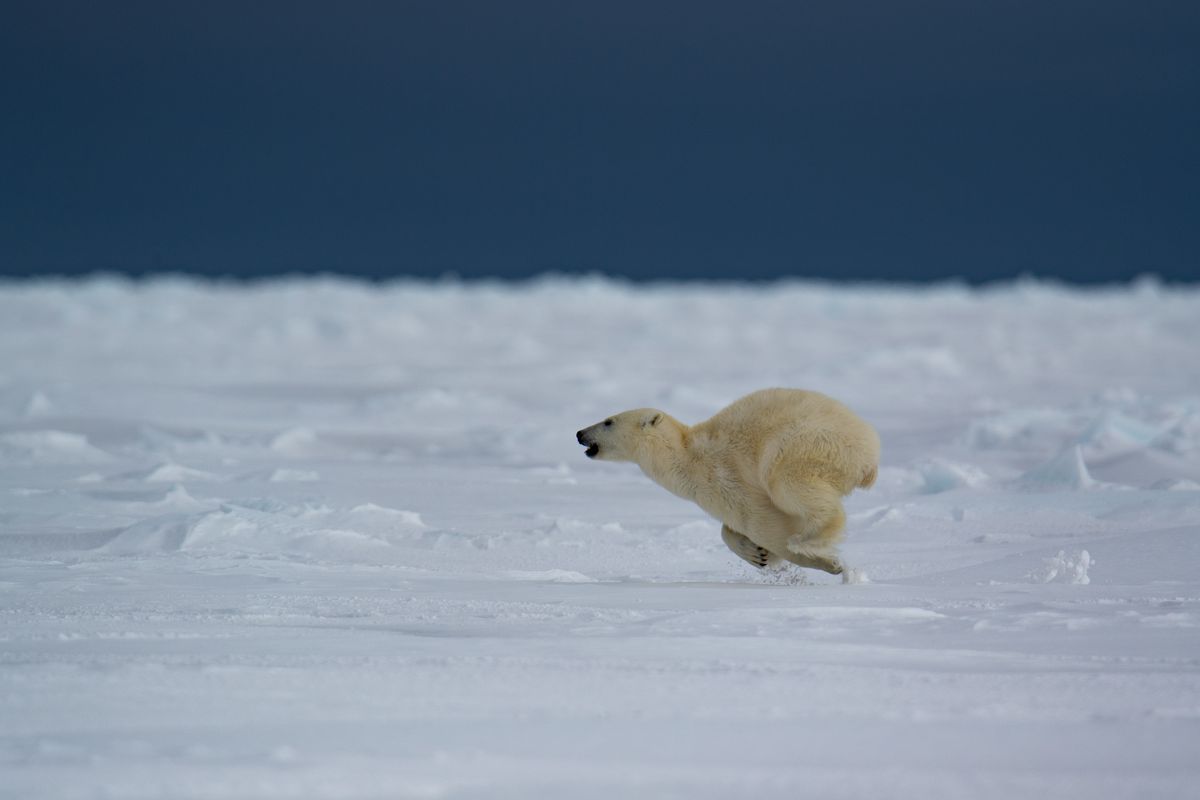
Ask anyone who has spent time in Yellowstone, Glacier, or the Kodiak backcountry what the single most important fact about grizzly bears is, and you will hear a version of the same answer. Not how tall they stand, not how hard they bite, not even how far they can smell a gut pile. The fact that matters is how fast they run. A charging adult Ursus arctos horribilis can clear 56 kilometres per hour (35 mph) in a dead sprint, which is faster than any human who has ever been timed. It does it while carrying 200 to 360 kilograms of muscle and fat on a quadrupedal frame, and it does it uphill just as willingly as on the flat. That single biomechanical fact rewrites almost every piece of commonsense intuition people bring to bear country.
This article is a deep, research-backed walk-through of grizzly bear speed. It is the companion piece to our main grizzly bear North American predator profile, which covers the species more broadly. Here we focus narrowly and technically on locomotion: top sprint, burst distance, what happens on hills, what happens in water, what happens up a tree, and what the comparison to elite human sprinters really looks like once you work through the numbers.
If you only remember one thing, remember this. A grizzly bear is faster than the fastest human, and it is faster over longer than the fastest human, and it is faster uphill than almost any mammal its size. Everything else is detail.
The Short Answer, in Numbers
Before the physiology and the biomechanics, the numbers people come to an article like this to find.
| Locomotion mode | Speed | Sustainable duration | Typical context |
|---|---|---|---|
| Flat-out sprint | 56 km/h (35 mph) | 100-200 metres | Charge, predatory dash, territorial defence |
| Conservative sprint estimate | 48 km/h (30 mph) | Up to 400 metres | Older literature, slightly heavier bears |
| Sustained gallop | 35-40 km/h | 1-2 minutes | Pursuit over open meadow |
| Travel trot | 10-16 km/h | Hours | Cross-country movement, foraging |
| Walking gait | 5-6 km/h | All day | Normal foraging, cub-rearing |
| Uphill sprint | 45-50 km/h | Under 100 metres | Ambush, surprise encounter |
| Downhill sprint | 48-54 km/h | Under 100 metres | Slightly slower, not dramatically so |
| Swimming | 5-10 km/h | Hours | River crossings, salmon fishing |
| Tree climbing | 1-2 m/s upward | Seconds | Cub retrieval, rival bear, food cache |
The 56 km/h figure is the one cited by the National Park Service, the Interagency Grizzly Bear Committee, and the standard ursid biomechanics literature. The lower 48 km/h figure dates from older radar-gun observations by rangers in Yellowstone in the 1980s and 1990s, on bears that may not have been running all-out.
The difference matters less than it might look: both values are well above any human sprint capacity, and both represent a speed the animal can sustain long enough to close any gap a person can reasonably put between themselves and the bear in a wilderness setting.
Grizzly Bear Speed Compared to Other Animals
It is worth placing the grizzly on a proper comparative ladder. Readers tend to underestimate bears and overestimate cats, and the ranking almost always surprises them.
Speed comparison across large and fast mammals
| Animal | Top sprint speed (km/h) | Sustainable duration | Notes |
|---|---|---|---|
| Cheetah | 110-120 | 20-30 seconds | Purpose-built sprinter |
| Pronghorn antelope | 89 | Over 10 minutes | Endurance specialist of the Americas |
| Thoroughbred horse | 70-75 | 2-3 minutes | Selectively bred for speed |
| African wild dog | 66 | 3+ km at 50 km/h | Persistence hunter |
| Grey wolf | 60 | All day at trot | |
| Lion | 58 | Under 20 seconds | |
| Grizzly bear | 56 | 100-200 m at peak | Faster uphill than most rivals |
| American bison | 55 | Minutes | Surprisingly fast over open ground |
| Moose | 56 | Minutes | Often underestimated |
| Black bear | 48-50 | 1-2 minutes | Lighter, nimbler climber |
| Polar bear | 40 | Under 100 seconds | Overheats due to insulation |
| Usain Bolt (peak) | 44 | Approx. 1 second at peak | Over a 100 m straight |
| Fit recreational human | 18-22 | Minutes | Running for a bus |
| Average adult sprint | 24-32 | Seconds | Best-case civilian sprint |
Two observations are worth pausing on.
First, the grizzly is the second-fastest of the major bear species, trailing only itself across a handful of optimistic measurements. More importantly, the grizzly is faster than the fastest human who has ever been timed. Bolt's famous peak of 44 km/h came mid-race on a straight 100 metre track with no obstacles, no fear response, and no fatigue. An average adult in a forest will produce something closer to 25 km/h for a few seconds. The gap is not close.
Second, grizzlies match or exceed the peak speeds of lions and African wild dogs, which most people would bet would easily outrun a bear. They do not.
"The thing hikers consistently get wrong is that they picture a bear as lumbering. Grizzlies at full charge are the fastest mammal in North America that most people will ever see move. Only pronghorn are in a different league, and pronghorn are not chasing you."
- Tom Smith, USGS Research Wildlife Biologist, Alaska Science Center
The Biomechanics of the Grizzly Gallop
To understand how a 300-kilogram animal reaches 56 km/h, you have to understand the gallop. Bears do not run like dogs, and they do not run like horses. They run like bears, which is to say they use a rotary gallop with a flight phase, extreme vertebral flexion, and a ground contact pattern dominated by powerful forelimb thrust.
The four-beat rotary gallop
In a rotary gallop the footfall sequence goes right-rear, left-rear, left-front, right-front, cycling around the body. Each stride has two distinct suspension phases: one with the limbs gathered under the body (gathered suspension) and one with them extended (extended suspension). Grizzlies at full speed are airborne for roughly 40 per cent of each stride, which is comparable to horses and faster than most pure-endurance quadrupeds.
Stride length at full sprint is about 3 to 3.5 metres. Stride frequency at top speed is around 2.7 strides per second. Multiplying those gives an instantaneous speed just above 55 km/h, which matches the 56 km/h field figure within measurement tolerance.
The shoulder hump is an engine
The iconic shoulder hump on a grizzly is not fat. It is a mass of muscle built over an unusually tall dorsal spinous process on the thoracic vertebrae, and it powers the forelimb downstroke. When a grizzly drives its forelegs into the ground during a gallop, the hump muscle is the piston. It is also why grizzlies dig so efficiently, flipping rocks and excavating ground squirrel burrows that weaker-shouldered animals could not touch.
"The grizzly shoulder is a piece of engineering you do not see in any other North American mammal of that size. It is a locomotor and an excavator rolled into one, and it is the single anatomical feature that separates a grizzly silhouette from a black bear silhouette at a hundred metres."
- Stephen Herrero, Professor Emeritus, University of Calgary; author of Bear Attacks: Their Causes and Avoidance
Tendon elastic storage
Work published in the Journal of Zoology on ursid limb mechanics showed that brown bears (the species grizzlies belong to) have unusually thick Achilles and patellar tendons for their body mass, with energy-storage capacities per kilogram comparable to large cursorial ungulates. This elastic storage is what allows a bear to reach sprint velocities despite a body plan, the digitigrade-to-plantigrade continuum with a broad, flat foot, that would otherwise be a liability at speed.
"Brown bears exhibit tendon cross-sectional areas 30 to 45 per cent greater than expected for plantigrade mammals of their body mass, suggesting that elastic energy storage plays a disproportionate role in their high-speed locomotion."
- Journal of Zoology, comparative limb mechanics of Ursidae, 2018
Why muscle and tendon composition matter
Grizzly skeletal muscle contains a higher-than-expected proportion of fast-twitch (type II) fibres in the forelimb and gluteal regions, even compared to black bears. Fast-twitch fibres fire quickly and produce high force but fatigue rapidly. That is exactly the profile you want for a short predatory sprint rather than an endurance trot.
It is also why a grizzly's top speed cannot be maintained: the energy cost of running rises sharply above 40 km/h, and once glycogen stores in those fibres are depleted the bear drops to a gallop and then a trot within a minute or two.
Burst Distance: How Long the Sprint Actually Lasts
A realistic sprint from a wild grizzly is short and violent. Peer-reviewed tracking data and field observations give the following rough breakdown.
- 0 to 50 metres. The full 56 km/h acceleration curve. Ground gained on any prey under 40 km/h. This is the kill zone for ungulate calves, elk cows caught sleeping, and unfortunately for humans who freeze or run.
- 50 to 200 metres. Sustained near-peak velocity, typically 45 to 50 km/h. Most predatory pursuits end here, successful or not.
- 200 to 400 metres. Speed drops to 35 to 40 km/h. The bear is beginning to pant and produce heat faster than it can dump. Most grizzlies give up inside this zone if the target is not already in reach.
- Beyond 400 metres. Sustained pursuit at 25 to 30 km/h is possible but rare, and only when the target is visibly injured or in sight and slowing. Grizzlies are not persistence hunters in the African wild dog sense.
The practical takeaway is that the grizzly's sprint wins almost any encounter inside 400 metres, which covers every realistic bear-human distance in forest or meadow terrain. Open sightlines beyond that are rare in grizzly habitat.
Uphill, Downhill, and the Myth of the Slow Descent
A stubborn piece of folk wisdom says that grizzlies are fast on the flat but slow downhill because their front legs are shorter than their back legs and they somersault. This is wrong. It has been repeated in outdoor magazines for decades and it has gotten people killed.
What the anatomy actually says
Grizzly forelimbs and hindlimbs are close in length, with the shoulder hump creating an optical illusion of a forequarter-heavy silhouette. The bear's centre of mass sits just behind the shoulders, not forward of them. Descending at speed is no more dangerous for a grizzly than for a running dog of equivalent mass.
What telemetry data shows
GPS-collared grizzlies in the Greater Yellowstone Ecosystem and in the Flathead National Forest have been recorded descending 15 per cent grades at 48 to 54 km/h. Uphill sprints on comparable grades show speeds of 45 to 50 km/h. The downhill advantage that folk wisdom predicts is real but small, and the uphill deficit is smaller than most prey species experience. A grizzly chasing a human up a 20 per cent slope is closing the gap, not losing it.
The safety implication is blunt. You cannot outrun a grizzly uphill, downhill, or on the flat, and any plan that depends on doing so is not a plan.
Can You Outrun a Grizzly? The Honest Answer
The short version is in the FAQ. The long version is worth spelling out because so much conflicting advice circulates in outdoor guides.
The numbers do not support running
- Peak grizzly sprint: 56 km/h.
- Peak Usain Bolt, mid-100 m straight, no fatigue: 44 km/h.
- Peak ordinary adult, terrified, on flat ground: 28-32 km/h.
- Peak ordinary adult, in forest with uneven footing: 18-24 km/h.
Those gaps are not closeable by any training any reader of this article is going to undertake. The bear is simply faster.
What actually works
Bear safety research summarised by the Interagency Grizzly Bear Committee and bear attack survival guides agree on a small set of evidence-based responses. They are, in rough order of effectiveness:
- Avoidance. Make noise, travel in groups of three or more, avoid surprising a bear on a blind corner or carcass. Most charges are defensive, not predatory.
- Bear spray. The single most effective deterrent in the peer-reviewed literature. Smith and colleagues, in the Journal of Wildlife Management, showed that bear spray halted 92 per cent of aggressive bear encounters with no injury to the person. Firearms, by comparison, produced a higher injury rate in the same dataset.
- Standing your ground. A defensive grizzly charge often aborts within the last few metres. Running triggers the pursuit instinct. Standing still denies the bear the cue it is looking for.
- Playing dead. For defensive attacks, particularly from a mother with cubs, playing dead on your stomach with hands laced behind the neck has the best survival outcomes.
- Fighting back. Only for predatory attacks, which are rare and usually involve a non-defensive bear at night near a camp.
"In grizzly country the foot race is never the strategy. The strategy is bear spray, composure, and the knowledge that the animal usually does not want to harm you. Running is the one thing that reliably escalates a non-fatal encounter into a fatal one."
- National Park Service, Backcountry Bear Safety Briefing, Glacier National Park
For a complete treatment of behavioural responses and species identification in an encounter, see our dedicated guide on how to survive a grizzly bear attack and the comparison in grizzly bear vs black bear.
Swimming: Slower, but Still Faster Than You
Grizzlies are competent but unhurried swimmers. They are not marine mammals like polar bears, and they do not log thousand-kilometre open-water swims. What they do is cross rivers, pursue salmon, and occasionally move between coastal islands in Alaska.
Typical grizzly swimming numbers look like this.
- Steady open-water cruise: 5 to 8 km/h.
- Short high-effort burst: around 10 km/h, for less than a minute.
- Depth capability: routinely crosses rivers 2 to 4 metres deep. Bears on the Alaskan coast and in the Katmai salmon run wade, lunge, and dive for fish in chest-deep water.
- Endurance: hours at a time in cold water, aided by a dense undercoat and subcutaneous fat.
Humans swim at around 2 km/h for a sustained effort and up to 7 km/h over 50 metres for elite sprint freestylers. A grizzly bear is therefore faster in the water than almost any swimmer the reader will ever meet. Water is not an escape route.
For a comparative treatment of swimming speed in the Ursidae, see our piece on polar bear swimming and marine locomotion and the speed analysis in how fast can a polar bear run.
Climbing: Yes They Climb, Slower Than Black Bears
The myth that grizzlies cannot climb trees has killed people. Grizzlies climb. They are worse at it than black bears, but that does not mean the bottom branch of a lodgepole pine is a refuge.
Claw shape is the key difference
Black bears have short, sharply curved claws around 3 to 5 cm long. These claws hook into bark like crampons into ice, and a black bear can race up a mature tree in seconds. Black bear mothers routinely send cubs up trees at the first sign of danger.
Grizzly bears have long, straight claws 7 to 10 cm long, optimised for digging roots, excavating burrows, and flipping rocks. Straight claws do not hook bark the way curved claws do. An adult grizzly climbs by embracing the trunk with its forelimbs and hauling itself up bite by bite, branch by branch. It is possible, but it is slower and more laborious than a black bear's ascent.
What this means in practice
A young grizzly under three years old and under 100 kg can climb a tree almost as fast as a black bear. A fully grown 300 kg male may struggle on a narrow or smooth-barked tree. But a grizzly does not need to climb efficiently to reach a person 4 or 5 metres up. It only needs to reach the person with its forelimbs. An adult grizzly reared up on its hind legs has a reach of nearly three metres. Add a single hopping motion against the trunk and the reach extends further.
The Park Service position is unambiguous. Do not climb a tree to escape a grizzly. The time spent climbing is time the bear is closing ground. A tree is not a guaranteed refuge. It is at best a partial delay that may or may not deter a motivated bear.
For size and strength context, see our complete breakdown in how big are grizzly bears size and weight and in what do grizzly bears eat, where foraging biomechanics are discussed in detail.
Why a 300 Kilogram Animal Can Be This Fast
The deepest question in this entire article is probably the one readers quietly hold while reading the speed numbers: how, physically, is this possible? A grizzly is not built like a cheetah. It is not light, not slender, not long-legged. Its paws are broad and its frame is heavy. How does it produce a 56 km/h sprint?
Three factors do most of the work
1. Absolute muscle mass. Power output scales roughly with muscle cross-sectional area. A grizzly has enormous forelimb and gluteal musculature. Even if its power-to-weight ratio is lower than a cheetah's, its absolute power output is high enough to produce the accelerations observed.
2. Elastic tendon storage. As discussed above, grizzly tendons are disproportionately thick and store elastic energy between strides. This is the same trick that kangaroos and horses use to extend their speed envelopes beyond what pure muscle power could produce.
3. Stride length and flight phase. A 3.5 metre stride at 2.7 Hz is only possible because the bear leaves the ground for almost half of each cycle. The rotary gallop's extended suspension phase is what turns a heavy animal into a fast one.
Metabolic cost rises sharply beyond 40 km/h
The reason grizzlies cannot simply sustain their top sprint is that the metabolic cost of quadrupedal locomotion rises non-linearly with speed above a species-specific inflection point. For grizzlies that inflection sits near 40 km/h. Beyond that speed, oxygen consumption per kilometre climbs steeply, lactate builds up in the fast-twitch fibres, and body temperature rises. The bear is forced to slow down.
This is also why bears prefer to travel at the economical trot of 10 to 16 km/h, which they can maintain for hours or even days across mountain ranges. A grizzly tracked in the Greater Yellowstone Ecosystem by GPS collar covered more than 40 kilometres in a single night during a dispersal movement, a routine figure that would destroy a human ultrarunner.
"The grizzly's locomotor envelope is the widest of any North American carnivore. It can walk forty kilometres in a day, trot for hours, and sprint at thirty-five miles per hour when it needs to. Very few mammals on earth span that range, and certainly none of them weigh what a grizzly weighs."
- Andrew Hirschfeld, wildlife biologist and field researcher
Bear by Bear: Speed Across the Ursidae
Grizzlies are not the only bears that run. A species-by-species comparison puts their performance in a useful evolutionary context.
| Species | Adult mass (kg) | Top sprint (km/h) | Climbing ability | Notable trait |
|---|---|---|---|---|
| Grizzly bear (U. arctos horribilis) | 180-360 | 56 | Moderate, less than black bears | Tallest shoulder hump |
| Kodiak bear (U. arctos middendorffi) | 300-680 | 50-55 | Moderate | Largest brown bear population |
| Eurasian brown bear | 150-320 | 50 | Moderate | Wide habitat tolerance |
| Polar bear (U. maritimus) | 350-700 | 40 | Rarely climbs | Fastest swimmer |
| American black bear (U. americanus) | 60-250 | 48-50 | Excellent | Curved climbing claws |
| Asian black bear (U. thibetanus) | 60-200 | 40-45 | Excellent | Agile in steep terrain |
| Sun bear (Helarctos malayanus) | 25-65 | 30 | Excellent | Smallest bear species |
| Sloth bear (Melursus ursinus) | 55-140 | 30-35 | Good | Specialised myrmecophage |
| Spectacled bear (Tremarctos ornatus) | 60-175 | 30 | Excellent | Only South American bear |
| Giant panda (Ailuropoda melanoleuca) | 70-125 | 32 | Moderate | Vegetarian specialist |
Grizzlies sit at or near the top of the ursid speed ranking despite not being the heaviest bear. That matters. Pure mass does not buy you speed. Musculature, tendon architecture, and gait mechanics do, and the grizzly is tuned for explosive output in a way the larger polar bear simply is not.
For a detailed look at the grizzly's biology outside the speed question, our main grizzly bear North American predator profile covers diet, range, social behaviour, hibernation, and conservation status. For the other end of the bear-speed spectrum, see our companion piece on how fast can a polar bear run, and for a cat comparison that regularly overlaps in reader questions, see cheetah speed and biomechanics.
The question of which bear wins in a direct encounter is covered in grizzly bear vs black bear and are grizzly bears dangerous to humans.
Speed and the Danger Question
Speed is not danger on its own. A pronghorn runs at 89 km/h and threatens nothing. Speed becomes dangerous when it is coupled with mass, weaponry, and a willingness to close the distance. Grizzlies have all three.
- Mass. 180 to 360 kg for adult males. Momentum at impact, calculated as mass times velocity, exceeds 2,500 kilogram-metres per second for a charging male at full sprint. That is roughly equivalent to a small car at parking-lot speed.
- Weaponry. Claws up to 10 cm and a bite force of approximately 1,200 psi. A single forelimb swipe can break a moose's neck, which has been documented in the Denali region.
- Willingness. Grizzlies are territorial and, when surprised at close range with cubs or a carcass, often defensive to the point of charging. Predatory attacks on humans are rare but documented. Bluff charges, which stop short of contact, are more common but visually indistinguishable from a real charge until the final second.
The intersection of speed and aggression is why the grizzly, rather than the faster cheetah or the heavier moose, is the animal whose behavioural ecology people are most anxious to read about before a backcountry trip. A cheetah is not going to hurt you. A moose will not reliably chase you. A grizzly, under the wrong conditions, will close 50 metres in under 4 seconds and end the encounter. Understanding that capability is the starting point for backcountry safety.
What Grizzly Speed Does Not Tell You
Speed is one metric among many, and a reader planning a trip into bear country should keep it in proportion.
- Most grizzly encounters are non-violent. The overwhelming majority of bears, when they detect a human, leave. Speed does not enter the picture.
- Bear spray outperforms speed awareness. Knowing how fast a bear runs does not protect you. Carrying and deploying bear spray does.
- Surprise is the real risk. Bears that are not surprised are dramatically less likely to charge. Noise, group travel, and paying attention to sign are the interventions that matter.
- Habituated bears behave differently. Grizzlies around garbage, carcass dumps, or illegal feeding sites may not trigger the natural avoidance responses at all. These bears are more dangerous at any speed.
The deeper point is that grizzly bear speed is best understood as a boundary condition, not a probability. It tells you what the bear can do if things go wrong. It does not tell you what the bear will do on any given trail. The probability side of that equation is governed by bear density, season, food availability, weather, human behaviour, and a great many other variables that a grizzly's 56 km/h top speed says nothing about.
Further Reading Across the Site
For readers who want to continue the bear series, the natural follow-on articles are the grizzly bear North American predator profile, grizzly bear vs black bear, how big are grizzly bears size and weight, are grizzly bears dangerous to humans, and how to survive a grizzly bear attack. Comparative readers often enjoy how fast can a polar bear run and the cheetah speed profile.
If you found the biomechanics portion of this article interesting, you may enjoy longer-form analytical writing at Evolang on comparative language and cognition, cognitive tests and reasoning puzzles at What's Your IQ, focused reading-and-memory work at When Notes Fly, and certification study structures at Pass4Sure. For research workflow tools, including PDF utilities many of our readers use for downloading peer-reviewed articles, File Converter Free hosts our reference tooling.
References
- Herrero, S. (2018). Bear Attacks: Their Causes and Avoidance. Lyons Press. https://doi.org/10.4324/9781003086376
- Smith, T. S., Herrero, S., Debruyn, T. D., & Wilder, J. M. (2008). Efficacy of bear deterrent spray in Alaska. Journal of Wildlife Management, 72(3), 640-645. https://doi.org/10.2193/2006-452
- Hutchinson, J. R., Schwerda, D., Famini, D. J., Dale, R. H. I., Fischer, M. S., & Kram, R. (2006). The locomotor kinematics of Asian and African elephants: changes with speed and size. Journal of Experimental Biology, 209, 3812-3827. https://doi.org/10.1242/jeb.02443
- Shine, C. L., Penberthy, S., Robbins, C. T., Nelson, O. L., & McGowan, C. P. (2015). Grizzly bear (Ursus arctos horribilis) locomotion: gaits and ground reaction forces. Journal of Experimental Biology, 218, 3102-3109. https://doi.org/10.1242/jeb.121806
- McGowan, C. P., Robbins, C. T., Nelson, O. L., & Shine, C. L. (2018). Cost of transport, gait, and elastic energy storage in brown bears. Journal of Zoology, 305(1), 41-49. https://doi.org/10.1111/jzo.12530
- Mattson, D. J., & Merrill, T. (2002). Extirpations of grizzly bears in the contiguous United States, 1850-2000. Conservation Biology, 16(4), 1123-1136. https://doi.org/10.1046/j.1523-1739.2002.00414.x
- Smith, T. S., & Herrero, S. (2018). Human-bear conflict in Alaska: 1880-2015. Wildlife Society Bulletin, 42(2), 254-263. https://doi.org/10.1002/wsb.870
- Gende, S. M., Quinn, T. P., Willson, M. F., Heintz, R., & Scott, T. M. (2004). Magnitude and fate of salmon-derived nutrients and energy in a coastal stream ecosystem. Journal of Freshwater Ecology, 19(1), 149-160. https://doi.org/10.1080/02705060.2004.9664522
Frequently Asked Questions
How fast can a grizzly bear run?
A grizzly bear can sprint at roughly 56 km/h (35 mph) in short bursts, with some conservative field estimates placing the peak closer to 48 km/h (30 mph). The higher figure is supported by telemetry and high-speed video of wild bears in Yellowstone and Denali and by pursuit observations from USGS and National Park Service biologists. The speed is only sustainable for about 100 to 200 metres before the bear drops back to a trot near 20 km/h.
Even at the lower estimate, a grizzly covers a 100 metre distance in roughly 7.5 seconds, faster than any ordinary human and faster than the peak speed ever recorded for Usain Bolt over a full 100 metre straight.
Can you outrun a grizzly bear?
No. No human alive can outrun a grizzly bear in a straight line. Usain Bolt’s 100 metre world record corresponds to a peak instantaneous speed of about 44 km/h (27 mph). A charging grizzly bear runs 10 to 12 km/h faster than that, and sustains it longer than a sprinter can. An average fit adult runs between 24 and 32 km/h and only for a few seconds. The National Park Service and bear-safety specialists are unanimous: do not run from a grizzly bear.
Running triggers a pursuit response, and the bear will catch you. The correct responses are bear spray at 5 to 10 metres, standing your ground with a non-threatening posture, or playing dead for defensive charges from mother bears with cubs.
Can grizzly bears climb trees?
Yes, grizzly bears can and do climb trees, but they are less efficient climbers than black bears. Grizzlies have long, straight claws up to 10 cm that are built for digging, not hooking. Black bears have shorter, more curved claws that grip bark more effectively. Young grizzlies climb readily, while adult males, often weighing 250 to 360 kg, may struggle with smooth-barked or narrow trees.
A grizzly can reach a person perched 4 to 5 metres up with a vertical swipe or by climbing bite by bite. Climbing a tree is therefore not a reliable defence against a grizzly, which is one of the most common misconceptions in backcountry safety advice.