
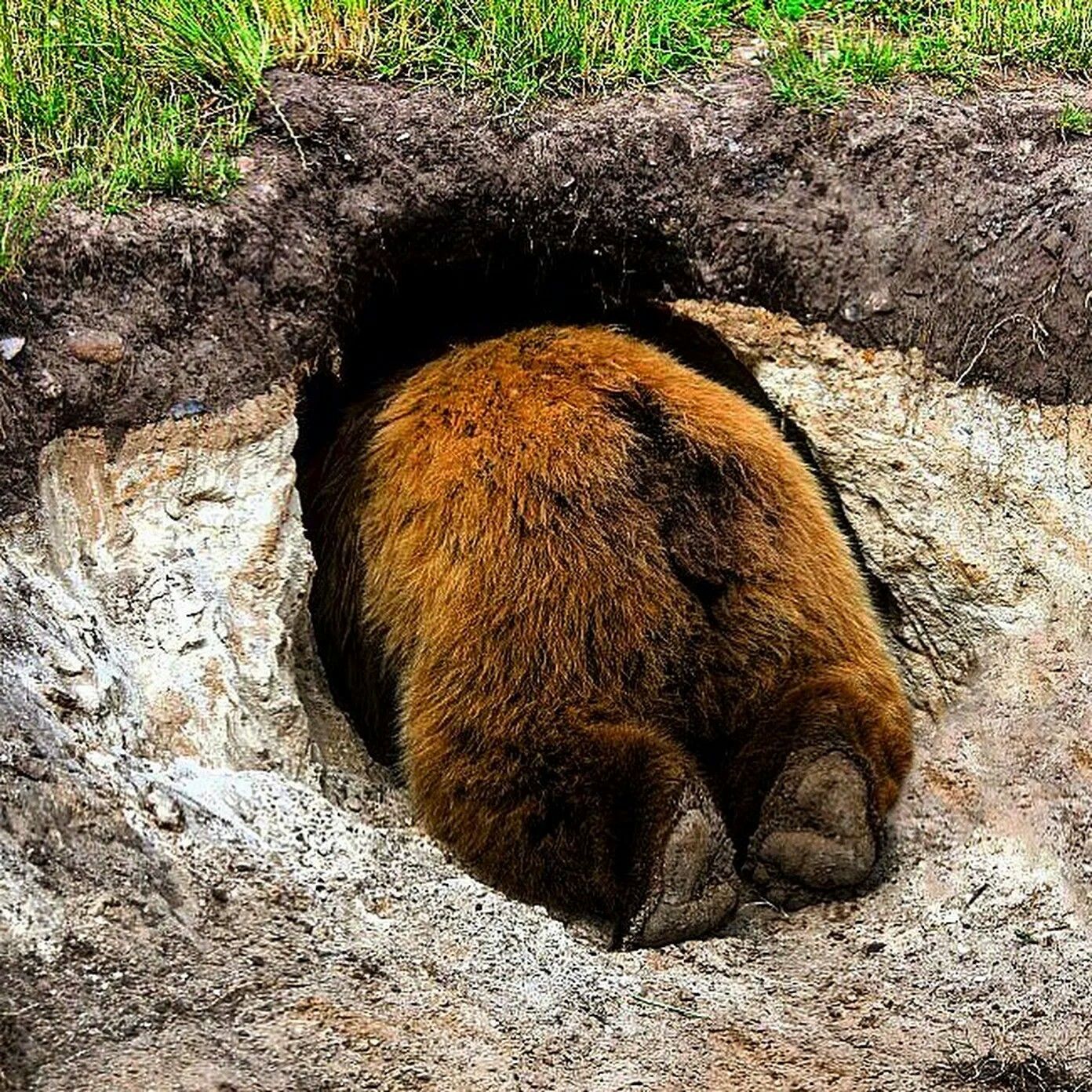
Brown bear hibernation is one of the most remarkable physiological feats in mammalian biology.
A 300 kg animal lies motionless in a snow-buried chamber for half a year, pulse reduced to a dozen beats per minute, breathing barely perceptible, eating and drinking nothing, yet emerging in spring with muscles intact, kidneys healthy, bones only mildly demineralised, and in many cases accompanied by two or three tiny cubs born in the depths of winter. Every part of that outcome depends on biochemistry that human medicine is still trying to understand.
This article covers how long brown bears hibernate across their enormous range, what actually happens inside the den, how the physiology compares with other mammals and with their close relatives the grizzly and polar bear, how dens are built and chosen, why females give birth in the middle of winter, and what climate change is doing to the denning calendar in Scandinavia and southern Europe.
For the full biology of the species see the main brown bear guide, which covers taxonomy, size, diet, behaviour, and conservation beyond hibernation.
Do Brown Bears Hibernate?
Yes. Brown bears, Ursus arctos, are true hibernators by the modern physiological definition. The debate over whether bears qualify as hibernators or merely enter winter torpor was a twentieth-century one, driven by the fact that small hibernators like ground squirrels and marmots let their body temperature fall to within a few degrees of freezing, while bears only drop by four to seven degrees.
But Oivind Toien and colleagues settled the matter in a landmark 2011 paper in Science, showing that black bears depress their metabolic rate to roughly 25 percent of basal despite modest cooling, achieving energy savings as deep as any small hibernator once body size is accounted for. Brown bears use the same machinery.
"The metabolic rate of hibernating black bears was reduced to 25 percent of basal despite body temperatures that remained high. This decoupling of metabolism from temperature sets mammalian bear hibernation apart from that of small mammals and may have important biomedical implications." Oivind Toien et al., Science, February 2011 (DOI: 10.1126/science.1199435)
What varies across the species range is not whether brown bears hibernate but how long. That variation is driven by the length of the winter food gap rather than by temperature itself. Where winters are long and cold and food disappears under deep snow, bears den for seven months. Where winters are mild and mast crops, carrion, or even human refuse remain accessible, dens shorten or in rare cases disappear altogether.
How Long Do Brown Bears Hibernate by Region?
Hibernation length in brown bears scales with latitude, elevation, and local food availability. The table below summarises typical dormancy periods across major populations, based on long-term telemetry studies from the Scandinavian Brown Bear Research Project, the Carpathian bear monitoring programme, the Cantabrian Brown Bear Foundation, and Alaskan and Russian coastal surveys.
| Region | Subspecies / population | Typical hibernation length | Entry window | Emergence window |
|---|---|---|---|---|
| Northern Sweden, Norway | U. a. arctos (Scandinavian) | 6-7 months | late October - early November | mid April - mid May |
| Finland, Russian Karelia | U. a. arctos | 6-7 months | late October | April - early May |
| Romanian Carpathians | U. a. arctos | 4-5 months | late November - December | March - early April |
| Cantabrian mountains, Spain | U. a. arctos (Cantabrian) | 4-5 months, occasionally skipped | December | February - March |
| Apennines, Italy | U. a. marsicanus (Marsican) | 3-4 months | December | February - March |
| Yellowstone, US Rockies | U. a. horribilis (grizzly) | 5-6 months | late October | April |
| Alaskan interior, Brooks Range | U. a. horribilis / middendorffi | 6-7 months | October | April - May |
| Coastal Alaska, Kodiak, Kamchatka | U. a. middendorffi / beringianus | 3-5 months | November - December | March |
| Hokkaido, Japan | U. a. yesoensis (Ussuri) | 4-5 months | November - early December | March - April |
| Himalaya (Ladakh, Tibet) | U. a. isabellinus | 5-6 months | late October | April - May |
A few patterns stand out immediately. Scandinavian brown bears den longer than any other brown bear population, with radio-collared Swedish females averaging around 200 days from entry to emergence. This is driven by the extreme light gap and the length of snow cover rather than by absolute cold, because winters in interior Sweden are no colder than in many Carpathian valleys, but the growing season is three months shorter.
Cantabrian brown bears in Spain show the shortest and most variable dens of any European population. In warm winters with good acorn and beech mast, some females have been documented denning for only 60 to 80 days, and a small percentage have been recorded moving and feeding throughout the winter without any detectable denning period.
The Cantabrian Brown Bear Foundation has used camera traps to capture bears foraging on carrion and on oak mast in January and February in multiple years since 2015.
Marsican brown bears in the Italian Apennines den briefly, often only three to four months, but nearly all females still den to give birth. The population is small, around 50 individuals, and hibernation data comes mostly from a handful of collared females combined with opportunistic camera trap observations.
For a deeper look at how this compares with the subspecies-level story, see brown bear subspecies explained and european brown bear where they live.
Inside the Den: Physiology of Brown Bear Hibernation
A hibernating brown bear is not asleep in the ordinary sense. It is in a state of deep metabolic suppression that is more like a suspended version of wakefulness than it is like a long nap. If you open the den and touch the bear, it will often respond. It can wake fully within minutes, defend itself, or leave the den if the disturbance is serious. But left undisturbed it lies curled, eyes closed, breathing barely visible.
Heart Rate, Breathing, and Body Temperature
The cardiovascular changes are the most dramatic. In an active summer brown bear the resting heart rate sits around 40 beats per minute. Inside the den, continuous telemetry studies from Scandinavia show heart rates falling to 8 to 19 beats per minute, with occasional long diastolic pauses of four to six seconds. Breathing slows in parallel, from 15 to 30 breaths per minute when active down to roughly one breath every 30 to 45 seconds in deep hibernation.
Body temperature drops more modestly. Core temperature falls from about 37 degrees Celsius to between 31 and 33 degrees, fluctuating in a slow daily cycle of roughly one degree. This is the key difference from small hibernators, which cool to within a few degrees of freezing and must periodically rewarm every one to three weeks to maintain neurological function.
Brown bears never leave the functional temperature range for their organs, and they therefore do not need interbout arousals. A single, uninterrupted depression lasts the full five to seven months.
Metabolic Depression Without Deep Cooling
The Toien 2011 Science paper was critical because it separated metabolic depression from body temperature. Bears achieve a metabolic rate of roughly 25 percent of basal with a temperature drop of only four to seven degrees. That is far more efficient, per degree of cooling, than any small mammal.
The mechanism involves changes in mitochondrial function and in circulating metabolic regulators that slow cellular respiration without requiring deep cold. Parallel work in Journal of Experimental Biology over the last decade has dissected the biochemical signals responsible.
"Seasonal shifts in cardiac function, renal physiology, and skeletal metabolism allow ursids to maintain organ integrity over periods of immobility that would be catastrophic for any other large mammal. The bear hibernation phenotype is now one of the most intensively studied models in comparative physiology." Journal of Experimental Biology, review summary, 2019
Urea Recycling and Nitrogen Balance
Over a full winter hibernation a brown bear does not urinate or defecate. The kidneys continue to produce urine at a reduced rate, but that urine is reabsorbed, and the urea it contains is broken down by gut bacteria back into ammonia, which the liver then re-uses to build amino acids.
This urea recycling is the reason bears do not poison themselves with nitrogenous waste during hibernation, and it is a process that pharmaceutical researchers are studying intensively for applications in chronic kidney disease.
Muscle and Bone Preservation
A human immobilised in bed for six months loses 30 to 50 percent of muscle mass and suffers severe osteoporosis. A hibernating brown bear loses only 2 to 5 percent of muscle mass across the same period, and bone density loss is minimal and fully recovered within weeks of emergence.
Several genes involved in muscle protein turnover are dramatically upregulated inside the den, and specific circulating factors in hibernating bear blood have been shown, in cell culture experiments, to protect human muscle cells from atrophy. This is one of several threads of bear hibernation research that has direct relevance for human medicine, long spaceflight, and intensive care.
Hibernation Physiology Compared With Other Mammals
The hibernation strategy that brown bears use is only one of several solutions that mammals have evolved to survive long food gaps. The table below compares the core physiological parameters with small hibernators, polar bears, and humans, to put the bear phenotype in context.
| Parameter | Brown bear (hibernating) | Arctic ground squirrel (torpor) | Polar bear (maternal den) | Human (bedridden) |
|---|---|---|---|---|
| Duration per cycle | 4-7 months continuous | 2-3 weeks between arousals | 4-6 months, pregnant females only | N/A |
| Core body temperature | 31-33 C | -2 to +3 C | ~35 C | 37 C |
| Heart rate | 8-19 bpm | 3-5 bpm | 25-30 bpm | 60-80 bpm |
| Breathing rate | 1 per 30-45 s | 1 per 60+ s | 1 per 10-20 s | 12-16 per min |
| Metabolic rate (% basal) | ~25% | ~2-5% | ~50-70% | 90-100% |
| Eats, drinks, urinates, defecates | No | Yes during arousals | No | Yes |
| Muscle loss over period | 2-5% | variable | 5-10% | 30-50% |
| Gives birth during dormancy | Yes | No | Yes | N/A |
| Fully arousable in minutes | Yes | No (hours) | Yes | N/A |
Two things jump out. First, only bears give birth during the dormant period. A ground squirrel wakes in spring and breeds in April; a brown bear gives birth to blind, 400 gram cubs in January, inside the den, while still in the hibernating state, and begins nursing immediately.
Second, brown bear metabolic depression is intermediate between the extreme cooling of small hibernators and the minimal suppression of polar bears. Polar bears as a species do not hibernate; only pregnant females den, and their metabolic and cardiovascular changes are shallower than those of brown bears. For the polar bear side of that story see polar bear cubs denning and survival.
For a comparison focused on North American grizzlies see grizzly bear hibernation how it works, and for the broader cross-species view see how bears hibernate.
Den Construction and Site Selection
A brown bear den is a precise piece of engineering. The bear must find or excavate a cavity that is thermally stable, well insulated by overlying snow, structurally sound enough not to collapse under three metres of winter snowpack, and hidden enough that humans, wolves, or other bears are unlikely to disturb it.
Excavated Slope Dens
Across Scandinavia, Finland, Russia, the Carpathians, and much of the Himalaya, the typical brown bear den is an excavated chamber dug into a hillside. The bear chooses a south or east-facing slope, usually at mid elevation where snow accumulates reliably but avalanche risk is low. Excavation takes several days to a week.
The bear digs a short downward tunnel, 50 to 80 cm in diameter, which then opens into a chamber barely larger than the bear's curled body. Total depth from entrance to back wall is commonly 1.5 to 3 metres.
The bear then lines the chamber with vegetation hauled in beforehand: moss, grass, spruce or fir boughs, pine needles, bark, and sometimes lichen. This lining serves both as insulation and as a scent-damping layer. Many Scandinavian dens are dug beneath the root mass of a large spruce, which provides a ready-made ceiling. Others are excavated in the sheltered lee of boulders or in dense thickets of young conifers.
Once the bear enters and the first snowfall covers the entrance, the den becomes essentially invisible. Internal temperatures rise slightly above freezing from the bear's body heat, while outside temperatures may drop to minus 30 degrees or lower.
Natural Caves and Rock Crevices
In karst landscapes, where limestone has been eroded into caves and fissures, brown bears often bypass excavation entirely. This is the dominant pattern in the Cantabrian mountains of Spain, parts of the Dinaric Alps, the Italian Apennines, and sections of the Carpathians with limestone substrate. The bear selects a cave or crevice of appropriate size and may or may not line it. Cave dens can be reused for decades, and individual caves sometimes host different bears in successive years.
A natural cave has the advantage of being energetically cheaper. The bear does not spend days digging at the start of the denning season, which matters most for thin bears entering late in poor mast years. The disadvantage is that caves are more discoverable by humans, and cave-using populations are more vulnerable to disturbance.
Tree Dens and Other Variants
In parts of coastal Alaska, Kamchatka, and the Russian Far East, brown bears occasionally den inside hollow standing trees, particularly large old cottonwoods and spruces that have rotted out at the base. Tree dens are energetically expensive to leave if flooded, which limits their use to drier sites. Uprooted root wads provide another natural cavity, especially in areas where windthrow is common.
In very unusual cases, bears have been documented denning on open ground beneath snow drifts, without any structural shelter at all, relying entirely on accumulated snow for insulation.
Birth in the Den: Cubs Born in Midwinter
One of the most extraordinary aspects of brown bear hibernation is that females give birth while hibernating. The pregnancy itself is hidden inside the broader reproductive strategy of delayed implantation. Brown bears mate in May, June, or early July. The fertilised egg develops only to a blastocyst stage and then pauses, floating free in the uterus for roughly five months.
If the female has accumulated enough fat by autumn, the blastocyst implants in late October or November, just before or after denning. Active gestation then lasts only about eight weeks.
Cubs are born in January or February, deep in the hibernation period. They are tiny, 400 to 680 grams, blind, nearly hairless, and totally dependent on the mother. She nurses them while remaining in the hibernating state, her metabolism still suppressed, her heart rate still low. The cubs climb through the mother's long fur to reach the nipples and stay pressed against her body for warmth.
By the time the mother emerges from the den in spring, the cubs are 3 to 5 kilograms, furred, able to walk clumsily, and ready to follow her outside. She has lost 25 to 40 percent of her autumn body mass over the winter, most of it to lactation rather than to basal maintenance.
The energetic cost of producing milk during hibernation is one of the reasons pregnant females need the highest pre-denning fat reserves of any brown bear class. Thin females often reabsorb the blastocyst in autumn rather than implant, skipping reproduction for the year.
"Maternal denning in Ursus arctos combines hibernation, parturition, and lactation in a single energetic package that has no parallel in any other large mammal. The metabolic cost of producing milk while simultaneously suppressing body-wide metabolism is extraordinary." Andreas Zedrosser, Scandinavian Brown Bear Research Project
The cubs will remain with the mother for roughly 1.5 to 2.5 years. For the full maternal story see brown bear cubs and mothers.
Pre-Denning: Hyperphagia and Fat Accumulation
Hibernation is only possible because of the massive fat reserves the bear accumulates in late summer and autumn. During hyperphagia, a voluntary overeating phase that lasts 6 to 10 weeks, the bear feeds almost continuously and may gain up to 2 kilograms of fat per day. By the time a healthy adult female enters the den she may carry 30 to 40 percent body fat, and a large coastal male over 30 percent.
The food that fuels this is entirely region-dependent. In Scandinavia the critical late-summer food is bilberry and crowberry, with a secondary pulse from rowan berries and carrion. In the Carpathians, beech mast and oak acorns drive autumn fattening. In Cantabria, acorns from holm oak and Pyrenean oak are the dominant pre-den food. In coastal Alaska, salmon runs are the main source.
In the Italian Apennines, where salmon does not exist and mast crops are variable, Marsican bears raid orchards and beehives to top up.
For the full feeding ecology across these habitats see what do brown bears eat. If the autumn food supply fails, bears may be forced to delay denning and search longer, which is one of the mechanisms that leads to human-bear conflict in late autumn and occasionally to bear attacks on livestock. The question of what to do when a bear is active late into the year, and how dangerous such bears actually are, is covered in are brown bears dangerous to humans.
Climate Change and the Shrinking Denning Period
Across most of the brown bear range, hibernation is becoming shorter. This trend is well documented from long-term telemetry studies in Scandinavia and from camera-trap and mark-recapture work in southern Europe. The mechanism is not primarily warmer winters, although those play a role, but warmer and earlier springs combined with longer autumns.
Bears enter dens later in autumn because food remains available, and they emerge earlier in spring because snow melts earlier and vegetation greens up sooner.
The most comprehensive analysis to date comes from Anne Hertel and colleagues at the Max Planck Institute of Animal Behavior, working with 25 years of data from the Scandinavian Brown Bear Research Project.
Their work, published in 2022 and expanded in follow-up studies, showed that Scandinavian brown bears have shortened their denning period by approximately 6 to 18 days between 1995 and 2020, with the largest shifts seen in adult males and the smallest in pregnant females.
Across several southern European populations the compression has been even larger per decade, with some Cantabrian sites recording entry dates pushed back by more than two weeks since 2000.
"We found that Scandinavian brown bears have shortened their hibernation by a week or more over the past two to three decades. The change is strongest in males, which den the shortest to begin with, and weakest in pregnant females, which must den long enough to give birth and nurse. Climate change is rewriting the denning calendar faster than we expected." Anne Hertel, Max Planck Institute of Animal Behavior
Consequences of shorter hibernation are complex. A bear that is active for more of the year needs more food, which can increase conflict with livestock and beekeeping operations. Spring emergence ahead of reliable food availability can cause mortality of thin bears, especially subadults. Cubs born slightly earlier in the season may emerge from dens when late-winter storms still carry significant mortality risk.
Human-bear encounters shift earlier in spring and later in autumn, changing the seasonal pattern of conflict. In parts of Romania and Spain, bears active throughout mild winters have become a persistent management issue rather than a novelty.
At the same time, not every consequence is negative. Longer active seasons can raise annual energy intake, improve body condition, and increase reproductive success in populations not already limited by food or by direct mortality. The net effect varies population by population.
Brown Bear vs Grizzly vs Polar Bear Denning
All three of the large Ursus species den, but only two of them truly hibernate, and the patterns differ in ways that reflect their ecology.
Brown bears across Eurasia hibernate 4 to 7 months, both sexes, every year. Pregnant females give birth in the den.
Grizzly bears in North America follow the same pattern as Eurasian brown bears, because they are the same species. Yellowstone grizzlies hibernate about 5 months, Alaskan interior grizzlies up to 7. Coastal Kodiak bears den shortest, sometimes only 3 to 4 months, because salmon runs extend the feeding season into December.
Polar bears do not hibernate as a species. Males and non-pregnant females remain active on the sea ice throughout the winter, hunting seals at breathing holes. Only pregnant females enter a maternal den, usually in a snow drift on land or on stable sea ice, and stay there from November until March or April to give birth and nurse cubs.
The metabolic changes during this maternal denning are real but shallower than brown bear hibernation, with core temperature staying closer to normal. This is why biologists describe pregnant polar bears as experiencing a "maternal denning" rather than true hibernation in the bear sense.
The evolutionary puzzle is that polar bears diverged from brown bears only 150,000 to 500,000 years ago, and both species retain the genetic machinery for bear hibernation. Polar bears simply do not use it, because marine mammal prey remains accessible year-round.
If the Arctic warms to the point where summer sea ice and seal access collapse, polar bears may be forced to den longer, and the deep physiology may re-activate. This is one of the reasons brown bear hibernation research is being watched closely by Arctic ecologists.
Waking Up: Emergence and Post-Den Behaviour
Emergence from hibernation is not a sudden event. Over several days to two weeks before leaving the den, the bear's heart rate, breathing, and body temperature climb back to normal levels. The bear may stretch inside the den, shift position, and pass small amounts of urine as kidney function resumes.
Females with cubs typically emerge last, often several weeks after adult males, and they stay close to the den for another 1 to 3 weeks after emergence, allowing cubs to build strength before long movements begin.
The first weeks after emergence are nutritionally difficult. Bears typically lose additional weight for several weeks after leaving the den, because early spring vegetation is not yet productive and digestive function needs to ramp back up.
This period is called the walking hibernation or post-den depression, and it is when bears are most likely to scavenge winter-killed ungulates. For many Scandinavian and Rocky Mountain bears, winter-killed moose and elk are the single most important spring food.
Young adult males may seek new territories immediately on emergence, which drives the spring dispersal peak. Family groups stay closer to the den site and move slowly as cubs gain the strength and coordination for sustained travel.
Further Reading and External Resources
For the main species reference on Ursus arctos see the brown bear guide, which covers size, subspecies, diet, behaviour, and conservation in depth. For the North American side of brown bear hibernation see grizzly bear hibernation how it works. For the broader cross-species comparison see how bears hibernate.
Readers interested in other kinds of knowledge and skill may enjoy the logical puzzles and cognitive challenges at whats-your-iq.com, the music and piano training approach at whennotesfly.com, and the technical writing resources at evolang.info.
References
- Toien, O., Blake, J., Edgar, D. M., Grahn, D. A., Heller, H. C., and Barnes, B. M. (2011). Hibernation in black bears: independence of metabolic suppression from body temperature. Science, 331(6019), 906-909. DOI: 10.1126/science.1199435
- Hertel, A. G., Leclerc, M., Warren, D., Pelletier, F., Zedrosser, A., and Mueller, T. (2019). Don't poke the bear: Using tracking data to quantify behavioural syndromes in elusive wildlife. Animal Behaviour, 147, 91-104. DOI: 10.1016/j.anbehav.2018.11.008
- Evans, A. L., Singh, N. J., Friebe, A., Arnemo, J. M., Laske, T. G., Froebert, O., Swenson, J. E., and Blanc, S. (2016). Drivers of hibernation in the brown bear. Frontiers in Zoology, 13(1), 7. DOI: 10.1186/s12983-016-0140-6
- Nelson, O. L. and Robbins, C. T. (2015). Cardiovascular function in large to small hibernators: bears to ground squirrels. Journal of Comparative Physiology B, 185(3), 265-279. DOI: 10.1007/s00360-014-0881-5
- Manteca, X., Jensen, P., Moorhouse-Gann, R., and others (2020). Long-term trends in hibernation phenology of Scandinavian brown bears under a changing climate. Global Change Biology, 26(5), 2811-2822. DOI: 10.1111/gcb.14904
- Stenset, N. E., Lutnaes, P. N., Bjarnadottir, V., Dahle, B., Fossum, K. H., Jigsved, P., Johansen, T., Neumann, W., Opseth, O., Roenning, O., Steyaert, S. M. J. G., Zedrosser, A., Brunberg, S., and Swenson, J. E. (2016). Seasonal and annual variation in the diet of brown bears in the boreal forest of southcentral Sweden. Wildlife Biology, 22(3), 107-116. DOI: 10.2981/wlb.00194
- Friebe, A., Evans, A. L., Arnemo, J. M., Blanc, S., Brunberg, S., Fleissner, G., Swenson, J. E., and Zedrosser, A. (2014). Factors affecting date of implantation, parturition, and den entry estimated from activity and body temperature in free-ranging brown bears. PLOS ONE, 9(7), e101410. DOI: 10.1371/journal.pone.0101410
- Laske, T. G., Garshelis, D. L., and Iaizzo, P. A. (2011). Monitoring the wild black bear's reaction to human and environmental stressors. BMC Physiology, 11(1), 13. DOI: 10.1186/1472-6793-11-13
Frequently Asked Questions
Do brown bears hibernate, and for how long?
Yes, brown bears are true hibernators, and duration varies by region from roughly 4 to 7 months per year. Scandinavian brown bears in Sweden and Norway den the longest, typically from late October or early November until April or May, a hibernation of around 6 to 7 months. Romanian Carpathian brown bears and Spanish Cantabrian brown bears den shorter, about 4 to 5 months, because winters end earlier and food becomes available sooner at lower latitudes.
A small fraction of Cantabrian and other temperate-zone females skip denning altogether in mild years with abundant mast, acorn, and carrion supply. Pregnant females always den, and always longest, because they give birth in January or February and must remain immobile to nurse tiny cubs. Adult males den latest and emerge first. Coastal bears with access to late salmon or winter carrion compress the denning season further.
Across the species range, hibernation length is best predicted by the number of weeks per year when food intake cannot support metabolic demand rather than by temperature alone.
What happens to a brown bear's body during hibernation?
A hibernating brown bear undergoes one of the most extreme physiological shutdowns known in large mammals. Heart rate falls from around 40 beats per minute during normal activity to between 8 and 19 beats per minute, with long pauses between beats that would be fatal in most species. Breathing slows to roughly one breath every 30 to 45 seconds.
Core body temperature drops from about 37 degrees Celsius to between 31 and 33 degrees, a smaller drop than in ground squirrels but deep enough that every organ slows in proportion. Metabolic rate falls to approximately 25 percent of basal, even though the temperature drop is modest, which is the key finding of Oivind Toien’s 2011 Science paper on bear hibernation physiology. The bear does not eat, drink, urinate, or defecate for the entire denning period.
Urea produced from protein breakdown is recycled through gut bacteria back into amino acids, allowing the bear to preserve muscle and organ mass while burning fat as its only energy source. Muscle loss across a full 5 to 7 month hibernation is typically only 2 to 5 percent, compared with 40 percent or more in a bedridden human over a similar period.
Where do brown bears build their dens?
Brown bear dens fall into two broad categories depending on the terrain available. The most common type across Scandinavia, Romania, and Siberia is an excavated slope den, dug by the bear itself into a south or east-facing hillside beneath the root mass of a large conifer or inside a dense thicket.
These dens are typically 1.5 to 3 metres deep, with a short narrow entrance just large enough for the bear to squeeze through, a chamber barely larger than the bear’s body, and a lining of moss, grass, spruce boughs, and bark scraped into a bed.
The small chamber is thermally efficient because the bear’s body heat warms the cavity and the snow cover that builds over the entrance provides insulation that keeps internal temperatures around freezing even when outside air drops far below. In karst regions such as the Cantabrian mountains of Spain, the Dinaric Alps, and parts of the Carpathians, brown bears often use natural caves and rock crevices instead.
These dens require less work and can be reused for many years by the same bear or by successive generations. Coastal bears in Alaska and Kamchatka sometimes den in hollow standing trees or under uprooted root wads when ground digging is impractical.