
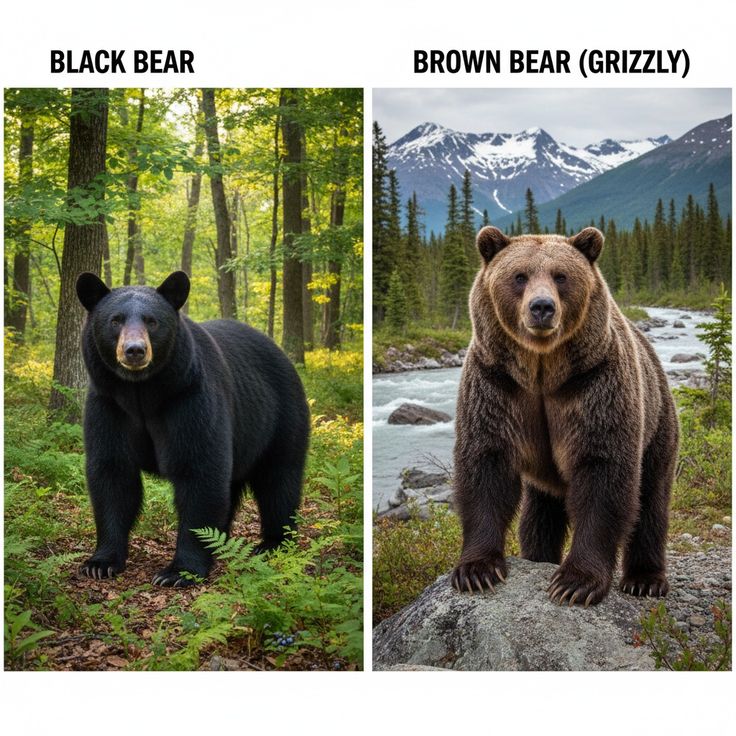
How many subspecies of brown bear are there?
Taxonomists have historically named at least 16 brown bear subspecies of Ursus arctos, though modern DNA research has consolidated these into roughly five well-supported clades.
The commonly recognised living forms are the Eurasian brown bear (U. a. arctos), the North American grizzly (U. a. horribilis), the Kodiak bear (U. a. middendorffi), the Syrian brown bear (U. a. syriacus), the Himalayan brown bear (U. a. isabellinus), the Gobi bear (U. a. gobiensis), and the Tibetan blue bear (U. a. pruinosus). Two subspecies, the Atlas bear and the California grizzly, are extinct.
One Species, One Hemisphere, Dozens of Names
There is a single brown bear species on Earth. Its scientific name is Ursus arctos, and it is the most widely distributed bear in the world, ranging from the coastal rainforests of southeast Alaska to the arid mountain steppe of Mongolia. Every bear commonly called a grizzly, a Kodiak, a Kamchatka bear, a Marsican bear, or a blue bear is the same species.
What varies is the subspecies: the regional form, shaped by isolation, climate, and diet, and given a trinomial Latin name by whichever 19th or 20th century zoologist happened to describe it first.
For a general overview of the species itself, see our main page on the brown bear. This article focuses on the deeper question of what the subspecies actually are, how many of them hold up under modern genetics, and why names you may still see in older field guides - Dall bear, Peninsular grizzly, Shirās grizzly, Admiralty Island brown bear - have quietly disappeared from the scientific literature.
The short version is that most of the 90-plus subspecies names coined before 1950 are no longer valid. Modern molecular work has collapsed them into a handful of genetically coherent lineages. The long version is more interesting, because it includes a critically endangered desert bear with a population of about 30, a North African subspecies hunted to extinction in the 1800s, and DNA evidence that polar bears are technically nested inside the brown bear family tree.
The 16 Historic Subspecies
Below is the traditional list of named brown bear subspecies that appears in most field guides published before the genomic era. Some of these are still widely used; others survive only as historical labels.
| Subspecies | Common name | Range | Status |
|---|---|---|---|
| U. a. arctos | Eurasian brown bear | Europe, Russia, western Asia | Widespread |
| U. a. horribilis | Grizzly bear | North America (interior) | Valid, Threatened in US |
| U. a. middendorffi | Kodiak bear | Kodiak Archipelago, Alaska | Valid, isolated |
| U. a. sitkensis | ABC Islands brown bear | Admiralty, Baranof, Chichagof | Disputed (genetics near polar) |
| U. a. dalli | Dall Island brown bear | Dall Island, Alaska | Not widely recognised |
| U. a. gyas | Peninsular giant bear | Alaska Peninsula | Synonymised with horribilis |
| U. a. syriacus | Syrian brown bear | Middle East, Caucasus, Iran | Valid, fragmented |
| U. a. isabellinus | Himalayan brown bear | Himalayas, Karakoram | Valid, Critically Endangered |
| U. a. pruinosus | Tibetan blue bear | Tibetan plateau | Valid, rarely observed |
| U. a. gobiensis | Gobi bear (mazaalai) | Mongolian Gobi desert | Valid, Critically Endangered |
| U. a. lasiotus | Ussuri brown bear | Russian Far East, NE China, Hokkaido | Sometimes retained |
| U. a. beringianus | Kamchatka brown bear | Kamchatka Peninsula | Sometimes retained |
| U. a. collaris | East Siberian brown bear | Siberia east of Yenisey | Sometimes retained |
| U. a. piscator | Bergman's bear | Kamchatka (cryptid/doubtful) | Invalid |
| U. a. crowtheri | Atlas bear | North Africa | Extinct (c. 1870) |
| U. a. californicus | California grizzly | California | Extinct (1924) |
The pattern is striking. More than half of these names describe populations that were isolated by mountains, islands, or rivers for long enough that morphology diverged, but not long enough to leave a clear genetic signature. The few that have stood up to genomic scrutiny are those with deep isolation, such as the Kodiak bears, or those with unique ecology, such as the Gobi bear.
Why Modern Genetics Collapsed the List
The revolution came from mitochondrial DNA. Starting in the late 1990s and accelerating through the 2010s, researchers extracted DNA from museum skins, hunter samples, scat collections, and live-caught bears across the species' range. They expected regional mitochondrial clades. What they found was messier and more interesting.
"We looked at more than 100 brown bears from across the Holarctic, and what jumped out is that the geographical labels on the museum trays didn't line up with the genetic clusters at all. A 'Kamchatka brown bear' from eastern Russia and a 'grizzly' from Montana were often in the same mitochondrial clade, while two 'Eurasian brown bears' from a few hundred kilometres apart were in different clades." - Charlotte Lindqvist, evolutionary biologist, University at Buffalo
Lindqvist and colleagues identified roughly five major mitochondrial clades in Ursus arctos:
- Clade 1: Western Europe (Spain, France, Italy, Scandinavia)
- Clade 2: Eastern Europe, Turkey, Caucasus, Middle East (includes syriacus)
- Clade 3: Siberia, Russian Far East, Hokkaido (lasiotus, beringianus)
- Clade 4: ABC Islands of Alaska (more closely related to polar bears than to other brown bears on some markers)
- Clade 5: Mainland North American grizzlies, Kodiak, Tibetan blue bear, Himalayan, Gobi (with internal structure)
This is why the old subspecies list quietly collapsed. A grizzly in Yellowstone, a Kodiak bear 4,000 kilometres away, and a Himalayan brown bear on the other side of the planet can all cluster together on mitochondrial markers, while Brown bears separated by a single Bulgarian valley can sit in different clades. The tree does not respect the labels.
For a deeper comparison between the two most famous North American forms, our article brown bear vs grizzly bear walks through the specific morphological and dietary differences without getting lost in taxonomy.
The Eurasian Brown Bear (U. a. arctos)
The Eurasian brown bear is the nominate subspecies, the one Linnaeus described in 1758 when he coined Ursus arctos. It is also the most widespread. A single population extends, with interruptions, from the Cantabrian Mountains of Spain through the Carpathians, across European Russia, through Siberia, and into the Russian Far East, where it grades into the Ussuri and Kamchatka forms.
Typical size: adult males 180-320 kg, females 100-200 kg. Some Carpathian males exceed 400 kg; Scandinavian bears tend to be slightly smaller. Coat colour ranges from pale blonde in the Cantabrian range to almost black in parts of central Europe.
Strongholds:
- Russia: roughly 100,000 bears, half the global total
- Romania: 6,000-8,000, the largest European population
- Slovakia, Slovenia, Croatia, Bosnia: 2,000-3,000 combined
- Finland and Sweden: 2,000-3,000 each
- Spain (Cantabrian) and Italy (Apennine): low hundreds, endangered
The Apennine brown bear of Italy (U. a. marsicanus to some authors) and the Cantabrian population of Spain are genetically distinct micro-populations of the Eurasian subspecies, isolated for roughly 10,000 years. Both number fewer than 70 adults and are among the most genetically depauperate large carnivores in Europe.
For a focused look at European populations, see European brown bear - where they live.
The North American Grizzly (U. a. horribilis)
The grizzly is the interior North American form, named horribilis by George Ord in 1815 from a description by Lewis and Clark. At the time of European contact, grizzlies ranged from central Mexico to the Arctic Ocean and from the Pacific coast to the Mississippi. Today, in the contiguous United States, they occupy less than 2% of that range, concentrated in five recovery zones centred on Yellowstone, the Northern Continental Divide, and the Cabinet-Yaak.
Typical size (interior): adult males 180-360 kg, females 130-180 kg. Coastal brown bears in Alaska, sometimes lumped into horribilis and sometimes not, routinely reach 450-600 kg.
Populations:
- Alaska: ~30,000 (including coastal forms)
- Western Canada: ~25,000
- Contiguous US: ~1,900 (federally listed Threatened)
For the detailed physiology and behaviour, our piece grizzly bear: North American predator covers it in full.
The Kodiak Bear (U. a. middendorffi)
The Kodiak bear is the giant. Isolated on the Kodiak Archipelago of southwest Alaska since the end of the last glaciation roughly 12,000 years ago, this subspecies has diverged in skull morphology and body mass to the point where it is clearly distinguishable on sight. Adult males commonly weigh 360-680 kg; the largest reliably recorded individual exceeded 750 kg.
Kodiak bears are not meaningfully larger than mainland Alaska Peninsula brown bears in skeletal terms, but their isolation has produced fixed genetic differences that earn the subspecies status. They feed heavily on five salmon species during the summer runs, supplemented by berries, grasses, and the occasional deer. The archipelago supports around 3,500 bears on 13,000 square kilometres, one of the highest bear densities on Earth.
"Kodiak is the closest thing we have to a natural experiment on what brown bears can become when you give them enough protein and enough time. They are not a different species, but they are measurably different animals, and the archipelago effect has produced a bear you cannot mistake." - Harry Reynolds, former chair, International Association for Bear Research and Management (IBA)
For the full profile, see Kodiak bear: the largest brown bear, and for a side-by-side with the grizzly, grizzly bear vs Kodiak bear.
The Syrian Brown Bear (U. a. syriacus)
The Syrian brown bear is the smallest and palest of the living subspecies. Adult males rarely exceed 250 kg and most weigh 150-200 kg. The coat is a straw-blonde to sandy brown, sometimes with a lighter collar across the shoulders, and the claws are pale ivory rather than the dark brown or black of most other forms.
The historical range stretched across the Levant, the Caucasus, Iraq, Iran, and parts of Anatolia. The Syrian brown bear has been extirpated from Syria, Lebanon, Jordan, Israel, and Egypt. Modern populations persist in:
- Turkey: ~3,000 (the single largest block)
- Iran: 1,500-2,000, mostly in the Alborz and Zagros mountains
- Georgia, Armenia, Azerbaijan: ~700 combined
- Iraq (Kurdistan): a few dozen
Italic note: the bear that Roman emperors imported for the Colosseum games in the 1st and 2nd centuries almost certainly included large numbers of Syrian brown bears, whose Middle Eastern populations collapsed in part because of that trade.
The Himalayan Brown Bear (U. a. isabellinus)
The Himalayan brown bear lives at elevations of 3,000 to 5,500 metres across the western Himalaya, Karakoram, Pamir, and Hindu Kush. Its coat is a distinctive reddish-brown to sandy tan, which is what the Latin name isabellinus refers to (the colour Isabella, a pale fawn yellow named after a 17th century Spanish queen).
These are small bears by brown bear standards, 150-250 kg for adult males, and they occupy some of the harshest terrain any bear inhabits. Populations are fragmented across Pakistan, northern India (Ladakh, Himachal, Uttarakhand), Nepal, Bhutan, Tibet, and the Pamir highlands of Tajikistan and Afghanistan. Total numbers are estimated at 500 to 1,000 individuals, and many local populations are genetically isolated to the point of inbreeding depression.
The Himalayan brown bear is also the likely source of many yeti reports. A 2017 study published in Proceedings of the Royal Society B analysed purported yeti samples and found that the majority belonged to local brown bears, with some from Himalayan black bears and one Tibetan mastiff.
The Gobi Bear (U. a. gobiensis)
The Gobi bear, known locally as mazaalai, is the only bear that lives in a true desert. Fewer than 40 individuals, and recent surveys place the number at around 30, survive in three oasis zones of the Mongolian Gobi: the Shar Khuls, Atas, and Tsagaan Bogd massifs. It is classified Critically Endangered by the IUCN, and many bear biologists consider it the rarest bear in the world after extinct species.
| Metric | Gobi bear (U. a. gobiensis) |
|---|---|
| Estimated population | ~30 adults |
| Range | 3 desert oases in Mongolian Gobi |
| Male weight | 90-140 kg |
| Female weight | 50-90 kg |
| Coat | Pale sandy-brown, lighter collar |
| Diet | Wild rhubarb, roots, ephedra, rodents, occasional ungulate carrion |
| Water | Obtained from plant tissue and seasonal springs |
| IUCN status | Critically Endangered |
Gobi bears are small, pale, and adapted to hyper-arid conditions. They do not rely on salmon or ungulate herds; their diet is mostly plant roots, wild rhubarb, ephedra, and occasional rodents. Conservation efforts by the Mongolian government and the Gobi Bear Project include supplemental feeding stations stocked with pellets during spring emergence from hibernation, when natural food is scarcest.
The Tibetan Blue Bear (U. a. pruinosus)
The Tibetan blue bear lives on the Tibetan plateau at 4,000 metres and above. Despite the name, it is not actually blue; the coat is a dark chocolate brown with silvery-grey tipping that gives it a slate-blue cast in certain light. It is one of the least-studied large mammals on Earth. Almost all reliable data comes from a handful of museum specimens and scattered recent camera-trap images. Population estimates are essentially guesses, in the range of a few thousand at most.
The Extinct Subspecies
Two subspecies of Ursus arctos were driven to extinction in historical times, and a third - the Mexican grizzly - is now considered extinct as well.
| Subspecies | Range | Extinction date | Cause |
|---|---|---|---|
| U. a. crowtheri (Atlas bear) | Morocco, Algeria, Tunisia, Libya | c. 1870 | Roman arena trade, firearms, deforestation |
| U. a. californicus (California grizzly) | California | 1924 (last confirmed) | Gold rush era bounty hunting |
| U. a. nelsoni (Mexican grizzly) | Northern Mexico | c. 1964 | Poisoning, ranching conflict |
The Atlas bear is the only bear that was ever native to Africa in historical times. It was smaller than Eurasian brown bears, with a blackish-brown coat and a reddish belly, and it had been hunted in Roman amphitheatres for centuries before firearms and habitat clearance finished it off in the late 1800s. The last confirmed specimen was shot in the Tétouan mountains of Morocco around 1870.
The California grizzly appears on the California state flag and is still the official state animal of a place where it has been extinct for over a century. Ord's 1815 original horribilis description was actually based partly on skins from what later became the California grizzly. An estimated 10,000 once roamed the state; the final confirmed kill was in Tulare County in August 1922, with the last sighting in Sequoia National Park in 1924.
"California is the only state whose official animal is an extinct subspecies. The grizzly on the flag is a ghost, and it is a ghost that went extinct in living memory. My grandfather could have seen one." - commentary in Ursus, the journal of the IBA
Polar Bears Are Brown Bears (Sort Of)
The strangest outcome of modern brown bear genetics is that the polar bear (Ursus maritimus) is phylogenetically nested inside the brown bear clade, not as a sister species to all brown bears combined. Specifically, polar bears and the brown bears of the ABC Islands of southeast Alaska share a more recent common ancestor than either shares with grizzlies from Montana.
What this means, taxonomically, is that Ursus arctos is a paraphyletic species; it does not contain all descendants of its common ancestor because polar bears have been split off as a separate species. Some genomicists have argued polar bears should be renamed Ursus arctos maritimus, i.e. a subspecies of the brown bear.
Most mammalogists have declined, partly because the two animals are so ecologically and morphologically different, and partly because confirmed wild hybrids ('pizzly' or 'grolar' bears) demonstrate ongoing gene flow without full species collapse. For a direct comparison, see our profile on the polar bear.
"Paraphyly is an uncomfortable result for taxonomists who like tidy trees, but it is biologically honest. Polar bears are extreme brown bears that specialised for sea ice in the last few hundred thousand years. The genomic signal is unambiguous." - Lindqvist et al., Molecular Ecology, discussion section
Subspecies Sizes Compared
A common question is how much size variation actually exists across living subspecies. The short answer is: an enormous amount. A male Kodiak weighs more than five adult Gobi bears combined. Our article on how big brown bears are digs into the numbers population by population, but the summary looks like this.
| Subspecies | Male weight range | Female weight range | Notes |
|---|---|---|---|
| Kodiak (middendorffi) | 360-680 kg | 180-320 kg | Largest living subspecies |
| Coastal Alaskan (horribilis coastal) | 270-500 kg | 160-280 kg | Salmon-fed, not always a distinct subspecies |
| Kamchatka (beringianus) | 300-500 kg | 150-280 kg | Russian Far East, salmon-fed |
| Eurasian (arctos) | 180-320 kg | 100-200 kg | Widespread, highly variable |
| Interior grizzly (horribilis interior) | 180-360 kg | 130-180 kg | Lower 48 US, western Canada |
| Ussuri (lasiotus) | 200-400 kg | 120-250 kg | Russian Far East, Hokkaido |
| Syrian (syriacus) | 150-250 kg | 90-180 kg | Smallest living western subspecies |
| Himalayan (isabellinus) | 150-250 kg | 90-150 kg | High altitude |
| Gobi (gobiensis) | 90-140 kg | 50-90 kg | Smallest living brown bear |
Coastal populations eating salmon consistently outweigh interior populations eating plants and ungulates, which is itself a strong argument that the old subspecies system is confounded with ecology. Whether a bear is big often depends on what is in the local river rather than what is in its genome. The feeding ecology is covered in depth in what do brown bears eat.
Conservation Status by Subspecies
The headline fact is that Ursus arctos as a species is listed as Least Concern by the IUCN. Globally the population is around 200,000 and stable. That headline hides a brutal patchwork underneath.
- U. a. gobiensis (Gobi): Critically Endangered, ~30 individuals
- U. a. isabellinus (Himalayan): Critically Endangered in parts of range
- U. a. syriacus (Syrian): Endangered across most of range
- U. a. marsicanus (Apennine, Italy): Critically Endangered, ~50 adults
- Cantabrian population (Spain): Endangered, ~370 individuals
- Pyrenean population (France/Spain): Critically Endangered, ~70 after reintroduction
- U. a. horribilis in contiguous US: Threatened under ESA, ~1,900 individuals
- U. a. crowtheri (Atlas): Extinct
- U. a. californicus (California): Extinct
- U. a. nelsoni (Mexican): Extinct
"We keep the species on Least Concern because Russia holds 100,000 bears and Alaska holds another 30,000, and those populations are genuinely doing fine. But the relict populations - the Pyrenean, the Marsican, the Gobi, the Himalayan - are in the bottom few hundred animals each, and every one of them is a distinct evolutionary lineage that cannot be replaced by importing bears from Siberia." - IUCN Bear Specialist Group assessment, 2024 update
How the Names Will Keep Changing
Taxonomy is not fixed. Over the next decade, as whole-genome sequencing becomes cheap enough to run on hundreds of wild-caught samples, several of the currently-accepted subspecies will likely be merged or split again. The likely changes:
- Kodiak and Alaska Peninsula bears may be merged into a single coastal clade, demoting middendorffi to a population rather than a subspecies.
- ABC Islands bears may be formally split off as their own lineage, given their unusual polar-bear-adjacent ancestry.
- The Apennine, Cantabrian, and Pyrenean European populations may each gain formal subspecies status to reflect their deep isolation.
- The Gobi bear may be elevated to full species status by some authors, though this is contentious.
- The Ussuri and Kamchatka subspecies may be merged or abandoned, depending on how nuclear DNA markers resolve.
What will not change is the underlying picture. There is one species, Ursus arctos, spread across the Holarctic in a handful of genetically distinct clades, with large populations in Russia and Alaska, threatened remnants in Europe and the Middle East, and a single, vanishingly rare desert population in Mongolia that would fit inside a single school gymnasium.
For readers who want to go deeper into the individual regional forms, the sibling articles on the Eurasian brown bear population in Europe, the grizzly as North American predator, and the Kodiak bear pick up from the subspecies framework laid out here. The species-level overview remains the main brown bear page, which ties together the physiology, hibernation, diet, and reproduction shared by every form discussed above.
Readers interested in related long-form science writing can also visit partner sites such as What's Your IQ, When Notes Fly, and Evolang, which cover adjacent topics in human cognition, music, and language.
References
Lindqvist, C., Schuster, S. C., Sun, Y., et al. (2010). Complete mitochondrial genome of a Pleistocene jawbone unveils the origin of polar bear. Proceedings of the National Academy of Sciences, 107(11), 5053-5057. https://doi.org/10.1073/pnas.0914266107
Hailer, F., Kutschera, V. E., Hallström, B. M., et al. (2012). Nuclear genomic sequences reveal that polar bears are an old and distinct bear lineage. Science, 336(6079), 344-347. https://doi.org/10.1126/science.1216424
Miller, W., Schuster, S. C., Welch, A. J., et al. (2012). Polar and brown bear genomes reveal ancient admixture and demographic footprints of past climate change. PNAS, 109(36), E2382-E2390. https://doi.org/10.1073/pnas.1210506109
Lan, T., Gill, S., Bellemain, E., Bischof, R., Nawaz, M. A., & Lindqvist, C. (2017). Evolutionary history of enigmatic bears in the Tibetan Plateau-Himalaya region and the identity of the yeti. Proceedings of the Royal Society B, 284(1868), 20171804. https://doi.org/10.1098/rspb.2017.1804
McLellan, B. N., Proctor, M. F., Huber, D., & Michel, S. (2017). Ursus arctos (amended version of 2017 assessment). The IUCN Red List of Threatened Species. https://doi.org/10.2305/IUCN.UK.2017-3.RLTS.T41688A121229971.en
Tumendemberel, O., Proctor, M., Reynolds, H., et al. (2015). Gobi bear abundance and inter-oases movements, Gobi Desert, Mongolia. Ursus, 26(2), 129-142. https://doi.org/10.2192/URSUS-D-15-00001.1
Calvignac, S., Hughes, S., & Hänni, C. (2009). Genetic diversity of endangered brown bear (Ursus arctos) populations at the crossroads of Europe, Asia and Africa. Diversity and Distributions, 15(5), 742-750. https://doi.org/10.1111/j.1472-4642.2009.00586.x
Davison, J., Ho, S. Y. W., Bray, S. C., et al. (2011). Late-Quaternary biogeographic scenarios for the brown bear (Ursus arctos), a wild mammal model species. Quaternary Science Reviews, 30(3-4), 418-430. https://doi.org/10.1016/j.quascirev.2010.11.023
Frequently Asked Questions
Is a grizzly bear a brown bear?
Yes. A grizzly bear is a brown bear. ‘Grizzly’ is the North American common name for Ursus arctos horribilis, the interior subspecies of the brown bear, named for the grizzled silver-tipped guard hairs that older animals develop. Every grizzly is a brown bear, but not every brown bear is a grizzly.
The coastal Kodiak bear (U. a. middendorffi), the Eurasian brown bear (U. a. arctos), the Syrian brown bear (U. a. syriacus), and the Himalayan brown bear (U. a. isabellinus) are all brown bears too, just different geographic populations of the same species. Genetically the divergence between ‘grizzlies’ and ‘coastal’ Alaskan brown bears is very small and does not even meet most criteria for subspecies rank in modern taxonomy.
How many subspecies of brown bear are there?
Historically, taxonomists named at least 16 living subspecies of Ursus arctos, and older literature sometimes lists more than 90 regional forms. Modern molecular genetics, particularly the mitochondrial and nuclear DNA work led by Charlotte Lindqvist and colleagues, has consolidated these into roughly five well-supported clades worldwide.
The commonly recognised living subspecies today are the Eurasian brown bear (U. a. arctos), the North American grizzly (U. a. horribilis), the Kodiak bear (U. a. middendorffi), the Syrian brown bear (U. a. syriacus), the Himalayan brown bear (U. a. isabellinus), the Gobi bear (U. a. gobiensis), and the Tibetan blue bear (U. a. pruinosus).
Two historically-named subspecies, the Atlas bear (U. a. crowtheri) and the California grizzly (U. a. californicus), are extinct.
Which brown bear subspecies is most endangered?
The Gobi bear (Ursus arctos gobiensis) is the most endangered living brown bear. Fewer than 40 individuals, with recent surveys estimating about 30, survive in three oasis zones of the Mongolian Gobi desert. The IUCN classifies this population as Critically Endangered and it is effectively the rarest bear population on Earth.
The Himalayan brown bear (U. a. isabellinus) is also Critically Endangered in parts of its range, with fewer than 1,000 animals scattered across Pakistan, northern India, Nepal, Tibet, and western China. The Syrian brown bear (U. a. syriacus) has been extirpated from most of its historic Middle Eastern range and persists in Turkey, the Caucasus, and Iran in fragmented populations totalling roughly 5,000 to 10,000 animals.