
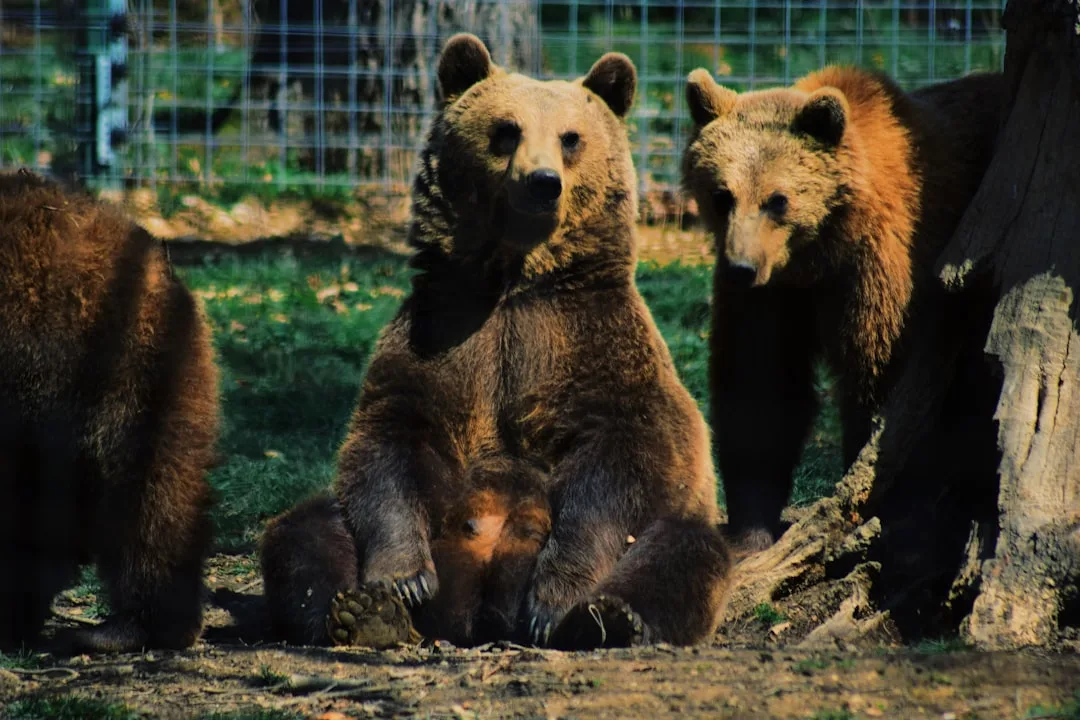
Where do brown bears live in Europe?
Brown bears live across roughly 22 European countries, with around 17,000 bears in Europe excluding Russia and more than 100,000 additional animals in Russia. The single largest population is Carpathian, centred on Romania, which alone holds about 6,000 bears, roughly 60 percent of the European Union total.
The Bear That Never Left Europe
Walk into a spruce forest in the Fagaras Mountains of central Romania on a damp May morning and the signs are everywhere. Turned stones. A pine log torn open lengthways for the ants inside. A muddy track the width of a dinner plate pressed into the edge of a streambed. Somewhere in that forest a brown bear is walking a trail its grandparents walked, on ground its species has occupied since the last ice sheets melted.
Europe never fully lost its brown bears. The wolf was exterminated from most of western Europe. The lynx was driven to a handful of refuges. The brown bear, Ursus arctos arctos, clung on in the mountain ranges that were too steep, too cold, or too politically inconvenient to clear.
The Carpathians, the Dinaric Alps, the Cantabrians, the Pyrenees at their last gasp, the Apennines in a single isolated pocket, and the vast forests of Scandinavia and European Russia all served as refuges during the two centuries when European farmers and foresters were most hostile to large predators.
Today those refuges are spilling outward. Europe now holds roughly 17,000 brown bears outside Russia and another 100,000-plus inside Russia, part of a Eurasian total approaching 700,000 animals when the Siberian and Far Eastern populations are included. That recovery, documented systematically by Chapron and colleagues in Science in 2014, is one of the quietest wildlife comebacks on the planet.
This guide covers where those bears actually live, country by country and population by population, with current numbers, conservation status, and the conflicts that still kill bears every year. For general biology, size, diet, and behaviour of the species, see the main brown bear profile.
One Subspecies, Ten Populations
All European brown bears belong to a single subspecies: Ursus arctos arctos, the Eurasian brown bear. This is one of several recognised subspecies within the global Ursus arctos complex, which also includes the North American grizzly, the coastal Kodiak, the Kamchatka bear of the Russian Far East, and more localised forms. For a deeper breakdown see the sibling article on brown bear subspecies explained.
Within Europe, bears are not distributed as one continuous range. Instead they form ten demographically and genetically recognisable populations, defined by the IUCN Large Carnivore Initiative for Europe (LCIE) as groups of animals that share reproductive continuity and a broadly common management context.
The concept of the population is the basic unit of conservation for large carnivores in Europe. Bears do not recognise national borders, and policy that stops at a border is policy that fails the animal., IUCN Large Carnivore Initiative for Europe, status review 2022
The ten populations, from largest to smallest, are summarised below.
Table 1: European brown bear populations by region
| Population | Countries | Approximate numbers | Trend | Status |
|---|---|---|---|---|
| Carpathian | Romania, Slovakia, Ukraine, Poland, Czechia, Serbia | ~8,100 (Romania ~6,000) | Stable to increasing | Least Concern (regional) |
| Dinaric-Pindos | Slovenia, Croatia, Bosnia, Montenegro, Albania, N. Macedonia, Greece | ~3,000 | Increasing | Least Concern (regional) |
| Scandinavian | Sweden, Norway | ~2,950 | Slowly increasing | Least Concern |
| Karelian (Finland-NW Russia) | Finland, NW Russia | ~2,300 in Finland alone | Stable | Least Concern |
| East Baltic | Estonia, Latvia, Belarus, Russia border | ~1,000 | Stable | Least Concern |
| Cantabrian | Spain | ~400 | Increasing | Near Threatened (regional) |
| Alpine | Italy (Trentino), small spillover to Austria, Switzerland, Slovenia | ~100 | Increasing | Critically Endangered (regional) |
| Pyrenean | France, Spain, Andorra | ~80 | Increasing | Critically Endangered (regional) |
| Apennine (Marsican) | Italy (Abruzzo) | ~50 | Stable | Critically Endangered (regional) |
| Russia (East European plain) | Russia (European) | ~30,000-40,000 within European Russia | Stable | Least Concern |
Numbers compiled from LCIE status reports, national monitoring programmes, and peer-reviewed estimates. Figures round to the nearest hundred for populations above 500.
The Carpathian Giant: Romania and Its Neighbours
The Carpathian Mountains arc 1,500 kilometres from the Czech Republic through Slovakia, southern Poland, western Ukraine, across Romania, and down into Serbia. Inside that arc lives Europe's bear superpower.
Romania: Europe's Bear Capital
Romania holds approximately 6,000 brown bears, by far the largest single-country bear population in the European Union and roughly 60 percent of the entire EU total. These bears are distributed along the full length of the Romanian Carpathians but are densest in:
- Harghita and Covasna counties in the eastern Carpathians
- The Fagaras and Piatra Craiului massifs in the Southern Carpathians
- The Rodnei and Maramures ranges in the north
Bear densities in parts of Harghita exceed 20 bears per 100 square kilometres, comparable to the highest densities recorded anywhere outside coastal Alaska. Bears regularly enter outlying districts of Brasov, a city of nearly 300,000 people, and have become a daily management problem in the resort town of Sinaia.
The Romanian story is peculiar. During the Communist period, general-secretary Nicolae Ceausescu reserved the best hunting for himself, shooting hundreds of bears from elevated hides over baited stations. The system was grotesque as conservation practice, but by suppressing commercial forestry and by protecting habitat for the dictator's trophies it also preserved an intact mountain ecosystem. When the regime fell in 1989, Romania inherited the healthiest bear population in Europe.
Management since has oscillated. A 2016 trophy hunting ban stopped most legal killing but was partially reversed after 2023 following rising livestock losses and the death of several hikers. In 2024 the Romanian parliament approved an increased management quota targeting specific problem animals.
Slovakia and Ukraine
Slovakia holds roughly 1,200 to 1,600 bears concentrated in the Tatra and Low Tatra ranges. Slovak bears have expanded westward into the Little Carpathians near Bratislava. Ukraine's Carpathian population, centred on the Chornohora and Gorgany ranges, is estimated at 300 to 400 bears, though reliable data since 2022 is limited due to the war.
Smaller Carpathian fringe numbers occur in Poland (around 110 in the Bieszczady and Tatras), in Czechia (a handful of animals in the Beskydy), and in Serbia (fewer than 100 in the far east).
The Dinarides and the Balkans
The second great European bear population runs down the Dinaric Alps and into the Pindos Mountains of Greece. This population has recovered strongly since the Yugoslav wars and now totals around 3,000 bears across six or seven countries.
Country breakdown
- Slovenia: ~1,000 bears in the Notranjska and Kocevje forests. Slovenia has become Europe's source population for reintroductions.
- Croatia: ~1,000 bears in Gorski Kotar and Velebit.
- Bosnia and Herzegovina: ~550, though monitoring is inconsistent.
- Montenegro: ~250.
- Albania: ~250, with much uncertainty.
- North Macedonia: ~200.
- Greece: ~500 in Pindos and Rhodopi.
Slovenia deserves special attention. Its bears have been translocated to the Pyrenees (from 1996 onward), to the Italian Alps (Life Ursus project, 1999-2002), and are studied as one of Europe's best-understood populations.
Slovenia's bears have become the genetic reservoir of western European bear conservation. Without the Slovenian source population, the Pyrenean and Alpine reintroductions would not have been biologically possible., Djuro Huber, University of Zagreb, lead Croatian bear biologist
Scandinavia: Boreal Recovery
The Scandinavian population technically spans Sweden and Norway, though the bulk is Swedish. A separate but connected population occupies Finland, and together with north-western Russia forms the Karelian population.
Table 2: Scandinavian and Baltic bear numbers
| Country | Current estimate | Historical low | Current trend | Primary habitat |
|---|---|---|---|---|
| Sweden | ~2,800 | ~130 in 1930 | Slowly increasing after cull reductions | Boreal spruce and pine forest |
| Finland | ~2,300 | ~150 in 1950s | Stable | Taiga, mixed boreal forest |
| Norway | ~150 | Near zero mid-20th C | Slowly increasing | Eastern border forests |
| Estonia | ~900 | ~60 in 1970s | Stable | Mixed lowland forest |
| Latvia | ~50 | ~10 | Slowly increasing | Eastern forests |
| Russian Karelia | ~3,500 | Stable | Stable | Taiga |
Sweden has the largest western European bear population, built up from a 1927 low of just over 100 animals after centuries of bounty hunting. Swedish bears were protected in 1927 and hunting was tightly regulated from 1943. By 2008 the population peaked at roughly 3,300, dropped to around 2,800 after increased licensed hunting, and appears to have stabilised.
Norway holds only about 150 bears, almost all along the forested border with Sweden, Finland, and Russia. The Norwegian population has never recovered the way Sweden's did because of consistent lethal control of problem animals near sheep pastures.
Norway has made a political choice to keep bear numbers very low and to cull individuals that predate sheep. This is not a failure of biology. It is a policy outcome driven by the Norwegian tradition of unguarded free-range sheep grazing., Andreas Zedrosser, Norwegian University of Life Sciences
For comparison with a New World population of the same species, see where do grizzly bears live.
The Alps: Italy's Quiet Triumph
At the end of the 1990s, the Italian Alpine population was down to three or four old males in Trentino's Adamello-Brenta mountains. Extinction was a matter of years. Then came Life Ursus.
Between 1999 and 2002 the Italian authorities translocated ten bears (seven females, three males) from Slovenia into the Brenta Dolomites under a European Union Life project. The animals bred. Today the Alpine population numbers approximately 100 bears, almost all descended from those ten founders.
The recovery has not been smooth. Bears occasionally kill livestock and a small number have displayed aggressive behaviour toward hikers. In 2023 a young male (M62, known as "JJ4") killed a runner in the Val di Sole, the first fatal bear attack in modern Italian history. Management culls of identified problem bears remain politically divisive.
Some descendants have crossed into Austria, Switzerland, and back into Slovenia, and a famous wanderer called Bruno reached Germany in 2006 before being shot. The genetic base is narrow and inbreeding is a growing concern, but the population continues to grow at roughly 6 to 10 percent per year.
The Cantabrian Bears of Spain
The Cantabrian population of northern Spain was down to about 80 bears in the 1990s, split into two subpopulations by the A-66 highway and associated development. Intensive protection, including anti-poaching brigades, livestock compensation schemes, and habitat corridor restoration, has brought numbers up to approximately 400 animals across the two subpopulations.
- Western Cantabrian subpopulation (Asturias, Leon, Lugo): ~300 bears
- Eastern Cantabrian subpopulation (Cantabria, Palencia, Burgos): ~100 bears
The two subpopulations have begun to exchange individuals again, with radio-collared males documented crossing the highway corridor. Cantabrian bears feed heavily on beech mast, chestnut, cherry, and bilberry, with limited predation on livestock. For detail on bear diet generally, see what do brown bears eat.
The Pyrenees: A Reintroduction in Progress
The native Pyrenean bear population went extinct as a functional breeding unit in the 1990s. The last native female, Canelle, was shot by a hunter in 2004. The modern Pyrenean population is entirely descended from Slovenian translocations that began in 1996.
Current numbers stand at roughly 80 bears distributed across both slopes of the Pyrenees in France, Spain (Catalonia, Aragon, Navarre), and Andorra. The translocations have been controversial in French sheep-farming valleys, and the population has suffered from shootings, vehicle collisions, and at least one accidental killing during a wild boar hunt.
Despite this, reproduction is consistent and the population has doubled since 2015.
The Apennine Brown Bear: Europe's Loneliest Population
The Marsican brown bear (Ursus arctos marsicanus in some older taxonomies, now treated as a genetically distinct isolate of U. a. arctos) lives only in a small area of the central Italian Apennines, principally within Abruzzo, Lazio, and Molise National Park and its surrounding wildlife corridors.
Numbers have held steady at approximately 50 animals for decades. The population is:
- Geographically isolated by hundreds of kilometres from any other bear population
- Genetically depauperate with very low heterozygosity
- Small enough that every single death matters demographically
- Surprisingly tolerant of humans, often foraging within villages
Local people generally regard Marsican bears with pride and protect them. The biggest threats are road mortality, illegal shooting (rare but impactful), disease spillover from domestic livestock, and accidental poisoning from baits intended for wolves or stray dogs.
The Marsican bear is biologically precarious but culturally loved. Every bear that dies on an Apennine road is a genetic catastrophe for a subpopulation that cannot absorb losses., Biological Conservation, Ciucci and Boitani, review of Marsican demographics
European Russia: The Forgotten Majority
Most discussions of "European bears" stop at the EU border. They should not. European Russia, roughly the area west of the Urals, holds between 30,000 and 40,000 brown bears in boreal taiga and mixed forest, about a third of the Russian national total of over 100,000.
Russian bears occupy the same subspecies (U. a. arctos) as other European bears and form a continuous demographic unit with the Finnish and Estonian populations along the frontier. Their habitat includes the taiga of Karelia, the Komi Republic, Arkhangelsk, and Vologda.
Conservation Status and Conflicts
Bear recovery in Europe is often presented as an unbroken success story. The reality is more complicated.
Primary threats
- Livestock predation, especially on unguarded sheep in Scandinavia, the Apennines, and the Pyrenees. Bear depredation in Europe totals roughly 15,000 to 20,000 sheep per year, almost all in a few conflict regions.
- Habitat fragmentation by highways, ski resorts, wind farms, and logging roads.
- Road mortality, the leading cause of death for Alpine, Marsican, and Cantabrian bears.
- Illegal killing, still significant in parts of Romania, Slovakia, and the Balkans.
- Hunting, legal in Sweden, Finland, Estonia, Slovenia, Croatia, Bosnia, Romania (since 2024), and several other countries.
- Human habituation, where bears raid rubbish, apiaries, or livestock feed and lose their natural wariness.
Conservation successes
Chapron and colleagues, writing in Science in 2014 (DOI 10.1126/science.1257553), demonstrated that European large carnivores including brown bears, wolves, lynx, and wolverines have expanded their ranges across human-dominated landscapes over the last four decades. This is a finding with few parallels globally. It suggests that coexistence rather than wilderness separation is the European model for large predator conservation.
Specific successes include:
- Life Ursus in the Italian Alps, 1999-2002.
- Project Pyrenean Bear in France and Spain from 1996.
- The Cantabrian Bear Foundation and anti-poaching teams in northern Spain since the 1990s.
- Slovenian-Croatian cross-border cooperation since the early 2000s.
- EU Habitats Directive Annex II and IV protection for bears in all member states.
Behaviour and Biology of European Bears
European brown bears are generally smaller than their coastal Alaskan or Kodiak relatives. Adult males weigh 150 to 320 kilograms, females 80 to 170 kilograms. Cantabrian and Apennine bears tend to be at the smaller end, Carpathian and Scandinavian bears at the larger end. For a full size comparison see how big are brown bears.
They are largely nocturnal across most of Europe, an adjustment to human presence rather than an innate trait, since in remote areas such as parts of Scandinavia and Romania they are readily active by day. They hibernate from roughly November to March or April, depending on latitude and food abundance, with females giving birth inside dens in January or February. See brown bear hibernation for physiological detail.
Attacks on humans are rare. Across Europe, there are fewer than one fatal bear attack per year on average, almost always in Romania or Slovakia, usually involving surprise encounters at close range or females with cubs. For risk assessment see are brown bears dangerous to humans.
Why European Bear Recovery Matters
Europe has more people per square kilometre than any continent except Asia. It has some of the oldest cultural antagonism toward large predators in the world. It has highways, farms, alpine villages, and intensive forestry everywhere. And it still has more brown bears now than at any point since the 19th century.
The lessons are transferable. North American managers studying range recovery for grizzly bears, South American managers working with Andean bears, and Asian managers working with sun bears and Asiatic black bears have all drawn directly on European case studies. The Life Ursus translocation protocols, Cantabrian anti-poaching model, and Slovenian-Croatian transboundary management framework are exported methodology.
For broader context on the species, including its global range, see the main brown bear article. For the largest relatives of the European bear, see Kodiak bear, the largest brown bear.
Other Kalenux resources on reasoning about evidence, data, and communication that may be useful to readers interested in conservation policy include Whats Your IQ, Evolang for writing clearly about science, and Pass4Sure for professional study frameworks. For music enthusiasts, When Notes Fly is also part of the family.
The Numbers at a Glance
- ~17,000 brown bears in Europe excluding Russia, plus 100,000+ in Russia.
- All European brown bears are Ursus arctos arctos, the Eurasian brown bear.
- Romania holds ~6,000, about 60 percent of the EU total.
- The Dinaric-Pindos population across the western Balkans holds ~3,000.
- Scandinavia (Sweden, Norway, Finland) holds over 5,000 combined.
- Alpine, Pyrenean, and Apennine populations are small (50 to 100 each) but growing except in the Apennines.
- Recovery is real, documented by Chapron et al. 2014 in Science, but conflicts with farmers, road networks, and hunting policy remain unresolved.
References
- Chapron, G., Kaczensky, P., Linnell, J.D.C., et al. (2014). Recovery of large carnivores in Europe's modern human-dominated landscapes. Science 346(6216), 1517-1519. DOI: 10.1126/science.1257553
- Kaczensky, P., Chapron, G., von Arx, M., Huber, D., Andren, H., Linnell, J. (2013). Status, management and distribution of large carnivores in Europe. IUCN Large Carnivore Initiative for Europe report to the European Commission.
- Ciucci, P., Boitani, L. (2008). The Apennine brown bear: a critically endangered population. Ursus 19(2), 130-145. DOI: 10.2192/08SC004.1
- Swenson, J.E., Taberlet, P., Bellemain, E. (2011). Genetics and conservation of European brown bears. Mammal Review 41(2), 87-98. DOI: 10.1111/j.1365-2907.2010.00179.x
- Huber, D. (2010). Rehabilitation and reintroduction of captive-reared bears: feasibility and methodology for European brown bears. International Zoo Yearbook 44(1), 47-54. DOI: 10.1111/j.1748-1090.2009.00086.x
- Zedrosser, A., Steyaert, S.M.J.G., Gossow, H., Swenson, J.E. (2011). Brown bear conservation and the ghost of persecution past. Biological Conservation 144(9), 2163-2170. DOI: 10.1016/j.biocon.2011.05.005
- Falcucci, A., Ciucci, P., Maiorano, L., Gentile, L., Boitani, L. (2009). Assessing habitat quality for conservation using an integrated occurrence-mortality model. Journal of Applied Ecology 46(3), 600-609. DOI: 10.1111/j.1365-2664.2009.01634.x
- Preatoni, D., Mustoni, A., Martinoli, A., et al. (2005). Conservation of brown bear in the Alps: space use and settlement behavior of reintroduced bears. Acta Oecologica 28(3), 189-197. DOI: 10.1016/j.actao.2005.04.002
Frequently Asked Questions
Where do brown bears live in Europe?
Brown bears live in roughly 22 European countries across ten recognised population units. Approximately 17,000 brown bears live in Europe excluding Russia, and more than 100,000 additional animals live across the East European plain and Siberian regions of Russia. The largest single population is the Carpathian population, centred on Romania, which holds around 6,000 bears.
The Dinaric-Pindos population across Slovenia, Croatia, Bosnia-Herzegovina, Montenegro, Albania, and northern Greece holds about 3,000 bears. Scandinavia (Sweden, Norway, Finland) holds over 5,000 combined. Smaller reintroduced or remnant populations persist in the Italian Alps, the Cantabrian Mountains of northern Spain, the Pyrenees between France and Spain, and the central Apennines of Italy.
All European brown bears belong to the subspecies Ursus arctos arctos, the Eurasian brown bear, and their range covers everything from Mediterranean oak forest to boreal taiga. Most populations are growing, though several remain critically small and genetically isolated.
How many brown bears are in Romania?
Romania holds approximately 6,000 brown bears, representing about 60 percent of the European Union’s entire brown bear population and making it Europe’s undisputed bear stronghold. These animals are concentrated in the Carpathian Mountains, a horseshoe-shaped range that arcs through central Romania and includes the Fagaras, Bucegi, Piatra Craiului, and Rodnei massifs.
The population survived the Communist era partly because Nicolae Ceausescu reserved bear hunting for himself and the Party elite, which perversely preserved habitat and bears from broader exploitation. Since 1990 Romania has been the source population for the Pyrenean and other European reintroductions.
Bear density in parts of Harghita and Covasna counties reaches some of the highest in the world outside coastal Alaska, with occasional bears wandering into towns such as Brasov and Sinaia. Management has been contentious. A 2016 hunting ban was partially reversed in 2024 after livestock losses and human fatalities rose. Romania remains the only place in the European Union where tourists can reliably see wild brown bears in a single weekend.
Are brown bears recovering in Europe?
Yes. Brown bears are one of Europe’s conservation success stories, alongside wolves, lynx, and wolverines. Chapron and colleagues documented the recovery in a landmark 2014 paper in Science showing that large carnivores are expanding across human-dominated European landscapes rather than being restricted to remote wilderness. Scandinavian bears have climbed from near extinction a century ago to over 5,000 today.
The Italian Alpine population, reduced to three or four individuals by the late 1990s, now numbers around 100 after reintroductions from Slovenia under the Life Ursus project. The Pyrenean population, down to a handful in the 1990s, is now roughly 80 after Slovenian translocations. The Cantabrian population in Spain has doubled since the 1990s to around 400 bears in two subpopulations. However, not every population is thriving.
The Apennine brown bear of central Italy, also called the Marsican bear, remains stuck at around 50 animals and is genetically distinct. Road mortality, illegal killing, and livestock conflict still kill dozens of bears each year across the continent.